


The $10 Gold Rush Coin That Helped Break a Bank
The 1849 Miners’ Bank $10 gold coin belongs to the first wild chapter of California gold. It also tells a sharper story than most Gold Rush relics. This coin did not simply serve commerce. It tested trust.
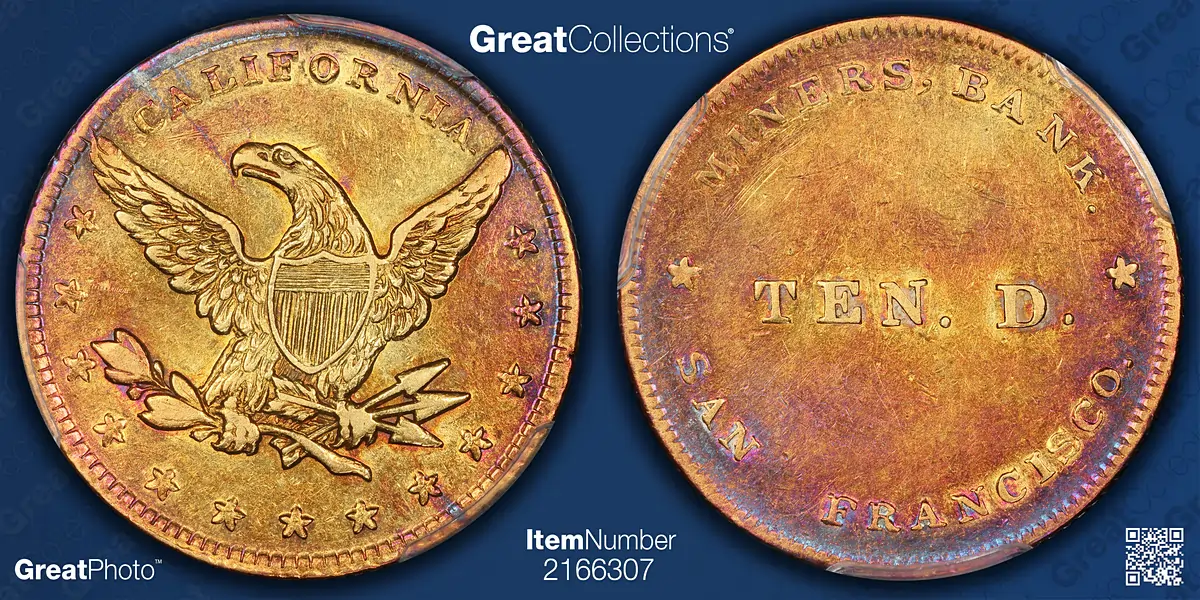
GreatCollections will offer a rare Plain Border example from the Palisades Phoenix Collection. The coin carries a PCGS AU-58 grade and a Green CAC sticker. It also shows superb violet toning, which gives the piece unusual visual drama for early California gold.
Even more important, GreatCollections notes that only two finer examples have CAC approval. Both remain in long-term collections. Therefore, this coin gives advanced collectors a rare chance to chase one of the most evocative private gold issues of 1849.
A Gold Rush Economy With Gold, But No Money
James Marshall found gold at Sutter’s Mill in January 1848. Then everything changed.
By 1849, prospectors, merchants, sailors, laborers, gamblers, and speculators poured into California. San Francisco became a boomtown almost overnight. However, the new economy had a strange problem. It had plenty of gold dust, yet it lacked enough coin.
Gold dust worked poorly in daily trade. A merchant needed a scale. A buyer needed trust. Every transaction invited an argument over weight, purity, and value. A man could carry wealth in a pouch and still struggle to buy bread, boots, tools, or passage.
Therefore, California created its own monetary pressure cooker. Federal coin could not arrive fast enough. The San Francisco Mint did not yet exist. In the gap, private firms stepped forward.
Some firms acted like emergency bankers. Others acted like opportunists. Often, they acted like both.
Wright & Co. Enters the Gap
The Miners’ Bank grew out of Wright & Co., an early San Francisco brokerage concern. Its key figures included Stephen A. Wright and Samuel W. Haight. Other names connected to the bank include James Wadsworth and John Thompson.
The firm’s paper-money activity came early. Surviving Miners’ Bank notes carry the date March 1, 1849. That detail matters. It predates California’s November 1849 constitutional ban on private currency.
Then, in July 1849, the Miners’ Bank announced business at Washington and Kearney Streets. The timing could not have looked better. San Francisco needed money. Gold seekers needed exchange. Merchants needed a medium that could move faster than dust.
Next came the bold move.
In August, Wright & Co. petitioned the Collector of the Port of San Francisco. The firm wanted permission to issue $5 and $10 gold coins. It also wanted the Customs House to accept those coins for import duties.
The government said no.
The Miners’ Bank moved ahead anyway.
The Bank Without a Mint
The Miners’ Bank had a problem. It wanted to issue gold coins, but it did not have the proper assay and refining equipment.
So, the firm appears to have turned to Broderick & Kohler. That San Francisco assay firm likely struck the coins for the bank. Contemporary testimony from James Wadsworth supports that connection.
The bank planned a $5 coin. However, that denomination never reached production. Only the $10 piece appeared.
That makes the Miners’ Bank $10 the entire coinage story of the firm. No long series followed. No later denomination saved the reputation. One coin carried the bank’s ambition into the marketplace.
A Coin With a Stark Message
The design looks direct, even blunt.
One side places TEN D. in the center. Stars flank the denomination. MINERS, BANK appears above. SAN FRANCISCO appears below.
The other side borrows the language of federal authority. An eagle spreads its wings. It holds an olive branch and three arrows. CALIFORNIA arcs above. Thirteen stars complete the design.
The result feels almost defiant. The coin does not name the United States. It does not carry a date. It does not explain itself. Instead, it announces California, San Francisco, a bank, and a value.
That worked perfectly in 1849. California lived in a rush. The coin did, too.
Why the Plain Border Matters
Collectors know this issue as Kagin-1, or K-1. GreatCollections attributes this example as K-1, R-6.
The Plain Border label matters. PCGS explains that the Plain Border and Crimped Border terms do not describe the edge. All Miners’ Bank $10 pieces have reeded edges. Instead, those terms describe the planchet and its effect on the outer border.
Plain Border coins show the normal, full border. They also tend to show orange-gold or reddish-gold color because the alloy contains copper.
Older references also listed Crimped Border pieces. Those coins showed a dished, distorted border effect and a greener hue. However, modern research changed the story. In 2017, David J. McCarthy identified repeating depressions on the so-called Crimped Border group. Greysheet now treats those pieces as 20th-century die-transfer forgeries.
That update gives the Plain Border K-1 even more force. It stands as the authentic survivor of the Miners’ Bank coinage drama.
The $9.65 Problem
At first, the Miners’ Bank $10 circulated widely. By October 1849, examples had reached New Orleans and the East Coast. By early 1850, they had traveled as far as Auckland, New Zealand.
Then the trouble started.
An assayer at the New Orleans Mint examined one of the coins. The verdict hit hard. The piece did not contain a full $10 in gold. Its value came in at only $9.65.
In a world where trust meant everything, that gap mattered.
Gold Rush California already ran on suspicion. Merchants weighed dust. Brokers judged ingots. Assayers built reputations one transaction at a time. Therefore, one bad assay could kill a private coinage operation.
That is exactly what happened.
From Gold Rush Money to Market Poison
News of the underweight coin spread fast. Soon, brokers wanted a steep discount. In April 1850, the Daily Alta California called the Miners’ Bank issue a “drug on the market.” Brokers refused to touch it unless sellers accepted about 20% less than face value.
That discount destroyed the coin’s usefulness. A $10 coin that traded like an $8 coin no longer solved the specie shortage. It made the shortage worse.
Then came the melt pots.
Many Miners’ Bank pieces ended up as bullion. Some entered the melting operations of the United States Assay Office of Gold. Later, others likely met the furnaces of the San Francisco Mint. As a result, survival fell sharply.
Today, Greysheet estimates around 35 K-1 examples extant. Most grade XF or AU. Only a handful reach Mint State.
That survival pattern gives this AU-58 CAC coin its power. It sits near the top of a small and historically loaded population.
The Newman Connection
This GreatCollections coin also carries serious provenance.
Its known ownership chain includes the Somerset Collection in May 1992. Later, it appeared from the Eric P. Newman Numismatic Education Society in November 2014. Then it entered the Palisades Phoenix Collection in 2024.
That path matters. Newman’s name adds scholarly weight. He spent decades studying American money, private issues, and controversial Western gold. A Miners’ Bank $10 fits that world perfectly. It touches every theme that makes pioneer gold so challenging: private enterprise, emergency money, imperfect records, assays, forgeries, and trust.
In other words, this is not just a rare coin with a famous pedigree. It is a coin that rewards research.
A Toned Survivor From a Failed Gold Rush Bank
GreatCollections describes the coin as toned with superb violet color. That matters more than surface beauty alone.
Pioneer gold often shows marks, friction, handling, and compromise. These coins served in a frantic economy. They changed hands in a world of mud streets, crowded counters, assay rooms, gambling halls, and ship decks. A near-Mint survivor with CAC approval and distinctive color offers a different experience.
It gives the collector history without heavy wear.
The AU-58 grade also gives the coin a special kind of tension. It sits just below Mint State. It likely shows only light friction. Yet it still feels close to the commerce that made it famous.
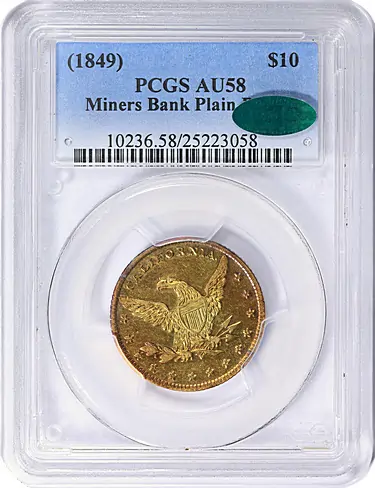
That may be the ideal grade for a story coin. It preserves the design. It keeps the luster. However, it still whispers that someone used it when San Francisco had more gold than coin.
CoinWeek Perspective
The 1849 Miners’ Bank $10 Plain Border is one of the most important private gold issues of the California Gold Rush. It appeared when California needed money, before the federal minting system could fully answer the crisis.
Yet it also shows why private coinage carried danger. The Miners’ Bank tried to fill a public need. It also tried to profit from that need. When the coin failed the assay test, the market judged it quickly and harshly.
That is the real backstory.
This coin represents more than pioneer gold. It represents the moment when gold dust became money, money became mistrust, and mistrust sent thousands of dollars in private gold to the melting pot.
For collectors, the lesson remains powerful. Some coins survive because people saved them. Others survive because history almost destroyed them first.
This 1849 Miners’ Bank $10 belongs to the second group.
Auction Details
GreatCollections will offer the (1849) California Gold $10 Ten Dollar Miners’ Bank Plain Border PCGS AU-58 CAC Green, toned, from the Palisades Phoenix Collection. The auction closes July 19, 2026.



great history story, was not aware of the scandal issue. I can imagine the craziness of the gold rush in and around SanFranciso at the time and the hassles involved with buying things with gold dust. Very informative andinteresting.
Man, that’s a crazy great article.
Thanks for the history lesson, got to love anything Gold.
Never knew anything about these. Good to know.
Awesome article
$9.65 when gold prices were stable. Interesting.
Awesome thank you
Very interesting article
Awesome piece of history!
Great story
Truly a great story
Amazing
What a crazy thingI didn’t even know there was a mint before the San Francisco Denver and Philadelphia that actually produced coins.Even though it’s not legitimate, it was still really cool.I’d love to have it that’s
Another good and informative article.
Thank you for this wild and wonderful history lesson. Can’t wait for the movie version!
Very interesting artivle!
Great article on history.
If 9.65 seemed short – the gold value today would boggle the minds of the 49-ers. From short to astronomical.
Interseting, were all coins weighed out to the exact dollar amount? What was an acceptable tolerance?
Very nice
Some new info.
What a great coin and an interesting back story!
I love these “rogue” gold coins from early California–wonder if anyone has ever gathered a complete set!
Now just to find a buried can full of them.
great looking coin
nice looking coin
Thanks for the interesting article! Who knew shrink-flation happened all the way back in 1849?
Great history and story of these coins. Shows what can happen when private business comes up with a solution for a federal problem and decides to make a little extra in the process
Interesting article about an interesting time.
The Gold Rush was a very interesting time in history! Great article!
Thanks for another informative article!
Fantastic bit of info.
It’s always said that coins were more trusted than paper money in the west. Mostly because they didn’t trust paper money. Seems they got took anyways. Sounds like today.
Fascinating history!
Interesting article, Who Knew ?
such amazing history indeed….I love it
Thanks for the info.
Great article
Awesome history lesson and article. Would’ve never thought about the early struggles and issues with raw commodities like gold dust for trading. Makes sense though
Interesting information about that gold coin. I wish I owned a gold coin of any variety.