


A Penny Made From the Wrong Metal Just Led a $341,470 Error-Coin Sale
Heritage Auctions’ June 29 Error Coinage U.S. Coins Showcase Auction delivered another strong signal from the mint error market. Collectors pushed the sale to $341,470, with wrong-planchet strikes, double strikes, and dramatic U.S. Mint mistakes driving the action.
The top lot told the story best. A 1944 Lincoln cent struck on a 2.9-gram steel planchet, graded VF35 by PCGS, brought $23,790. For Lincoln cent specialists, few errors carry the same World War II mystique. In 1943, the Mint used zinc-coated steel to save copper for the war effort. Then, in 1944, the Mint returned to bronze cent production. A steel planchet that found its way between 1944-dated dies created one of America’s most famous wrong-metal errors.
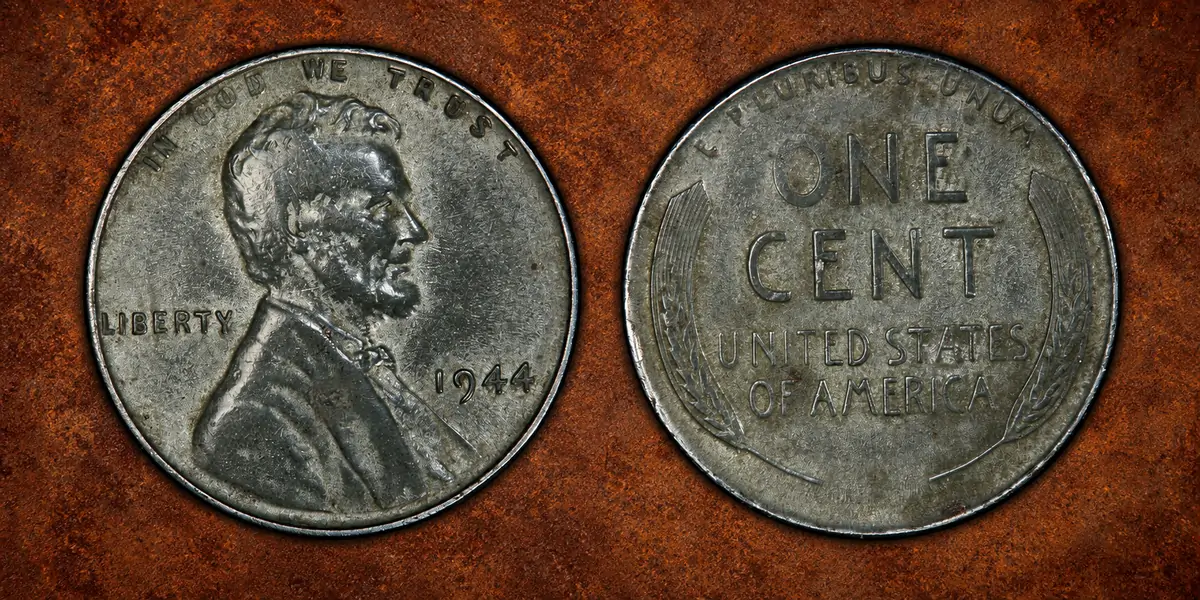
This example adds an extra wrinkle. Its 2.9-gram planchet weighs slightly more than a normal wartime steel cent planchet. Therefore, the coin offers collectors more than a headline rarity. It also raises the kind of technical question that keeps advanced error specialists engaged.
Civil War Two-Cent Error Brings $18,300
The second-highest result came from a much earlier corner of American coinage. An 1864 Large Motto Two Cent Piece, double struck and graded MS62 Red and Brown by ANACS, realized $18,300.
That result made sense. The 1864 Two Cent Piece already holds a special place in U.S. numismatic history. It introduced IN GOD WE TRUST to American coinage during the Civil War. Here, however, the coin also carried a dramatic Mint error. The double strike turned an important first-year type into a showpiece.
Even better, the coin retained attractive original color. As a result, bidders did not chase only the mechanical mistake. They also pursued eye appeal, history, and the denomination’s Civil War backdrop.
Wrong-Planchet Eisenhower Dollar Draws Strong Bidding
Modern errors also showed depth. A 1974-D Eisenhower Dollar struck on a 40% silver dollar planchet, graded MS62 by PCGS, brought $8,845.
Collectors prize these off-metal Ike dollars because they connect two different parts of the Mint’s 1970s production. Regular Denver Mint Eisenhower dollars entered circulation in copper-nickel clad composition. However, this coin landed on a silver-clad planchet. That mistake created a major wrong-planchet error from the large-dollar era.
The price also shows how modern mint errors continue to move beyond novelty status. Advanced buyers now treat top-tier wrong-planchet pieces as serious numismatic trophies.
A Sacagawea Dollar Struck Over an Israeli Coin
One of the auction’s most unusual pieces crossed national lines before it reached the coining press. A 2000-D Sacagawea Dollar struck on a previously struck Israel 1 New Sheqel, KM-160a, realized $8,540. NGC graded the piece MS67.
The lot also included a normal 2000-P Sacagawea dollar and an Israel 1 New Sheqel. Together, the three coins helped illustrate the mistake. A foreign coin entered the Mint’s production stream, then received a new U.S. dollar design. That chain of events rarely happens. When it does, collectors take notice.
This result also shows the appeal of errors that explain themselves visually. A collector does not need a technical manual to understand the drama. The coin carries its own story.
Experimental Connecticut Quarter Sells for $7,015
Another important modern error came from the launch era of the Sacagawea dollar. A 1999-P Connecticut Statehood Quarter struck on an experimental planchet, graded MS62 by PCGS, realized $7,015.
In 1999, the United States Mint tested manganese-alloy planchets for the new golden dollar. However, Sacagawea dollar dies were not yet available. So, the Mint used 1999 Statehood quarter dies, which had a similar diameter, for the tests.
Examples exist for each of the five 1999 Statehood quarter designs: Delaware, Pennsylvania, New Jersey, Georgia, and Connecticut. Even so, collectors seldom encounter them. As a result, the Connecticut quarter offered both a modern U.S. Mint backstory and a direct link to the birth of the golden dollar.
1977-D Kennedy Half Dollar on 40% Silver Planchet Hits $6,405
A 1977-D Kennedy Half Dollar struck on a 40% silver half dollar planchet brought $6,405. NGC graded the coin AU53, and the piece weighs 11.4 grams.
This error should not be confused with a 1776-1976 Bicentennial half dollar. Instead, it represents a post-Bicentennial Kennedy half struck on a silver-clad planchet that did not belong in 1977 Denver Mint circulation production.
That detail matters. The Mint used 40% silver half dollar planchets for Bicentennial collector issues. A leftover silver-clad planchet that reached 1977-D half dollar dies created a compelling transitional alloy error. Decades later, collectors still reward that kind of mistake.
Error Coins Continue to Command Attention
Heritage’s June 29 sale showed strength across several categories. The market responded to wartime alloy mistakes. It also rewarded Civil War-era double strikes, modern wrong-planchet dollars, foreign-coin overstrikes, and experimental planchet pieces.
Most importantly, the results showed that collectors do not view major mint errors as curiosities. Instead, they pursue them as historic production evidence. Each coin preserves a moment when the Mint’s normal process broke down. Sometimes, that breakdown produced a $23,790 cent.
Complete results for Heritage auction 60547 appear on Heritage’s website.






I love wheat pennies. I have thousands. Perks of being a cashier in my younger days. Would snatch any coins I found interesting.
1999P quarter Connecticut George Washington have it yes+966572094856 contact
1976D Lincoln wheat memorial penny. Have it. I don’t have website please help
Thanks for your the penny article. I did learn a few things from it.
love learning about all this
Interesting article!
I wonder how many of these error coins actually circulated versus being carried out by Mint employees or insiders.
Cool errors
I have a complete set of the wheat Pennies me and my mom completed when I was 8 years old I’m now 62
Enjoyed these articles about error coins.
Error coins are fascinating. Shows human error in manufacturing. Will this still happen when AI runs everything?
I have a 1943 d mint error coin . How hard is it to really get that much money on a action .