

Proof Dies in Pocket Change? Mint Records Reveal an 1880s Coinage Surprise
Collectors like clean categories. Proof coins belong in one box. Circulation strikes belong elsewhere. One came from special preparation and careful handling. The other came from the machinery of commerce.
However, the Mint did not always keep the story that tidy.
Newly reviewed Philadelphia Mint die reports confirm that certain dies used to strike Proof coins also struck circulation coins in the same calendar year. That does not turn every sharp business strike into a Proof. It does something more interesting. It gives collectors a documented bridge between two worlds that often get treated as separate.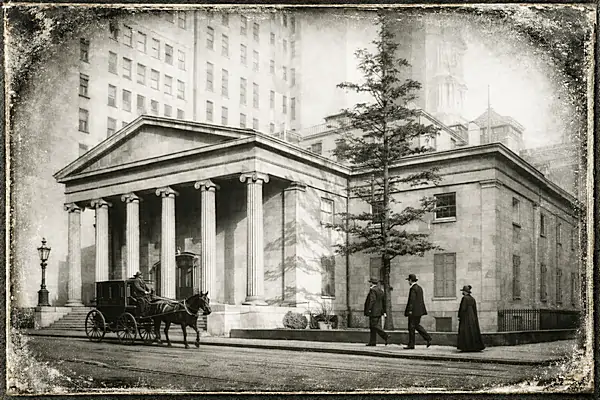
The evidence comes from die-use reports for the Philadelphia Mint. After checking reports from 1876 through 1888, only 1883 and 1884 currently verify the reuse of Proof dies for circulation coinage. Most earlier reports do not identify Proof dies separately. Therefore, they cannot confirm the practice with the same level of confidence.
That makes the 1883 and 1884 reports especially important. They do not rely on style, guesswork, or auction-room tradition. They record what the Mint reported.
Why Proof Dies Matter
A Proof coin starts with intention. The Mint prepared dies and planchets with extra care. Then workers struck the coins for collectors, presentation, or official sale. As a result, Proof coins usually show sharper detail, stronger rims, and more reflective fields than ordinary circulation pieces.
Yet the die itself tells only part of the story. A die could begin its life in the Proof room and later move into ordinary production. Once that happened, it no longer struck Proof coins by method. Instead, it struck circulation coins with a die that had already served a special purpose.
That small distinction matters.
For specialists, it can explain why some circulation coins show unusually sharp features or prooflike surfaces. Also, it warns against easy conclusions. A coin struck from a Proof die does not automatically qualify as a Proof. The planchet, striking method, handling, and die pairing all matter.
In other words, the die may carry Proof history. The coin still needs proof of its own.
The 1883 Philadelphia Mint Evidence
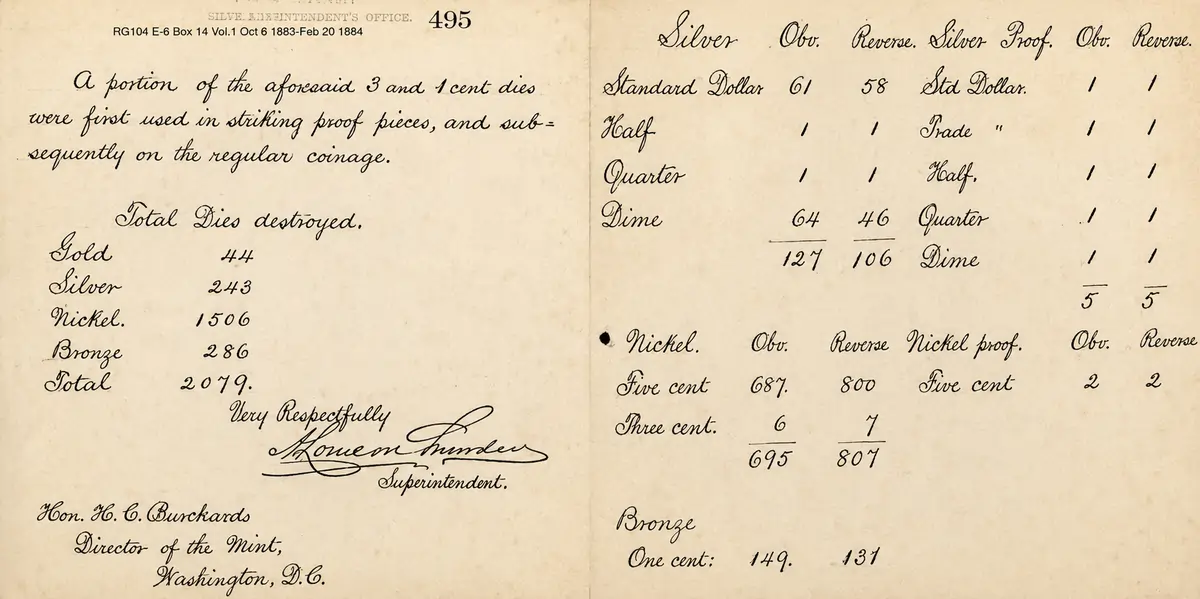
For the three-cent denomination, the Philadelphia Mint reported six obverse dies and seven reverse dies for all coins. For the cent, the Mint reported 149 obverse dies and 137 reverse dies.
Normally, one pair of Proof dies handled a denomination. However, larger Proof sales sometimes required more than one pair. The five-cent Proof coinage for 1883 shows that pattern.
That detail opens a useful window into Mint practice. The Mint did not treat dies as museum objects after Proof production ended. Instead, officials could use serviceable steel where production needed it. If a Proof die still had life, the Coining Department could press it into harder work.
The result gives today’s collector a sharper problem. Some circulation pieces from 1883 may carry the fingerprint of Proof production. But they remain circulation strikes unless all other Proof characteristics support the attribution.
The 1884 Report Adds a Second Year
![Figure 2. Sample pages from report of dies used at the Philadelphia Mint in 1884. Left page includes a note stating that certain Proof dies also struck circulation coins. Right table presents dies used for silver and minor coinage. Combine circulation and Proof die quantities for the total of each denomination. [2]](https://coinweek.com/wp-content/uploads/2026/07/Figure-2.webp)
For 1884, the dime used 20 obverse dies and 20 reverse dies, plus one pair of Proof dies. Among the minor denominations, the cent used 123 obverse dies and 122 reverse dies. The three-cent coin used two obverse dies and two reverse dies. The five-cent coin used 166 obverse dies and 147 reverse dies.
The three minor denominations each had one pair of Proof dies.
Again, the report does not ask collectors to infer the practice from appearance alone. It documents the reuse. Moreover, it shows how carefully researchers must read die totals. The Proof and circulation figures need to be combined to understand total die use for each denomination.
That point sounds technical. Yet it changes the story. A Proof die did not always retire after its collector duty ended. Sometimes it went back to work.
A Hidden Link Between Proofs and Pocket Change
This research gives 1883 and 1884 collectors a stronger framework for die study. It also gives variety specialists a reason to compare Proof and circulation pieces more closely.
The best method starts with a visually convincing Proof of the desired denomination. That coin must match legitimate Proofs from years where specialists already recognize authentic Proof issues. Then the researcher must identify both the obverse and reverse dies without ambiguity.
That last step matters. The Mint could pair dies differently during circulation-strike use. Therefore, a Proof obverse might not remain married to the same Proof reverse. A collector who identifies only one side of the coin risks building a case on half the evidence.
The goal should not involve stretching a business strike into a Proof. Instead, the goal should involve reconstructing die history. Which die struck Proofs? Which die later struck circulation coins? Did the die remain paired with its original mate? Or did the Mint break the marriage and send one die back into ordinary service?
Those questions bring the Mint floor to life.
What This Changes for Collectors
The discovery does not rewrite the entire Proof coinage record. It also does not prove that every Philadelphia Mint year from the 1870s and 1880s saw this practice. The surviving reports only verify 1883 and 1884.
Still, the evidence matters because it replaces suspicion with documentation.
Collectors have long encountered coins that sit near the border between Proof and circulation strike. Some show mirrorlike fields. Others show sharp rims. A few display die polish or detail that seems too strong for ordinary production. However, appearance can mislead.
Now, for 1883 and 1884, researchers have a documented reason to study certain coins with fresh eyes. The Mint itself reported that some Proof dies also struck circulation coins.
That turns a minor bookkeeping note into a numismatic clue.
The Bigger Lesson
The Philadelphia Mint ran on rules, but it also ran on steel, labor, deadlines, and economy. A good die had value. If a die could still strike coins, the Mint had a practical reason to use it.
Therefore, the story of Proof dies in circulation coinage belongs to more than one field. It touches Proof coinage and business strikes. It touches die marriages, die states, and attribution standards. Most importantly, it reminds collectors that Mint records can still surprise us.
A coin may look like a finished object. Yet behind it sits a chain of decisions. Someone prepared the die. Someone used it for Proofs. Then, in at least two verified years, someone used certain Proof dies again for coins made for everyday commerce.
That is the kind of detail that turns a coin into evidence.
By Roger W. Burdette
Copyright 2026. All rights reserved.
Sources
[1] RG104 E-6 Box 14 Vol. 1, October 6, 1883–February 20, 1884. Report dated January 3, 1884, from Snowden to Burchard, pp. 2–3.
[2] RG104 E-6 Box 14 Vol. 3, July 21, 1884–January 29, 1885. Report dated January 10, 1885, from Snowden to Burchard, pp. 2–3.

THANK YOU!!
Nice