


A High-Grade Survivor From a Nation in Crisis
GreatCollections will close bidding on a Civil War-era 1862 Indian Head Cent certified PCGS MS-66+ with CAC Green approval on Sunday, May 3, 2026. The auction listing identifies the coin as GreatCollections Item 1981836.
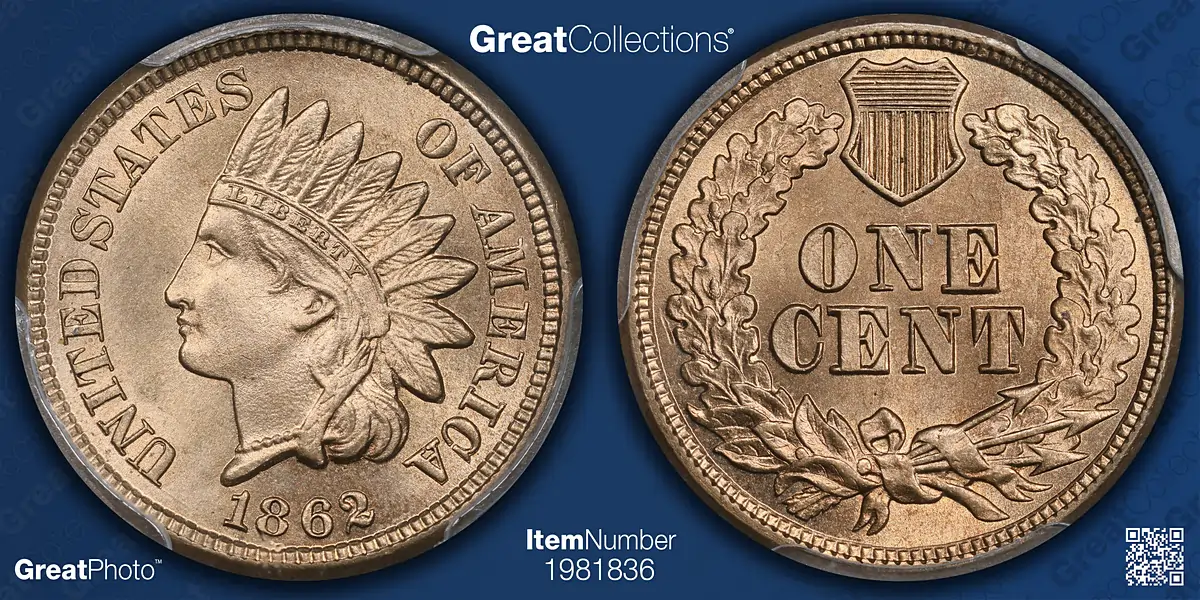
A Civil War-Era 1862 Indian Head Cent
The 1862 Indian Head Cent carries more than high-grade appeal. It also reflects the economic stress of the American Civil War.
The Philadelphia Mint struck 28,075,000 examples of the date. That total nearly tripled the 10,100,000 cents struck in 1861. As a result, the 1862 issue became one of the major production dates of the early copper-nickel Indian Head Cent era.
Even so, condition matters. The 1862 Indian Head Cent appears with some frequency in Mint State grades. However, it becomes much tougher near the Superb Gem level. PCGS CoinFacts estimates about 8,000 survivors in all grades, 2,750 in MS60 or better, and 400 in MS65 or better.
Why the 1862 Issue Matters
Collectors know the 1862 Indian Head Cent as a copper-nickel “white cent.” The alloy contains 88% copper and 12% nickel, which gives the coin a lighter color than later bronze cents. PCGS notes that these copper-nickel cents earned the nickname “white cents” because of that light hue.
The GreatCollections listing gives the coin’s weight as 4.67 grams, with a 19 mm diameter. It also identifies the coin as a Philadelphia Mint business strike with no mint mark.
Wartime Hoarding Changed Small Change
The Civil War changed daily commerce. Americans hoarded gold and silver first. Then they hoarded copper-nickel cents as well. Because of that, merchants needed substitutes for small change.
By 1862, the coin shortage grew severe. The federal government allowed debts up to five dollars to use postage stamps. It also issued Postage Currency, better known today as Fractional Currency. Meanwhile, private merchants issued Civil War tokens to help customers make change.
Therefore, the 1862 Indian Head Cent tells two stories at once. It represents a practical coinage response to crisis. It also survives as a tangible artifact from a divided nation.
The “White Cent” Before Bronze
The U.S. Mint used copper-nickel for small cents before the Civil War. The alloy began with the Flying Eagle cent and continued into the Indian Head Cent series. PCGS identifies the 1860-1864 Indian Head cents as the copper-nickel Type 2 issues.

However, the alloy caused problems. Nickel supplies tightened during the war. Also, the hard metal made production more difficult and shortened die life. As a result, the Mint moved to bronze in 1864. Congress authorized the new bronze cent through the Coinage Act of April 22, 1864.
That transition created one of the most important composition changes in the Indian Head Cent series. The early “white cents” weighed 4.67 grams. The later bronze cents weighed only 3.11 grams.
James B. Longacre’s American Design
James B. Longacre designed the Indian Head Cent. The obverse shows Liberty wearing a feathered Native American-style headdress.
While many collectors still repeat the old story that Longacre modeled Liberty after his daughter Sarah, the better-supported account points elsewhere. Greysheet notes that Longacre said the model came from a statue known as Venus Crouching.
In 1860, the Mint changed the reverse. It replaced the earlier laurel wreath with an oak wreath and added a small shield above the denomination. PCGS notes that this Type 2 reverse carried through the copper-nickel issues of 1860-1864.
That shield gave the design a stronger national feel. In the early 1860s, that symbolism mattered.
Coin Snapshot
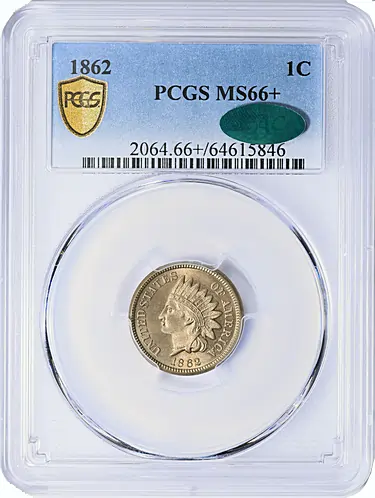
- Coin: 1862 Indian Head Cent
- Certification: PCGS MS-66+ CAC Green
- GreatCollections Item ID: 1981836
- PCGS / Industry Number: 2064
- Mint: Philadelphia
- Mintage: 28,075,000
- Composition: 88% copper, 12% nickel
- Weight: 4.67 grams
- Diameter: 19 mm
- Strike Type: Business Strike
- Auction Close: Sunday, May 3, 2026, at 4:07:45 p.m. Pacific Time
A High-Grade Survivor From a Nation in Crisis
The 1862 Indian Head Cent remains accessible in many grades. Yet premium Gems tell a different story. A PCGS MS-66+ CAC Green example brings the date into a far more selective tier.
For collectors, this coin offers several points of appeal. It belongs to the short copper-nickel Indian Head Cent subtype and dates to the second year of the Civil War. The coin also shows the pale “white cent” look that disappeared after the 1864 transition to bronze.
Most importantly, it connects numismatic quality with American history. The 1862 Indian Head Cent stands as a small coin from a moment of national strain, monetary disruption, and rapid change.




Never thought weight and it’s role.
A coin that old with that high of a grade? Wow! Good luck on the coin giveaway everybody!
Always liked the Indian head cent!!!
Interesting how the war efforts have effected coinage throughout history
Great design, predates my oldest US coin
I never knew about the change before the bronze came out. I learn a lot here.