


Kings of Cappadocia
PART I – PART II
A mountain kingdom, a murdered dynasty, and a courtesan’s son.
Silver coins that recorded Cappadocia’s fall into Rome’s orbit.
This is the PART II of our look at the Kings of Cappadocia coinage, a series that traces the rise and fall of a small but strategically vital kingdom in central Anatolia.
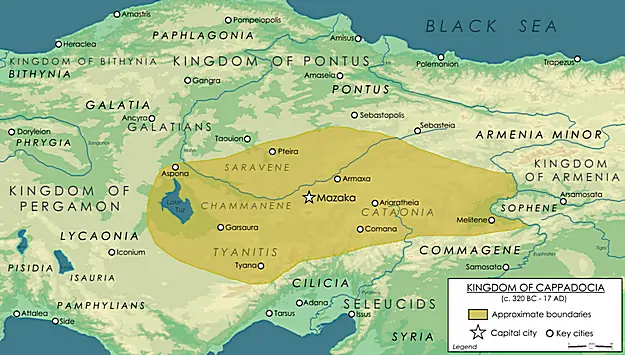
Cappadocia stood between empires. Pontus wanted it. Armenia invaded it. Rome claimed to protect it. Yet the kingdom kept announcing its legitimacy in silver.
Its kings placed royal portraits on the obverse. Then, on the reverse, they returned again and again to Athena. She held Nike, a spear, a shield, or a palm branch. The message was clear. Cappadocia wanted to look stable, Greek, royal, and victorious.
However, the history behind these coins tells a darker story. These drachms and tetradrachms came from a world of assassinations, puppet kings, Roman interventions, mercenary payments, and political survival.
By the end, the old Hellenistic kingdom had vanished. In its place stood the Roman province of Cappadocia.
Ariarathes VII Philometor, c. 116 – 100 BCE
Ariarathes VII came to the throne after the death of his father. Since he was still young, his mother, Laodike, governed as regent.
That regency created an opening. Nikomedes III of Bithynia invaded Cappadocia, married Laodike, and took control of the country. Soon after, Mithradates VI of Pontus expelled him and restored Ariarathes VII.
At first, Mithradates looked like a protector. Then he became a threat.
Ariarathes VII lost faith in the Pontic king and prepared to move against him. Mithradates responded with a trap. During negotiations in 100 BCE, he murdered Ariarathes VII. Then he placed his own young son on the Cappadocian throne under the royal name Ariarathes IX.
The Coins of Ariarathes VII
The coinage of Ariarathes VII continued the tradition of his father. He struck tetradrachms and drachms with the familiar Cappadocian types. Yet he also issued an important and unusual series of tetradrachms in the style of the dead Seleucid king Antiochos VII.
These Antiochos-style pieces closely resemble Cappadocian royal tetradrachms. The main difference appears on the reverse. Athena stands inside a laurel wreath, and the issuing authority names Antiochos rather than Ariarathes. The legend reads in the name of Antiochos.
These coins likely served a practical purpose. Ariarathes VII may have used them to pay Syrian mercenaries. A coin that looked Seleucid would have carried trust among soldiers used to Seleucid silver.
Ariarathes VII also struck tetradrachms in his own name. On these issues, he used the title Philometor, meaning “Mother-loving.” Alongside the three mints used earlier in the kingdom, Ariaratheia also entered the royal mint system.

Ariarathes VIII, c. 100 – 95 BCE
The Cappadocian nobility rejected Mithradates’ son Ariarathes IX. They wanted a native dynastic alternative. So they called on Ariarathes VIII, the younger son of Ariarathes VI, to expel the Pontic-backed usurper.
The effort failed. Cappadocia could not match Mithradates’ army. Pontic forces defeated the Cappadocians and drove Ariarathes VIII into exile. He later died, and with him ended the Ariarathid dynasty.
His coinage was brief but important.
In his own name, Ariarathes VIII struck only drachms on the reduced Attic standard, at about 4.05 grams. These coins show the royal portrait on the obverse and standing Athena on the reverse. They also continue the familiar titulature of the Cappadocian kings.
He also struck Antiochos VII-style tetradrachms like those issued under his brother. Only two mints appear in this phase: Tyana and Comana.
Public auction records and numismatic listings support the attribution of Ariarathes VIII drachms dated to 100–95 BCE, with Athena standing on the reverse. They also record Antiochos VII-style tetradrachms struck in Cappadocia during the period of Ariarathes VIII to Ariobarzanes I.
Ariarathes IX Eusebes Philopator, c. 100 – 85 BCE
After Mithradates VI removed Ariarathes VII, he installed his own son as Ariarathes IX. The child king served Pontic policy, not Cappadocian independence.
Rome soon intervened. The Senate deposed the Pontic-backed king and supported Ariobarzanes I instead. Then Tigranes II of Armenia invaded Cappadocia in 93 and 92 BCE. Each time, he drove out the Roman-backed ruler. Yet when Armenian forces withdrew, Rome restored its preferred king.
At the beginning of the First Mithradatic War, usually dated 90/89–85 BCE, Mithradates again placed his son on the Cappadocian throne. However, the Peace of Dardanos ended that arrangement. Ariarathes IX lost the throne again in 85 BCE. His later fate remains uncertain in many summaries of the period.
The Coins of Ariarathes IX
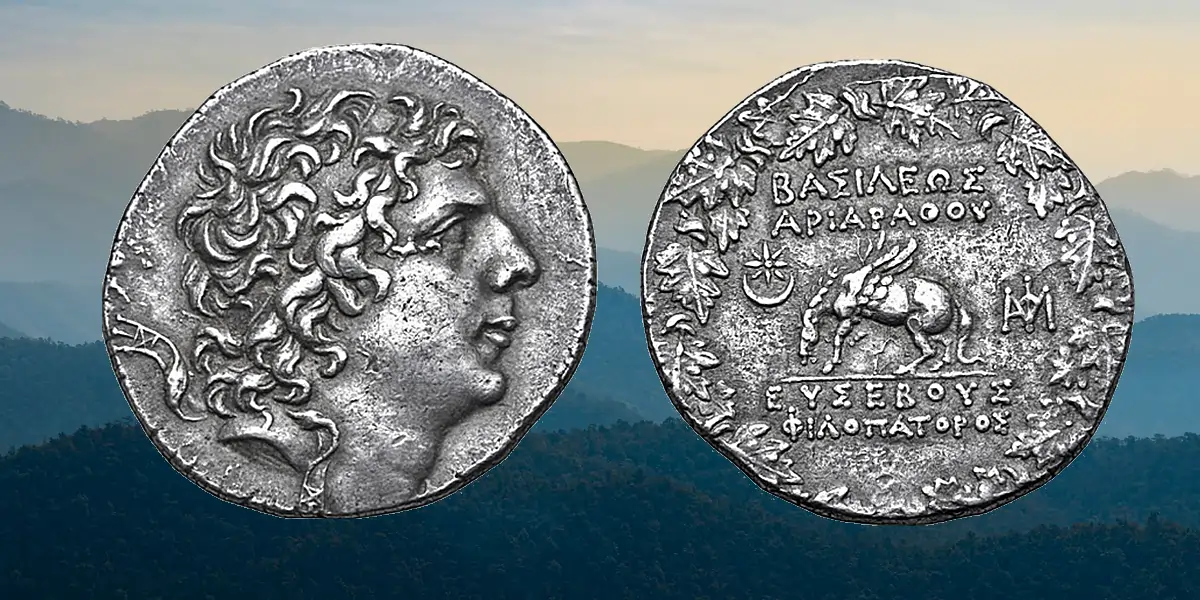
Ariarathes IX struck tetradrachms and drachms in the tradition of earlier Cappadocian kings. Most reverses show Athena. One exceptional tetradrachm type instead shows Pegasos.
Some of the obverse portraits show flowing hair. This style recalls the coin portraits of Mithradates VI, his father. The legends preserve the royal titles used by his predecessors. The main mint was probably Eusebeia, the former Mazaka.
CoinArchives records Ariarathes IX drachms of Eusebeia with Athena Nikephoros on the reverse and notes his relationship to Mithradates VI. Other listings describe later Ariarathes IX drachms with features of Mithradates VI.
Ariobarzanes I Philoromaios, c. 96/95 – 63/62 BCE
Rome had grown tired of interference from Pontus and Armenia. The Senate first tried to dissolve the monarchy and turn Cappadocia into a republic. The plan failed with the Cappadocians. They wanted a king.
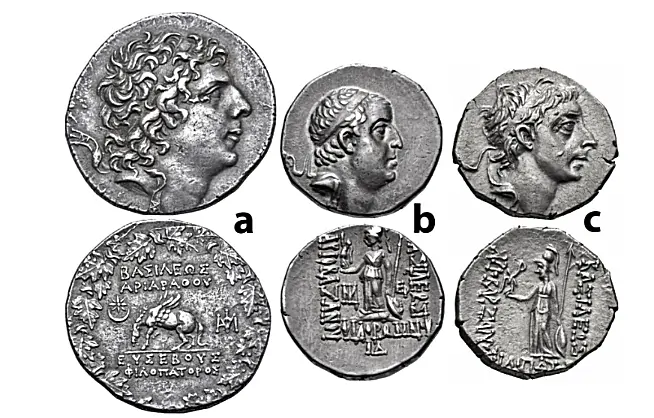
They chose Ariobarzanes I, a Cappadocian noble of Persian ancestry. He then made his political alignment obvious. He took the title Philoromaios, meaning “Friend of the Romans.”
The Greek form appears as ΦIΛOPΩMAIOY on some of his coins.
Ariobarzanes I needed that Roman friendship. His throne never stood on firm ground. Tigranes II drove him out in 93 BCE. Lucius Cornelius Sulla, then governor of Cilicia, restored him. Tigranes forced him out again, and Manius Aquilius restored him in 91 BCE.
Mithradates then expelled him during the First Mithradatic War. Rome restored him again in 84 BCE after the war ended.
The Cycle Continued
During the Second Mithradatic War, from 83 to 81 BCE, Ariobarzanes again lost the throne. Lucius Licinius Murena brought him back. During the Third Mithradatic War, from 73 to 63 BCE, he suffered another expulsion. Lucius Licinius Lucullus restored him.
Finally, Mithradates and Tigranes forced him out in 67 BCE. Pompey the Great restored him once more. By 63 BCE, Ariobarzanes had endured enough. He abdicated, probably from exhaustion, and his son Ariobarzanes II took over.
Ariobarzanes I struck only drachms on the reduced Attic standard, around 4.05 grams. The types follow the older Cappadocian model. The obverse shows the diademed king. The reverse shows Athena standing. Some issues carry the title “Friend of the Romans.” His coins came from the four mints used earlier in the kingdom.
Encyclopaedia Iranica identifies Ariobarzanes I as a Cappadocian aristocrat and explains the title Philoromaios. It also notes that Mithradates VI, Tigranes, and their allies repeatedly dispossessed him. Livius likewise notes that Ariobarzanes gained the kingship several times but never fully controlled his kingdom.
Ariobarzanes II Philopator, c. 63/62 – 52/51 BCE
After Ariobarzanes I abdicated, Pompey approved the accession of his son, Ariobarzanes II.
Ariobarzanes II had both Persian and Greek ancestry. He married Athenais Philostorgos II, a daughter of Mithradates VI. Yet this dynastic connection did not make him a strong ruler.
In 57 BCE, he asked Aulus Gabinius, proconsul of Syria, for military help against his opponents in Cappadocia.
One cultural achievement stands out. Ariobarzanes II funded the restoration of the Athenian Odeion. That act placed a Cappadocian king inside the civic memory of Athens.
His reign ended violently. In 52 or 51 BCE, a pro-Parthian faction assassinated him. His son Ariobarzanes III succeeded him.
Ariobarzanes II struck a series of silver drachms, around 3.73 grams. These show his diademed portrait on the obverse. Athena stands on the reverse, as on earlier Cappadocian coins. The legends continue the royal titulature.
These coins do not appear often. They may have helped finance the army of Gabinius.
Attalus summarizes key ancient-source references for Ariobarzanes II, including Gabinius’ involvement, the rebuilding of the Odeion at Athens, and the king’s death in 52 BCE. Encyclopaedia Iranica gives his reign as 63/62 to about 52 BCE and identifies his wife and sons.
Ariobarzanes III Eusebes Philoromaios, 52/51 – 42 BCE
After the murder of Ariobarzanes II, the Roman Senate appointed Ariobarzanes III king of Cappadocia.
He faced enemies from the start. His opponents included his mother, Athenais, and Archelaos, the high priest of Ma. The pressure grew so serious that he sought help from Marcus Tullius Cicero, then proconsul of Cilicia. Yes, that Cicero.
During the Roman Civil War, Ariobarzanes III first supported Pompey against Julius Caesar. Then Pompey lost at Pharsalus in 48 BCE. Ariobarzanes quickly changed course and reconciled with Caesar.
Caesar then marched east to fight Pharnaces II of Pontus. After Caesar won at Zela, he rewarded Ariobarzanes III with parts of Lesser Armenia.
Even after Caesar’s assassination in 44 BCE, Ariobarzanes III stayed loyal to the Caesarian cause. When Cassius, one of Caesar’s assassins, came to Cappadocia and demanded money for the war, the king refused. Cassius had him killed.
His brother Ariarathes X succeeded him.
The Coins of Ariobarzanes III
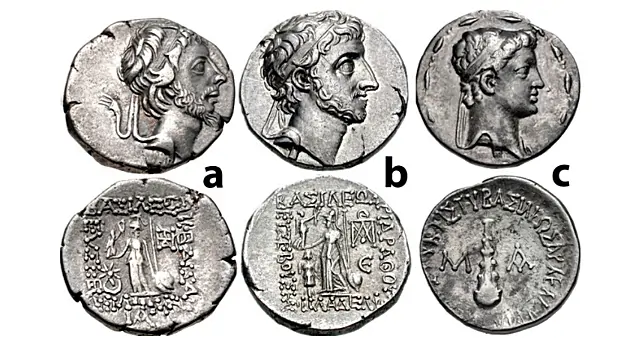
Ariobarzanes III struck only silver drachms, around 3.67 grams. The obverse shows a bearded royal portrait. The reverse returns to Athena standing.
A star and crescent appear in the reverse field. This symbol may point to his descent from Mithradates VI through his mother. It may also commemorate the defeat of Pharnaces II, which led to Cappadocia’s territorial expansion.
The reverse legends identify Ariobarzanes III as Eusebes and Philoromaios — “Pious” and “Friend of the Romans.” The mint was probably Eusebeia.
Numista records Ariobarzanes III drachms as silver issues of 51–42 BCE, with Athena standing left and a star over crescent in the field. CoinArchives also records dated Ariobarzanes III drachms with the Eusebes and Philoromaios titles.
Ariarathes X Eusebes Philadelphos, 42 – 36 BCE
After the defeat of Caesar’s assassins in 42 BCE, Mark Antony reorganized the East. He appointed Ariarathes X, brother of Ariobarzanes III, as king of Cappadocia.
His reign did not last long. Antony had him killed so he could install Archelaus as king.
Like his brother and earlier Cappadocian rulers, Ariarathes X struck silver drachms. They weigh about 3.71 grams. The obverse shows his diademed and bearded portrait. The reverse keeps the standing Athena of the Cappadocian royal house.
A trophy appears in the reverse field. It probably refers to the Caesarian victory at Philippi.
The reverse legend gives his titles as Eusebes and Philadelphos, or “Pious” and “Sibling-loving.” In Greek, the titles appear as EVΣEBOYΣ KAI ΦIΛAΔEΛΦOY. The mint was again Eusebeia.
Ariarathes X also issued a bronze coin of about 3.71 grams, sometimes described as a bronze “drachm.” It shows Artemis on the obverse and a standing stag on the reverse. The type resembles bronze coinage produced in Galatia.
Livius records the transition after Cassius ended the rule of Ariobarzanes III and notes the rise of Archelaus after the Caesarian victory at Philippi. It also identifies Archelaus as the last king of Cappadocia.
Archelaus Philopatris Ktistes, 36 BCE – 17 CE
Archelaus Sisines of Comana became king of Cappadocia after the death of Ariarathes X.
His rise had a remarkable backstory. Antony killed Ariarathes X at the request of Glaphyra, the mother of Archelaus. Glaphyra was Antony’s mistress and a hetaera, or courtesan. Archelaus himself was the son of another Archelaus, the high priest of Bellona, the Roman goddess of war.
This was not a normal dynastic succession. It was court politics at the highest level of the Roman East.
After Antony lost at Actium in 31 BCE, Archelaus changed sides. He transferred his loyalty to Octavian, the future Augustus. That move saved his crown.
Augustus later expanded his kingdom. Archelaus gained parts of Cilicia and Lesser Armenia. He moved his capital to the Cilician coastal city of Elaiussa, which he refounded as Sebaste. The name honored Augustus, since Sebaste is the Greek equivalent of Augusta.
He also renamed Eusebeia as Caesarea and founded Archelais as an administrative center.
Building Projects
Because of these building projects, Archelaus adopted a striking royal title: Philopatris Ktistes, or “Lover and Founder of his Country.” The phrase appears on his coins as ΦΙΛΟΠΑΤΡΙΔΟΣ TOY ΚΤΙΣΤΟΥ.
His family ties also reached into Judaea and Pontus. In 18/17 BCE, he married his daughter Glaphyra to a son of Herod the Great. In 8 BCE, he married Pythodoris, the widow of Polemon I of Pontus. Through that marriage, he gained access to the kingdom of Pontus.
Yet Archelaus never won the affection of his subjects. Their complaints to Augustus led to the temporary appointment of a regent.
He also made a dangerous political choice. Archelaus favored Gaius Caesar, the nephew and intended heir of Augustus, over Tiberius. When Tiberius became emperor, he remembered the slight.
Tiberius summoned Archelaus to Rome and charged him with sedition. Archelaus died of old age before the case reached its conclusion. Then Tiberius ended the kingdom and turned Cappadocia into a Roman province.
Archelaus continued to strike silver drachms, around 3.65 grams. He also issued hemidrachms of about 1.84 grams.
The drachms show his diademed head on the obverse. The reverse breaks with the long Athena tradition. Instead, it shows the club of Herakles, surrounded by the legend naming the king and his title, “Lover and Founder of his Country.”
One example carries M-A in the field. Read as regnal year 41, it dates the coin to 4/5 CE.
The hemidrachms show the head of Herakles on the obverse and Mount Argaios on the reverse.
WildWinds records Archelaus drachms from Caesarea with the club reverse and the legend BAΣIΛEΩΣ AΡXEΛAOY ΦIΛOΠATΡIΔOΣ TOY KTIΣTOY. It also records hemidrachms with Herakles on the obverse and Mount Argaeus on the reverse.
Collecting the Coinage of the Kings of Cappadocia
The silver tetradrachms of the Cappadocian kings make excellent additions to an ancient coin collection. They offer strong portraits, attractive Hellenistic style, and a direct link to the political struggle between Rome, Pontus, Armenia, and the old Seleucid world.
The drachms also deserve attention. They are usually smaller and less dramatic than the tetradrachms, but they tell the story of the kingdom in a more continuous way.
However, collectors should note one drawback. The reverses show limited variety. Athena dominates the series. She appears seated or standing, often holding Nike or a palm branch. Ariarathes IX’s Pegasos reverse stands as a rare exception. Archelaus later changed the visual language with his Herakles club reverse.
That change matters. For generations, Cappadocian kings had used Athena to project Greek royal legitimacy. Archelaus used the club of Herakles and the title of founder. His coins no longer looked backward to the old Hellenistic house. They looked toward a new order shaped by Rome.
In 17 CE, that new order arrived. Cappadocia ceased to be a kingdom. It became a Roman province.
Its coins remain the last royal witnesses.
References
- Acsearch.info: auction database.
- Berk, Harlan. 100 Greatest Ancient Coins. Whitman Publishing, 2023.
- Classical Numismatic Group.
- Grant, Michael. A Guide to the Ancient World: A Dictionary of Classical Place Names. Barnes & Noble, 1986.
- Head, Barclay V. Historia Numorum: A Manual of Greek Numismatics. Oxford, 1887.
- Hoover, Oliver. Handbook of Coins of Northern and Central Anatolia, Vol. 7. Classical Numismatic Group, Lancaster/London, 2012.
- Hornblower, Simon, and Antony Spawforth, eds. The Oxford Classical Dictionary, 3rd ed. Oxford, 1996.
- Sear, David. Greek Coins and Their Values, Vol. 2: Asia. B.A. Seaby Ltd., 1979.
By Steve Benner for CoinWeek






The facts behind these coins are quite interesting! I enjoyed reading about them. As far as craftsmanship, I’m amazed at the detail and work that was put into them.
Very interesting article. I love the history of these old coins.