


By Philip Thomas for PCGS ……
Small-size U.S. banknotes often stand in the shadow of earlier large-size notes. Collectors know the names: Battleship, Bison, Black Eagle, Woodchopper, and Watermelon.
Those classic notes offer bold designs, larger formats, and major eye appeal. However, small-size notes tell a different story. They reward close study. They also offer collectors subtle varieties, scarce production features, and real numismatic depth.
In 1929, the federal government reduced the size of U.S. banknotes by about 30%. It also standardized note designs by denomination. This change cut production costs and helped the public identify genuine notes more easily.
That shift ended the large-size era. Yet it also opened a new field for collectors.
Why Small-Size Notes Matter
Small-size notes may look more familiar. Still, they contain many varieties. Collectors study series, districts, blocks, plate numbers, star notes, and printing anomalies.
As a result, these notes can offer strong value and serious rarity. They also remain more accessible than many large-size type notes.
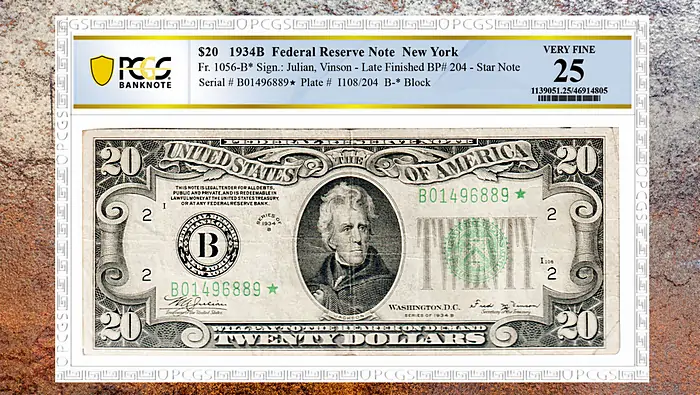
This featured “Noteworthy Note” proves that point. It is not a Woodchopper. It is not a Watermelon. Even so, it delivers a remarkable combination of scarcity factors.
A Scarce 1934-B $20 Federal Reserve Note
PCGS certified this Series 1934-B $20 Federal Reserve Note from the New York district and graded it Very Fine 25. The note carries several scarce traits that intersect in one example. PCGS described it as a potentially unique note for its series and district.
First, consider the series.
The “B” in Series 1934-B does not identify the New York Federal Reserve district. Instead, it marks the series variety. The district letter “B” separately represents the Federal Reserve Bank of New York.
That distinction matters.
Series 1934-B Federal Reserve Notes carry the engraved signature of Treasury Secretary Fred M. Vinson. Vinson held that Treasury post for less than one year. The U.S. Treasury states that he resigned in 1946 to become Chief Justice of the Supreme Court.
Justia records that Vinson joined the Supreme Court on June 24, 1946.
Because Vinson served briefly, notes with his signature saw shorter production periods than nearby series, such as 1934-A and 1934-C. Therefore, Series 1934-B notes often draw added collector interest.
The Star Note Adds Another Layer
Next, this note carries star-note status.
Both serial numbers end with bold green stars. That feature tells collectors that the note replaced an imperfect sheet during production.
The Bureau of Engraving and Printing explains that a star sheet replaces an imperfect sheet after serial numbers have been added. A star note then carries its own special serial number followed by a star instead of the regular suffix letter.
Therefore, this note gains another rarity factor. It combines a scarcer series with a replacement-note format.
Back Plate #204 Makes the Note Special
Finally, the back plate number delivers the key feature.
The back of this $20 note came from Back Plate #204. Collectors know this plate as a Late-Finished Back Plate.
The Paper Money Project reports that Back Plate #204 began life during the BEP’s move to new-gauge plates in 1934. It then served as a master plate before the BEP certified it as a production plate on March 18, 1944. The BEP used it for press rotations from April 4, 1944, to October 2, 1946, and canceled it on October 3, 1946.
That timeline explains the collector excitement.
Back Plate #204 carried a low plate number from the mid-1930s. However, it entered production nearly a decade later. By that time, other $20 back plates carried much higher numbers. So, plate #204 stands out immediately to specialists.
A Rare Combination of Features
This note brings together three important traits.
It is a Series 1934-B note that comes from the New York district. It also carries star serial numbers and a Late-Finished Back Plate #204 reverse.
Each factor matters on its own. Together, they create a far more compelling banknote.
The exact number of surviving notes with this same combination remains unknown. New discoveries can always change the census. However, based on currently published information, this example appears to stand alone for its series and district. It also joins a small group of known $20 Federal Reserve Star Notes connected to Late-Finished Back Plate #204.
Small Details Create Big Rarity
Small-size notes do not need oversized designs to command attention. Sometimes, the strongest stories hide in plate numbers, signatures, stars, and production history.
This 1934-B $20 Federal Reserve Star Note shows why collectors study the details. At first glance, it may look like a circulated $20 bill from the 1930s and 1940s. However, its series, district, star-note status, and Late-Finished Back Plate #204 make it far more important.
For advanced paper money collectors, that combination turns a modest-looking note into a standout piece of U.S. currency history.
* * *







I have a 1934 D Star note green back ,could you please tell. Me what it’s worth.
I have a 2023 error quarter with Eleanor Roosevelt on the reverse, she has 3 bumps on her right cheek which look like tears. On the Obverse Washington has squiggly lines down his cheek like tears. I call it my “Crying Quarter”
You should send it into PCGS or NGC for authentication and certification that it is in fact a mint error
Hey I hAve a 1930 twenty dollar bill can you tell what’s it’s worth please.
@Jimmy Blueman Please take another look at your note and post a new question with more details.
> The Treasury didn’t print any $20 bills with a 1930 series date. The nearest dates are 1929 and 1934.
> It’s important to know what letter, if any, is next to the date.
> It’s also important to know the bill’s condition and seal color.
The serial number is generally _not_ important to a bill’s value unless it’s somehow unusual: low e.g. 00000012, a special pattern e.g. 45454545, and so on.
Never considered that small notes were that collectible.
Paper money history is so cool. I wonder what the odds are of finding them “in the wild”