


The Rare Jever Thaler That Linked Russia to the North Sea
In 1798, a small North Sea lordship issued one of the strangest coins of the German States. The Jever thaler looked German. It carried a German denomination. It named a German princess. Yet its obverse displayed a crowned double-headed eagle tied to the Russian imperial story.
That tension gives the coin its power. The Jever thaler does not simply represent a rare silver issue. It records a short, unlikely moment when a remote Frisian territory and the Romanov dynasty met on the same piece of metal.
A Small Lordship With a Large Dynastic Problem
Jever stood on the northwestern edge of Germany, near the North Sea. In the late 18th century, it belonged to the House of Anhalt-Zerbst. Its ruler, Prince Friedrich August of Anhalt-Zerbst, had no children. He died in Luxembourg on March 3, 1793. With him, the male Anhalt-Zerbst line ended.
However, Jever had a special legal status. It could pass through the female line. Therefore, Jever did not follow the same path as the rest of Anhalt-Zerbst. Instead, it passed to Friedrich August’s sister, Sophie Auguste Friederike of Anhalt-Zerbst. History knows her by a far more famous name: Catherine II of Russia, or Catherine the Great.
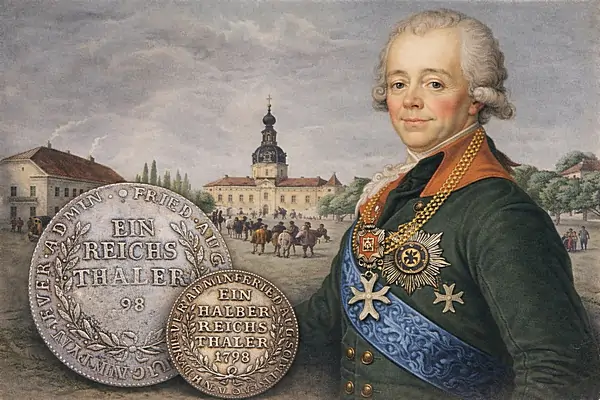
This point matters. Jever did not become part of Russia. The Schlossmuseum Jever makes that clear. Jever and Russia remained legally separate. They shared a ruler through personal union. In other words, the Russian monarch held Jever, but the territory did not merge into the Russian state.
Catherine the Great Ruled From Afar
Catherine did not move west to rule Jever. Instead, she left local government in trusted hands. She appointed Friedrich August’s widow, Friederike Auguste Sophie of Anhalt-Bernburg, as imperial Russian governor, or Statthalterin, in Jever. As a result, Jever kept its German administration while acknowledging a Russian sovereign.
The new relationship needed symbols. Catherine sent Jever a state portrait in 1794. The Schlossmuseum Jever describes the gift as both a sign of favor and a political statement. The portrait represented the absent monarch and made Russian authority visible inside Jever Castle.
Coins served the same purpose. They carried authority into daily life. Yet the 1798 Jever thaler did more than declare a ruler. It captured a complicated legal arrangement in silver.
Paul I Inherits Jever and Looks Toward Malta
Catherine died in 1796. Her son, Paul I, inherited the Russian throne and Jever’s personal-union claim.
Paul brought a very different imagination to the throne. He admired chivalric orders, heraldry, and the ideals of knighthood. Soon, events in the Mediterranean gave those interests political force. Napoleon seized Malta in June 1798, forcing the Knights Hospitaller from their island stronghold. After that, Paul took up the Order’s cause. His claim to the Grand Master title remained controversial because he was a married Orthodox ruler, not a Roman Catholic knight. Still, he treated the matter as a question of honor and power.
At the same time, Russia entered the struggle against Revolutionary France. Admiral Fyodor Ushakov operated in the Mediterranean with a Russo-Ottoman squadron. His fleet helped take the Ionian Islands from the French and pushed Russian influence into waters that Britain also considered strategic.
Then Malta became a breaking point. British forces took Malta from the French in September 1800. Paul expected Britain to return the island to the Order. Britain did not. Paul responded with an embargo on British commerce and seized British ships in Russian ports.
Therefore, Jever gained new symbolic value. Malta had slipped beyond Paul’s reach. Jever had not. Jever belonged to him by inheritance. It gave the Russian emperor a real, legal foothold in the Holy Roman Empire.
The 1798 Jever Thaler
The 1798 Jever coinage included a silver Reichsthaler and a half Reichsthaler. The Silberhütte mint, in the Harz region, struck the thaler. Numista lists the thaler as 22.27 grams, .750 fine silver, and 36 mm in diameter. NGC confirms the same weight and fineness.
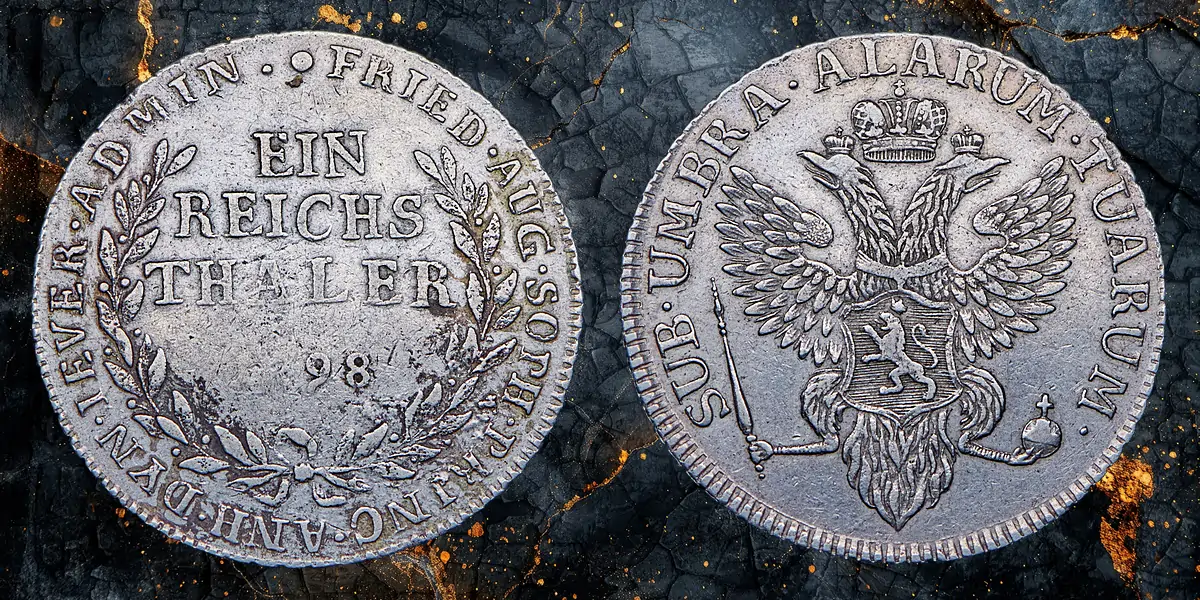
The obverse shows a crowned double-headed imperial eagle with the arms of Jever on its breast. Around it appears the Latin motto:
SUB UMBRA ALARUM TUARUM
The phrase means “Under the shadow of your wings.” In this setting, the motto spoke to divine protection. It also fit the political message. Jever stood under the protection of an absent ruler.
The reverse gives the value and date within branches. The thaler reads EIN REICHS THALER. The surrounding legend names Friederike Auguste Sophie as Princess of Anhalt and administrator of Jever: FRIED. AUG. SOPH. PRINC. ANH. DYN. IEVER. ADMIN.
The half Reichsthaler followed the same political language. Numista lists it as a 1798 silver half Reichsthaler of 11.14 grams and .750 fine silver. Künker identifies the half Reichsthaler as struck at Silberhütte and cites Mann 426 and Merzdorf 133.
A Corrected Mintage Picture
Older summaries sometimes describe the Jever thaler as the smaller issue. The accessible catalog and auction records reviewed for this article do not support that claim.
Numista lists the 1798 Reichsthaler mintage as 1,000 pieces, citing Mann 425. Künker lists the 1798 half Reichsthaler mintage as 1,000 pieces, citing Mann 426 and Merzdorf 133.
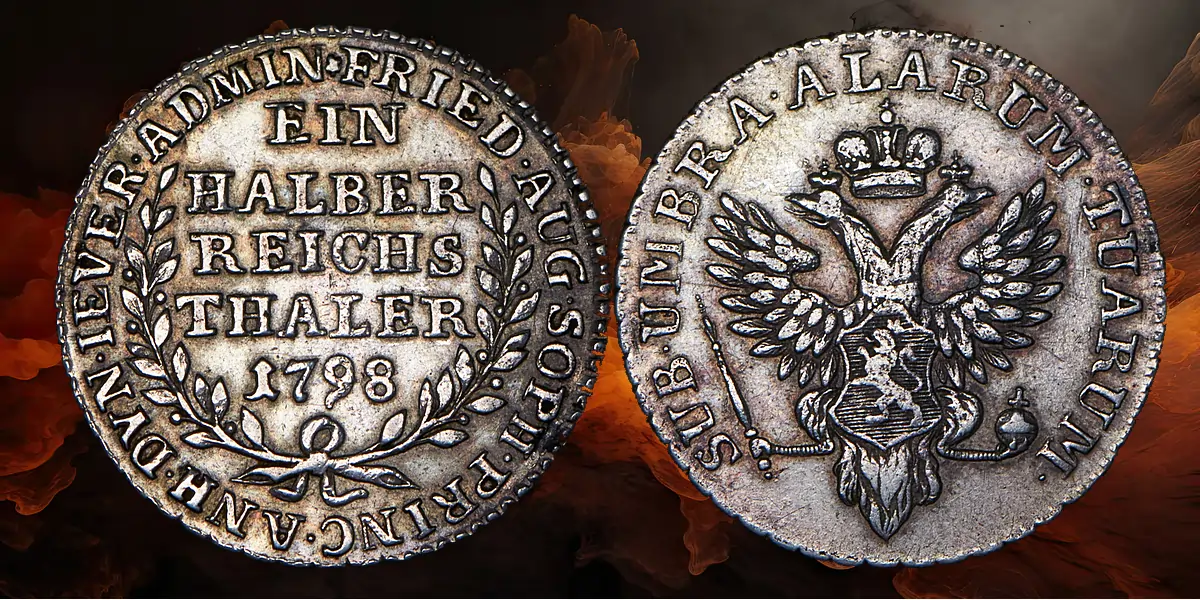
Even so, both coins remain rare. A mintage of 1,000 pieces gives little room for survival. Moreover, the issue lasted only one year. It also belonged to a narrow political moment that ended soon after.
Why Collectors Still Watch This Coin
The Jever thaler attracts collectors for three reasons.
First, it belongs to German States numismatics. Second, it connects directly to Romanov history. Third, it carries the drama of Paul I, Malta, and the collapse of old European alliances.
Recent public auction records show continued interest. Numista records a Heritage sale of a 1798 Jever Reichsthaler graded NGC MS61 for $2,040 in April 2019. It also records a Katz sale of an AU example for €1,001 in March 2026. For the half Reichsthaler, Numista records a Katz sale of an XF example for €720 in June 2024. These results do not set a fixed value. However, they confirm that collectors still compete for the type when attractive examples appear.
The End of Russian Jever
The Russian-Jever connection did not last long.
Napoleonic Europe soon redrew the map. In 1807, Jever went to the Kingdom of Holland. In 1810, France took direct control. Then, in 1813, Russia regained possession after Napoleon’s retreat. Finally, in 1818, Russia ceded Jever to Oldenburg.
That transfer ended the Russian chapter. Yet the 1798 coinage preserved it.
A Coin That Captured an Impossible Moment
The Jever thaler should not surprise collectors because it is impossible. It should surprise them because it is perfectly legal.
A German lordship passed through a female inheritance line. A Russian empress became its ruler. A German princess governed it in her name. Then a Russian emperor inherited the title while Europe fought over Malta, France, Britain, and the future of the old order.
The coin brings all of that together. It is German in denomination, local in administration and Russian in dynastic meaning. Above all, it shows how a small North Sea lordship and a vast empire briefly shared one political shadow.






Unbelievable! A rare display of how political marriage makes stranger things happen. Indeed, it’s a very unique coin from the land on can hardly find on a map these days. Great story showing how sometimes two unmergeable cultures blend into one another in the piece of metal carried over through the centuries.
Interesting little tidbit of history!
That’s an interesting historical story!