

The $1.25 Coin: How the U.S. Mint Created Its Most Famous Modern Mule Error
In May 2000, Arkansas collector Frank Wallis opened a roll of new Sacagawea dollars and found the impossible.
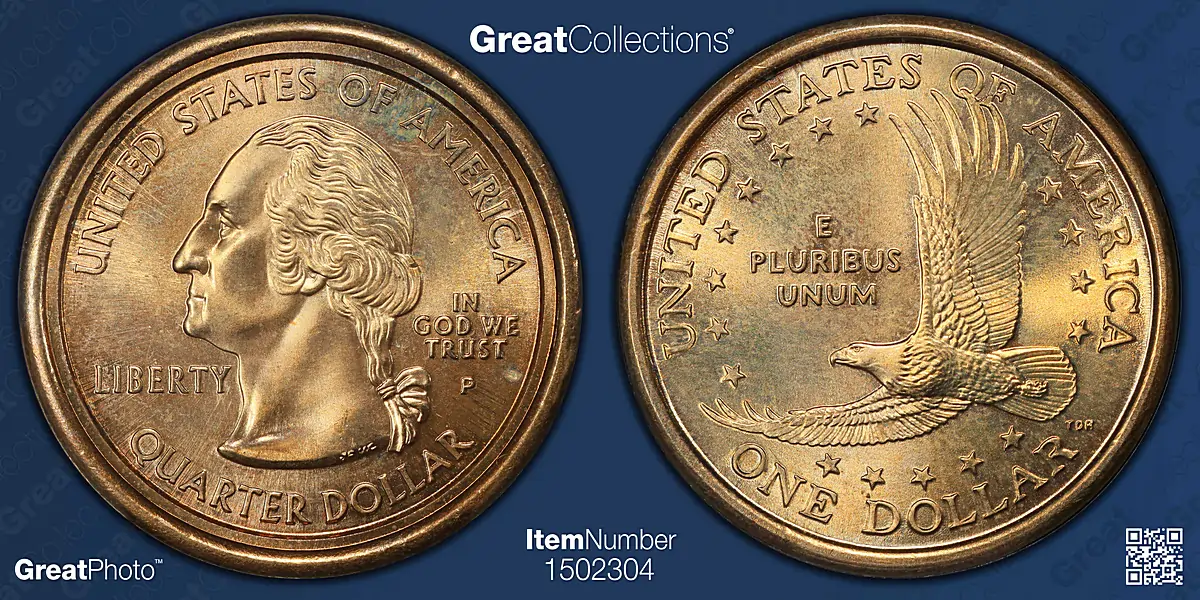
One side showed George Washington and the denomination QUARTER DOLLAR. The other displayed the soaring eagle reverse of the new Sacagawea dollar and the denomination ONE DOLLAR.
The Philadelphia Mint had paired dies from two different coin programs. It then struck the mismatched designs on a golden-colored Sacagawea dollar planchet.
The result became the famous 2000-P Sacagawea Dollar–Washington Quarter mule. Collectors quickly called it the “$1.25 coin.” More importantly, the hobby recognized it as one of the greatest modern U.S. Mint errors ever released.
PCGS now ranks the coin among its “100 Greatest U.S. Modern Coins.” Meanwhile, 100 Greatest U.S. Error Coins placed the mule at No. 1 and featured it on the book’s cover.
A Discovery Hidden in a Bank Roll
Wallis found the discovery coin in Mountain Home, Arkansas, inside a 25-coin roll obtained from First National Bank & Trust. The roll contained circulation-quality Sacagawea dollars from the new coin’s inaugural year.
At first glance, the coin looked like a golden Washington quarter. However, the reverse revealed Thomas D. Rogers Sr.’s soaring eagle design from the Sacagawea dollar.
Wallis had found a mule.
Numismatists use that term for a coin struck from dies that the Mint never intended to pair. In this case, Mint employees combined a State quarter obverse die with a Sacagawea dollar reverse die. They then struck the pairing on a manganese-brass-clad dollar planchet.
The coin carries two denominations. Yet neither side shows a date. The quarter obverse places its date on the state-specific reverse, while the original Sacagawea dollar places its date on the obverse.
Nevertheless, the Philadelphia Mint could only have produced these coins in 2000. The quarter obverse carries a P mintmark, and the Sacagawea dollar entered production that year.
The U.S. Mint formally confirmed the error on June 19, 2000. Soon afterward, the discovery attracted national media attention and introduced millions of Americans to mule errors.
How Could the Philadelphia Mint Make This Mistake?
The Mint has never released a complete public account of every step that produced the error. Therefore, collectors should treat the leading explanation as a reconstruction based on Mint practices and expert research.
According to error specialist Fred Weinberg, Mint employees kept new dies beneath protective plastic covers. Those covers concealed the designs until workers removed them.
That practice created an opportunity for confusion.
A Sacagawea dollar measures about 26.5 millimeters in diameter. A Washington quarter measures about 24.3 millimeters. Although the dies differ in size, a covered quarter die could resemble a covered dollar die during a hurried visual inspection.
A press operator reportedly requested a Sacagawea dollar obverse die. Instead, the Die Room supplied a Washington quarter obverse die. The operator installed it opposite a Sacagawea dollar reverse die in a press assigned to dollar production.
The press then began striking $1.25 mules.
Experts have also pointed to staffing changes as another possible factor. Weinberg reported that an Occupational Safety and Health Administration-related policy required certain Mint employees to rotate among jobs during the late 1990s. As a result, less-experienced workers may have entered the Die Room during the spring of 2000.
That rotation could have increased the chance of a die-selection mistake. However, no public Mint report has established a single employee action as the definitive cause.
Three Die Pairs Reveal a Larger Production Run
The error did not result from one brief press malfunction.
Researchers have identified three separate die pairings. That evidence suggests Mint personnel installed mismatched dies more than once, or replaced dies while the erroneous production setup continued.
The three pairings also provide collectors with useful diagnostics.
Die Pair 1
Die Pair 1 shows strong radial striations around Washington’s portrait. Stress from the differently sized dies likely created the sunburst effect during striking.
In addition, the Sacagawea reverse carries a die crack at the letter F in OF within UNITED STATES OF AMERICA. The crack extends toward the eagle’s wing.
Most known examples belong to this pairing, including the discovery coin and several of the finest-certified pieces.
Die Pair 2
Die Pair 2 lacks the dramatic obverse striations associated with Die Pair 1. However, its reverse shows three important cracks.
One projects from the star above the E in ONE. Another appears near the star above the D in DOLLAR. A third curves across the eagle’s wing above the same area.
Die Pair 3
Die Pair 3 shows only faint radial lines on the obverse. It also displays a small die gouge in front of Washington’s lips.
The reverse appears clean and lacks the cracks found on the first two pairings.
These diagnostics matter because they help experts separate individual coins, reconstruct the striking sequence, and confirm that the Mint produced the error with three different die marriages.
The Mint May Have Struck Hundreds of Thousands
Early reports suggested that the Mint struck thousands of the errors. Later research revealed a much larger possible production total.
U.S. Mint officials reportedly concluded that the Philadelphia facility may have struck as many as 350,000 Sacagawea–quarter mules before employees discovered the mistake.
Fortunately for the Mint, most had not entered public circulation.
Treasury personnel located much of the suspect production at a Philadelphia-area armored carrier that handled coins for the Federal Reserve. The Mint recovered the coins and destroyed them for metal reclamation.
However, a small number had already escaped through normal distribution channels. Collectors found several examples in fresh bank rolls or circulation.
Today, experts recognize 20 confirmed examples. Therefore, the survival rate remains microscopic when compared with the possible original production.
The Mint Workers Who Smuggled Out Five Mules
Not every surviving mule reached the public by accident.
Federal prosecutors charged two Philadelphia Mint employees, James Watkins and Raymond Jackson, with stealing five examples and selling them outside the Mint.
Authorities accused Watkins of taking four coins. He reportedly sold them for about $9,200. Jackson took one coin and sold it for $5,000. Later transactions generated a combined total of $137,395 for the five pieces.
The government charged both men with converting government property. Prosecutors also filed witness-tampering charges.
Both men eventually received probation, home confinement, fines, and other financial penalties. The case demonstrated how dramatically the private-market value had exceeded the coins’ nominal value.
Assistant U.S. Attorney Anita Eve later explained that the Mint sought to punish the defendants and discourage future thefts. However, the government did not attempt to reclaim the privately held mule errors from collectors.
That decision proved important. It allowed the coins to trade openly, unlike controversial pieces such as the 1974-D aluminum cent or most 1933 Saint-Gaudens double eagles.
One Collector Cornered Much of the Market
Few modern rarities have attracted a buyer as determined as New Mexico collector Tommy Bolack.
Bolack began acquiring Sacagawea–quarter mules soon after the discovery. Over the following two decades, he bought examples at auctions and through private transactions.
At one point, he owned 16 of the 19 publicly known specimens. However, the emergence of a previously undisclosed 20th coin changed the count.
In January 2024, Bolack purchased that piece through GreatCollections. The acquisition gave him 15 of the 20 confirmed examples, according to reporting published after the sale.
Bolack has openly acknowledged the power of his position. With most known examples under one owner, public offerings remain exceptionally rare. Therefore, even wealthy collectors may wait years for another buying opportunity.
Major Sacagawea–Quarter Mule Auction Sales
The discovery coin reached auction only months after Wallis found it.
Bowers and Merena offered the PCGS MS66 Die Pair 1 specimen during the August 2000 American Numismatic Association convention in Philadelphia. It realized $29,900.
At the time, the price shocked many collectors. However, later results made that figure look modest.
Several important public sales followed:
- August 2000: NGC MS66, Die Pair 2, Heritage Auctions, $31,050.
- June 2001: NGC MS67, Die Pair 2, Heritage Auctions, $56,350. The coin had previously sold through eBay for $41,395.
- August 2012: NGC MS67, Die Pair 1, Stack’s Bowers, $158,625.
- January 2013: PCGS MS66, Die Pair 1, Heritage Auctions, $88,125.
- March 2018: NGC MS67, Die Pair 1, Stack’s Bowers, $192,000.
- January 2019: NGC MS67, Die Pair 1, Heritage Auctions, $102,000.
- May 2022: PCGS MS65+, Heritage Auctions, $144,000.
- January 2024: PCGS MS66, Die Pair 1, GreatCollections, $194,062.50.
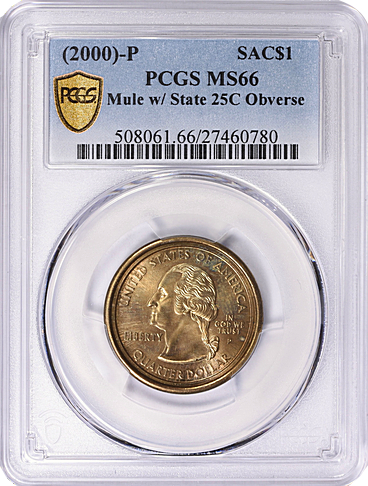
The 2024 GreatCollections result set a new public-auction record for the type. The hammer reached $172,500. The buyer’s premium raised the final price to $194,062.50.
Private transactions may have reached even higher levels. Stack’s Bowers reported that some examples reportedly traded privately near $250,000 during 2007 and 2008. However, private sales often lack the documentation that accompanies public auctions.
What Is a Sacagawea / Quarter Mule Worth Today?
Earlier market estimates placed a typical example near $100,000 to $150,000. However, the 2024 record shows that strong specimens can approach or exceed $200,000.
Grade matters. Die pairing also matters. Provenance adds further appeal. Most importantly, availability controls the market.
With 15 of the 20 confirmed examples concentrated in one collection, buyers cannot rely on regular auction appearances. A newly discovered coin could attract intense competition, particularly if it grades MS66 or MS67.
Therefore, a premium-quality example could plausibly bring between $150,000 and $225,000 under current market conditions. A fresh discovery with an extraordinary story might command even more.
Still, every estimate depends on the bidders present when the coin reaches the block.
Could Another Example Still Be Hiding?
The possibility remains.
Mint officials recovered and destroyed most of the production. Collectors and dealers also searched countless rolls after the discovery received national attention. Those facts make another find unlikely.
Yet the 20th specimen remained publicly unknown for years. Its former owner reportedly acquired it through a private transaction roughly eight or nine years before the 2024 auction.
Therefore, another example could sit inside an old collection, a safe-deposit box, or an unopened group of early Sacagawea dollar rolls.
The odds remain extremely low. Nevertheless, roll hunters need only one coin to rewrite the census.
The Sacagawea Dollar Produced Another Famous Mule
The 2000-P Washington quarter pairing does not stand alone.
In 2014, the Denver Mint created another cross-denomination mule. This time, the Mint paired a Native American/Sacagawea dollar obverse with a Presidential dollar reverse.
Experts know only one example of that mule. PCGS recognizes it as one of the major modern U.S. mule errors. Heritage Auctions sold the unique coin during its April 2021 Platinum Night event for a $84,000 with buyer’s premium.
However, the 2000-P Sacagawea–quarter mule still holds a special place in American numismatics.
It arrived during the launch of a major new dollar program. It escaped through both legitimate and criminal channels. It triggered a federal investigation. It also created a modern rarity that collectors could understand at a glance.
One side says quarter. The other says dollar.
That simple contradiction turned an ordinary bank-roll search into one of the greatest discoveries in modern U.S. coin collecting.
What a fascinating story! I have often wondered whether some of the more dramatic mint errors might have been intentional rather than accidental. While this case doesn’t necessarily suggest that the errors themselves were deliberate, the involvement of mint employees in getting the coins into circulation certainly adds an interesting dimension. I’ve long been curious about the circumstances surrounding unusual mint errors, and I really appreciate articles like this that explore the history behind them. Thank you for another excellent article!