

The Hidden Die Curve Behind Philadelphia Mint Error Coins
Collectors have long believed that U.S. coin errors and varieties appear more often on Philadelphia Mint coins than on Denver Mint coins.
They are correct.

A 2011–2026 Frequency Survey of error and variety listings shows a dramatic split.
Philadelphia Mint coins account for:
- 85% of feeder mechanism die damage in Pete Apple’s census [1].
- 95% of listed die clashes [2]
- 96.4% of doubled dies in Wexler’s listings [3]
- 92.4% of listings in Cuds on Coins [4].
That pattern demands a serious explanation. It also challenges a common assumption.
The answer may not lie in simple quality control. Instead, the strongest clue may sit inside the geometry of the die itself.
The Philadelphia Mint Pattern Is Too Large to Ignore
The numbers show more than a small imbalance. They show a major skew toward Philadelphia.
Such a lopsided distribution suggests that Denver and Philadelphia differ in their coinage operations. Collectors often point first to quality control. That explanation sounds logical. However, the available evidence does not support it as the main cause.
Both mints test raw coinage materials against specifications. A Treasury audit found that each mint used a different set of incomplete procedures [5]. Still, those differences do not explain a skew this large.
Philadelphia also uses riddlers at more stages of the minting process than Denver. A riddler checks coin size by passing coins through screens. Coins that fall through the screen holes measure too small, so the Mint recycles them [6]. Even so, riddlers do not target most of the errors and varieties covered in the Frequency Survey.
Therefore, quality control alone does not explain the Philadelphia advantage.
What Quality Control Actually Targets
The Mint does use quality control systems throughout its production lines. However, those systems focus mostly on major errors, not the minor die varieties that collectors often study.
For example, the Mint uses a Press Die Vision System. This system works with the coin press and prevents striking until it inspects and approves the installed dies. It uses computer-controlled servo motors, infrared lights, special mirrors, and a camera. If the dies do not form the correct pair, the system locks the press and helps prevent mule coins [7].
A mule occurs when two dies strike a coin even though the Mint never intended those dies to work together [7]. Other major targets include major rotated dies, piece out engraving, and cracks [8].
However, the Frequency Survey focuses on feeder mechanism die damage, die clashes, doubled dies, and cuds. Most of those issues can develop at levels the Mint may still consider acceptable for circulating coinage.
The Mint Accepts Minor Defects
The Mint does not require circulating coins to look perfect. Instead, the coins must stay within dimensional tolerances. Any observed defects must also remain limited in size [9].
That policy matters.
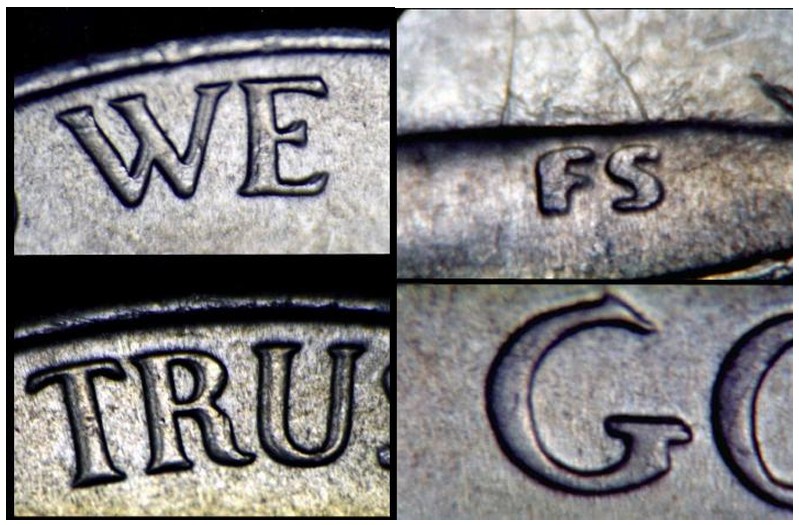
Die life tests show that the Mint does not retire a die simply because it develops a small piece out. It may even continue using a die with more than one such defect . A “piece out” occurs when a small part of the die breaks away, often because of local fatigue failure, and changes the struck image [10]. Coins that show these defects can still qualify as acceptable circulating coins [11].
The Mint made the same point in a 2005 letter to Ken Potter about a 2004 Peace Medal nickel. The Mint stated that subtle imperfections on circulating-quality coins, including the doubled die image found on that nickel, come from the coin-making process and do not affect commercial use [12].
So the evidence points away from quality control as the main reason for the Philadelphia skew.
The Backstory: A Hidden Curve Changed U.S. Coinage
The stronger explanation starts in 1836.
At that time, the Mint struggled with flat dies. Those dies cracked, formed cuds, and required excessive striking pressure. The Mint learned that a convex die face could extend die life and reduce striking pressure.
That discovery still matters today.

The curved face of a die is called the crown. The crown describes the curved die surface before the artwork goes onto it [13]. The crown has the shape of a convex spherical cap. The Mint defines that shape by its radius. In February 1909, cent dies used a 25-inch radius [14].
A simple image helps. Imagine placing a cent on a large red ball. If the ball has the right radius, the curve beneath the cent matches the curve of the die face [15].
That tiny curve controls how metal flows during striking. It also influences die life, design fill, relief, pressure, and wear.
Radius Explains the Shape
The Mint expresses die-face curvature as the radius of the sphere that underlies the die shape. Roger W. Burdette copied a “Die Radius Book” from Mint Archives dated 1904, which shows how seriously the Mint tracked die radius [16].
That record also shows that the Mint applied different radii to different denominations. In some cases, the obverse and reverse radii differed by almost a factor of two.
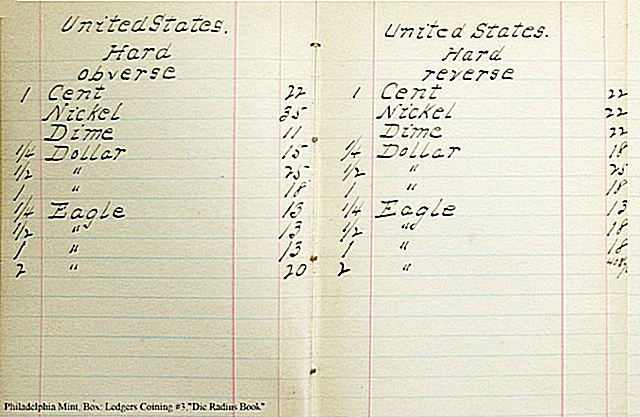
The likely reason is practical. The Mint adjusted die curvature to fit the design, the relief, and the striking requirements of each coin. A higher-relief design needs stronger metal flow. Therefore, it may require a steeper crown. That crown can also protect the design during circulation.
In short, crown height and design relief move together.
Coin Modernization Put Crown Height Back in Focus
The Coin Modernization, Oversight, and Continuity Act of 2010 pushed the Mint to study ways to reduce coin production costs [17]. As a result, crown height received renewed attention.
In 2014, the Mint studied alternative coinage metals and tested three crown heights: full, half, and flat. That choice shows how important crown height is to coinability [18].
In 2018, the Mint experimented with matching die curvatures and planchet profiles [19]. Then, in 2022, the Mint tested a change from spherical die curvature to exponential die curvature. The goal was to extend die life. If the tests succeeded, the Mint planned to begin implementation with the nickel in 2024 and then add other denominations when appropriate [20].
These studies confirm one point. Crown height is not a minor detail. It is a major production variable.
Denver and Philadelphia Do Not Match Perfectly
The most important evidence comes from a 2012 Mint report.
The report states that all coin designs are modeled and digitized or produced digitally. Philadelphia prepares master dies on digitally controlled milling machines. Philadelphia then distributes master dies to Denver. Denver uses those masters to produce its own working hubs and dies [21].
That process sounds uniform. However, the report adds a crucial detail.
Even though Denver and Philadelphia use the same masters, the crown heights of dies and the design heights of relief produced at the two facilities differ. The report also states that those differences have a measurable effect on coin fill [21].
That statement changes the story.
If die crown height and relief height differ between the two mints, then collectors should not expect identical error and variety rates.
Lower Crown Height May Mean More Errors and Varieties
The 2012 report does not state which mint has higher crowns [21]. However, several clues point in one direction.
The lessons learned in 1836, visual strike comparisons, and the skewed modern listings suggest that Denver dies likely have higher crown and relief. By contrast, Philadelphia dies likely have lower, flatter crown and lower relief.
This remains an evidence-based working theory. Still, it explains the data better than quality control.
A flatter crown exposes more die surface to feeder mechanism damage and die clashes. Therefore, Philadelphia coins may show more examples of both categories [1][2].
A flatter crown also engages the planchet more fully across the entire surface during striking. That action creates a sudden and uniform compressive shock. By contrast, a more convex die face loads the planchet in a more gradual center-to-rim sequence. The sharper pressure event may encourage cracks and chips.
Finally, a shallower working hub may resist misalignment less during hubbing. That geometry may increase the chance of hub doubling. This point fits the heavy Philadelphia share in Wexler’s doubled die listings [3].
Why Cuds Also Fit the Theory
Cuds form when a die break reaches the rim and transfers a raised, blank-looking area onto the coin. Since Cuds on Coins lists Philadelphia pieces at a much higher rate, the pattern also fits the crown-height theory [4].
A lower crown and lower relief may place different stress on the die. It may also expose more die face to damaging contact. Over time, that combination can help explain why Philadelphia listings dominate.
Again, other causes still matter. But the crown-height difference offers a broad explanation that applies across several error and variety classes.
Other Factors Can Still Contribute
Several production factors can create or encourage the errors and varieties in the Frequency Survey.
Improper die annealing can play a role. So can die preparation. Variability in striking pressure may also matter. In addition, wear or malfunction in press and hubbing mechanisms can contribute to these results.
However, those factors do not explain why Philadelphia dominates so many categories at once. Flatter crowns and lower design relief heights offer a stronger unifying explanation.
The Likely Culprit
The evidence points to die geometry.
Philadelphia and Denver use the same master dies. Yet the Mint has reported that the two facilities produce dies with different crown heights and different design relief heights. The Mint has also reported that those differences affect coin fill [21].
That fact gives collectors a better explanation for the Philadelphia skew.
Philadelphia Mint coins likely show more feeder mechanism die damage, die clashes, doubled dies, and cuds because flatter crowns and lower relief heights create conditions that favor those varieties [1][2][3][4].
Conclusion: The Smallest Curve May Leave the Biggest Clue
Collectors often search the mintmark first. In this case, they should also think about the die face behind it.
The Philadelphia Mint does not simply “make more mistakes.” Instead, its production geometry may create more opportunities for certain minor errors and varieties to appear.
Quality control systems exist at both mints. They target raw materials, sizing, and major errors [5][6][7][8]. However, the Mint also accepts limited minor defects on circulating coinage [9][10][11][12].
Therefore, the most compelling explanation sits deeper in the process.
A flatter crown can change how the die meets the planchet. It can change pressure, metal flow, die stress, and hub alignment. Those changes may explain why Philadelphia Mint errors dominate modern listings.
In modern U.S. coinage, one hidden curve may tell the whole story.
Source Citations
- [1] Feeder Mechanism Die Damage Census maintained by Pete Apple.
- [2] MADdieClashes.com.
- [3] Wexler’s Doubled Die Listings, doubleddie.com/228401.html.
- [4] Cuds-on-Coins.com.
- [5] Audit Report, OIG-20-042, Manufacturing and Revenue, Office of Inspector General, Department of the Treasury, August 18, 2020.
- [6] James Wiles, The Modern Minting Process and U.S. Minting Errors and Varieties, ANA correspondence course, 1996, p. 6; 2012 Biennial Report to Congress, United StatesMint, p. 292.
- [7] United States Mint, 2013 Annual Report, p. 9.
- [8] 2012 Biennial Report to Congress, United States Mint, pp. 140–141.
- [9] 2014 Technical Report, United States Mint, pp. 107–108.
- [10] 2012 Biennial Report, footnote 140, p. 305.
- [11] 2014 Technical Report, p. 109.
- [12] 2005 Mint letter to Ken Potter; Pete Apple, “Quality Control at the US Mint: An Overview.”
- [13] Alternative Metals Study, Phase II, Coin Industry Stakeholder Feedback, 2014 Biennial Report, p. 107.
- [14] U.S. Mint, NARA-CP, Entry 1A 3281; February 13, 1909 letter to Brenner from Barber; Roger W. Burdette, Renaissance of American Coinage 1909–1915, p. 37.
- [15] Pete Apple, “A Review of Die Curvature at the US Mint.”
- [16] Philadelphia Mint Box, Ledgers Coining #3, “Die Radius Book”; email from Roger Burdette, April 26, 2023.
- [17] Public Law 111-302, Coin Modernization, Oversight, and Continuity Act of 2010.
- [18] 2014 Technical Report, p. 109.
- [19] 2018 Biennial Report to Congress, United States Mint, April 2019, p. 7.
- [20] 2022 Biennial Report to Congress, United States Mint, p. 13.
- [21] Alternative Metals Study, Contract Number TM-HQ-11-C-0049, Final Report, August 31, 2012, submitted to the United States Mint, p. 301.
Copyright 2026 By Pete Apple


Very interesting article. I didn’t know that the dies had a crown dimension to them.
I don’t understand why the differences in production were allowed through history. At some point they should have been standardized.
Good to Know, very helpful, thank u
Good read and interesting information!
Very interesting and elucidating article
Interesting article, though I’m still a bit confused.
A study of Hertzian Contact Theory leads me to suspect that:
The article states a faulty syllogism that since the mint experienced die breakage and shorter die life using flat dies and in 1836 converted to spherical die faces thus extending die life, therefore Philadelphia, since they experience more die events, must have flatter dies than Denver.
I hope to have more data to work with to resolve that question when I complete my analysis from additional scans I have scheduled for the end of the month.