


By CoinWeek Notes …..
The 1895 Barber Quarter represents a readily available issue within the Barber quarter series. However, availability alone does not define collector interest. Instead, condition, eye appeal, and registry demand shape the market for this date. As a result, the 1895 Philadelphia issue offers an instructive case study for both new and advanced collectors.
The Barber Quarter Series: Historical Context
The Barber quarter debuted in 1892. The U.S. Mint introduced the design following public dissatisfaction with the long-running Seated Liberty series. Congress authorized the redesign after the mandatory 25-year period expired.
Chief Engraver Charles E. Barber created the new motifs for the dime, quarter, and half dollar. Each denomination shared the same obverse portrait of Liberty. However, the reverse designs differed by denomination.
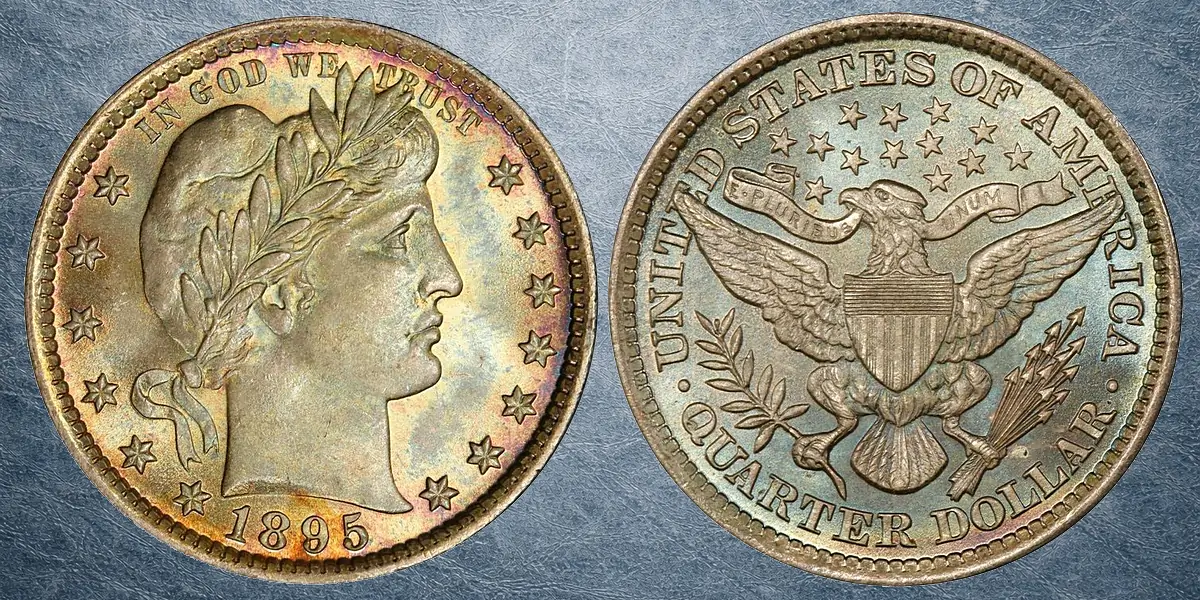
For the quarter dollar, Barber paired Liberty’s classical profile with a heraldic eagle reverse. This approach reflected the Mint’s preference for conservative, medal-style designs during the late 19th century. As a result, the Barber quarter emphasized uniformity and durability over artistic experimentation.
The Philadelphia Mint struck Barber quarters continuously from 1892 through 1916. During this period, the coins circulated heavily. Consequently, fully original Mint State survivors remain far scarcer than raw mintage figures suggest.
Mintage and Production
The Philadelphia Mint struck 4,440,000 Barber Quarters in 1895. By modern standards, that figure appears small. However, at the time, it represented a routine production run for a circulating silver coin.
The Mint produced the coins using standard business-strike methods. Only 880 Proof quarters dated 1895 came from the Philadelphia Mint, which further defines the issue as a circulation-focused release.
Survival Rates and Circulated Examples

Today, the 1895 Barber Quarter survives in large numbers. Hundreds of examples exist in Mint State. In addition, circulated coins remain plentiful.
Specifically, examples graded below Very Fine appear frequently in the market. This pattern reflects the coin’s extended circulation life and the economic conditions of the late 19th and early 20th centuries.
Because of this availability, collectors often acquire low-grade examples as type coins or bullion-adjacent holdings.
Pricing in Circulated Grades
In grades below Very Fine, the market price of an 1895 Barber Quarter closely tracks the prevailing silver spot price. Typically, buyers pay only a small premium above melt value.
That premium reflects the coin’s recognized numismatic status rather than scarcity. Therefore, price movement in this grade range often follows changes in the silver market rather than shifts in collector demand.
Mint State Availability and Pricing
Mint State examples of the 1895 Barber Quarter appear regularly at auction and through established dealers.
Coins graded below MS63 frequently trade for $500 or less, depending on eye appeal and overall market conditions. These pieces often display average luster and typical strike quality for the series.
However, collectors should note that surface preservation varies widely within this grade range.
Registry Demand and High-Grade Coins
Registry Set collectors drive demand at the upper end of the condition spectrum. These collectors typically pursue examples graded MS66 or higher.
At these levels, buyers focus closely on luster, strike sharpness, and originality. Coins with strong cartwheel luster and clean fields command meaningful premiums.
In addition, collectors often evaluate toning with equal scrutiny.
Toning and Eye Appeal
Attractively toned 1895 Barber Quarters exist. Several examples photographed by NGC, PCGS, and major auction firms exhibit vibrant iridescent colors on one or both sides.
These coins often display natural toning patterns that enhance visual appeal without obscuring design details. As a result, they tend to realize strong prices relative to similarly graded untoned examples.
Conversely, not all toning enhances value. Some coins with numerically high grades show dark, uneven, or visually distracting toning. In those cases, collectors may hesitate, especially given the high prices typically associated with top-population pieces.
Therefore, eye appeal remains a decisive factor, even when certification grades suggest quality.
Final Thoughts
The 1895 Barber Quarter occupies a stable position within the series. It offers accessibility in circulated grades and meaningful selectivity at the Mint State level. While the issue does not qualify as rare, condition and visual quality strongly influence market outcomes.
For collectors, the date rewards careful evaluation rather than assumption. As always, certification, originality, and eye appeal should guide purchasing decisions.
* * *
Market Data and Noteworthy Specimens
Top Population: PCGS MS67+ (3, 11/2024), NGC MS67 (5, 11/2024), and CAC MS67 (4:0 stickered:graded, 11/2024).
- PCGS MS67+ CAC #38855604: “D. Brent Pogue Collection, Part VII,” Stack’s Bowers, March 20, 2020, Lot 7078 – $19,200. Custom Pogue insert. Attractively toned.
- PCGS MS67+ 81285709: As PCGS MS67 #6071171. Heritage Auctions, June 23, 2014, Lot 30420 – $8,812.50. Since this sale, this coin has been upgraded by 1/2 point. Imaged above.
- NGC MS67 #6329598-013: As NGC MS67 #652429-001. Heritage Auctions, September 18, 2020, Lot 3129 – $4,800. As NGC MS67 #3818282-001. Stack’s Bowers, August 25, 2022, Lot 4166 – $5,040. As NGC MS67 #6329598-013. Heritage Auctions, December 15, 2023, Lot 3285 – $4,320. Stack’s Bowers, April 3, 2024, Lot 5351 – $4,200. Brilliant. In RARCOA green holder. Copper spot to the right of Liberty’s chin. Planchet void on the reverse between the eagle’s wing and arrow tips. Scattered toning spots.
- PCGS MS67 #35793869: As PCGS MS67 #15493869. Heritage Auctions, August 14, 2006, Lot 5189 – $11,500; Heritage Auctions, January 6, 2010, Lot 920 – $6,612.50. As PCGS MS67 CAC #35793869. “R.S.D. Collection”; Legend Rare Coin Auctions, April 28, 2022, Lot 131 – $7,931.25. R.S.D. Collection on the insert; Legend Rare Coin Auctions, September 8, 2022, Lot 103 – $8,812.50. Rust-colored toning on the obverse. Foam-colored toning on the reverse.
- PCGS MS67 #38995052: Heritage Auctions, April 23, 2020, Lot 3420 – $6,300.
- PCGS MS67 #35201358: Heritage Auctions, June 14, 2018, Lot 3918 – $3,840. Dark orange and russet toning on the obverse. Lightly toned reverse.
* * *
Coin Specifications
- Country: United States of America
- Year Of Issue: 1895
- Denomination: Quarter Dollar (25 Cents USD)
- Mint Mark: None (Philadelphia)
- Mintage: 4,440,000
- Alloy: 90% Silver, 10% copper
- Weight: 6.30 g
- Diameter: 24.30 mm
- Edge: Reeded
- OBV Designer: Charles E. Barber
- REV Designer: Charles E. Barber
- Quality: Business Strike
* * *




Great article I learned alot. thanks
So many circulated Barber quarters going to the melting pot. Glad to know the writer has a more upbeat evaluation of supply of lower grade quarters. Great!