


Why the 1922 High Relief Peace Dollar Became a Six-Figure Mint Experiment
The 1922 High Relief Peace Dollar tells a more complicated story than collectors once believed.
For decades, numismatic accounts treated the issue mainly as a failed attempt to continue the dramatic relief of the 1921 Peace Dollar. The United States Mint tried high relief, shattered dies, abandoned the concept, and moved on to the familiar low-relief coin.
Modern research has revealed a much richer story.
During a frantic series of experiments in January 1922, the Philadelphia Mint tested several versions of Anthony de Francisci’s design. George T. Morgan altered hubs, changed details, lowered relief, and paired different obverse and reverse designs. The resulting coins now fall into several distinct experimental varieties.
At the center of that story sits the Judd-2019 1922 High Relief Matte Proof Peace Dollar. It ranks among the great rarities of 20th-century American numismatics. Moreover, recent auctions have again placed the entire 1922 experimental program in the spotlight.
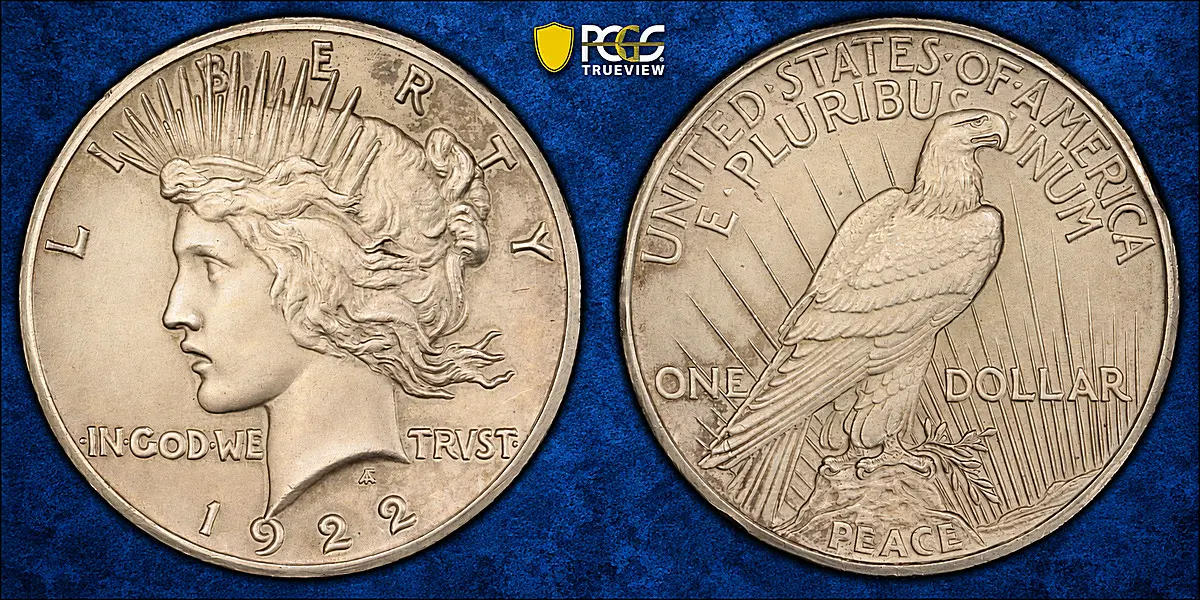
In April 2025, Heritage sold a PCGS PR63 CAC Judd-2019 for $192,000. Then, in 2026, two related Judd-2020 Modified High Relief pieces brought $252,000 at Stack’s Bowers and $213,500 at Heritage. Those later coins are not Judd-2019 Matte Proofs. However, they provide important new evidence of how aggressively the Mint searched for a workable Peace Dollar in 1922.
The Pittman Act Forced the Silver Dollar Back Into Production
The Peace Dollar story begins with the Pittman Act of 1918.
Congress authorized the Treasury to convert as many as 350 million standard silver dollars into bullion. Ultimately, the government broke up 270,232,722 silver dollars. The law also required the Treasury to buy domestic silver and replace the dollars that it had destroyed.
Between May 1920 and June 1923, the government purchased replacement silver from American mines at a fixed price of $1 per ounce. Therefore, the Mint had to resume large-scale silver dollar production.
At first, the Mint returned to George T. Morgan’s long-running silver dollar design in 1921.
Meanwhile, numismatist Farran Zerbe became one of the most visible advocates for a new dollar commemorating the return of peace after World War I. He promoted the concept at the 1920 American Numismatic Association convention.
The timing proved ideal. The government needed silver dollars, while collectors and public officials wanted a coin that symbolized a new era.
The Peace Dollar emerged from those two forces.
Anthony de Francisci Wins the Peace Dollar Competition

On December 13, 1921, the Commission of Fine Arts met at sculptor James Earle Fraser’s New York studio to evaluate designs for the new silver dollar.
The commission selected the work of Anthony de Francisci, a 34-year-old sculptor. For Liberty, de Francisci drew inspiration from his wife, Teresa. His reverse featured an American bald eagle perched above rays of a rising sun.
However, the design soon created controversy.
The original reverse included a broken sword. Public criticism erupted after newspapers reported the feature. As a result, Chief Engraver George T. Morgan removed the sword directly from the reverse hub rather than starting over.
Morgan also refined other elements of the design. Those changes became especially important when the Mint began planning the 1922 coinage.
The Beautiful 1921 Peace Dollar Had a Serious Problem
The first Peace Dollars appeared during the closing days of December 1921.
The Philadelphia Mint produced 1,006,473 1921 Peace Dollars in high relief. Published accounts differ slightly on the precise first production date, but the entire regular-issue run took place during the final days of December.
Visually, the coin was striking. Mechanically, it created problems.
The high points required tremendous pressure. Even then, a single blow from the dies often failed to fill Liberty’s central hair detail and the eagle completely. Die life also fell sharply. In addition, uneven metal flow could create raised rims that interfered with proper stacking.
The Mint could not simply continue making millions of dollars this way.
Yet officials did not abandon high relief immediately.
Instead, they spent January 1922 trying to save it.
The Key to Understanding 1922: There Was More Than One High Relief Experiment
This distinction matters.
Older accounts sometimes grouped almost every experimental 1922 Peace Dollar under the broad heading “High Relief.” Current research and pattern cataloging separate several different stages of development.
That newer framework changes how collectors should understand the Judd-2019 Matte Proof.
Judd-2018 and the 35,401-Coin High Relief Trial
Researcher R.W. Julian located Mint records in 1974 documenting a trial production of 35,401 High Relief 1922 Peace Dollars during January 1922.
The Mint used four obverse dies and nine reverse dies. Unlike the special Proofs, workers struck these experimental coins on standard production toggle presses.
The results remained unacceptable. High striking pressure caused excessive die failures.
Earlier literature often stated that the Mint destroyed every one of the 35,401 coins. Today, that statement requires qualification.
Judd-2018 represents this early experimental design stage. Heritage has reported three examples of Judd-2018, including special-finish and impaired pieces that escaped the general destruction of the trial coinage. Therefore, it is safer to say that the Mint destroyed nearly all of the experimental pieces rather than every one.
This also corrects another long-standing misconception: the 1922 High Relief story does not consist solely of Matte Proofs.
Judd-2019: The High Relief Matte Proof
Next came the design collectors usually mean when they discuss the great 1922 High Relief Matte Proof Peace Dollar.
Judd-2019 used a different reverse from the early 35,401-piece trial. Stack’s Bowers specifically notes that the two issues represent distinct designs.
Morgan further refined the Peace Dollar for this version. The portrait gained stronger definition. Lettering changed. Hair details became sharper. The reverse received additional modifications as well.
Roger W. Burdette has described this interpretation as perhaps the finest realization of the Peace Dollar design produced by the Mint.
Unlike the experimental production pieces, the known Judd-2019 coins were made as special Proofs.
That distinction would eventually solve one of the greatest mysteries surrounding the issue.
Judd-2020: The Mint Tries Again
The Mint still had not surrendered.
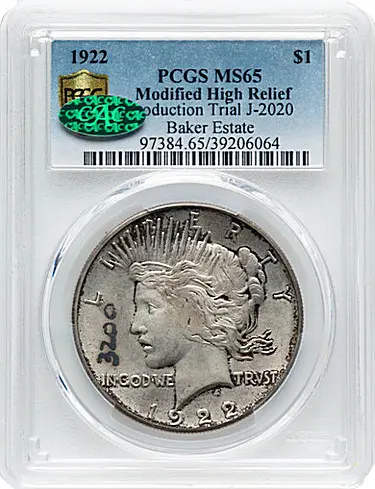
Morgan next lowered the relief further, creating what collectors now call the Modified High Relief or Medium Relief Judd-2020.
The Mint struck a trial run of 3,200 coins from the modified dies. However, the dies again failed.
One remarkable survivor carries the handwritten number “3200” in the left obverse field. Mint correspondence and its Baker provenance identify it with the end of that production test.
Heritage sold the PCGS MS65 CAC “3200” specimen for $213,500 on April 29, 2026. Heritage reports six known examples from those dies, with the “3200” coin unique for its inscription.
Just weeks earlier, Stack’s Bowers sold a Judd-2020 Proof-63 PCGS CMQ for $252,000 in its Spring 2026 Showcase Auction. That piece had not appeared publicly for more than four decades.
Again, these Judd-2020 coins should not be confused with the Judd-2019 Matte Proof. Instead, they document the next step in the Mint’s unsuccessful attempt to preserve more of de Francisci’s sculptural relief.
Eventually, practicality won.
The Mint adopted the familiar low-relief version for normal 1922 production. That basic format continued through the end of the original Peace Dollar series in 1935.
How the 1922 High Relief Matte Proofs Were Made
The Judd-2019 Proofs did not come from an ordinary coinage press.
Mint employees struck them multiple times on a medal press. The repeated blows forced metal into the deepest parts of the dies and brought out details that normal high-speed production could not reproduce.
After striking, Mint employees sandblasted the coins.
Collectors commonly call them Matte Proofs. However, “Sandblast Proof” describes the manufacturing process more precisely. Stack’s Bowers uses both terms when discussing the issue.
The result looks very different from a brilliant modern Proof.
Instead of mirrored fields, these coins display finely textured surfaces. That texture softens reflected light and emphasizes the sculptural modeling of Liberty and the eagle.
The effect makes the coin look more like a small medal than a mass-produced silver dollar.
How Many 1922 High Relief Matte Proofs Exist?
This question does not have one universally accepted answer.
That is an important point for CoinWeek readers because mintage estimates, known examples, certification populations, and roster counts are not the same thing.
Heritage has cited evidence associated with Mint Director Raymond T. Baker suggesting that approximately 20 Judd-2019 pieces may have been struck. Heritage also reported 11 confirmed specimens when it offered the Ernest Lush coin in 2022.
Stack’s Bowers took a slightly broader approach in its 2024 catalog. The firm described “a dozen or so” Proof 1922 High Relief Peace Dollars as extant.
PCGS currently lists the 1922 Matte Finish High Relief under coin number 7383 and labels it “Est. 5-8 known.” Its May 2026 population report showed eight certification entries for the issue. PCGS CoinFacts separately lists a mintage of 10.
Those numbers should not be forced into artificial agreement.
Resubmissions, crossovers, changing attributions, museum holdings, and differences between “mintage” and “survival” can distort simple population counts.
Therefore, CoinWeek considers the most responsible description to be this: the Judd-2019 1922 High Relief Matte Proof survives in roughly the high single digits to around a dozen pieces, depending on the roster and attribution standard used.
Whatever exact number future research establishes, the issue remains an extreme rarity.
The Ernest Lush Coin Solved a Decades-Old Mystery
No surviving Judd-2019 tells a stranger story than the Ernest Lush discovery coin.
Lush found the dollar during the late 1970s in Lathrup Village, Michigan, mixed with a group of circulated silver dollars.
The coin had actually circulated.
That fact created a puzzle for decades.
Had Lush found the lone survivor from the Mint’s 35,401-piece production trial? Or had someone unknowingly spent one of the special Proofs?
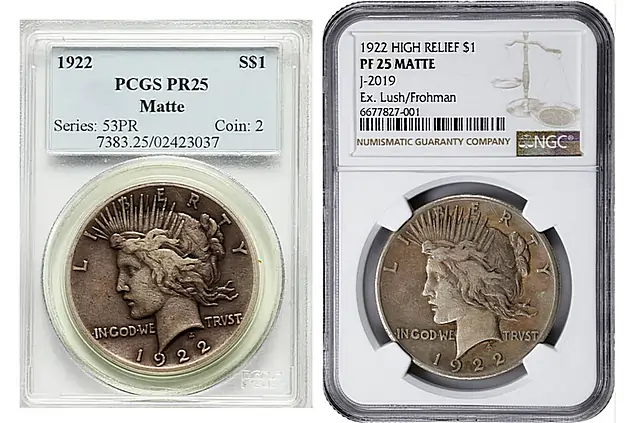
When Heritage sold the coin in April 2002, PCGS had graded it Proof-25, certification number 02423037. At that time, the catalog still discussed both possibilities. The coin realized $10,637.50.
Later die study resolved the issue.
The reverse diagnostics match the Judd-2019 Proof dies rather than the dies associated with the early production trial. Stack’s Bowers now identifies the Lush coin firmly as a Judd-2019 Matte Proof that entered circulation.
That makes it unique in another sense.
It remains the only circulated Judd-2019 Matte Proof currently known.
From a Michigan Find to a Major Peace Dollar Pedigree
The Lush coin has developed an unusually well-documented ownership and auction history.
After Ernest Lush recognized the coin, it passed into a Michigan collection. It later appeared in RARCOA’s Auction ’83, then passed to Gwyn Houston.
Numismatist Julian Leidman displayed it while holding it on consignment at the 1992 ANA convention. Bowers and Merena offered it in August 1995. Heritage sold it in April 2002, and Stack’s offered it again in January 2007.
The coin returned to Heritage in August 2022, where the PCGS Proof-25 brought $37,200.
Then its appearance changed.
Conservation Reveals the Lush Coin’s Sandblast Surface
Earlier photographs showed the Lush coin beneath dark toning. That toning obscured much of its delicate matte texture.
Before the 2024 Stack’s Bowers sale, the owner elected to have the coin carefully conserved.
2024 Conservation and Crossover
According to Stack’s Bowers, removal of the dark toning revealed that much of the original sandblast surface texture remained visible despite the coin’s circulation wear. The coin then appeared in an NGC holder graded Matte Proof-25.
Stack’s Bowers described bold remaining detail, light golden overtones, and contact consistent with the grade.
On November 19, 2024, the Lush coin realized $45,600 in Stack’s Bowers’ Rarities Night sale.
The price was far below those of Gem examples. However, no other Judd-2019 offers its combination of circulation history, discovery story, and distinctive provenance.
A New $192,000 Sale Updates the Judd-2019 Market
The most recent verified public auction of a Judd-2019 Matte Finish High Relief Proof located by CoinWeek occurred on April 30, 2025.
Heritage offered a PCGS PR63 CAC example as Lot 3253 of its Central States U.S. Coins Signature Auction.
It realized $192,000.
Heritage also published useful diagnostics for the issue. On the obverse, the top of the E in WE sits above the W, while the S in TRVST has a broad base. On the reverse, four rays appear below ONE, with the highest ray extending well to the northwest of the N.
That $192,000 result gives collectors a much more current benchmark than the auction records included in earlier versions of this CoinWeek article.
Major Auction Records for the 1922 Matte Proof
The auction history demonstrates how much grade, surface quality, provenance, and rarity affect prices for this issue.
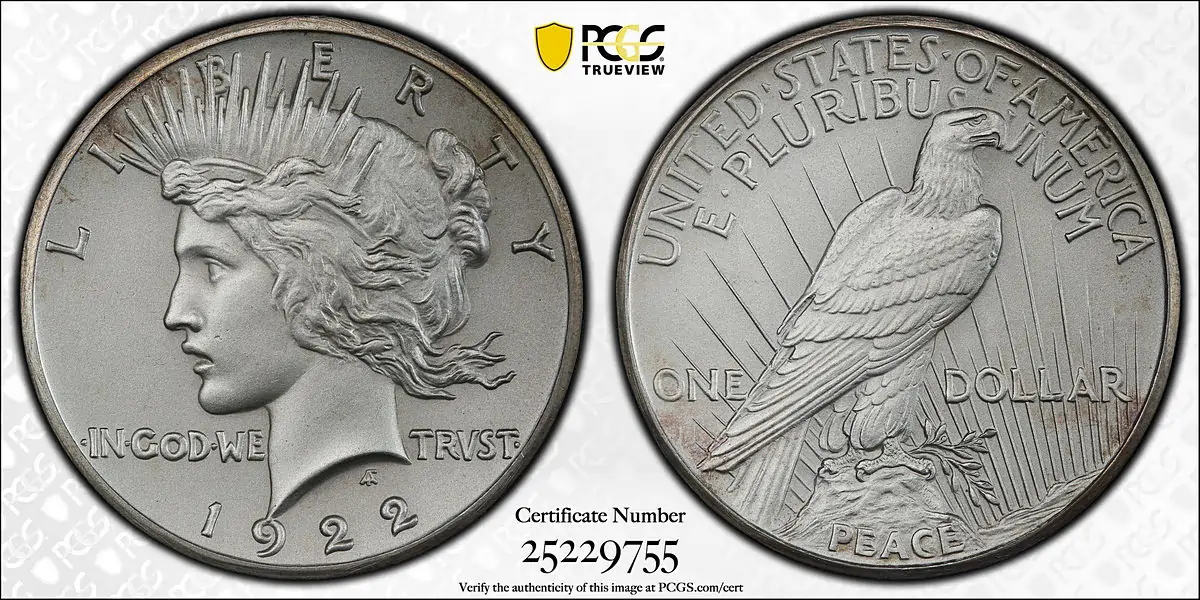
The standing public auction record belongs to the extraordinary PCGS PR67 Raymond T. Baker specimen. Goldberg Auctioneers sold it on June 2, 2014, for $458,250. It later entered the Bob R. Simpson Collection. PCGS continues to list that result as the auction record for coin number 7383.
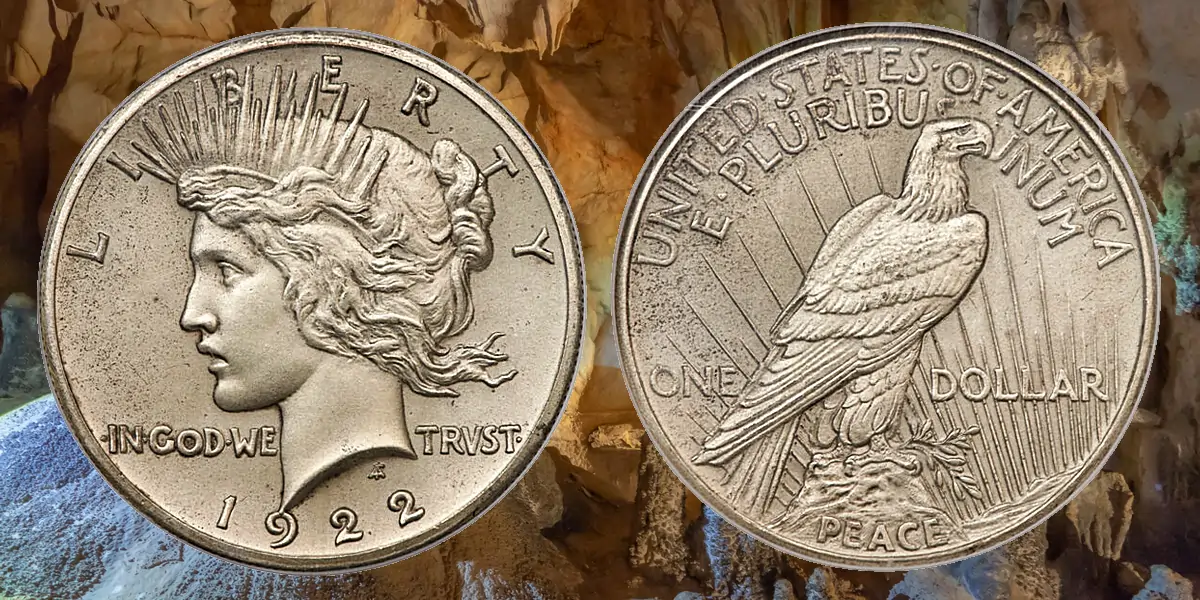
Another PR67, certified by NGC and pedigreed to the Greensboro Collection, realized $329,000 at Heritage in January 2014.
The Joseph C. Thomas Collection PR66 brought $161,000 at Heritage in 2009.
A PCGS PR64 CAC realized $158,625 at Heritage in 2017. Another PCGS PR64 CAC brought $198,000 in January 2021.
One of the most famous specimens entered popular culture through the television program Pawn Stars. A seller who had reportedly won the coin in a poker game sold it to Rick Harrison for $80,000. The NGC PR61 later realized $99,875 at Heritage in January 2015.
Even problem coins can command extraordinary prices. In February 2023, an example in a PCGS Proof Uncirculated Details holder with altered surfaces brought $144,000, according to Stack’s Bowers.
Meanwhile, the circulated Lush coin has traced a different price path: $10,637.50 in 2002, $37,200 in 2022, and $45,600 after conservation and crossover to NGC in 2024.
No example above PR67 currently appears in the PCGS data for the Matte Finish High Relief issue.
Why the 2026 Judd-2020 Sales Matter to the Matte Proof Story
The two major Judd-2020 sales of 2026 do not establish a new price level for Judd-2019.
They do something more historically useful.
They show just how complicated the Mint’s 1922 experimental program really was.
The $252,000 Stack’s Bowers Judd-2020 Proof and the $213,500 Heritage “3200” production-trial specimen came from the same urgent search for a solution to the Peace Dollar’s relief problem.
Together with Judd-2018 and Judd-2019, these coins reveal a Mint engineering project unfolding almost coin by coin.
Officials wanted to preserve de Francisci’s sculptural design.
Production realities kept forcing them backward.
Eventually, the Mint lowered the relief enough to make the Peace Dollar practical for mass production.
Why the High Relief Proof Remains the Artistic Ideal
The ordinary low-relief 1922 Peace Dollar succeeded as a circulating coin.
However, efficiency came at an artistic cost.
On the Judd-2019 High Relief Proof, Liberty displays deeper sculptural modeling. Her hair has greater separation and dimensionality. Lettering rises more decisively from the fields. On the reverse, the eagle shows stronger feather detail and sits more dramatically against the rays.
The medal press also allowed the Mint to capture details that a single strike from a production press could not reproduce consistently.
Therefore, the Judd-2019 occupies an unusual position.
It was not the design the Mint could manufacture efficiently.
It was the design that best demonstrated what the Peace Dollar could have been without the limitations of mass production.
That tension between art and machinery gives the coin much of its historical importance.
1922 High Relief Matte Proof Peace Dollar Specifications

- Country: United States
- Year: 1922
- Mint: Philadelphia
- Mintmark: None
- Denomination: One Dollar
- Designer: Anthony de Francisci
- Composition: 90% silver, 10% copper
- Weight: 26.73 grams
- Diameter: 38.10 mm
- Edge: Reeded
- Silver Content: Approximately 0.77346 troy ounce
- Variety: Judd-2019
- Relief: High Relief
- Finish: Sandblast / Matte Proof
- Production: Exact number uncertain; published estimates vary
- Survival: Roughly high single digits to about a dozen, depending on roster and attribution
- Highest Certified Grade: PR67
- Verified Auction Record: $458,250, Goldberg Auctioneers, June 2, 2014
Basic physical specifications and the $458,250 auction record agree with current PCGS data.
The Peace Dollar the Mint Could Not Mass-Produce
The 1922 High Relief Matte Proof Peace Dollar is much more than a rare Proof.
It represents the point where artistic ambition met the physical limits of early 20th-century coin production.
The Mint did not simply abandon high relief after 1921. Instead, Morgan and his colleagues tried several solutions. They changed hubs. They altered relief. They tested new die combinations. They made special Proofs. They ran thousands of production trials.
Each experiment moved them closer to the low-relief coin that entered mass production in 1922.
The Judd-2019 Matte Proof captures the design near the artistic high point of that process.
Meanwhile, the circulated Ernest Lush example shows how easily even a major rarity can disappear into ordinary commerce. The 2025 Heritage sale confirms that high-grade Judd-2019 examples still command six-figure prices. Finally, the major 2026 sales of related Judd-2020 coins have brought renewed attention to the Mint’s larger experimental program.
More than a century later, those surviving coins allow collectors to reconstruct a few extraordinary weeks inside the Philadelphia Mint.
The production design won the argument.
The High Relief Proof preserved the art.




My second favorite coin but still nice.
It was a great coin to own!
David Frohman
My Favorite!
Beautiful coin. Unfortunately I will never own one :(
very nice, historic and attractive
Very interesting read on Peace dollars
Add A Comment
Wow, it seems like they tried everything.
Sure is a beauty. Thanks for the history lesson again.
Cool coin
Historic Design!
One of my favorites. Always interesting reading these stories.
Thanks for the chance!
I have a few early 1900 silver dollars I’d like to get graded n keep a few for my future n sale a few for my financial struggles but I don’t no where to begin
nice looking coin
Really want the diamond field version in the two coin set this year.
I love the Peace Dollars. I am so happy when people like the peace dollar because im sorry yes the Morgan started them all but I thing the morgan is ugly and not well thought out when created as the peace dollar was. Next best to that is the Eisenhower Dollar. Not as valuable nor rare by any means compared to the Morgan and peace dollars. But still also An amazing coin. The Susan B dollars tho were the downfall to the dollar coins we have today.. If I want quarter sized dollars I would just have alot of quarters.
I have a few Peace dollars, I’m always looking for these.
Have always liked the Peace Dollar. I have a few, but not this one.
This artical has brought attention back to a 1922 low relief dollar that I have with a unique look. Upon further research I had learned about two examples of peace dollars from the Baker collection that had a antique finish, one 1921 and one 1922. The 1922 low relief specimen that I have has similar toning on the reverse and a clean prestein obverse. The two differences didn’t add up to me. It had always puzzled me as to why the reverse looked warn yet the obverse seemed untouched. It wasn’t until today as the sun shined on to it that it revealed a sandblasted surface. Having been a sandblaster myself, there was no denying what I was looking at. I’m planning on getting it graded ASAP. Great article, Thanks! I owe you one for bring my attention back to this coin. More to come……