


The U.S. Half Dollar With Three Dates, and a $19,200 Record
Some coins tell their story with a portrait. Others rely on a famous battle, monument, or national symbol.
The 1936 Delaware Tercentenary Half Dollar does something stranger.
It carries a 1936 date. Yet the Philadelphia Mint struck it in 1937. Meanwhile, its reverse celebrates an anniversary that did not arrive until 1938.
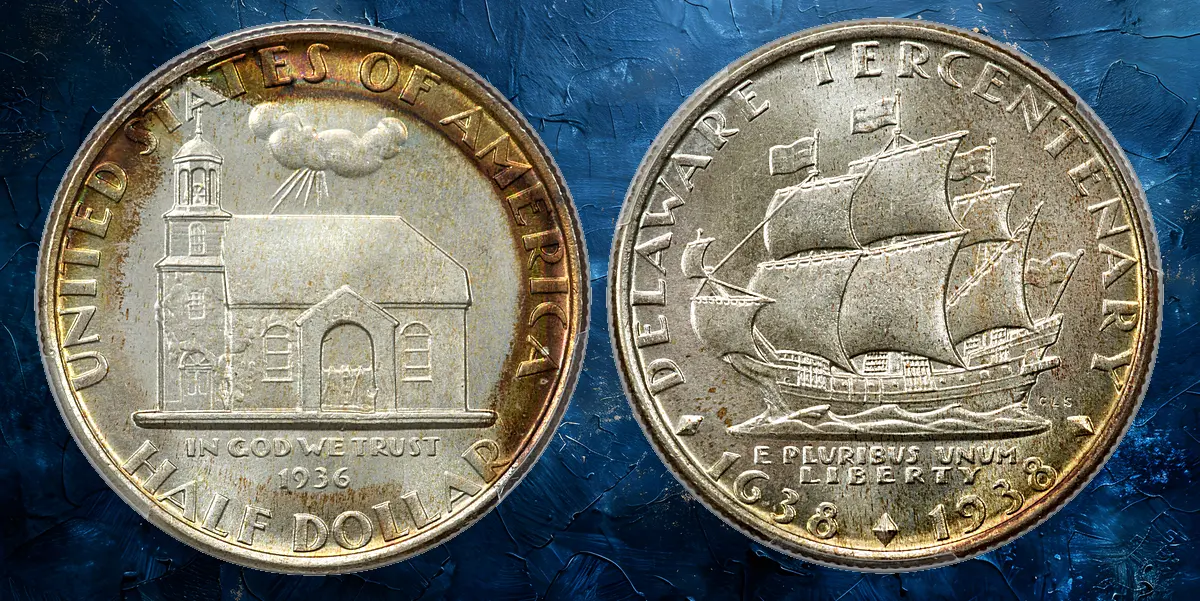
That three-year calendar puzzle already makes the Delaware Half Dollar unusual. However, the story gets better. The coin connects early Swedish America, a 17th-century church, a colonial sailing ship, 1930s commemorative-coin speculation, and an international anniversary celebration.
Then, in August 2025, one extraordinary example added another chapter.
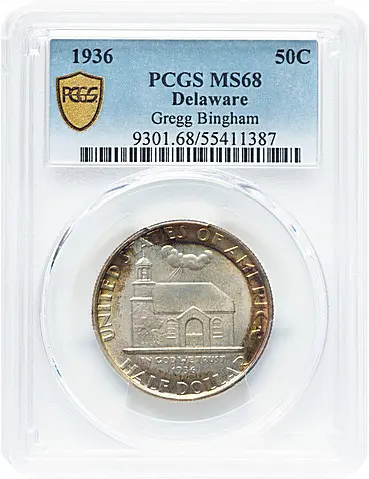
Heritage Auctions sold a PCGS MS68 Delaware Half Dollar from the Gregg Bingham Collection for $19,200. That result now stands as the auction record that PCGS reports for the issue. Heritage sold the individual lot on August 28 during its August 26-31 ANA U.S. Coins auction. PCGS records the sale under the auction’s August 31 closing date.
For a commemorative half dollar that originally cost collectors $1.75, that represents quite a journey.
1936: The Peak of America’s Classic Commemorative Boom
The Delaware Half Dollar emerged during the most feverish period of America’s classic commemorative coin era.
The 1936 commemorative calendar included roughly 21 distinct issues. That count does not even include all mintmark combinations and special presentation pieces. Congress approved coins for cities, states, anniversaries, battles, expositions, and historical events.
As a result, collectors faced a flood of new issues.
The Delaware coin stood apart for another reason. It honored one of the nation’s smallest states and the state that would later earn the title “The First State” by becoming the first to ratify the U.S. Constitution in 1787.
Yet the story on the coin begins nearly 150 years before American independence.
The Voyage That Created New Sweden
In late 1637, the New Sweden Company sent an expedition across the Atlantic. Two vessels made the voyage: the Kalmar Nyckel and the Fogel Grip.
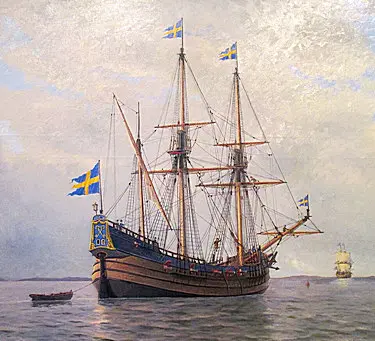
Under Peter Minuit’s leadership, the expedition reached the Christina River in March 1638. Swedish and Finnish settlers then established Fort Christina near present-day Wilmington.
The settlement became the first permanent European settlement in what is now Delaware. It also served as the center of the colony that became known as New Sweden.
However, control of the region soon changed hands.
The Dutch established Fort Casimir near present-day New Castle in 1651. New Sweden seized that outpost in 1654. The Dutch responded the following year and conquered New Sweden.
Then England took control of the region in 1664. Later, the Duke of York transferred the Three Lower Counties on the Delaware to William Penn. Delaware remained connected politically with Pennsylvania for much of the colonial era, although it developed its own assembly.
Delaware’s colonial history therefore passed through Swedish, Dutch, and English rule before independence.
That complicated history gave Carl L. Schmitz two powerful subjects for his half dollar.
Old Swedes Church Anchors the Obverse
Schmitz placed Holy Trinity Church, better known as Old Swedes Church, at the center of the coin’s obverse.
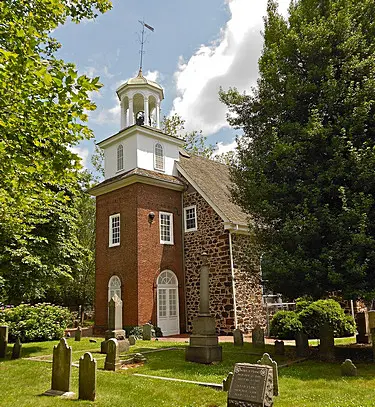
Swedish and Finnish settlers built the Wilmington church in 1698 and 1699. The Reverend Eric Björk consecrated the completed building on June 4, 1699.
Remarkably, the original structure still stands.
The National Park Service recognizes Old Swedes as one of America’s oldest church buildings that still serves as a place of worship. Earlier numismatic literature often described it more emphatically as the country’s oldest Protestant church building still in active worship. The NPS wording offers the safer historical description.
Schmitz gave the church a broad roof and simple architectural lines. Those large, flat surfaces later created a challenge for collectors because even small contact marks become easy to see.
Below the church appears 1936.
That date starts the coin’s famous calendar puzzle.
The Kalmar Nyckel Returns on the Reverse
Schmitz turned to the settlers’ voyage for the reverse.
A full-sailed Kalmar Nyckel dominates the design. The ship carried members of the 1638 expedition from Europe to the Delaware Valley.
Its name translates as the Key of Kalmar, a reference to the Swedish city of Kalmar.
Below the ship, Schmitz placed the dates 1638-1938.
Three small diamonds also appear in the design. They reference Delaware’s familiar “Diamond State” nickname and the state’s three counties: New Castle, Kent, and Sussex.
Thus, a collector can read three different years into the story of one coin.
Congress ordered the coin to carry 1936. The Philadelphia Mint actually struck the coins in 1937. Finally, the reverse points toward the 1938 tercentenary.
Few American commemoratives offer such an entertaining chronology.
A $500 Contest Produced the Design
The Delaware Swedish Tercentenary Commission did not simply hand the project to a well-known sculptor.
Instead, it opened a design competition.

Congressional records from 1938 state that artists submitted 40 designs. The winning artist received a $500 prize. Mint Chief Engraver John R. Sinnock and sculptor Dr. R. Tait McKenzie took part in the professional review, and the commission selected Carl L. Schmitz.
Schmitz was French-born and came from a German-American background. His Delaware designs ultimately became his best-known numismatic work.
McKenzie brought an unusual résumé to the judging process. The Canadian-born physician became an important pioneer in physical education and rehabilitation medicine. He also built a major second career as a sculptor. His works included the well-known statue of a young Benjamin Franklin at the University of Pennsylvania, where McKenzie taught. Contemporary accounts credit him with creating roughly 200 works of sculpture.
Therefore, the Delaware competition brought together Mint expertise, fine-art judgment, and local historical interests.
Interestingly, early commission material treated the ship side as the obverse. U.S. Mint records ultimately recognized the church side as the obverse, and collectors follow that convention today.
Congress Tried to Rein In Commemorative-Coin Abuses
The Delaware legislation came during growing concern about the way sponsors marketed commemorative coins.
Earlier programs sometimes exploited multiple mints, multiple dates, and artificially small releases. Those practices forced collectors to buy numerous varieties to keep sets complete.
Congress had started adding safeguards.
For Delaware, Congress required one special design and production at one Mint. It also required the coins to carry the date 1936 regardless of when the Mint actually produced them. Finally, the law gave the commission only one year after enactment to request coins.
One commonly repeated detail needs correction, however.
Congress did not authorize a maximum of 25,000 Delaware Half Dollars. The May 15, 1936, resolution called for “not less than twenty-five thousand” pieces. It also required requests in batches of at least 25,000.
Therefore, 25,000 functioned as a minimum order, not a statutory ceiling.
Likewise, Delaware did not share one authorizing law with the Bridgeport and Wisconsin commemoratives. Congress approved all three programs on May 15, 1936, but separate acts or resolutions governed them. Wisconsin carried Public No. 593, Bridgeport Public No. 596, and Delaware Public Resolution No. 91.
The Mint Struck 25,015 Coins – Then 4,022 Disappeared
The Philadelphia Mint struck 25,015 Delaware Half Dollars in March 1937.
That total included 15 pieces for assay purposes.
The Delaware Swedish Tercentenary Commission offered the coins through the Equitable Trust Company of Wilmington. Buyers paid $1.75 each, including postage according to contemporary congressional records. Equitable Trust handled the sale and distribution.
However, demand did not absorb the full quantity.
Collectors ultimately purchased 20,978 coins. The commission returned 4,022 unsold pieces to the U.S. Mint, which melted them.
That creates another number that often causes confusion.
The collector distribution totaled 20,978. However, PCGS and standard references list a net mintage of 20,993 because that figure adds the 15 assay pieces to the 20,978 coins that escaped melting.
So both numbers have meaning. They simply describe different things.
A Surprisingly High Survival Rate
PCGS currently estimates that about 17,000 Delaware Half Dollars survive in all grades. It estimates approximately 13,500 at MS60 or better and 6,500 at MS65 or better.
Those figures make sense.
Collectors bought these coins as souvenirs and collectibles. Few owners had any reason to spend a commemorative half dollar that had cost $1.75.
Therefore, most survivors remain in Mint State.
However, grade alone does not tell the whole story.
The broad church roof can attract distracting marks. Likewise, contact marks often appear across the Kalmar Nyckel’s sails. Collectors should also examine luster closely.
Some coins show attractive semi-Prooflike character. Others display softer, subdued frost. Meanwhile, uneven or blotchy toning can significantly reduce eye appeal.
Well-struck examples with clean sails, an undisturbed church roof, strong luster, and attractive original color therefore command attention.
From an $18,400 Record to $19,200
For years, the auction benchmark belonged to a PCGS MS67 with CAC approval. Heritage sold that coin in January 2012 for $18,400.
Then the Gregg Bingham Collection example appeared in 2025.
PCGS graded it MS68. Heritage described brilliant centers beneath light champagne color, with amber, plum, and emerald peripheral toning on the obverse. The reverse showed softer gold coloration.
On August 28, the coin realized $19,200.
At the time of the sale, Heritage reported only two PCGS examples at MS68+ and no numerically finer grade than MS68+.
The result established a new auction high for the issue.
PCGS CoinFacts continues to list $19,200 as the Delaware Half Dollar auction record.
That record also illustrates how sharply the market changes at the extreme top of the grading scale.
When CoinWeek examined the coin in 2020, PCGS reported 43 pieces at MS67+, five at MS68, and one at MS68+. Those numbers represented a snapshot at that time. Subsequent submissions and regrades changed the census, so collectors should not use those older figures as today’s population data.
The same caution applies to older price levels. In 2020, collectors could often find MS64 and MS65 coins for less than $300, while MS67 examples commonly traded near $700. Those figures describe the market of that period, not a fixed present-day valuation.
Did the Mint Make Delaware Matte Proofs?
One mystery remains.
Commemorative-coin specialist Anthony Swiatek has suggested that a small number of Proof Delaware Half Dollars could exist. If genuine Proofs surfaced, he expected them to show a Matte Proof finish.
However, researchers have not established a confirmed Proof population. PCGS continues to catalog the standard Delaware issue as a regular strike.
Therefore, collectors should treat the Matte Proof idea as an intriguing but unconfirmed possibility.
Sweden Struck Its Own Delaware Anniversary Coin
The United States did not commemorate New Sweden alone.
Sweden issued a special 2 Kronor coin in 1938 for the same 300th anniversary.
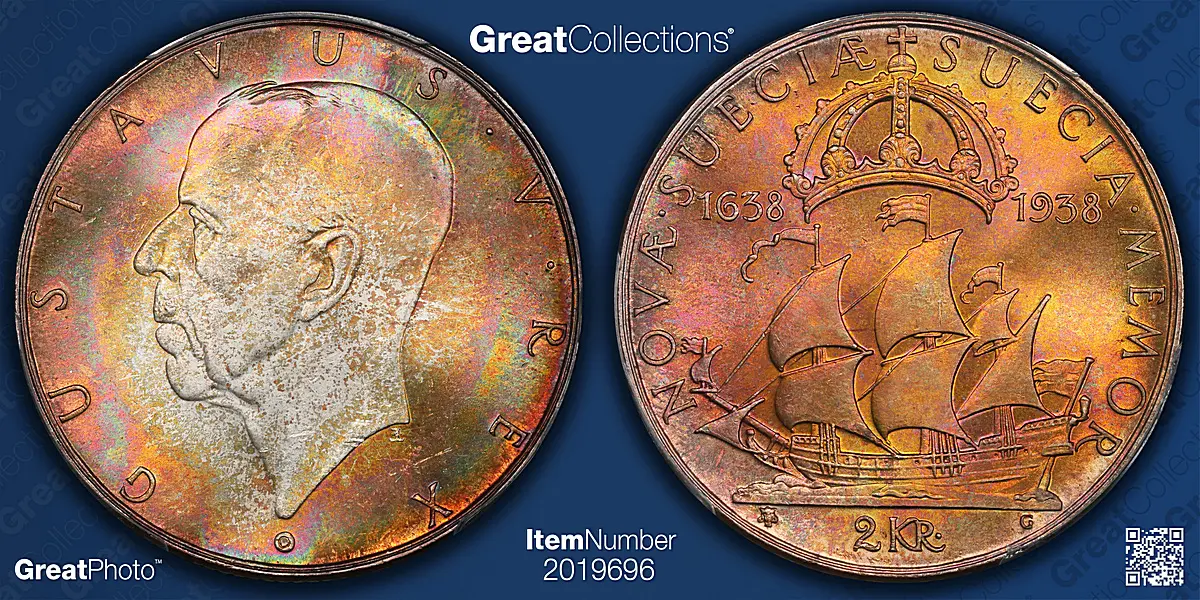
King Gustaf V appears on the obverse. On the reverse, the Calmare Nyckel sails beneath a royal crown between the dates 1638 and 1938.
Even more interesting, the inscriptions use Latin. Sweden’s Riksbank notes that Swedish coinage had not used Latin inscriptions since the reign of Gustav III.
Artist and Royal Mint engraver Erik Lindberg designed, modeled, and engraved the coin. The Royal Mint in Stockholm produced 508,815 pieces. Each coin weighs 15 grams and measures 31 millimeters. Numismatic references identify the alloy as .800 fine silver.
Earlier CoinWeek coverage noted that collectors could sometimes buy Uncirculated examples for less than $20. That figure reflected the market at the time. It should not serve as a fixed 2026 price guide.
Still, the Swedish coin makes a fascinating companion to the American Delaware Half Dollar. Together, they show how two countries used the same ship to remember one transatlantic story.
1936 Delaware Tercentenary Half Dollar Specifications
- Denomination: Half Dollar
- Face Value: 50 Cents
- Date on Obverse: 1936
- Actual Year Struck: 1937
- Anniversary Dates on Reverse: 1638-1938
- Mint: Philadelphia
- Mintmark: None
- Designer: Carl L. Schmitz
- Composition: 90% silver, 10% copper
- Weight: 12.50 grams
- Diameter: 30.60 mm
- Actual Silver Weight: About 0.3617 troy ounce
- Edge: Reeded
- Total Struck: 25,015, including 15 assay pieces
- Coins Returned and Melted: 4,022
- Coins Distributed to Collectors: 20,978
- Standard Net Mintage: 20,993
- Original Issue Price: $1.75
- PCGS Number: 9301
- Obverse: Old Swedes Church
- Reverse: Kalmar Nyckel
- Current PCGS Survival Estimate: Approximately 17,000 in all grades
- Auction Record: $19,200 for a PCGS MS68, Heritage Auctions, August 2025
Why the Delaware Half Dollar Matters
The Delaware Tercentenary Half Dollar does not need an ultra-low mintage to tell a great numismatic story.
Its appeal comes from layers.
A Swedish ship crossed the Atlantic in 1638. A Lutheran congregation completed a church in 1699. Congress approved a commemorative coin in 1936. Philadelphia struck it in 1937. Delaware celebrated the tercentenary in 1938. Sweden struck a companion coin that same year.
Then, nearly nine decades later, a superb MS68 Delaware Half Dollar brought $19,200.
Few classic commemoratives compress so much history into 30.6 millimeters of silver.
And perhaps no other U.S. half dollar can make 1936, 1937, and 1938 all equally important to understanding a single coin.




Swedish coin is really special. Love it
Wow that’s cool
I have a mint set from Sweden. Maybe I should really look at it. There won’t be this coin, but maybe a nice collector’s coin within.
Very interesting article about the 1936 Delaware Tercentenary Half Dollar.
Nice Article. Makes me understand i need to relook at mine.
Hadn’t heard of New Sweden – guess the commemorative coin did it’s job!
Very interesting article.
Interesting info, learn something new every day
I wish I would have collected commemoratives. I always liked them. Now I’m too old to start another collection.
Nice article
Clean sails and a clean roof for all!
Interesting article! Remember the Swedish Finns!
New info. Unusual coin.
I never even knew about this coin until now.
Wow. I have really got some reading to do. Love these coin stories. Thanks.
interesting coin history
interesting story – amazing the price these coins command
Very Interesting article
So cool looking!
Interesting story – amazing the price these coins command