


The U.S. coin with five dates, but not the year it was struck.
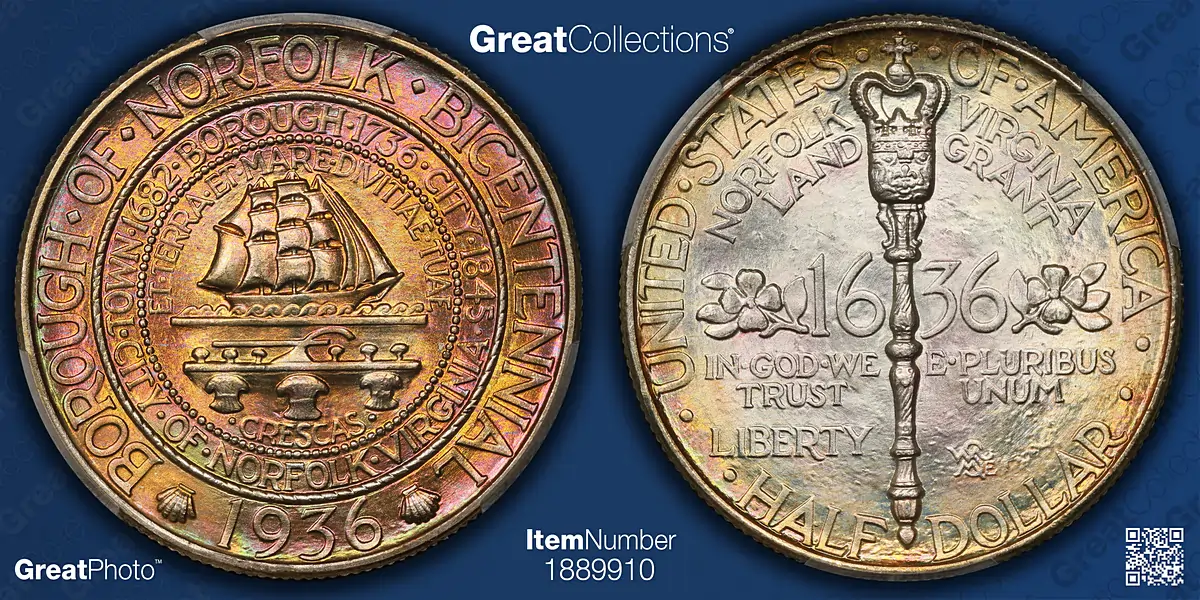
The 1936 Norfolk half dollar may be the most “talkative” coin in United States history. It carries five dates. It packs more characters onto its surfaces than any other U.S. coin. Yet it leaves out the one date collectors most want to know: 1937, the year the Philadelphia Mint actually struck it. Stack’s Bowers counts 218 characters on the coin, including spaces, and calls it the U.S. coin with the largest number of characters.
That oddity gives the Norfolk commemorative its charm. However, its backstory gives it real drama. This half dollar grew out of a civic celebration, a Congressional mistake, a rejected medal plan, and a colonial mace topped by a British crown.
A Coin for Norfolk’s Big Anniversaries
Congress authorized the coin to mark two official anniversaries: the 300th anniversary of the original Norfolk land grant in 1636 and the 200th anniversary of Norfolk’s establishment as a borough in 1736. Public No. 164 of the 75th Congress approved up to 25,000 silver half dollars on June 28, 1937. The law also ordered every coin to carry the date 1936, no matter when the Mint struck or issued it.
That requirement created the coin’s famous timeline puzzle. The design includes 1636, 1682, 1736, 1845, and 1936. However, it omits 1937. APMEX notes the same missing date and identifies 1937 as the actual year of striking.
The Congressional Mix-Up
The path to the 1936 Norfolk half dollar did not run smoothly. Virginia Senator Carter Glass first sought a commemorative coin. Then a committee changed the proposal and turned it into a medal bill. Glass moved it through Congress without realizing the change. Norfolk promoters wanted legal-tender half dollars, not medals, so they pushed for corrected legislation. That second effort finally produced the June 1937 coin act.
By then, Norfolk’s intended 1936 celebration had already passed. As a result, the coin reached collectors late. That hurt sales from the start.
A Design That Reads Like a Document
William Marks Simpson and Marjory/Marjorie Emory Simpson designed the coin. Sources vary on the spelling of her first name, but major grading and numismatic references credit the husband-and-wife team. PCGS lists the designers as William Marks Simpson and Marjorie Emory Simpson.
The obverse shows the official Norfolk city seal. A full-rigged ship rises above a plow and three sheaves of wheat. Together, they point to Norfolk’s maritime trade and surrounding agriculture. The Latin motto Crescas means “Thou shalt grow,” while Et terra et mare divitiae tuae means “Both by land and by sea thy riches are.” The City of Norfolk explains these seal elements and translations.
The Crown That Raised Eyebrows
The reverse delivers the coin’s “wow” factor. It shows Norfolk’s ceremonial mace, a symbol of royal authority and civic power. The mace carries a British crown at its top. That made some collectors uneasy. After all, a royal crown looked strange on an American coin.
The mace also survived an extraordinary history. Norfolk says Royal Lt. Governor Robert Dinwiddie formally presented the silver mace to the Norfolk Common Council on April 1, 1754. During the Civil War, Mayor William Lamb hid it under a hearth as Union forces occupied Norfolk. Later, the mace disappeared again, resurfaced in a police station in 1894, and now remains on display at the Chrysler Museum of Art.
Mintage, Melting, and Collector Demand
The Philadelphia Mint struck the Norfolk half dollar without a mint mark. PCGS lists the issue at 12.50 grams, 90% silver and 10% copper, with a mintage figure of 16,936.
That number needs context. The Mint struck 25,000 coins for sale, plus 13 assay pieces. Sales lagged because the anniversary had passed and the commemorative market had cooled. CoinWeek notes that 8,077 unsold pieces went back for melting. That left 16,923 sold pieces, or 16,936 when collectors include the 13 assay pieces.
Today, the Norfolk issue sits in the moderate-scarcity tier of classic commemorative half dollars. PCGS estimates about 14,000 survivors in all grades and 11,500 in Mint State 60 or better.
Why the 1936 Norfolk Half Dollar Still Matters
The 1936 Norfolk half dollar stands out because it breaks expectations. It looks crowded, yet every word matters. It honors American civic growth, yet it displays a British crown. It bears 1936, yet the Mint struck it in 1937. It celebrates history, but its own legislative mistake became part of that history.
For collectors, that makes the Norfolk half dollar more than another classic commemorative. It is a silver archive. It preserves a city seal, a colonial mace, a Congressional blunder, and one of the strangest dating stories in U.S. coinage. Few American coins say more. None say it quite like Norfolk.
A Superb Toned Norfolk Half Dollar at GreatCollections
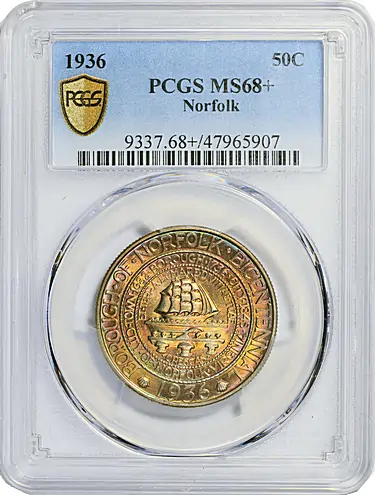
Collectors currently have a chance to pursue a high-end example of this historic commemorative. GreatCollections is offering a 1936 Norfolk, Virginia, Bicentennial Half Dollar graded PCGS MS-68+ with toning. The coin appears as GC Item ID 1889910 and comes from Terry’s Toners Collection of U.S. Coins. GreatCollections lists the coin with PCGS certification number 47965907 and confirms the Philadelphia Mint issue, Simpson design attribution, 16,936 mintage figure, 90% silver composition, and 12.5-gram weight.
The auction closes on Sunday, May 10, 2026, at 6:45:51 p.m. Pacific Time. At the time the listing was checked, GreatCollections showed a current bid of $4,300, before buyer’s fee. Because active auction prices can change quickly, bidders should review the live listing before placing a bid



Wow never heard of it but what a nice coin.
Beautiful coin!