


The Rare Gold Medal That Turns Cinco de Mayo Into Numismatic History
A great medal does more than preserve metal. It preserves memory.
The 1962-Mo Mexico Centennial of the Battle of Puebla gold medal does exactly that. It takes one of Mexico’s most famous military victories and gives it the weight of gold. More importantly, it turns Cinco de Mayo from a date on the calendar into a numismatic monument.
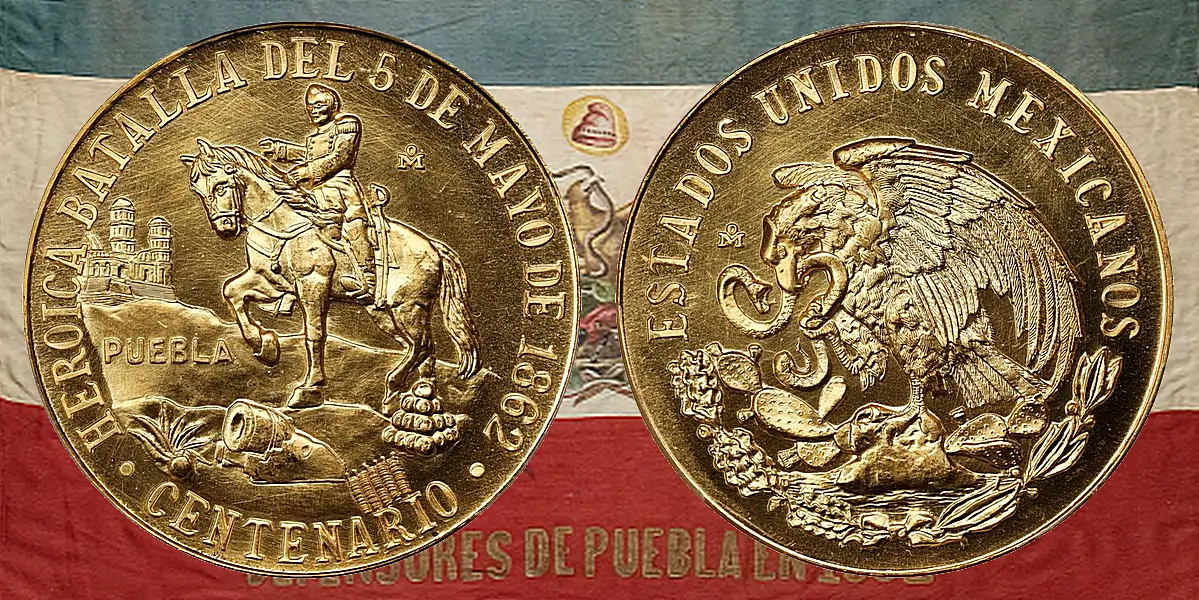
Stack’s Bowers Galleries describes the piece as the MEXICO. Centennial of the Battle of Puebla (Cinco de Mayo) Gold Medal, 1962-Mo. Mexico City Mint. PCGS MS-66. The firm also identifies it as Grove-802 and gives its weight as 41.72 grams. The obverse shows an equestrian statue of General Ignacio Zaragoza facing left, with Puebla in the background. The reverse displays Mexico’s National Eagle facing left, enclosed within oak and laurel branches.
A Medal With the Presence of a 50 Pesos Gold Coin
Collectors often connect this medal with Mexico’s famous 50 Pesos gold Centenario. That comparison makes sense. The medal uses a large gold format, and examples in the market often appear with an actual gold weight near the classic 50 Pesos standard of 1.2057 troy ounces. The Centenario itself contains 1.2057 ounces of gold, and Mexico first issued that coin in 1921 for the centennial of Mexican independence.
However, this 1962 Puebla issue is not the standard Winged Victory 50 Pesos. It is a medal. Therefore, the design does not show the familiar Angel of Independence. Instead, it puts Zaragoza on horseback and places the Battle of Puebla at the center of the story.
That change gives the medal its power. The Centenario celebrates independence. This medal celebrates resistance.
The Backstory: Mexico Against an Empire
The Battle of Puebla took place on May 5, 1862. Today, the anniversary gives Cinco de Mayo its historical meaning. The battle pitted Mexican forces against French troops sent by Napoleon III. France wanted to establish a client state in Mexico, and that goal carried huge consequences for North America.
At Puebla, Mexican forces fought under General Ignacio Zaragoza. The Library of Congress describes Zaragoza’s army as “ragtag” and the French force as superior. Yet Zaragoza stopped the French advance about 80 miles southeast of Mexico City. The French then withdrew and waited nearly a year for reinforcements.
That is the history behind this medal. It does not honor a routine battle. It honors the moment when Mexico stunned one of Europe’s great military powers. The victory did not end the war. The French returned, captured Puebla, and occupied Mexico City in June 1863. Still, the May 5 victory became a lasting symbol of Mexican determination against foreign intervention.
Zaragoza in Gold
The obverse design matters. It places General Zaragoza on horseback, not as a distant name in a textbook, but as the medal’s central figure. Puebla appears behind him. That detail anchors the medal in place. It also reminds collectors that Cinco de Mayo belongs to a specific battlefield, a specific city, and a specific crisis.
Zaragoza died only months after the victory, but his name endured. Puebla itself later carried his name in official memory. As a result, the medal functions as both a military tribute and a national keepsake.
The reverse reinforces that message. Mexico’s National Eagle stands inside oak and laurel. Those branches add a classical language of strength and victory. Meanwhile, the eagle and serpent image reaches deeper into Mexican identity. The Mexican national emblem shows an eagle holding a snake while standing on a nopal cactus. Mexico’s embassy material traces that emblem to the Aztec founding legend of Tenochtitlan.
So, the medal speaks in two languages at once. One side honors a 19th-century battlefield. The other side reaches back to the origin story of Mexico itself.
Why Collectors Notice This Medal
The 1962-Mo Battle of Puebla gold medal stands apart for three reasons.
First, it carries major historical weight. Cinco de Mayo often suffers from shallow popular treatment, especially outside Mexico. This medal restores the date to its real source: the Battle of Puebla and Zaragoza’s victory over French forces.
Second, the medal has strong physical presence. At more than 41 grams, it feels substantial. It belongs to the same broad gold tradition that made Mexico’s large-format gold issues famous with collectors and bullion buyers.
Third, certified examples remain scarce. The PCGS Population Report, last updated May 4, 2026, lists the (1962)-Mo Medal Grove-802 Au Cinco De Mayo Centennial with a total MS population of 65.
That number matters. Standard 1947-dated 50 Pesos restrikes appear far more often in the marketplace. By contrast, this medal offers a much narrower collecting field. It also gives specialists a more focused story.
A Medallic 50 Pesos With a Different Mission
Many collectors call this type a “medallic 50 Pesos” because it follows the large gold module associated with Mexico’s 50 Pesos series. Yet its mission differs from a circulating-denomination coin. It does not advertise value through the famous Winged Victory design. Instead, it uses gold to frame a national moment.

In that sense, the medal belongs to the grand tradition of historical medals. It records the past with art. It gives collectors a tangible link to a crisis. And it asks the viewer to remember that May 5, 1862, mattered because Mexico refused to yield.
The CoinWeek Takeaway
The 1962-Mo Mexico Battle of Puebla gold medal offers more than bullion. It offers a story with force, drama, and identity. It connects General Ignacio Zaragoza, the city of Puebla, the French Intervention, and the deeper symbolism of Mexico’s National Eagle.
For collectors, that blend creates lasting appeal. The medal has gold content, rarity, certified quality, and historical resonance. Yet its strongest feature remains the backstory.
Cinco de Mayo began as an underdog victory. A smaller Mexican army stopped a powerful imperial force. A year later, France advanced again. Even so, the first victory endured. Mexico remembered it. Then, a century later, the Mexico City Mint struck that memory in gold.
That is why this medal stands out. It does not simply commemorate Cinco de Mayo. It gives the holiday its history back.






You learn something new every day.
Great article and featured coin for Cinco De Mayo!
Great coin with a great historical moment.