


A Rare 1939 Nickel With Naked-Eye Doubling Can Still Hide in Pocket Change
The 1939 Jefferson Nickel already gives collectors more to study than most second-year U.S. coin issues. Yet one variety towers above the rest.
That coin is the 1939 Jefferson Nickel Doubled Die Reverse, FS-801. Many collectors still call it the “Doubled Monticello” nickel. However, that nickname sells the coin short.
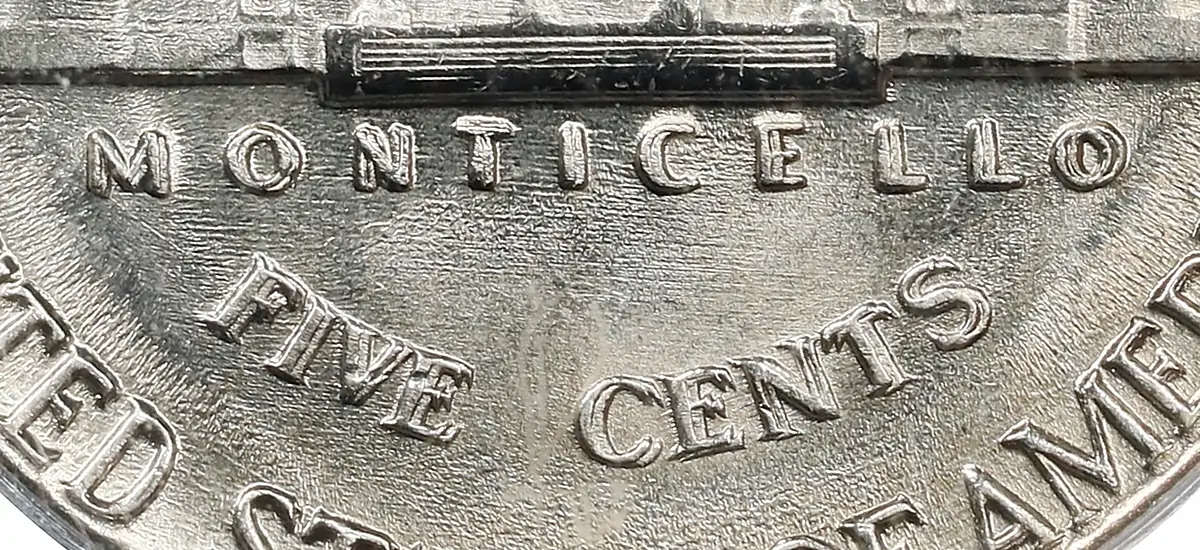
Yes, MONTICELLO shows strong doubling. But FIVE CENTS does, too. In fact, FIVE CENTS often shows the most dramatic spread. That makes this coin a true Doubled Die Reverse, not just a doubled building name.
Even better, this famous Jefferson nickel can still turn up in circulation, old collections, dealer stock, and even unattributed holders. That gives it rare cross-market appeal. Registry collectors want top-grade Full Steps examples. Meanwhile, roll hunters and sharp-eyed collectors still have a reason to check every 1939 nickel they see.
A Second-Year Nickel With a Complicated Reverse
The Jefferson nickel debuted in 1938. It replaced the Buffalo nickel after that design completed its 25-year production run.
The United States Mint chose Felix Schlag’s design after a 1937 competition. Schlag, a German-born American sculptor, received $1,000 for the winning design. However, the Mint requested several changes before production began. Most importantly, officials pushed Schlag toward the flat, head-on view of Monticello that collectors know today.
Then, in 1939, the Mint changed the reverse again.
Philadelphia struck 120,615,000 business-strike Jefferson nickels in 1939. That total made the coin common in circulation. However, the issue also carries extra complexity because the Mint modified Monticello’s steps during the year.
Collectors now divide the regular 1939 nickels into two main reverse types.
The Reverse of 1938 shows weaker, wavy steps. The Reverse of 1940 shows sharper, better-defined steps. The FS-801 Doubled Die Reverse belongs to this larger 1939 reverse-variety story, but it sits in a class of its own.
Why the 1939 DDR Matters
The 1939 Doubled Die Reverse ranks as one of the most important varieties in the entire Jefferson nickel series.
It also has one huge advantage over many rare die varieties: collectors can see the doubling without a microscope.
Look first at FIVE CENTS. The doubling shifts toward the southeast. Then look at MONTICELLO. The letters show a strong spread toward the east, with a slight southern shift.
This is not machine doubling. It is not shelf-like chatter. It is hub doubling on the die. As a result, every coin struck from that die carries the same major doubled design.
That gives the coin its power. It offers drama, history, and real scarcity in one affordable denomination.
“Doubled Monticello” Is the Wrong Story
The nickname “Doubled Monticello” helped make this coin famous. It also created a problem.
The nickname points collectors to only one part of the reverse. However, the variety’s strength comes from the full reverse doubling. FIVE CENTS shows bold separation. MONTICELLO also shows strong doubling. Together, those features confirm the FS-801 attribution.
![[LEFT] 1939 Jeffereson Nickel Double Die Reverse - [RIGHT] Regular reverse of Jefferson Nickel](https://coinweek.com/wp-content/uploads/2026/06/two_reverses_1939_nickel.webp)
This matters because some coins sit in holders with incomplete descriptions. Others appear in old holders with no variety listed at all. In at least one public auction record, an old-style NGC insert made no mention of the Doubled Die Reverse variety, even though the coin later sold as an FS-801.
That is the kind of mistake collectors dream about.
The Pocket Change Angle
Most great U.S. coin rarities left circulation long ago. The 1939 DDR tells a different story.
PCGS estimates that perhaps 1,000 to 1,500 examples exist in all grades combined. Most survive in VF or lower grades. That detail matters. It means many examples entered daily commerce before collectors recognized the variety.
In other words, this coin did not start as a trophy. It started as a nickel.
A coin struck in the tens of millions can hide a variety that survives at a tiny fraction of the regular issue. If the 1,000-to-1,500-piece estimate proves close, then known survivors represent roughly one coin for every 80,000 to 120,000 Philadelphia business strikes.
That ratio does not measure the exact number struck from the doubled die. Instead, it shows the collecting reality. Regular 1939 nickels remain common. The DDR does not.
And yes, collectors can still find one. It may sit in a jar or in a Whitman folder. Some may sit in a dealer’s “common date” box. or may even sit in a slab that fails to call out the variety.
That possibility keeps this coin exciting.
A Discovery Story With New York Energy
The 1939 DDR has a backstory worthy of the coin.
The exact first discovery trail remains tangled. However, the variety reached collector attention early. A November 1942 letter in The Numismatist reported active searches and noted that collectors had found only 12 examples during a recent search period.
Later numismatic accounts add more flavor. Malcolm O.E. Chell-Frost, a major early student of the variety, reportedly discovered the coin in the summer of 1939. Another account from Bernard Nagengast, written to Q. David Bowers in 1984, places the discovery in New York City among subway token collectors in the early 1940s.
That detail gives the coin a remarkable origin story.
This was not a variety born in a museum case. It came out of circulation culture. People who handled small change and tokens noticed something unusual. Then the search began.
By the time collectors understood the variety, many examples had already worn down in commerce. That helps explain why Mint State coins remain so elusive today.
Why Full Steps Examples Are So Rare
Jefferson nickel specialists prize Full Steps coins. The designation rewards a sharp strike across Monticello’s steps. However, the 1939 DDR makes that challenge harder.
The variety already starts with a limited population. Then collectors must subtract coins with wear, marks, weak strike, or damaged steps. As a result, Full Steps examples bring the variety into elite Registry Set territory.
A premium Gem with Full Steps can command many multiples of a regular high-grade 1939 nickel. The reason is simple. It combines three things that rarely meet on one coin:
Strong doubled-die diagnostics.
High technical grade.
Full Step detail.
That combination explains the intense demand for the finest examples.
The Alan Harlan Collection Example
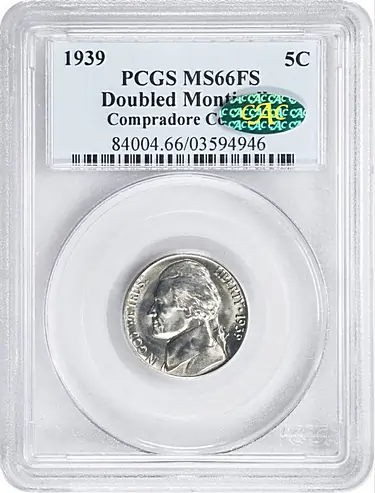
One standout offering is the 1939 Jefferson Nickel FS-801 Doubled Die Reverse, Doubled MONTICELLO, graded MS-66 FS by PCGS and approved by CAC.
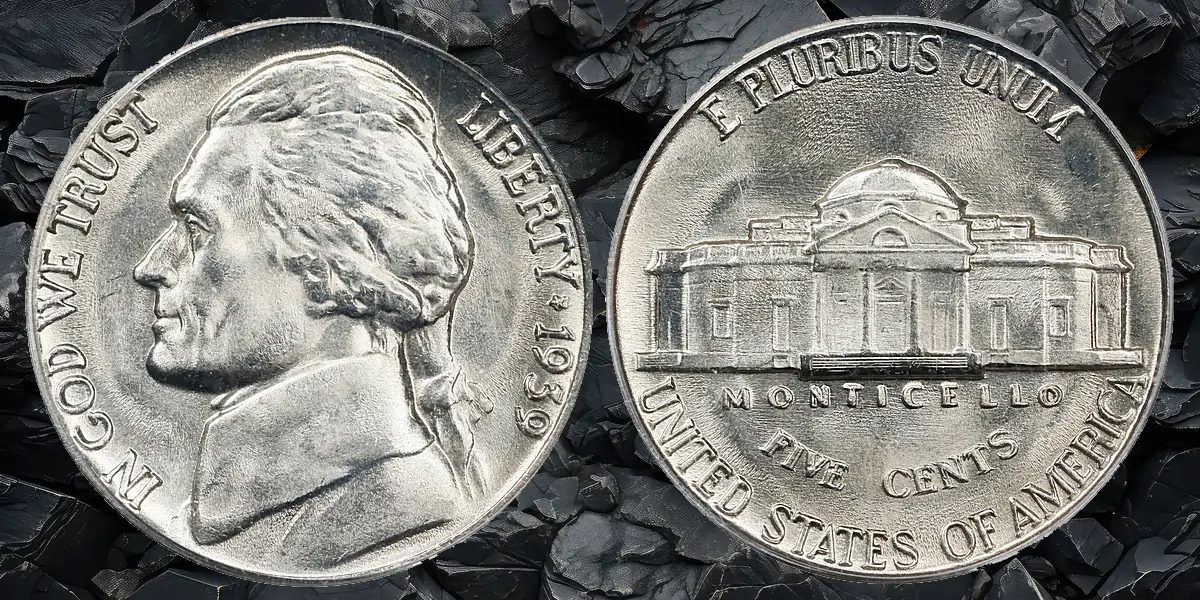
The coin offers the look collectors want. It shows lustrous, smooth, brilliant surfaces. It also displays razor-sharp detail across the reverse, including the central design elements around Monticello. That matters because strike quality defines the upper end of this variety.
This coin also carries an important pedigree.
It comes from the Alan Harlan Collection. Earlier, it appeared in Heritage’s June 2008 Summer FUN Signature Auction as part of the Compradore Collections, lot 509. Then it appeared in Heritage’s February 2010 Long Beach Signature Auction, lot 306. Later, Stack’s Bowers offered it in the George “Buddy” Byers Buckeye Collection during the August 2021 ANA Auction, lot 2014.
That kind of public trail matters. It gives specialists confidence. It also separates a major variety coin from the many raw pieces that still require expert attribution.
The Legend MS67 Full Steps Benchmark
A higher-grade benchmark shows how far this variety can go.
Legend Rare Coin Auctions offered a 1939 Doubled Monticello PCGS MS-67 FS example in its Regency Auction 34 in September 2019. The coin sold for $23,500.
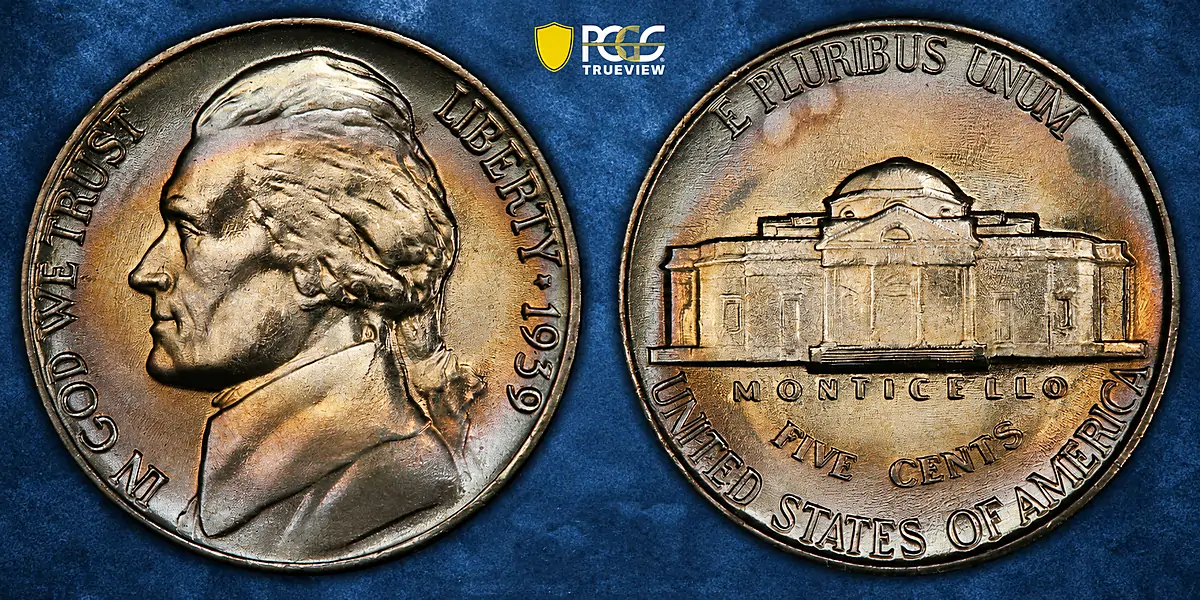
That sale showed the power of a top-tier Full Steps DDR. The catalog described fresh, lustrous nickel-silver-gray surfaces with light champagne, gold, lilac, peach, and rose toning. It also emphasized the full strike and the bold devices.
Most importantly, the catalog corrected the shorthand. “Doubled Monticello” may appear on labels and in listings, but the coin is a true Doubled Die Reverse. FIVE CENTS also shows bold doubling.
That point should guide every collector who searches for one.
How to Check a 1939 Nickel
Start with the reverse.
First, examine FIVE CENTS. Look for a strong southeast spread. Next, inspect MONTICELLO. Look for eastward doubling with a slight southern shift. Then study the steps. The well-known FS-801 listing belongs to the broader Reverse of 1940 classification, with sharper steps than the Reverse of 1938.
Also, watch for old holders and incomplete labels. A holder may say only “1939,” “Reverse of 1940,” or “Doubled Monticello.” Some holders may miss the variety entirely.
Finally, remember that condition changes everything. A circulated example can still carry real value. However, Mint State coins, Full Steps examples, and CAC-approved Gems move into a very different market.
The Bottom Line
The 1939 Jefferson Nickel Doubled Die Reverse remains one of the great cherry-pickable U.S. coin varieties.
It has visible diagnostics and an old-school discovery story. It has real rarity, plus a strong market from circulated grades through elite Full Steps coins.
Most regular 1939 nickels will never become valuable. Yet this one variety turns a five-cent coin into a serious numismatic prize.
That is why collectors should keep looking.
The next 1939 DDR may not come from a major auction. It may come from a jar, a roll, a folder, or a holder that nobody read closely enough.
Coin Specifications
- Country: United States
- Year of Issue: 1939
- Denomination: Five Cents
- Mint: Philadelphia
- Mintmark: None
- Business-Strike Mintage: 120,615,000
- Composition: 75% copper, 25% nickel
- Weight: 5.00 grams
- Diameter: 21.2 mm
- Edge: Plain
- Designer: Felix Schlag
- Major Variety: FS-801 Doubled Die Reverse
- Common Nickname: Doubled Monticello
- Primary Diagnostics: Doubling on FIVE CENTS and MONTICELLO




I have alot of old old dimes quarters and nickles. Silver dollars. Can someone answer with me back about somethings please. Thank you
@Evelyn Pointon This isn’t a “what’s it worth” site, but a good way to start would be to get a copy of the famous “Red Book” guide that will give you important info about how to locate mint marks, make estimates of a coin’s condition, and so on. All of those factors are needed to get even a rough idea of a coin’s value.
Armed with the Red Book, you can find lots of verified information at major numismatic sites like those run by the ANA, PCGS, and other agencies as well as others that are privately run by coin experts.
I’d caution against relying on general auction sites such as the two whose names both start with “e” and end in “y”. While they have a lot* of very good information, my experiences have been that there’s at least as much that ranges from poorly-informed to deliberately misleading. Knowing what’s what can be very difficult unless you’re already a well-informed collector.
If you find a coin that appears to be very rare and/or valuable, my recommendations would be to first have it evaluated by a local dealer, preferably one who’s certified by one of the major coin agencies. If that pans out, you could have the coin further investigated by sending it (insured, of course) to one of those agencies for evaluation. However you need to decide up front whether the coin’s possible value is high enough to justify the cost of evaluation.
Happy collecting!
(*) FWIW, two words rather than one. Also “nickel” rather than “nickle”. :)
What would you like to know?
Cool coin
What a great story. Thank goodness there are nickel rolls to inspect
I have a 1941 nickels in very good shape I need to know is it worth anything
Previous to this article I have not checked any nickels. I will begin to from now on.
I imagine actually spotting the doubling effect is not as easy as you may think. I’m looking at the one in the article and it’s not as obvious as you make it sound.
I’ve been collecting coins for years an I’ve come across a few 1938 an 1939 but not many with Full Steps, But I have some good ones in my collection my Friend,, An thanks for sharing it was very helpful
I have a 1964 Nickel in very good condition Iwant to know if it worth.
@Eunice Addo: A quick search will tell you that 1964 was and still is the highest-mintage year for Jefferson nickels. They still show up in change occasionally. Unless yours is either a proof or uncirculated coin, it’s only worth 5¢ despite its age.
To explain the high mintage: 1964 was the last date (though not the last year!) for 90% silver coins in the US. The changeover to clad coinage triggered a massive wave of hoarding and melting; combined with the new JFK half dollar being saved as a keepsake, denominations from the dime on up started disappearing from circulation. Merchants were forced to use large numbers of cents and nickels, the only two base-metal coins in use at the time, to the point where even those denominations were hard to come by. To blunt the problem the Treasury increased production of those two denominations until enough higher-denomination clad coins became available.
Bought a set of unc nickles to brighten up my Dansco album. About a month later, flipped the 39 and almost died. Low and behold, i was starring at a mint condition Fs 801. FS is debatable but a beautiful raw DDR MONTICELLO. Still has the mint luster and oil like finish. Brought it to a few shows and was told it’s the nicest one grader has even seen in the raw. I still haven’t had it sent off yet. But need to either sell or get it slabbed.
I remember as a kid in the 50’s pulling ’38s and 39’s outta change.
I wonder how many of them just wore down before anyone noticed.
GreAt information
Very informative article. I’ll be checking all my nickels!
Wonder if any of them passed through my 80 year old hands!
Always looking for this variety in rolls. Never found one
great article!
Alot of dealers never look for this error so look at full sets to possibly find one.
Really interesting information
Good information in these articles!! One of the most poignant pieces for me was in Clockwork Squirrel’s reply above…. “being a well-informed collector”. I would add to that…. if you suspect you may have a valuable coin/coins and you want some good information… seek advice from those in the profession… not random queries on a post on ANY platform. You have no idea who is answering much less what their knowledge depth is, qualifications are let alone their level of trustworthiness!! Anyone can say/claim anything…. and sadly do, all to often these days, and people blindly believe them. Get informed!!
@Charles Emerick: Thank you so much. One of the most difficult – and sometimes contentious – things I’ve had to do over many years of collecting is to explain to a non-collector why their coin that was promoted as “rare”, “special”, etc. (especially on one of those “eXXy” sites!) is actually none of the above.
Not quite as obvious as a 1955 penny but still worth looking at …
As I start going through my fathers collection and checking each coin with new equipment this gives me something solid to search for. I have 10s of thousands of coins to sort through, most are face value, but it makes the search fun.
Dad, I wonder how many we missed going through your coin jar.
Time to check my nickles.
I have a bunch of nickels to go through but it will have to wait until I get new glasses. These old eyes aren’t what they used to be. These atricles give me so much to look for.
Nice looking coin, great article
Great info.
If I had a nickel for every nickel I don’t have, I’d be a very rich man!
I started with collecting Jeffersons 40 years ago. I have some in MS. I have never came across a more informative article than this. Time to look again with renewed excitement. My collection may have tripled in value.
nice
I didn’t see what that coin was worth. Anyone know the value?
Pocket change hunters still can find things if you look carefully!
I’ll have to check my collection.Might get lucky.!!
I was lucky to find one going through rolls of nickels in fine condition.
This is really nice
Time to recheck some old nickels.
I guess I need some better optics to check them all
A very interesting article, I only wish I had one of the DDR’s in my collection
Now I need to go through all my old nickels again. Kudos to the writers! Extremely informative and helpful.
I checked got my hopes up still great info.
How much is a 1939 quarter
I am going to check my nickels. Thank you for another informative and amazing article.
Never really paid much attention to error coins, but I have a roll of 39s I’ll have to take a look at, just for fun.
Now I will keep an eye on all my change, thanks.
very interesting
Thank you for yet another informative article.
That was a very interesting read. I’m new to coin collecting!
Time to go through the nickels I’ve been saving.
TY
I’ve never seen a double-strike IRL. Much less in pocket change. Cool.
I have a vintage sketch of Monticello that would be a great addition to anyone’s coin collection!
The amount of nickels I’ve overlook…
Excellent article. It is still amazing to me that mint errors are being discovered as we speak. The 1939 Jefferson Nickel error was unknown to me up to this moment. So, . . . let the search begin. Get out the nickels once again and let’s see what we’ve got (or not).
You really need to be watching close to see this!
I doubt “NYC subway token collectors” discovered this variety in the 1940s, because the first NYC subway token wasn’t issued until 1953! The station agents, who sat in a booth and made change for commuters, were probably the ones making the discovery, since the subway fare was a nickel from 1904 to 1948. Plenty of boring hours between commuter rushes to stare at all those nickels.
Wishing that I had been looking a lot closer years ago !
Definitely gonna be looking in my change bag!
Will find one one day.
Great story!
If a new collector seeks advice on a coin type to start collecting on a shoestring budget, I steer them to the Jefferson nickel. Quite a few older dates can still be found in circulation. What fun searching for them!
Now I need to go through my nickels again lol
It time to check my half full 5 gallon bottle.