


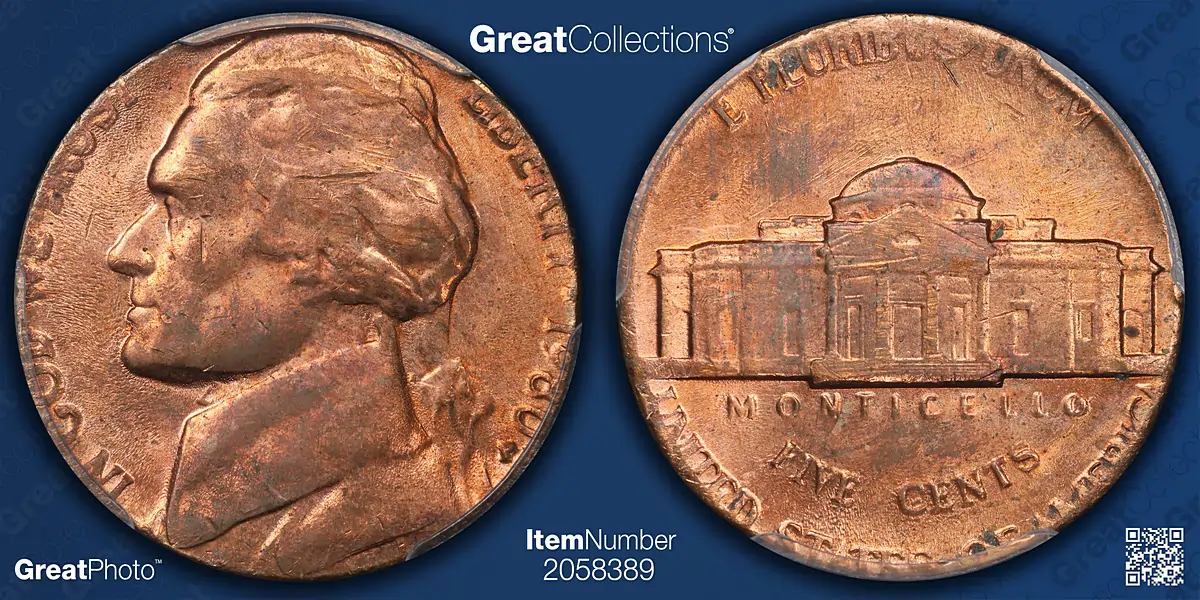
Mint errors captivate collectors. However, some errors rise far above the ordinary. The 1980 Jefferson Nickel struck on a cent planchet graded PCGS MS-64 RB stands firmly in that elite category.
This is not a minor striking flaw. Instead, it is a dramatic off-metal error that reveals how even modern Mint systems can falter. More importantly, it survived detection and entered the marketplace.
That alone gives this coin its power.
What Is a Jefferson Nickel Struck on a Cent Planchet?
A Jefferson Nickel struck on a cent planchet represents a major off-metal error.
In simple terms, the Mint struck a blank intended for a one-cent coin with nickel dies. As a result, the finished piece carries the Jefferson Nickel design on a smaller copper-colored cent blank.
The visual impact proves immediate. The coin appears undersized. The design looks compressed. Portions of the outer lettering often cut off. Therefore, even casual collectors can see that something went wrong.
Yet, this error follows a logical mechanical path.
How This Mint Error Happens
Modern coin production depends on speed and precision. Nevertheless, small disruptions sometimes occur.
Planchet Contamination
First, cent planchets can mix with nickel blanks. For example, leftover penny blanks may remain in a hopper from an earlier run. Alternatively, cent blanks may slip into a shipment prepared for nickel production.
Even one stray blank can create a major error.
Size Mismatch in the Press
A cent planchet measures approximately 2.1 millimeters smaller than a nickel planchet. Therefore, it does not fit securely within a nickel press collar.
When the press activates, the heavy nickel dies strike the smaller cent blank. Because the retaining collar cannot fully restrain the metal, the planchet spreads outward. Consequently, the coin often displays a broadstruck or distended appearance.
Design elements near the rim, such as “IN GOD WE TRUST”, may appear incomplete or partially missing.
The result looks dramatic. More importantly, it reflects a clear mechanical mismatch.
Why These Errors Rarely Escape
The United States Mint employs riddling devices to prevent wrong-size coins from leaving the facility. These screens contain holes sized to catch pieces that do not match proper dimensions.
As a result, most off-metal strikes never enter circulation.
However, no system operates flawlessly. On rare occasions, a coin slips through the safeguards. It may mix into standard bags of nickels. It may pass through unnoticed due to oversight.
Because of those strict controls, surviving examples remain scarce.
The Importance of Planchet Composition
Collectors classify these errors based on the cent blank used.
Copper Cent Planchet (Pre-1982)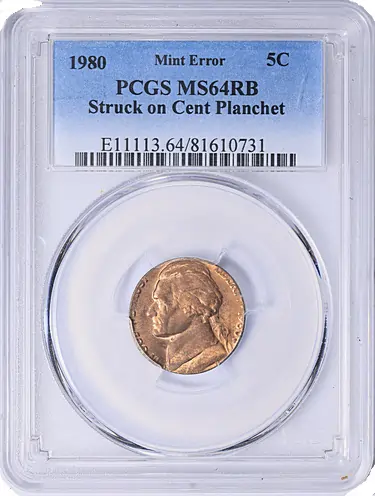
Before mid-1982, cents contained a solid copper-zinc alloy and weighed 3.11 grams. These planchets produce the classic reddish-brown appearance associated with this error type.
The 1980 example fits squarely into this category. Its Red-Brown (RB) designation reflects original red copper color that has begun transitioning toward brown.
Zinc Cent Planchet (Post-1982)
After 1982, cents shifted to copper-plated zinc and weighed 2.5 grams. If the plating fractures during the heavy nickel strike, the silver-gray zinc core may show through.
Steel Cent Planchet (1943)
The rarest and most coveted examples involve zinc-coated steel blanks from 1943. These pieces appear gray and respond to magnets. Collectors pursue them aggressively.
Transitional Errors
Occasionally, transitional mismatches occur. For instance, a 1983 nickel struck on a leftover 1982 copper cent planchet commands strong premiums. These coins combine denomination error with composition rarity.
Market Performance for Off-Metal Nickels
Jefferson Nickels struck on cent planchets qualify as major Mint errors.
Common dates such as 1978 and 1980 typically sell between $350 and $500. However, high-grade examples often exceed $1,000 to $1,700. Condition drives the upper range. Eye appeal adds further strength.
This coin carries a PCGS MS-64 RB grade. That certification confirms Mint State preservation and attractive original color. As a result, it ranks near the upper tier for this popular error type.
A Coin That Should Not Exist
In 1980, the Mint struck hundreds of millions of nickels. At the same time, it produced billions of copper cents. The system relied on scale, automation, and layered quality control.
Yet, amid that efficiency, one copper blank entered a nickel press.
The dies struck with full pressure. The collar failed to contain the smaller planchet. The coin exited the press and traveled down the production line. Somehow, it passed the riddling screens. Then it left the Mint.
This coin should not exist. Nevertheless, it does.
That improbability defines the emotional pull of major Mint errors. They freeze a brief mechanical failure inside a controlled industrial process. Therefore, they offer collectors a tangible artifact of numismatic history.
Auction Information
This Mint Error 1980 Jefferson Nickel Struck on Cent Planchet PCGS MS-64 RB is currently offered by GreatCollections.
- Auction Closes: Sunday, February 22, 2026 at 7:57:42 PM
- Auction House: GreatCollections
- Nickel-Struck-on-Cent-Planchet-PCGS-MS-64-RB






Now there’s a margin of error.
Thanks for the information.
I have one. These are really interesting errors. As are quarters on nickels, etc..
That is so cool,,, gotta love errors!
great story
would love to find one something like this…
I’ll keep my eye out!
Nice error coin!
Collecting a error coin is alot work but worth it.
This is really cool. It’s amazing how these errors happen and how they make it into circulation.
I love error coins! My collection contains multiple error & die variety coins, but no off-metal or wrong planchet errors yet.
I got one really cool one for $1,500 wanna see the picture
i’m keeping my eyes open.
I would have thought it was a penny at first glance
Very cool to see the coin being auctioned off at Great Collections by clicking in the link.
I’ve always been fascinated with errors. Thank you for the article.
I love searching for errors or varieties.
Interesting!
Cool. Anybody know of a 01 and 04 penny being silver? It weighs 2.47 and is a little wider than a penny. Like it got stretched or something. Something like perfectly stretched.
And how about a 1974 penny that weighs 2.38???
Yes my name is Philip Koerner I cosider my self a hobbiest I owned a 1980 ms 63 RB Penny Struck On a nickel Die Yes I owned a penny for a little while. AS I was zthinking about keeping It I decided it was better offer with the younger generation so I included the penny in with a bunch of other coins and sold them in on lot. Learn I ng zto collect is is fun but to let go of the past is is liking too share with other people.