


“Authenticated” Counterfeit 1901-S Barber Quarter
By Jack D. Young – The Dark Side Group
Four years ago, I worked with my friend Kevin Bailey, known to many collectors as KB, on a CoinWeek article about a certified 1901-S Barber quarter that did not prove genuine.
That case offered a clear lesson. In fact, it remains one of the most important lessons in counterfeit detection:
Attribution. Attribution. Attribution.
When collectors study key-date coins, they must look past the label. They must also study the coin. More importantly, they must confirm that every diagnostic detail matches the date, mintmark, and known die characteristics.
That point matters again here.
A Previous “Authenticated” Counterfeit 1901-S Barber Quarter
The earlier CoinWeek article examined a 1901-S Barber quarter that a third-party grading holder presented as genuine. However, the coin had serious problems.
Kevin Bailey had already written about that coin for the Barber Coin Collectors Society (BCCS). He also helped me with the technical details for my CoinWeek version.
That earlier coin turned out to be a “put together” piece. The counterfeiters had sandwiched an obverse and a different reverse together.
However, they made a major mistake.
They used the wrong “S” reverse. Specifically, they used a Reverse II. The Mint did not use that reverse beyond 1900. Therefore, a genuine 1901-S Barber quarter cannot carry that reverse.
That diagnostic detail should stop the coin cold.
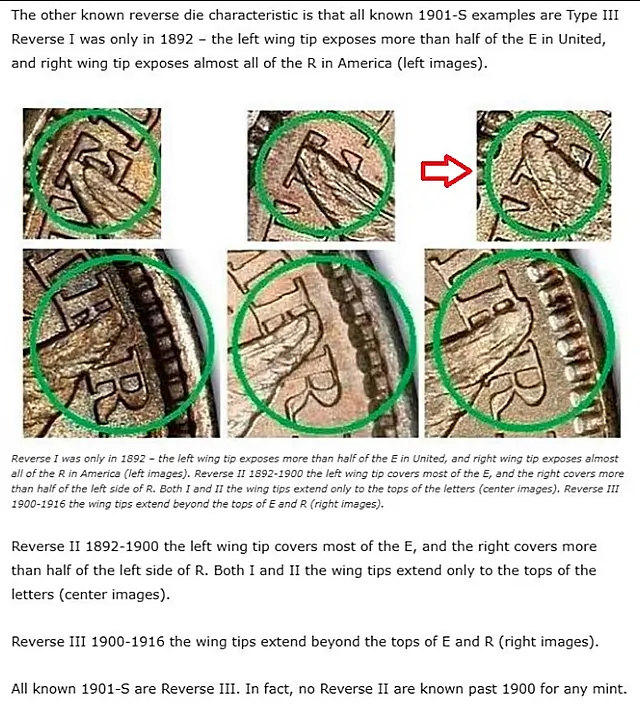
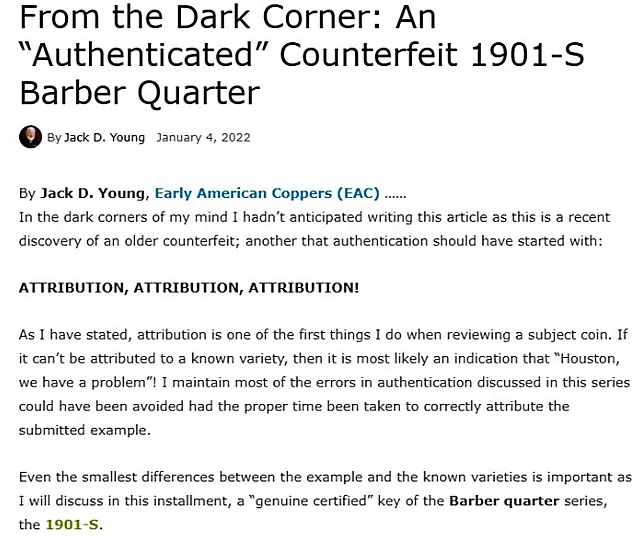
The first article also included a key image that many people had overlooked. That feature remains important in this new discussion.
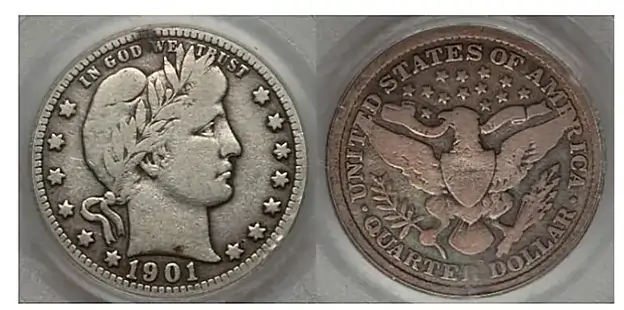 In hindsight, the earlier counterfeit also looked suspicious for another reason. The obverse and reverse showed drastically different colors. That contrast should raise concern during any careful review.
A New 1901-S Barber Quarter Raises Questions
Now, another troubling example has surfaced.
Members saw this “new” coin at a coin show. Once again, the coin sat in a third-party grading holder that presented it as genuine. BCCS members reviewed it and attributed it as counterfeit.
Then, one of my go-to contacts on these issues alerted me. He also pointed me to the current BCCS Journal, which discussed the coin.
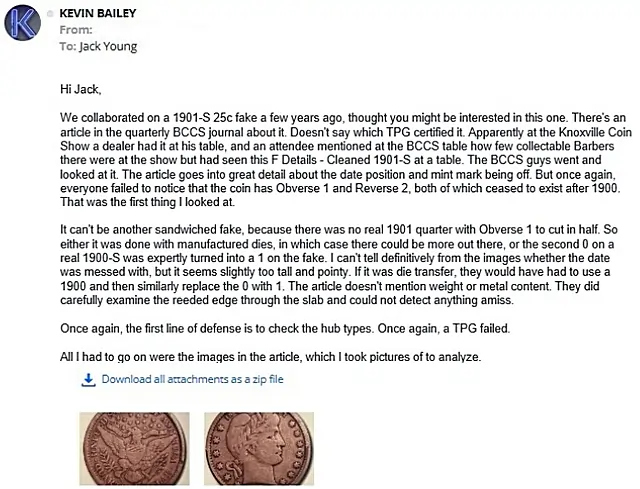
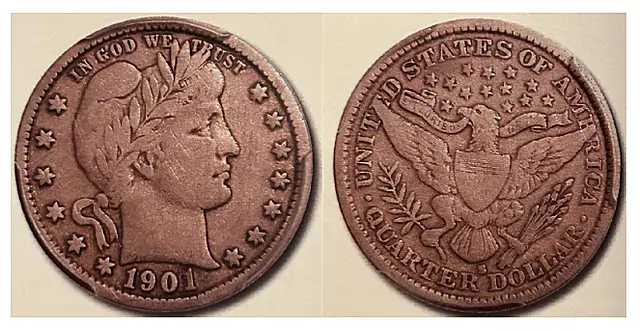 The BCCS deserves credit for finding this example. Kevin Bailey also deserves credit for correctly identifying the issues.
At first, I focused on the reverse type. That approach made sense because the previous counterfeit carried the wrong reverse.
However, this new example goes even further.
The earlier counterfeit had the wrong reverse type. This new example has the wrong obverse, too. It carries a Type I obverse. Therefore, both hub types create problems for this coin.
That makes this example different from the previous counterfeit. It also makes the attribution case even stronger.
The Obverse Denticle Count Tells the Story
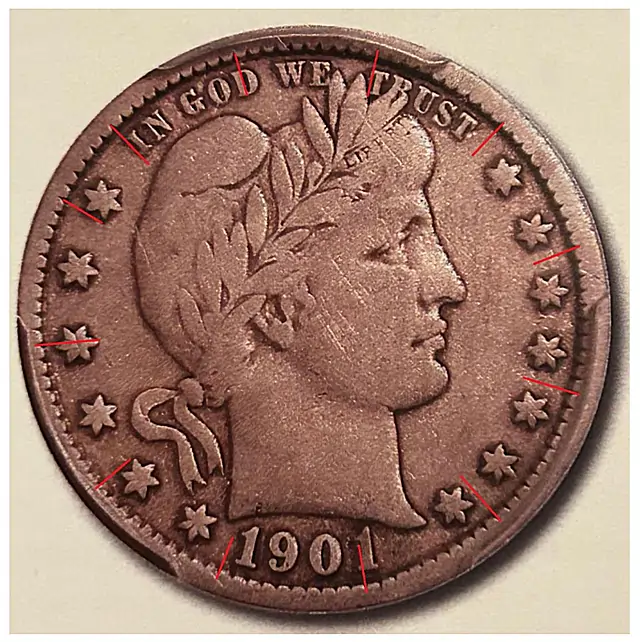
Kevin Bailey focused on a key diagnostic: the denticle count.
He wrote:
“The obverse denticle count of 116 absolutely confirms it as Obverse 1. It had previously been observed that the denticles shifted when going from Obv1 to Obv2 (and now Obv3); obverses 2 and 3 have 113.”
That matters.
A genuine 1901-S Barber quarter should not show this Obverse 1 diagnostic. The denticle count gives collectors a measurable feature. It also removes guesswork from the discussion.
In other words, this coin does not merely “look wrong.” Its hub diagnostics do not match what a genuine 1901-S should show.
Central States Images Help Confirm the Issue
The following images come from the deck used during the joint Liberty Seated Collectors Club (LSCC) and Barber Coin Collectors Society (BCCS) meeting at Central States.
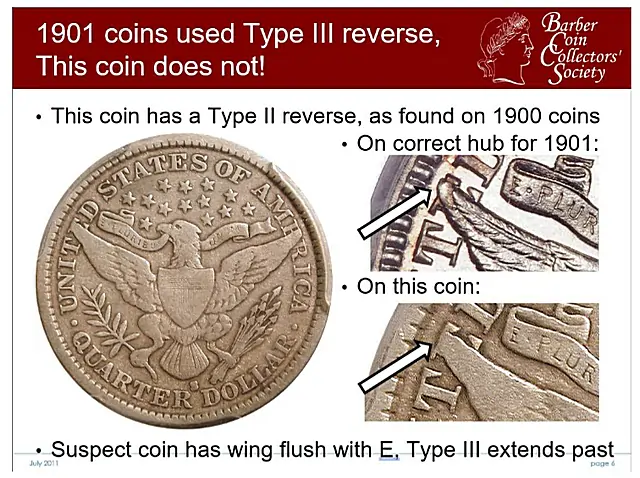
These images helped illustrate the diagnostic concerns. They also supported the conclusion that this coin does not match the correct hub type for a genuine 1901-S Barber quarter.
After reviewing the BCCS image deck, I did my traditional “dumpster dive.” I then pulled images from a prior sale.
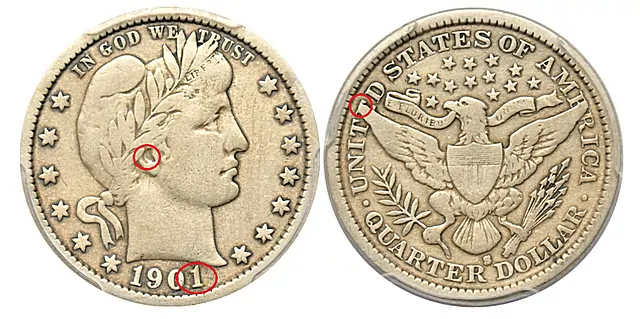
Those older images added another layer to the review.
The Date Shows Suspicious Activity
Next, I studied the date area.
The last “1” in the date shows suspicious activity. It also shows odd toning around the digit.
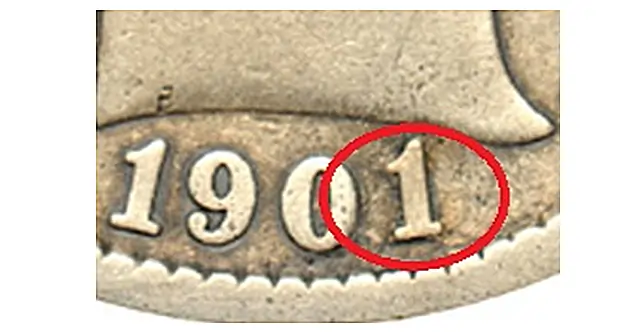
That may provide a clue.
However, the real question remains: What exactly is this coin?
One date offers a possible answer. The year 1900 appears with both combinations of the genuine hub types.
That fact matters because an altered-date theory requires a logical starting point. Also, the “S” mintmark appears close to a known genuine example. That would make the mintmark the easiest part of an altered date.
So, the best current guess may point in that direction.
Starting with a 1900 or 1900-O quarter, though, would require a lot of effort to turn it into the subject coin.
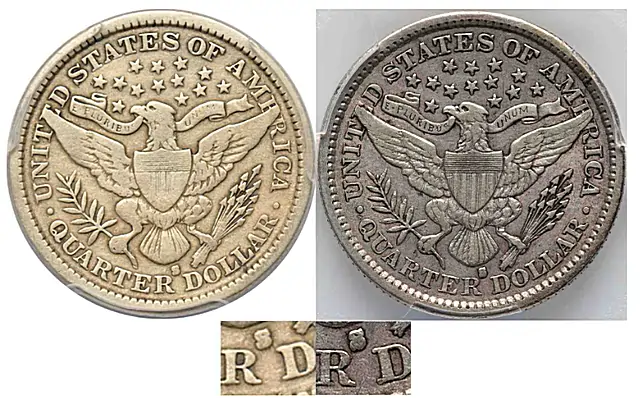
Could This Be a Struck Counterfeit?
Another possibility remains.
This coin could be a struck counterfeit from false dies. However, we have not seen another example like it.
That matters because struck counterfeits often appear in groups. When multiple examples show the same defects, researchers can link them. In this case, we do not yet have that pattern.
For now, the altered-date explanation may offer the best working theory. Still, collectors should keep an open mind until more evidence appears.
Why Do Coins Like This Get Missed?
This case also raises a bigger question.
Why do pieces like this get missed by the third-party graders?
Maybe graders do not always examine attribution details closely when they grade a coin. A coin can show the right general appearance, but the hub diagnostics still may not match.
That issue becomes especially important with rare key dates. The 1901-S Barber quarter carries major value. Therefore, counterfeiters have strong incentive to create deceptive examples.
Attribution details help protect the market.
They also protect collectors.
PCGS CoinFacts and the 1900-S Reverse Types
I also note one related issue.
PCGS CoinFacts does not appear to distinguish between the 1900-S variety with a Type II reverse and the 1900-S with a Type III reverse.
Their site shows both examples among the top three listed images. However, it notes only one variety.
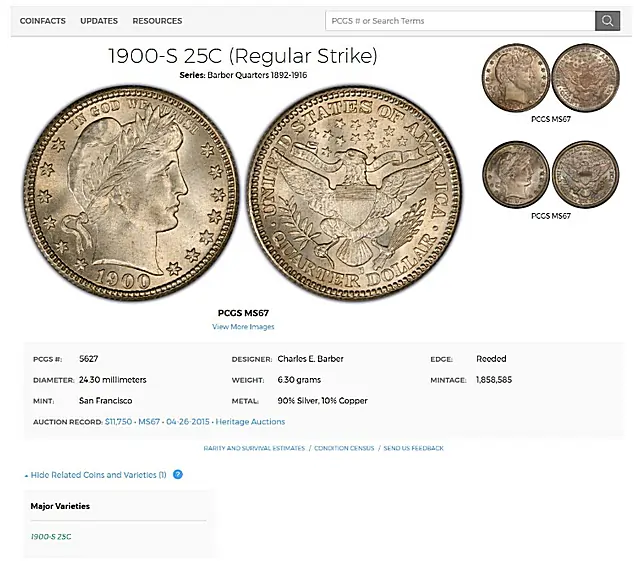
That matters because these reverse distinctions help researchers identify what a coin can and cannot be. When references blur those differences, collectors may miss important diagnostics.
The TPG Received Notice
Sources told me that the third-party grading service received notice about this coin. I feel sure my contacts there also received the information.
Now, we will see what happens next.
Will the certification get addressed? Will the coin appear again in the marketplace?
Time will tell.
Meanwhile, we will continue to watch for other examples. If more appear, they may help us understand whether this piece came from an altered date, false dies, or another method.
Best as always,
Jack





Very informative article on the counterfeit 1901 S Barber quarter.
Interesting; since the article dropped the cert went from active this morning to being terminated…
First coin I ever metal detected. Still have it.
I actually have this coin but its real
I actually have this coin but its real I have alot of collectable coins I just dont have the cash to get them graded
The Date replaced is clearly a 1903 or 1908!
I bought a number of what I was under the impression & what was described as silver dollars…. also gold Indian head 2& a half dollar, Indian head 5 dollar coins, all fake!! I’m out of 1000s of dollars,and I am not happy! Don’t know what to do…I have a bunch of counterfeit coins that are worthless….I wish I could find the clowns,I would prosecute to the fullest… don’t buy stuff off the web…
Great information.
That is very interesting I must say I do not know much about barbers and I would have most definitely been fooled by it if I had bought it. Thank you Mr Young for this very educational article.
Certification service?
What if I got the 1904 penny how much can I get for it…
I have a real 1901 and 1910 s Barbra coin
Jack , as usual you are the wizard of smart when it comes to counterfeit coin detection and more. The interesting thing is that there are many instances of die changes over the life span of a particular series . . While we think we have seen them all it is hard to pick up the nuances and keep them straight. That’s what we should be able to count on TPG services for and for the most part they succeed. We now have fake TPG holders to contend with as well but those seem to be easy to distinguish from the genuine article. Apparently it’s the Wild West and buyer better be aware even in the rare coin market in the genuine holder. The old adage applies “buy the coin not the holder” and we all need to brush up on our identification skills. I thought I was done learning man was I wrong!
Interesting!
Very informative
oops !
Great information. Hard for the amature to ensure they are not being scammed by conterfiters.
Always have to be on the lookout for fakes in the coin market, unfortunately.
Authenticated counterfeit? Now there’s an oxymoron for ya.
How about we create a state sponsored program to counterfeit Chinese coins.
With ‘Dark side’ in the title, i thought this was going to be a Darth Vader coin. lol
Great article! Loaded with excellent information.
Enjoyed article, so sad that there is such dishonest people in the world.
Good article I just wonder how often ordinary people come across counterfeits.
Very Good information. Seams like a lot of effort to go through to counterfeit a Quarter.
Interesting counterfeit, I did not know about this one.
Another gift from China???
My grandson has become interested in coin collecting. Great information.
Good info
Thanks for the info.
Oh boy. A head is gonna roll at PCGS….
What ‘third party” made a grading error like this? So collectors know to stay away from them!
Awesome information
Shows everyone makes mistakes.
Wow
I wish there was a fool proof AI method to complement studying the coin
Wow!You have to be so careful with everything you buy sell or trade
Infuriating, thank you for the information.
Interesting article thanks for all the info and the wonderful article
“Authenticated” Counterfeit, enought to make a novice nervous about buying
very nice to know on the counterfeit 1901 S Barber quarter.
Very interesting article
Not enough is done to combat counterfeiting
Fascinating. The detailed investigation surrounding these coins reverberates with a loud “Who done it?” Thank you for sharing the work that goes into authenticating coins.
Amazing how good counterfeits can be!
Very interesting, glad to have the diagnostics
When considering purchasing anything of value, we need to know exactly what we’re dealing with. We have to do our own research before we make a purchase.
Great catch!
how cool
Very informative, and also rather depressing.
Don’t have any
I need to learn more about coins selling, identity, verify and about the errors of coins I have old coins to get appraisal need HELP, THANKS, MILTON
Great article. Sad at the length people will go to deceive and profit
TY
Interesting article.
I have the same 1901 coin I don’t know if I was authentic or not cuz I’m not a coin collector but if you send me a website link I’ll send you a picture of the coin so you can tell me if it’s authentic or not I would like to sell
Darron Rivers 205)8551311 call me anytime
Lots of info! I hate it when people try to take advantage.
Very Interesting article
Interesting article
I dabble in coin collecting and am thinking about adding to my collection. I was not aware there was “authenticated” counterfeits. Are they still worth something?
Awesome coin
Very informative article on the counterfeit 1901 S Barber quarter.
Very informative article.
Excellent detective work, but also horrifying that we can’t count on these expensive grading experts to catch something that should have been obvious.
Great read!
I thank you so much for the education on the the Barbara quarter I learned a lot by reading this it will definitely help me identify certain things and I never knew before I was very intrigued I hope I find more like this to read.
I would have liked to download the literature I just read and the coins that I saw and the defects in the coins that I learned about but I didn’t see where I could download it so I can keep it maybe you can help me and send me something that I can keep that I just finished reading about the barber 1900 1901 s that is on this page thank you
I have one of these coins and it’s been drilled a small hole in it I guess for a necklace, does it have any value?
What if i told you .That i have a 1804 libety dallor coin.Fak or not it has to have value if one sold for $35000 Than mine should be worth more becouse mine in mint condition
Nice read. I wish I had more Barbers in my collection.
If anything has value it has been counterfeited by someone. Some things with little value get counterfeited because some folks like to pull one over on others.
Really enjoyed the article. Like that by by applying some deep knowledge you can solve the mystery