


This $10 Gold Coin Was Once the Only One Known, Now It is the Finest Know by 18 Points
For decades, collectors knew of only one.
Then a legendary shipwreck yielded four more.
Now, the finest certified example of the 1852 Wass, Molitor & Company $10 Close Date gold coin has returned to the spotlight. The PCGS AU-58 coin, which carries a CAC Green sticker, realized $354,375 at GreatCollections on September 27, 2026. The price included the buyer’s premium. Its hammer price reached $315,000 after 74 bids.
That alone makes the result significant. However, the story behind the coin reaches far beyond its auction price.
This rare $10 gold piece connects the failed Hungarian Revolution of 1848, the California Gold Rush, San Francisco’s chronic shortage of usable money, and one of the most famous shipwreck treasures ever recovered.
Moreover, this particular coin carries an extraordinary pedigree. It passed through the collections of A.C. Nygren and Louis E. Eliasberg Sr. Today, it also serves as the Red Book plate coin for the variety. GreatCollections describes it as the finest known by 18 grading points.
From Revolution in Hungary to Gold Rush California
The story begins thousands of miles from California.
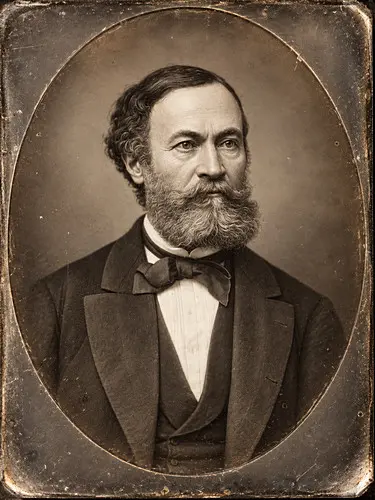
Count Samuel C. Wass and Agoston P. Molitor came from Hungary. Both supported Hungary during its struggle for independence from Austrian rule.
They also possessed unusually strong technical backgrounds for men who would later enter California’s private coinage business.
Both men had studied mining at the celebrated School of Mines in Germany. They later gained practical experience in Hungarian mines.
After Austria suppressed the Hungarian independence movement, Wass and Molitor left Europe.
California offered an obvious destination.
Wass arrived there in October 1850. He soon spent about three months studying California’s mining regions.
His detailed observations later appeared in the Alta California in January 1851.
Molitor reached California in 1851.
By October of that year, the two men had joined forces.
Wass, Molitor & Co. Opens in San Francisco
Wass and Molitor established an assay office on Montgomery Street below Bush Street in San Francisco in October 1851. Business grew quickly.
The following month, they moved into Naglee’s fireproof building at the southwest corner of Merchant and Montgomery streets. Their equipment came from London and the United States and ranked among the best available.
Just as importantly, the partners brought complementary skills.
Wass understood mining, chemistry, and mineralogy. Molitor specialized in assaying, smelting, and refining. Together, they developed one of California’s most respected private assaying operations.
Speed also mattered.
At a time when processing gold could take more than a week, Wass, Molitor & Co. could return processed material in roughly two days. That quick turnaround helped the company build trust among miners and merchants.
Soon, however, San Francisco needed more than assay services.
It needed money.
San Francisco Had Gold But Not Enough Coins
This was one of the great paradoxes of California Gold Rush.
Gold surrounded San Francisco. Convenient money did not.
Miners produced enormous quantities of gold dust and bullion. Yet businesses still needed practical denominations for wages, purchases, and everyday transactions. Federal coinage remained scarce.
The United States Assay Office produced large-value pieces, including cumbersome $50 issues. However, merchants wanted smaller denominations.
Wass and Molitor saw the opportunity.
In January 1852, the firm began issuing $5 gold pieces. About a week later, it added $10 coins.
The market welcomed them enthusiastically.
In fact, John L. Moffat complained in a letter to Treasury Secretary Thomas Corwin that Wass, Molitor & Co. coins traded at a 2% to 3% premium over equivalent United States Assay Office pieces.
Contemporary calculations also showed why.
Although the Wass, Molitor coins contained slightly lower-fineness gold than federal coins, they carried additional weight. According to contemporary reporting cited by PCGS, a $5 Wass, Molitor coin contained about $5.04 worth of gold when valued at the United States Mint.
The company reportedly produced $7,000 to $8,000 worth of coins per day during part of this period.
That reputation for dependable value explains why so many Wass, Molitor coins actually circulated.
It also helps explain why high-grade survivors command such attention today.
A Liberty Head With a California Identity
At first glance, the 1852 Wass, Molitor $10 resembles a federal Liberty Head Eagle.
That similarity was intentional.
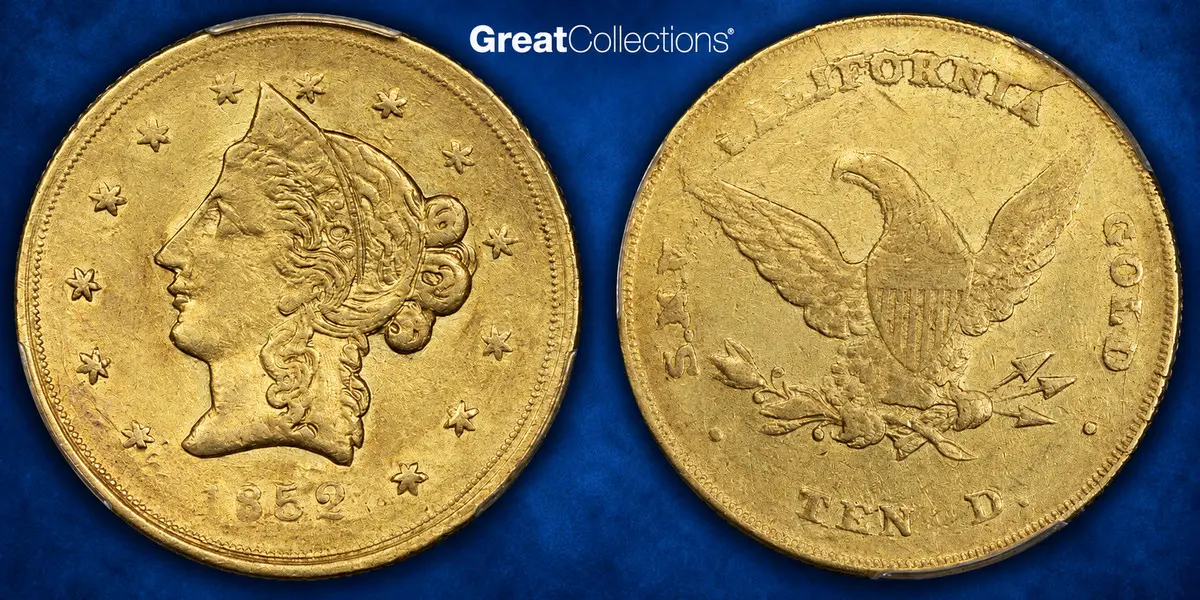
The obverse shows Liberty facing left and wearing a coronet. Thirteen stars surround the portrait. However, instead of the familiar federal inscription LIBERTY, the coronet reads:
W. M. & CO.
The date appears below.
The reverse carries a heraldic eagle with a shield on its breast. Around it appears the inscription:
S.M.V. CALIFORNIA GOLD
Below sits the denomination:
TEN D.
S.M.V. stands for Standard Mint Value.
Even more remarkably, Wass, Molitor & Co. reused a reverse die originally associated with the earlier Dubosq & Company $10 coinage. GreatCollections notes that the firm eventually paired that reverse with three successive 1852 obverse types.
The last became the famous Close Date variety.
Why the 1852 Close Date Became a Major Rarity
Not every 1852 Wass, Molitor $10 carries the same rarity.
Collectors recognize several major varieties. The Close Date sits at the top.
GreatCollections explains that the reused reverse die had become heavily cracked by the time the Close Date obverse entered service. The die apparently failed after only a small number of impressions.
Therefore, very few Close Date coins entered circulation.
Today, specialists classify the variety as Kagin-5, or K-5.
Its defining obverse combines a short-neck Liberty portrait with the closely spaced 1852 date. The reverse carries the familiar eagle and California gold inscription.
For years, collectors regarded the variety as essentially unobtainable.
Indeed, GreatCollections states that numismatists considered the Nygren-Eliasberg specimen unique until the Eliasberg sale in 1996.
Then the story changed dramatically.
The S.S. Central America Changed the Census

The steamship S.S. Central America sank in September 1857 while carrying passengers and a vast quantity of California gold toward the East Coast.
Its loss became one of the defining financial disasters of its era. More than a century later, recovery expeditions brought an extraordinary cross-section of Gold Rush gold back to the surface.
Among the recovered coins were examples of Wass, Molitor & Co.
Four were Close Date $10 pieces.
Suddenly, a variety that collectors had once treated as unique had company.
Even so, surviving examples remain exceptionally rare.
Here, however, published censuses differ.
GreatCollections currently states that six examples are known in all grades. By contrast, the current Greysheet catalog reports eight known, including four pieces recovered from the S.S. Central America. Therefore, CoinWeek considers the exact census unsettled rather than treating either number as definitive.
Either total places the Close Date among the great rarities of California private gold.
The Nygren-Eliasberg Coin Stands Apart
The GreatCollections coin does not merely survive.
It towers above the other certified examples.
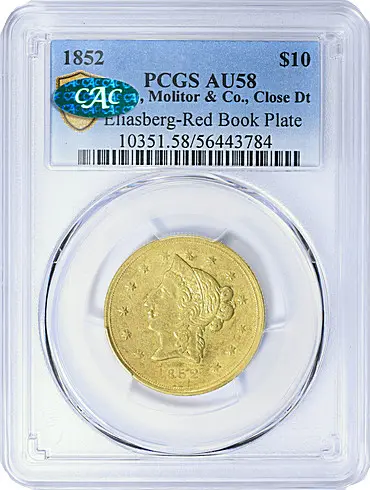
PCGS graded it AU-58, while CAC awarded it a Green sticker. GreatCollections reports that the coin stands 18 grading points above the next-finest known example.
GreatCollections also identifies it as the Red Book plate coin.
Its documented pedigree extends back more than a century.
The coin appeared in the A.C. Nygren Collection, sold by the Chapman brothers in April 1924 as Lot 144. Later, it entered the legendary collection of Louis E. Eliasberg Sr.
When Bowers and Merena sold the Eliasberg gold collection in May 1996, the coin appeared as Lot 360.
That sale proved especially important because collectors still considered the Close Date variety unique at the time.
GreatCollections also cites numismatic researchers Dr. Donald H. Kagin and David McCarthy, whose America’s Golden Age reference describes this specimen as the issue’s only known Mint State coin. The coin now resides in a PCGS AU-58 holder, so CoinWeek treats that statement as the researchers’ published characterization rather than its current certified grade.
A $354,375 Piece of Gold Rush History
The September 27 auction formed part of GreatCollections’ Centennial Collection of Territorial Rarities sale.
The collection included eight PCGS-certified coins and attracted 475 bids across the offering.
The Wass, Molitor Close Date alone drew 74 bids.
Its $315,000 hammer became $354,375 with GreatCollections’ buyer’s premium.
Yet the price tells only part of the story.
This coin represents something much larger than a six-figure territorial rarity.
Two Hungarian exiles escaped a failed revolution. They carried European mining and metallurgical expertise to California. There, they entered a city overflowing with gold yet desperately short of practical money.
They solved part of that problem by placing their own initials where the United States Mint normally placed the word LIBERTY.
Then almost every example disappeared.
More than a century later, a shipwreck surrendered several survivors from the Atlantic seabed.
And through it all, one remarkable coin remained above the rest, the Nygren-Eliasberg specimen that collectors once believed was the only one in existence.
That combination of rarity, pedigree, Gold Rush history, and survival explains why the 1852 Wass, Molitor & Co. Close Date $10 has earned true trophy-coin status.
1852 Wass, Molitor & Co. $10 Close Date Specifications
- Issuer: Wass, Molitor & Company
- Date: 1852
- Denomination: $10
- Classification: Private and Pioneer Gold
- Mint location: San Francisco, California
- Variety: Close Date, Short Neck
- Kagin number: K-5
- PCGS number: 10351
- Composition: Gold
- Shape: Round
- Edge: Reeded
- Strike: Business Strike
- Obverse: Liberty head left, 13 stars, W. M. & CO. on coronet, 1852 below
- Reverse: Heraldic eagle; S.M.V. CALIFORNIA GOLD / TEN D.
- Known examples: GreatCollections reports six; Greysheet currently reports eight
- Finest certified: PCGS AU-58, CAC Green; Nygren-Eliasberg specimen
- 2026 auction result: $354,375 with buyer’s premium; $315,000 hammer




Another very informative article!
I’d love to own a nice older gold coin. Maybe someday.
Very cool coin!!
That would be a nice coin to have.
Thank you for sharing these typee of informative posts..that is a beautiful coin!
Very interesting article and cool coin!
Good looking coin.