


For many Americans, the Oregon Trail symbolizes opportunity. However, the reality was brutal. The 2,170-mile journey across Kansas, Nebraska, Wyoming, Idaho, and Oregon tested endurance and faith. Historians estimate that as many as 20,000 pioneers died along the route. Most rest in unmarked graves.
Yet one man refused to let their story fade. His name was Ezra Meeker. Moreover, his campaign would produce one of the most celebrated and controversial coins in American numismatics: the Oregon Trail Memorial Half Dollar.
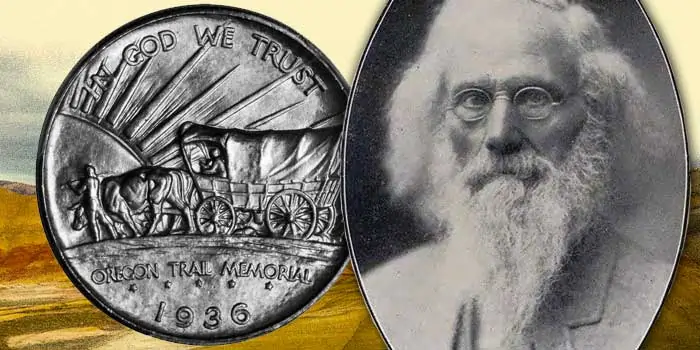
The Man Who Refused to Let the Trail Die
As a young man, Ezra Meeker traveled the Oregon Trail by ox-drawn wagon. He began in Iowa and reached the Pacific Coast after six grueling months. The experience shaped his life.
Later, Meeker built a fortune growing hops for brewing beer. However, disaster struck in 1891. An aphid infestation destroyed his crop. Consequently, he lost much of his wealth. He attempted to rebuild. Still, success proved elusive.
In his late 70s, Meeker found a new mission. He realized Americans were forgetting the pioneers. Therefore, he resolved to preserve their memory. Remarkably, he retraced the Oregon Trail by wagon once again, this time as an elderly man.
His journey reignited national interest in the trail. Communities across Idaho and beyond rallied behind preservation efforts. In particular, citizens sought to protect Fort Hall, a critical way station on the route.
Soon, supporters proposed a commemorative coin. Meeker embraced the idea. Indeed, he became the driving force behind it.
Congressional Approval and a Numismatic Vision
In 1926, Washington Congressman John Franklin Miller introduced legislation to authorize a commemorative half dollar. Ezra Meeker personally testified before the House Coinage Committee. His testimony carried weight. The bill passed with unanimous consent.
Thus began the story of the Oregon Trail Memorial Half Dollar.
The coin aimed to raise funds for the Oregon Trail Memorial Association, which Meeker helped found. Proceeds would finance historical markers along the original trail. The mission was clear. Honor the pioneers. Mark their path. Preserve history.

A Fraser Masterpiece in Silver
Officials selected the husband-and-wife team of James Earle Fraser and Laura Gardin Fraser to design the coin. Both artists already enjoyed strong reputations with the United States Mint.
James Earle Fraser designed one side. Laura Gardin Fraser designed the other.
The Obverse: Westward Into the Sunset
The obverse depicts a Conestoga wagon pulled by two oxen. A blazing sunset fills the horizon. The imagery captures both hope and hardship.
Five stars appear at the bottom. Many believe they represent the five states and territories early travelers crossed: Kansas, Nebraska, Wyoming, Idaho, and Oregon.
The design feels dynamic. It conveys motion. It tells a story in silver.
The Reverse: A Symbol of Native Presence
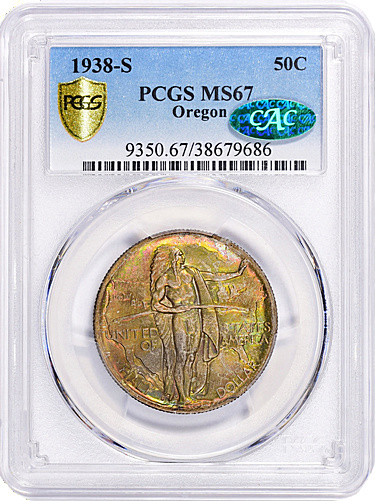
Laura Gardin Fraser’s reverse design features a Native American figure with an outstretched arm. The gesture signals peace. The figure stands before a map of the United States.
The design remains powerful and complex. It reflects the human dimension of westward expansion. Moreover, it gives the coin artistic depth rarely matched in the classic commemorative series.
Mintages, Multi-Mint Issues, and Growing Controversy
 The Philadelphia Mint struck the first 48,000 coins in 1926. Ezra Meeker stood by anxiously. He planned to sell each coin for $1. Proceeds would fund trail markers.
Later that year, the San Francisco Mint produced an additional 100,000 coins. Notably, this became the first commemorative issue struck at more than one mint.
Although Congress authorized up to 6 million coins, far fewer reached collectors. Across multiple years, 1926, 1928, 1933 through 1939, the Mint produced coins at Philadelphia, San Francisco, and Denver.
In 1928, the Mint issued another 50,000 pieces. Then in 1933, it struck an additional 17,000 coins. Total sales across the series reached approximately 264,250 coins.
However, the staggered releases created controversy. Critics argued that organizers manufactured artificial scarcity. Multiple mintmarks and limited quantities encouraged repeat purchases. As a result, some collectors grew frustrated.
Nevertheless, the series endured. In fact, it became the longest-running classic commemorative coin program in United States history.
Ezra Meeker’s Final Journey
Ezra Meeker lived to age 97. Even in advanced age, he remained committed to the trail’s memory.
In 1924, he crossed portions of the Oregon Trail by airplane. His pilot, Lt. Oakley G. Kelley, had achieved fame just one year earlier. Kelley completed the first nonstop transcontinental flight from New York to San Diego without refueling.
The symbolism felt profound. Meeker had crossed the frontier by wagon as a boy. Decades later, he soared above it in a modern aircraft. America had changed. Yet he ensured its history endured.
Market Performance and Collector Appeal
Today, the Oregon Trail Memorial Half Dollar ranks among the most admired classic commemoratives. Its artistry stands out. So does its dramatic backstory.
Many circulated examples remain affordable. However, certain issues command strong premiums. High-grade examples from Denver or San Francisco, such as the 1934-D, 1938-D, or 1939-S, often achieve significant prices when certified in top condition.
Collectors appreciate both the design and the narrative. Few coins blend art, advocacy, controversy, and American mythology so effectively.
Why the Oregon Trail Half Dollar Still Matters
The Oregon Trail Memorial Half Dollar does more than commemorate westward expansion. It reflects a citizen-led preservation effort. It honors sacrifice. It highlights early 20th-century commemorative coin politics.
Above all, it tells a human story.
Ezra Meeker lost his fortune. Yet he found purpose. He retraced the trail in his 70s. He testified before Congress. He sold coins for history, not profit. Because of him, thousands of markers now trace a once-forgotten path.
That legacy gives the coin its enduring power.
The 1938-S Oregon Trail Memorial Half Dollar PCGS MS-67 (CAC Green) (Toned) coin presented in this Coin Profile is up for Auction on GreatCollections as GC Item ID:1889914 The sale ends on Sun, Feb 22, 2026
* * *





Spectacular coin
Always loved these coins, wish they were more accessible
This is why coin collecting is so fun, the history is just fascinating behind so many coins.
The power of 1 man!
The information about the Oregon Trail half dollar was very informative
SUPER NICE COIN & A HISTORY LESSON.
Very few of our coins deliberately omit the word “LIBERTY.” This is one. Anyone know of others outside of omitted edge lettering and other errors?
What a beautiful design coin. Love history
Cool coin!
I have never seen the actual coin. Very interesting story; I did not know he actually made the trip!!
These old commemoratives are my favorite coins, I wish i had the funds to collect them.
I didn’t know there was an Oregon Trail coin – cool story!
I never knew these existed
Great story and coin, what a age we live in, he honored his past and help
Preserved the future in history and historical content in a coin.
what an amazing story
Great looking coin
Not into early commemoratives, but this is a nice coin with a rich history.
Loved this story as a kid and great to see its history in coin form
Interesting history on this coin.
Great article. Very informative
Wow! I didn’t know the story behind this coin. Very interesting!
Very historic looking coins.
A truly beautiful example of Numismatic art!
Great looking coin!!
Very cool historical background on this coin
The Oregon Trail Memorial half dollar is very lovely design coin. All the memorial Half dollars produce before 1970 were well thoughtful design to remember a well historical point in our country history.
This article is exactly why I want one of these. The Oregon Trail half has the design and the backstory. For those who own one—any buying tips? Best grade range/value spot?
Great article
My home-schooled kids had much fun playing the Oregon Trail computer game. If starvation didn’t kill you the dysentery might. Great history lesson for us all.
My homeschooled kids had much fun playing the Oregon Trail computer game. If starvation didn’t kill you the dysentery might. Great history lesson for us all.
A beautiful coin and a rich history behind it. Some day I’d love to add one of those to my collection.
Love it that I can learn the history of a coin. I am starting to build my own set based on themes.
Such a beautiful piece of history and exquisite toning!
One of the most stunningly beautiful coins that the United States has ever produced. One of these days, I will have one in my collection.
Noice!
That Oregon in 67 looks really great.
Thanks for the history lesson, I had heard the name before but didn’t know how important he was in numismatic and American history. It’s probably because of him so many died of dysentery in the computer game LOL
Great Story, that I never knew. Would be a good addition to any collection.
Being of Apache heritage, I do not celebrate the existence of this coin, but I admire Meeker for his persistence and dedication in pursuing his passion and purpose.
This commemorative is a beautiful design and the toning really makes the coin pictured very desirable.
Just love this coin and both images.
Awesome commemerative!
Thanks for another great article! I would love to have some of these coins in my collection.
I love the commerative half-dollars. All of them were very well done.
Preserving our history instead of erasing it.
Superb coin – I wish I owned one. The U.S. Mint was capable of great things in the past, and I hope they improve in the future. They are making the effort at least.
Beautiful coin!!! Love to own one!!
Imagine the mint producing confusion and manufactured scarcity. Say it ain’t so.
They would be appalled by the “artificial scarcity” these days.
Beautiful coin. Would be a welcome addition to anyone’s collection.
Great story about a coin and the man behind its creation.
GREAT article. Wasn’t even aware of this coin before. THANKS !!
Beautiful coins, I love the western coins or early 1900s coins.
Been collecting Classic Commems for 40+ years. Oregon Trail is one of my favorite series, especially nicely toned pieces. Great article.
The history of this coin and the story of the Oregon Trail is what makes coin collecting so fun for me.
Beautiful coin.
Always thought these were grossly underrated
Thanks for the informative article. This is one coin that I’d love to have! Ezra Meeker liking the history involved with coins is also why I enjoy coins.
Classic commems are some of my favorite to collect.
Coins or computer games, people have made an effort to remember those pioneers.
Mostly all Memorial coins like the Oregon Trail were very will craft to remember great moments in history of this country.
HISTORY!
Never had any idea this coin existed.
that is an absolute amazing coin–great article
TY
Awesome
Beautiful color, detail and history to this coin.
Never seen this coin in person, great find and information you provide. I look around at coin shows always. Coin Shops in Pgh. Pa. very limited to just a few. Back in the 60’s there where several shops.Times have changed. So called dealers at local shows sell the best moving popular coins only for making money.
Fantastic coin and story.
What a beautiful design and interesting story. The persistence of one man and that influence is impressive
It is amazing that Mr. Meeker was able to travel the Oregon trail twice by wagon and the later in life, fly parts of the trail by airplane.
Should do another commemorating his love of beer!
nice article I wish I had this coin. thank you
Wow, I had no idea. Thank you for sharing that wonderful story
I am impressed by Mr. Meeker! He had the passion and fortitude to preserve the history of the early pioneer spirit. Until reading this story, I never thought much about the reason for designing a coin. His spirit and the spirit of the pioneers lives on, what a GREAT thing!
Ooooo…fingers crossed I come across one of these when I’m coin roll hunting! What a beauty!