


Lost for 55 Years: Seven Uncancelled Dies Reveal the Secret Life of Indonesia’s 1971 Coins
More than half a century after Indonesia rebuilt its circulating coinage, seven pieces of the minting process have surfaced in an extraordinary form.
They are not rare coins. They are the tools that helped create them.
Numismatic error specialist and MintErrorNews publisher Mike Byers has revealed a group of seven uncancelled Indonesian dies and design-validation pieces connected to the country’s 1971 10-, 25-, and 50-rupiah coinage. NGC authenticated and encapsulated the group. According to Byers, the discovery had remained unknown to the numismatic community before its recent emergence.
That distinction matters.
Mints normally destroy obsolete coin dies or deliberately deface them after production. They do so because an intact die could theoretically strike unauthorized coins. NGC calls uncancelled dies the rarest category of surviving coin dies because they show no evidence of destruction or cancellation and seldom reach private hands.
In other words, collectors can find the 1971 Indonesian coins themselves for modest prices. More than two billion 25- and 50-rupiah pieces appear in published mintage totals.
The tools that created those designs tell an entirely different story.
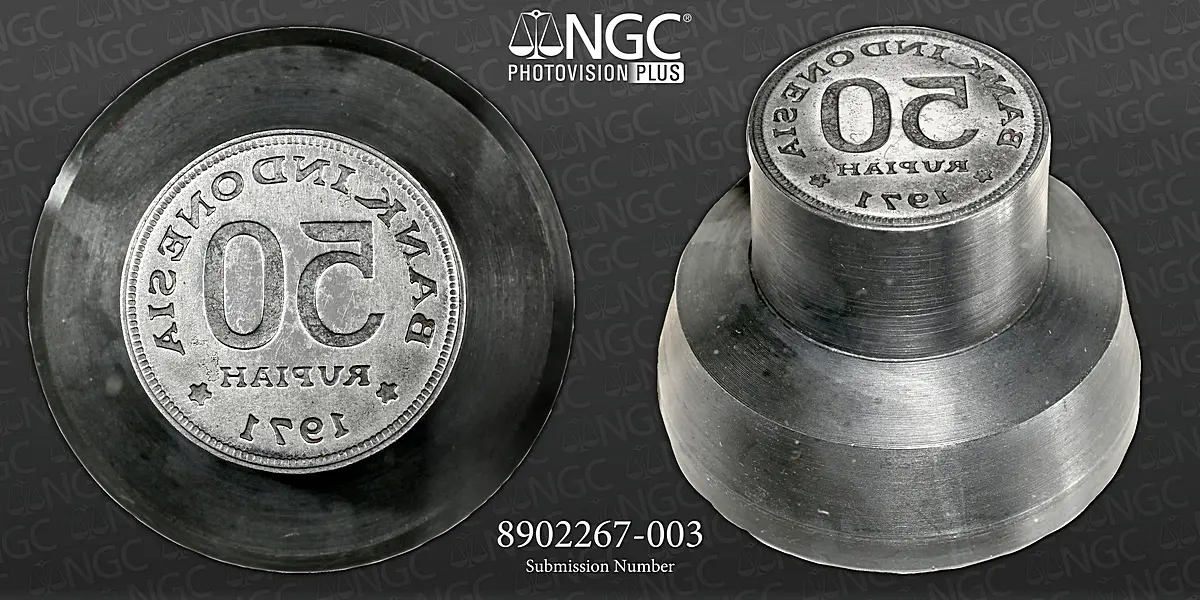
Seven Survivors From Indonesia’s Minting Floor
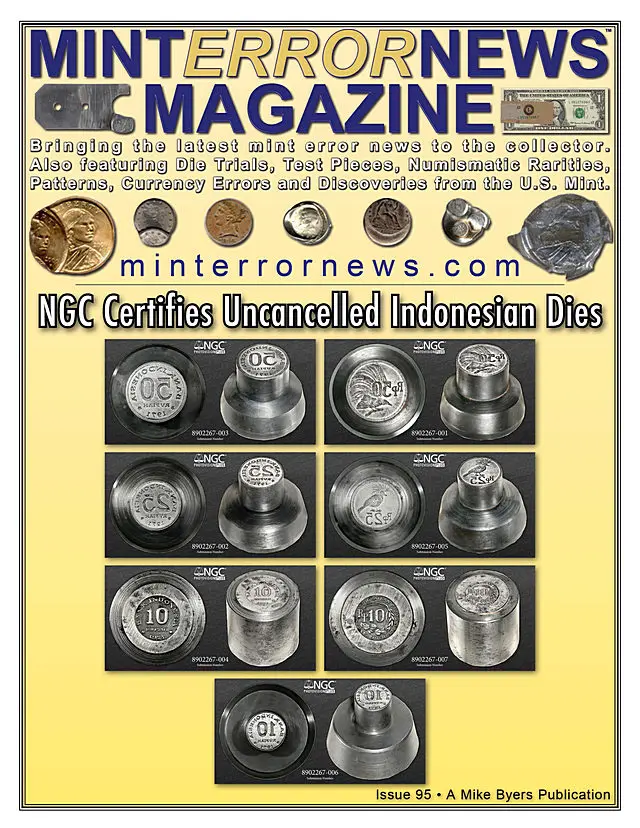
The newly certified group contains:
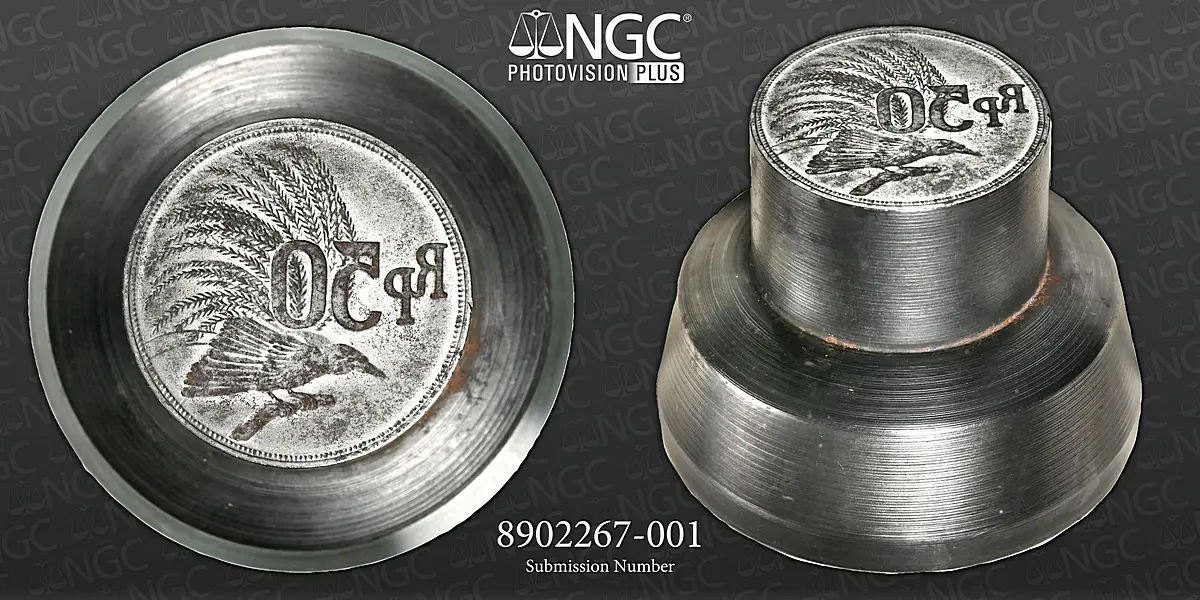
- The uncancelled obverse and reverse dies for the 1971 50 Rupiah;
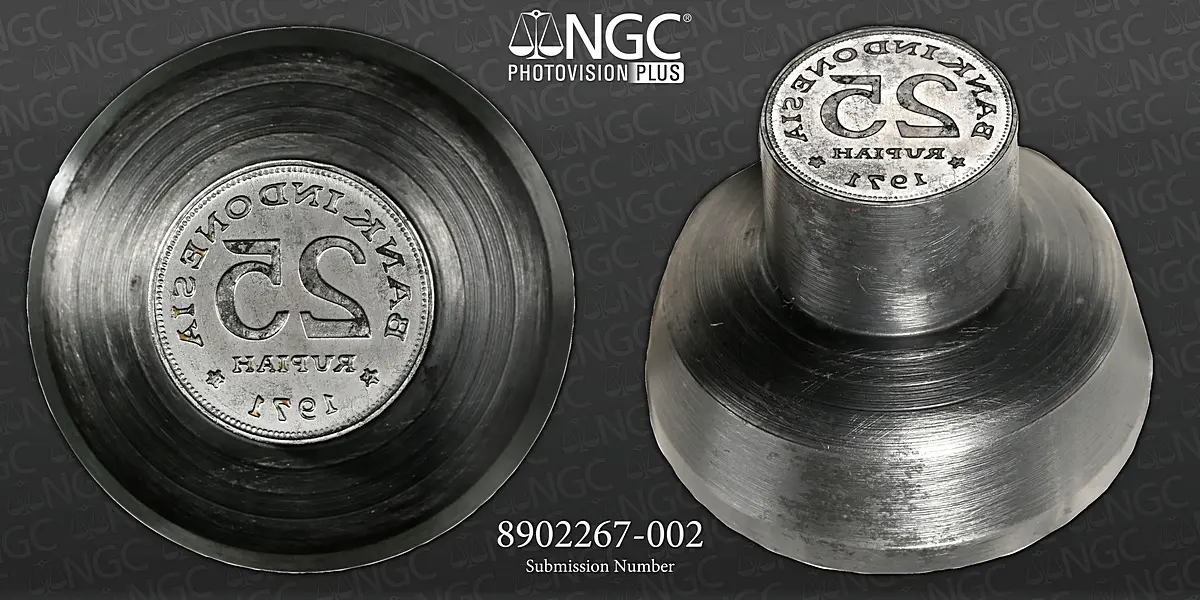
- Additional uncancelled obverse and reverse dies for the 1971 25 Rupiah;
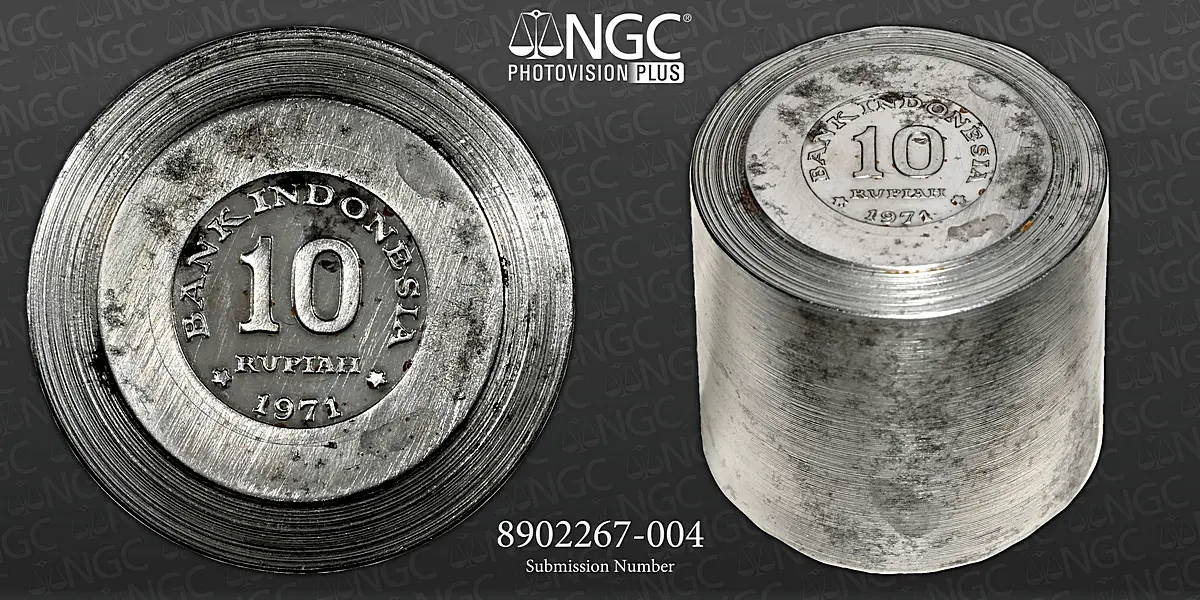
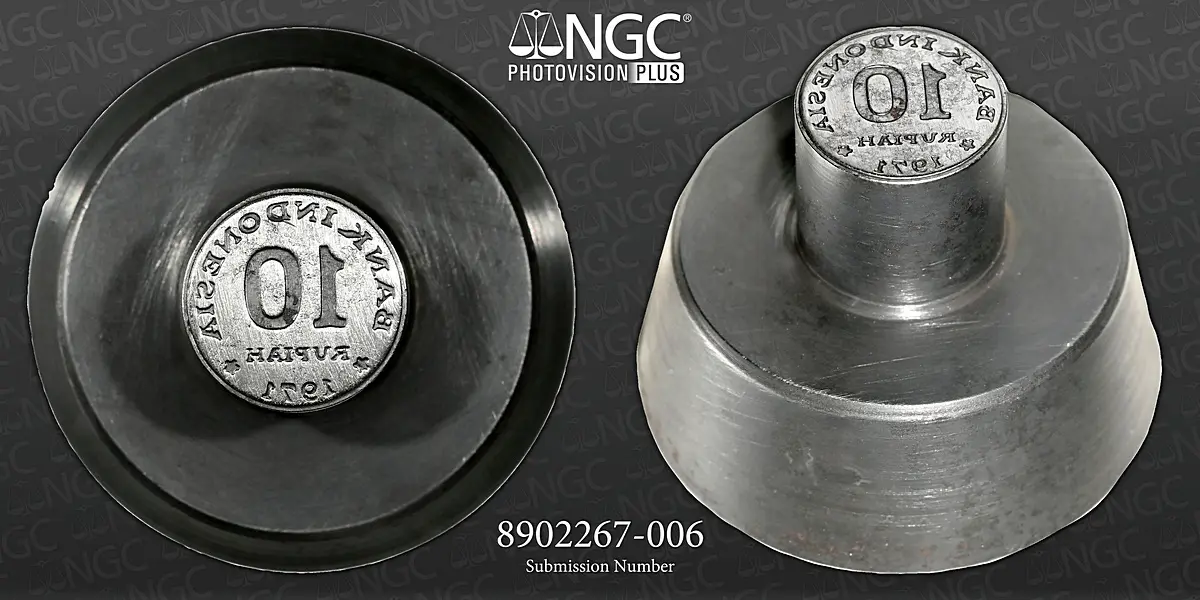
- An uncancelled obverse die for the 1971 10 Rupiah; and
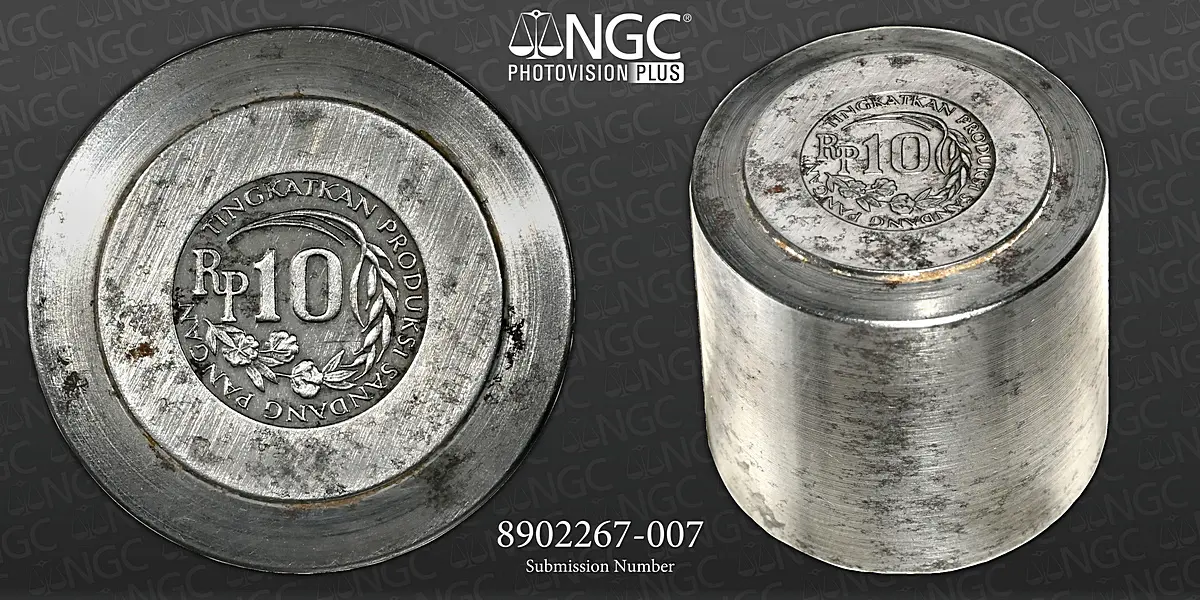
- Both obverse and reverse Design Validation, or DV, dies for the 1971 10 Rupiah.
Byers describes the last pair as pieces from the die-making process that carry the final adopted 10-rupiah design. The group therefore provides something far more revealing than a collection of finished coins. It preserves evidence from both production and design validation.
NGC’s certification adds another layer of importance. The company created its die-certification program in 2018. NGC explains that mints usually destroy dies after their useful lives end. In some cases, mints cancel them with an “X,” remove part of the design, or otherwise deface the working surface. An intact die escapes that process.
That makes this Indonesian group especially striking.
The dies do not merely represent an obscure world-coin issue. They connect directly with a pivotal period in Indonesia’s monetary history.
Indonesia Had Used Coins for Centuries
Indonesia’s monetary history stretches back long before the rupiah.
Bank Indonesia’s museum traces metal money in the archipelago through several early kingdoms. Gold and silver Ma money circulated in Java, while later kingdoms developed their own currencies. Majapahit left copper gobog pieces that researchers date to roughly the 14th through 16th centuries. Foreign money also circulated alongside local issues as maritime trade expanded.
European trade added another layer. The Spanish real reached the Indonesian archipelago, while the Dutch East India Company, or VOC, later introduced its own money. In 1727, the VOC circulated copper duit coins as low-value money. The Dutch word ultimately entered Indonesian speech, where duit still serves as an informal word for money.
Dutch colonial rule eventually centered monetary life around the Netherlands Indies gulden.
Then independence changed everything.
ORI Turned Money Into a Symbol of Independence
Indonesia declared independence in 1945. However, Dutch authorities attempted to restore colonial control after World War II.
Money became part of that struggle.
The Republic introduced Oeang Repoeblik Indonesia, better known as ORI, in October 1946. Bank Indonesia describes ORI as more than a payment instrument. It helped build solidarity and represented the sovereignty of the new republic at a moment when competing currencies circulated across the country.
The word rupiah belongs to the wider South Asian monetary family that ultimately traces to Sanskrit terms associated with silver. However, Indonesia gave the word a distinctly national identity through its post-independence currency.
Coins followed during the 1950s. Yet severe inflation eventually made tiny denominations increasingly impractical. Indonesia’s earlier sen-denominated national coinage ended in 1961.
Then inflation became much worse.
From Runaway Inflation to Coins Again
By the middle of the 1960s, Indonesia faced an economic crisis.
An IMF review published in 1970 reported extraordinary inflation during the first half of that decade. During the 12 months ending in June 1966, the Jakarta price index increased by more than 1,500 percent. The government launched a major stabilization program in October 1966.
The results came quickly.
Bank Indonesia records inflation near 600 percent in 1965. By 1971, the rate had fallen to about 2.5 percent.
That turnaround provides the real historical backdrop for the newly discovered dies.
However, 1971 did not mark the first return of Indonesian metal money, as some secondary summaries claim. Indonesia had already introduced new 1-, 2-, and 5-rupiah circulating coins dated 1970. The 1971 issues then expanded the circulating coinage with the 10-, 25-, and 50-rupiah denominations represented by the newly discovered dies.
Therefore, the dies capture the second stage of a much larger transformation.
Indonesia had moved from hyperinflation and monetary instability toward a currency system in which metal coins once again made economic sense.
A Remarkable Coincidence: PERURI Also Arrived in 1971
The date carries another important connection.
Indonesia established Perum Percetakan Uang Republik Indonesia, better known as PERURI, on September 15, 1971. The government formed the state-owned enterprise by merging PN Arta Yasa, which handled coin production, with PN Pertjetakan Kebajoran, which produced banknotes. PERURI received a mandate to produce rupiah currency and other state security documents.
Thus, 1971 sits at the intersection of several major developments.
Inflation had plunged. Indonesia had restored circulating coinage. The country also reorganized its government security-printing and minting operations under PERURI.
The surviving dies bring collectors unusually close to that moment.
Birds, Agriculture, and a New National Coinage
Indonesia did not place a ruler on these three denominations.
Instead, the designs emphasized wildlife and agriculture.
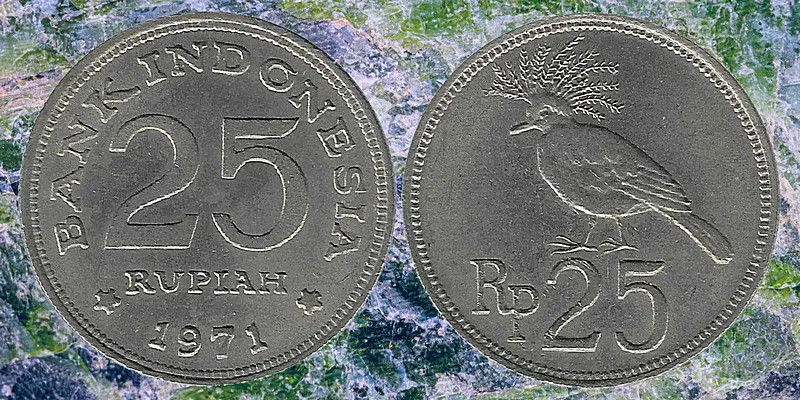
The 25 Rupiah depicts a Victoria crowned pigeon (Goura victoria), a spectacular ground-dwelling pigeon native to New Guinea and surrounding areas. Published references report a total of 1,221,610,000 pieces for the type.
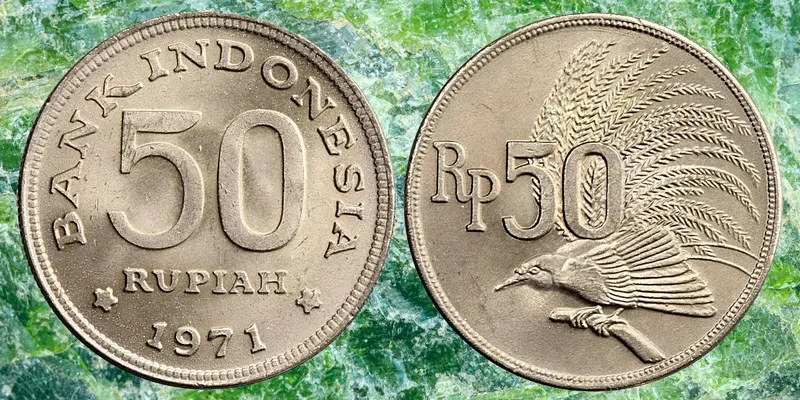
The 50 Rupiah features the Greater Bird of Paradise (Paradisaea apoda). Its dramatic plumage connects the coin with one of the most recognizable groups of birds from the Indonesian region. Published mintage data total 1,035,435,000 pieces.
Together, the two denominations brought Indonesia’s natural heritage directly into everyday commerce.
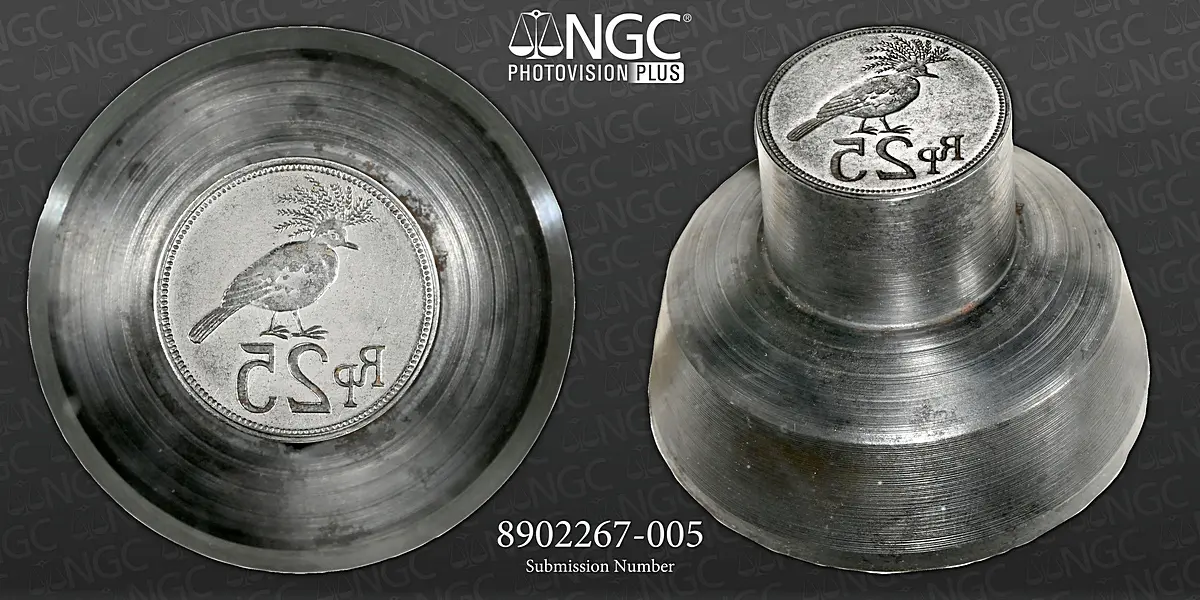
The 10 Rupiah Carried a Different Message
The 1971 10 Rupiah tells another story.
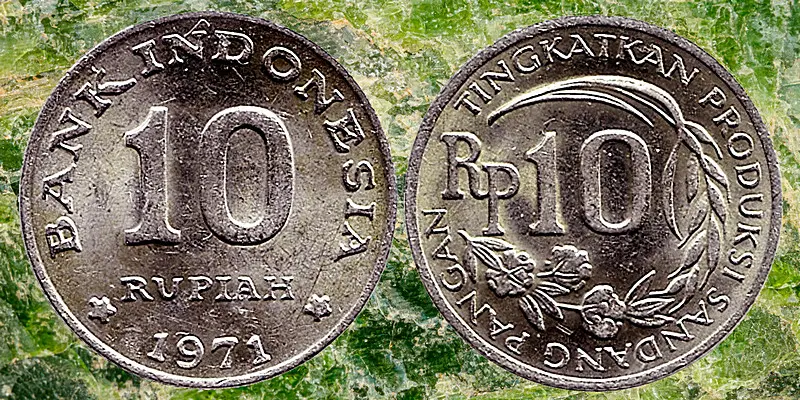
Its reverse shows rice and cotton stalks. The inscription TINGKATKAN PRODUKSI SANDANG PANGAN calls for increased production of clothing and food. Numismatic references associate the issue with the United Nations Food and Agriculture Organization program (FAO).
That message fit Indonesia’s economic priorities.
Food supply played a major role in the country’s battle against inflation. The IMF noted that rice shortages contributed to a severe inflationary surge in late 1967 and early 1968. Therefore, agriculture represented more than decorative symbolism when Indonesia placed rice and cotton on its coinage. Food production formed part of the country’s economic stabilization effort.
Indonesia struck 286,360,000 of the 1971 10-rupiah pieces according to standard catalog data.
The newly discovered group includes not only an uncancelled obverse production die for this denomination but also the obverse and reverse DV dies. Those two pieces offer a rare view into the process behind the adopted design.
The Strange Case of the Frozen 1971 Date
The 25- and 50-rupiah coins contain another numismatic surprise.
Their date does not always reveal when Indonesia actually struck them.
Numista records both types as carrying a fixed 1971 date through at least 1990. It specifically notes that 36.5 million examples of each denomination entered production in 1977 while still carrying the 1971 date.
Therefore, a 50-rupiah coin marked “1971” could have left the presses years later.
The same applies to the 25 Rupiah.
However, collectors should not extend that fact to the 1971 10 Rupiah. That particular FAO type belongs to the 1971 issue itself. Indonesia introduced different 10-rupiah designs in 1974 and 1979.
Nor can we assume that these newly discovered production dies remained in service for decades. The evidence supports long-term use of the 1971-dated design, not necessarily continuous use of these exact individual dies.
That distinction matters when studying minting tools.
Coin Specifications
- Coin: 1971 10 Rupiah -1971 25 Rupiah – 1971 50 Rupiah
- Catalog: KM#33 -KM#34 -KM#35
- Composition: Copper-nickel
- Weights: 1.77 g- 3.52 g- 6.06 g
- Diameters approx:16 mm – 20 mm – 24 mm
- Edge: Reeded – Reeded/Milled – Reeded/Milled
- Alignment: Medal
- Principal reverse design: Rice and cotton – Victoria crowned pigeon – Greater Bird of Paradise
- Published mintage: 286,360,000 -1,221,610,000 -1,035,435,000
Specifications draw from NGC, Numista, and Indonesian numismatic references.
Common Coins, Almost Impossible Tools
That contrast creates the strongest part of this story.
The finished coins did their job on a massive scale. Indonesia produced hundreds of millions of them. The 25- and 50-rupiah types ultimately reached billion-piece totals.
Yet the dies belonged to another world.
Mints create dies to manufacture money, not to become collectibles. Once those dies reach the end of their working lives, security procedures normally erase their ability to make more coins. NGC specifically notes that completely uncancelled dies seldom escape that fate.
These seven pieces did.
They also survived for more than 50 years in unusually preserved condition, according to Byers. NGC has now authenticated and encapsulated them, and Byers has offered the complete group to the market for the first time. His current listing places a $50,000 asking price on the discovery.
For specialists, however, the importance goes beyond price.
The dies connect Indonesia’s ancient monetary tradition, colonial coinage, independence, hyperinflation, economic stabilization, the creation of PERURI, and the rebirth of practical circulating coinage.
Most collectors study history through the coins a mint produced.
This time, the history survives in the steel that produced them.




Facinating story.
Wow, incredible hype (and price!) for such a mundane and insignificant group of objects.
Very interesting article on the history and rarity of these dies!