


Collectors Saved the 1909-S VDB. They Spent the Lincoln Cent That’s Rarer in Mint State
One Lincoln cent became famous almost the moment it appeared.
The other became famous because almost nobody noticed it.
That distinction explains the extraordinary story of the 1914-D Lincoln Cent. The celebrated 1909-S VDB owns the lowest mintage and the bigger name. Yet collectors who chase original Red Mint State coins face a very different reality.
In high grade, the 1914-D turns the traditional Lincoln cent hierarchy upside down.
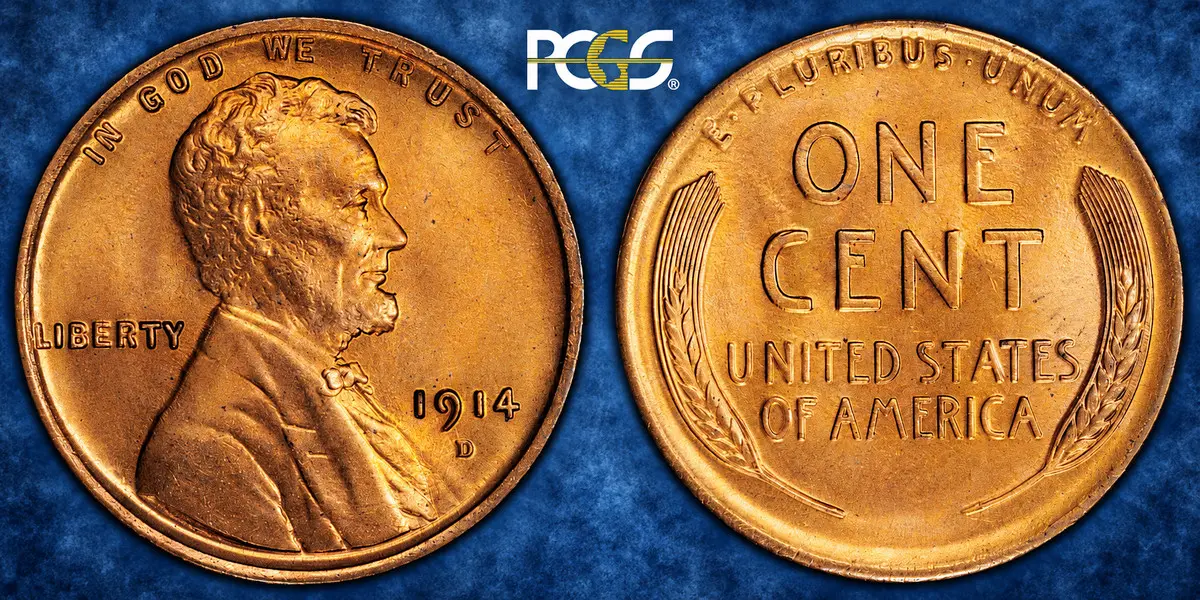
Denver struck 1,193,000 cents in 1914. That total looks generous beside the 484,000-piece mintage of the 1909-S VDB. However, survival tells the real story. Collectors aggressively saved the famous 1909-S VDB. They largely spent the 1914-D.
More than a century later, that difference has created one of the great condition rarities in American numismatics. PCGS now records more than nine full-Red 1909-S VDB cents for every full-Red 1914-D in its population report.
And at the very top, the numbers become brutal.
That makes the 1914-D far more than another hole in a Lincoln cent album. For the collector who wants an elite Mint State set, it may represent the toughest regular-issue date of them all.
The Famous Coin Got Saved But The 1914-D Got Spent
The Lincoln cent arrived with enormous attention in 1909.
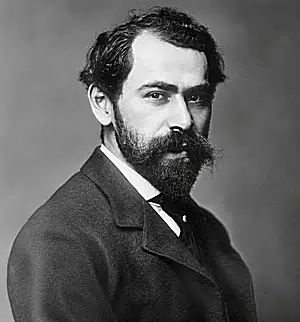
President Theodore Roosevelt had admired sculptor Victor David Brenner’s work, including his 1907 Lincoln plaque. Brenner’s portrait then appeared on the new cent. Lincoln became the first U.S. president to appear on a regular circulating American coin. The Mint released the new cents on August 2, 1909.
Then came the controversy.
Brenner’s V.D.B. initials appeared prominently at the bottom of the reverse. Newspaper criticism and public complaints quickly followed. The Mint removed the initials after only a short production run. San Francisco had struck just 484,000 VDB cents before the change.
Collectors immediately understood that something unusual had happened.
The 1909-S VDB carried a premium early. Collectors, souvenir seekers, and speculators saved examples. PCGS notes that Mint State pieces survived in meaningful numbers because people recognized the issue from the start.
Five years later, the 1914-D enjoyed none of that attention.
Denver quietly produced 1,193,000 cents. Philadelphia struck 75,238,432 that year, while San Francisco made 4,137,000. The Denver total looked small, but no publicity campaign warned Americans that they should put the coins away.
So Americans did what people normally did with cents.
They spent them.
A Rarity Created in America’s Pockets
That point matters.
The 1914-D did not begin life as a famous collectible. It began life as money.
America had not yet entered World War I. Ordinary commerce still demanded enormous quantities of small change. A cent passed through cash drawers, pockets, purses, and tills again and again.
Meanwhile, mass-market date-and-mintmark collecting had not yet transformed the hobby.
The inexpensive coin boards that helped create America’s great penny-collecting boom arrived in the 1930s. Joseph Kent Post developed the concept, and Whitman embraced coin boards as the hobby expanded. PCGS credits the boards with helping Lincoln cent collecting explode in popularity during that decade.
By then, collectors faced a problem.
Their new boards contained a space marked 1914-D.
However, the coins had enjoyed roughly two decades to circulate before millions of Americans started looking for them.
Collectors could still find worn examples. Yet the supply of fresh, original Mint State coins had already vanished from everyday circulation.
That single timing difference explains much of the 1914-D story.
The 1909-S VDB entered numismatic history almost immediately.
The 1914-D had to circulate first.
The Mysterious Hoards That May Have Saved the Mint State Population
Without a few unusual discoveries, today’s Mint State population could look even smaller.
NGC cites Walter Breen for a remarkable group of roughly 700 Mint State 1914-D cents that reportedly remained together into the early 1950s. NGC believes that hoard probably supplied many of the Mint State pieces collectors know today.
However, the historical record deserves some caution.
PCGS preserves a somewhat different Breen account. According to that version, a New England dealer held 10 rolls of Mint State 1914-D cents as late as 1943. Ten standard rolls would represent about 500 coins. PCGS also warns that Breen’s recollections do not always prove infallible.
Therefore, CoinWeek would not present “700 coins” as an established census fact.
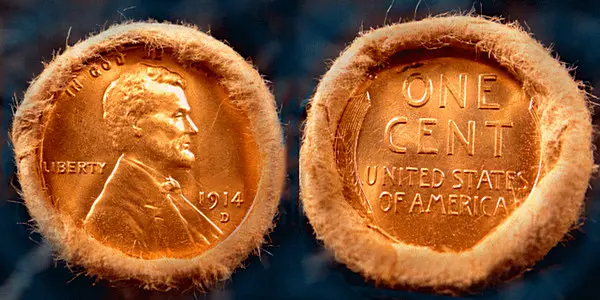
Still, both accounts point toward the same conclusion: a relatively small concentration of uncirculated coins probably preserved a meaningful portion of today’s Mint State supply.
Then another curious group surfaced decades later.
NGC cites Q. David Bowers for the discovery of two original rolls, or about 100 coins, during the 1970s. Bowers placed their origin in either Hawaii or the Philippines. The tropical environment apparently left many examples with spotting and Red-Brown or Brown coloration.
Those coins survived without circulation wear.
Nature still collected its tax.
Why Full Red Changes Everything
Copper never stops reacting with its environment.
That chemistry creates one of the great challenges of classic copper collecting. A Lincoln cent may escape wear yet gradually lose the bright orange-red color it displayed when fresh from the dies.
Grading services therefore use color designations for copper coins.
NGC classifies a coin as RD, or Red, when it displays at least 85% of its original red luster. Red-Brown, or RB, occupies the middle ground. Brown, or BN, describes coins that retain less original red.
For the 1914-D, that distinction transforms scarcity.
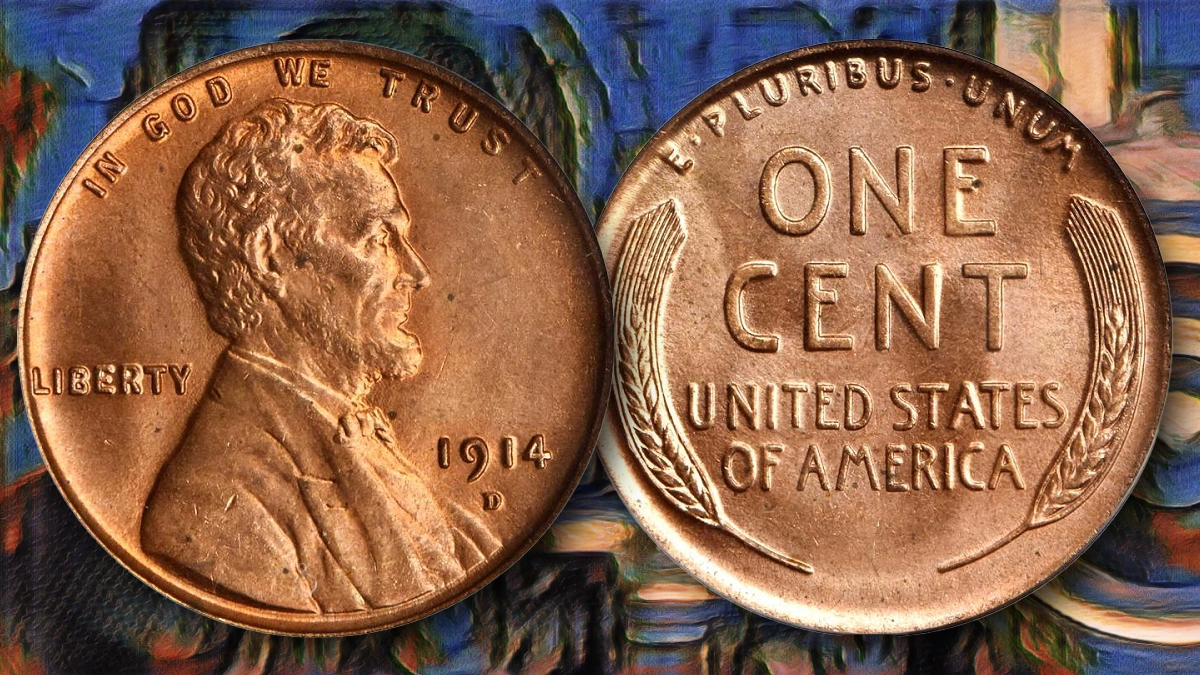
Carbon spotting also plagues the issue. PCGS calls spotting an endemic characteristic of high-grade 1914-D cents. Even top examples often show tiny carbon flecks.
Strike quality adds another complication.
NGC notes that many examples show moderate die erosion. Heavy die polishing can also weaken details, especially around Lincoln’s coat lapel. Therefore, an uncirculated coin does not automatically deliver the sharp strike and pristine surfaces that advanced collectors demand.
Put all three factors together — no circulation wear, strong strike, and original Red color — and the available population collapses.
1914-D vs. 1909-S VDB: The Numbers Tell the Story
This comparison provides the clearest evidence for the 1914-D’s extraordinary condition rarity.
PCGS updated its Population Report on September 9, 2026. It lists:
Issue Mintage PCGS RD Population:
- 1909-S VDB Lincoln Cent 484,000 2,573
- 1914-D Lincoln Cent 1,193,000 279
That means PCGS has graded more than nine times as many 1909-S VDB cents with the RD designation as 1914-D cents with the same designation.
Population reports do not equal exact survival totals. Coins can undergo resubmission, and raw examples remain outside the reports. PCGS itself cautions collectors against treating population figures as perfect rarity censuses. Still, the scale of this difference matters.
At MS66 RD, the gap grows even more dramatic.
PCGS currently reports eight 1914-D cents in MS66 RD and two in MS66+ RD. No PCGS example grades higher.
By comparison, the September 2026 report lists 288 1909-S VDB cents at MS66 RD, another 34 at MS66+ RD, and 18 at MS67 RD.
That is the statistic that changes the conversation.
The 1909-S VDB remains the glamour coin.
The 1914-D becomes the condition rarity.
Two Coins Now Share the Top
Older references describe one PCGS MS66+ RD 1914-D as the sole finest-known example.
That statement no longer holds.
PCGS now recognizes two MS66+ RD examples, with none finer. Heritage confirmed the two-coin top population when it sold the second example in January 2026.
One of those coins belongs to the celebrated Dell Loy Hansen pedigree.
That specimen previously carried an NGC MS66 RD grade. After PCGS graded it MS66+ RD, Legend Rare Coin Auctions sold it in May 2018 for an extraordinary $158,625.
That price still stands as the PCGS CoinFacts auction record for the issue.
The other PCGS MS66+ RD appeared at Heritage in January 2026. It realized $128,100. PCGS currently assigns the grade a $165,000 Price Guide value, although actual auction prices naturally depend on the individual coin and market conditions.
Even coins one grading step lower can bring remarkable prices.
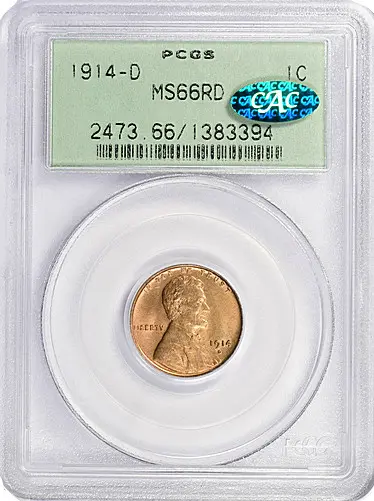
GreatCollections sold the Stewart Blay Red Copper Collection’s PCGS MS66 RD example, housed in an old green holder and carrying CAC approval, for $109,687.50 in January 2023. Another PCGS MS66 RD brought $62,156.25 through GreatCollections in November 2024. Heritage sold another for $66,000 in January 2025.
Clearly, grade alone does not tell the entire story. Color, surfaces, strike, eye appeal, pedigree, and CAC approval can dramatically influence competition.
Even a Worn 1914-D Commands Serious Money
Collectors do not need six figures to own a 1914-D.
However, even heavily circulated coins carry meaningful premiums.
As of September 2026, the PCGS Price Guide lists the Brown 1914-D at approximately $120 in Poor-1, $185 in Good-4, $260 in Very Good-8, $285 in Fine-12, and $375 in Very Fine-20. XF and AU examples climb sharply from there.
Mint State changes the equation again.
PCGS currently places MS60 BN at about $2,900. The Red designation starts around $3,100 at MS61 and rises dramatically through Gem grades, reaching $85,000 at MS66 RD and $165,000 at MS66+ RD.
Those numbers explain why collectors should never treat the 1914-D as an ordinary early Wheat cent.
The Counterfeit Problem Every Collector Needs to Know
Its value creates another problem.
Counterfeiters love the 1914-D.
NGC ranks it among the most commonly counterfeited U.S. coins. Fraudsters have produced complete counterfeits, added false Denver mintmarks to genuine 1914 Philadelphia cents, and altered 1944-D cents to imitate the rare date.
The altered 1944-D can reveal itself through incorrect date spacing. Moreover, the Mint did not restore Brenner’s tiny V.D.B. initials to Lincoln’s shoulder until 1918. Therefore, a genuine 1914-D lacks those initials, while a genuine 1944-D carries them. The mintmark style also provides diagnostic evidence.
For expensive examples, third-party authentication makes sense.
The financial difference between an ordinary 1914 cent and a genuine 1914-D can reach thousands of dollars.
That creates plenty of incentive for deception.
So Which Coin Is the Real Lincoln Cent Key?
That depends on what a collector means by “key.”
The 1909-S VDB owns the lower mintage at 484,000. It also owns more than a century of fame. Its VDB controversy gave the coin an origin story that almost no other American cent can match.
For a circulated date-and-mint collection, few collectors would challenge its status as the Lincoln cent’s signature key.
However, Mint State collectors face another reality.
NGC notes that the 1914-D has a smaller surviving population than either the 1909-S VDB or the lower-mintage 1931-S. Stack’s Bowers has gone even further, describing the 1914-D as the rarest Lincoln cent regular issue, excluding varieties and errors, in Mint State.
The population data support that view.
For collectors who demand full original Red color, the contest does not come particularly close.
The 1909-S VDB may test a collector’s budget.
The 1914-D tests patience.
1914-D Lincoln Cent Specifications
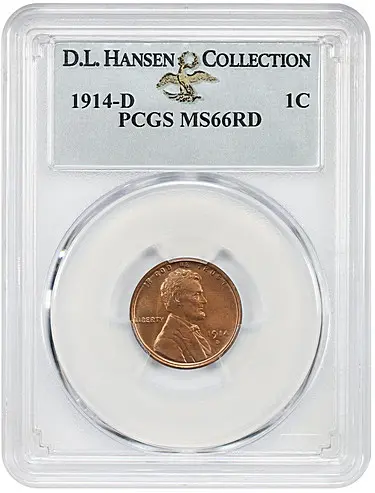
- Specification: 1914-D Lincoln Cent
- Denomination: One Cent
- Date: 1914
- Mint: Denver
- Mintmark: D, below the date
- Mintage: 1,193,000
- Designer: Victor David Brenner
- Composition: 95% copper, 5% tin and zinc
- Weight: 3.11 grams
- Diameter: 19.00 mm
- Edge: Plain
- Obverse: Abraham Lincoln portrait
- Reverse: Wheat ears flanking ONE CENT and UNITED STATES OF AMERICA
- PCGS Numbers: 2471 BN; 2472 RB; 2473 RD
- PCGS Auction Record: $158,625, MS66+ RD, Legend Rare Coin Auctions, May 2018
PCGS confirms the mintage, composition, weight, diameter, designer, edge, and current auction record.
The Coin That Became Rare Because Nobody Cared …… Yet
The 1914-D Lincoln Cent offers one of the best lessons in numismatics.
Mintage does not decide rarity by itself.
Survival does.
So does timing.
Collectors knew the 1909-S VDB mattered almost immediately. They saved it, protected it, and gave it a reputation before most examples had a chance to wear out.
The 1914-D received no such protection.
It entered circulation as a cent. Americans spent it as a cent. Then, nearly 20 years later, a generation of new collectors opened their penny boards and discovered one stubborn empty hole.
By then, the damage had occurred.
Today, two PCGS MS66+ RD coins sit at the summit. Hundreds of Red 1909-S VDB cents populate grades where only a handful of 1914-D examples survive.
That gives the 1914-D its special place in the Lincoln cent series.
The 1909-S VDB became famous and people saved it. The 1914-D became famous because they didn’t.




I love old copper red pennies that are mint
Very interesting article.
Great article. Learn something new every week from your articles.
Beautiful coin!
Interesting article
Terrific article. I wonder if mine is real?
Love those Wheatley’s.
Always wanted a nice 14-d didn’t think of my old place holder as worth much.
Thanks for the deep dive into this elusive coin.
Maybe one day I can complete my penny collection
I save every single penny that I can and still go out purchasing what I can.
Nice article
Great story!
Interesting that the 1914-D commands such attention. How hard would it be to find a nicely circulated copy.
Love learning about pennies that have value
Collected pennies all my life. Never even thought of a circulation story like this. Amazing every time I come to this sweepstakes. Thanks.
Very interesting and desirable.
1976D Lincoln wheat memorial penny copper zinc 3.11g
Normal
good information
Really cool story on pennies. Thanks.
Always learning from these articles.
Years ago, my parents had eight 1914 d cents saved in circulated condition. A baby sitter stole them in the late 1950s. sigh
If I only would’ve known decades ago…..wow, what a gem of value I would have…great article indeed
So much to learn, so many variables. Great information
Ty
To almost the entire population, a penny is a penny. Some people just throw them away as if they are worth nothing. It is wonderful to have the knowledge that certain coins of certain dates and conditions may be worth much, much more
Awesome article,
It causes one to pause and look at the new coins coming out each year and wondering, “Which one of these will end up worn by use and the coins sacked away become prime collector’s pieces some day?”
I have a 1914 cent but not sure if it has a mint mark that area has like a dye chip or some type of coating. It’s mostly brown with a red rim.
Letters are clear. Should I get it graded?
Great Article!!! I found a 1914-D Lincoln Cent in G-4 condition in change back in the early 1960’s!!!
As a kid always checked my pennies thinking I might find a 1909 S-DVb, who would have thought to save the 1914-D
I never knew that the 1914D regular issue was such a low mintage.
Very interesting read about the 1914-D cent and it’s rarity!
Great issue.
great article, now i have to look through all my pennies in my collection!
Really good article. I saved pennies as a kid b/c i did not have enough money to save quarters. I have a collection of wheat pennies in a 5 gallon bucket that i moved through the years since 1967. I wonder if I might be hiding one????
For me, Lincoln cents are far and away the most fun coins to study. These days, I’d be hesitant to purchase any 1914-D that hasn’t been graded by ANACS, NGC, or PCGS.