


A Tiny Mark on This Massive 1687 Gold Coin Reveals a Much Bigger Story
A massive gold coin struck for a king who would lose his throne only a year later will offer collectors a direct link to one of the most turbulent chapters in British history.
Sovereign Rarities will hold Auction XXIII in partnership with The Royal Mint on Tuesday, September 22, 2026. The live sale begins at 10 a.m. BST. The 475-lot auction ranges from ancient coins to modern British issues and commemorative medals. Moreover, it features the Kilmarnock Collection of Mary, Queen of Scots and James VI coins and Part III of the Highcliff Collection of British and European Medals.
Yet one coin provides an especially powerful historical centerpiece.
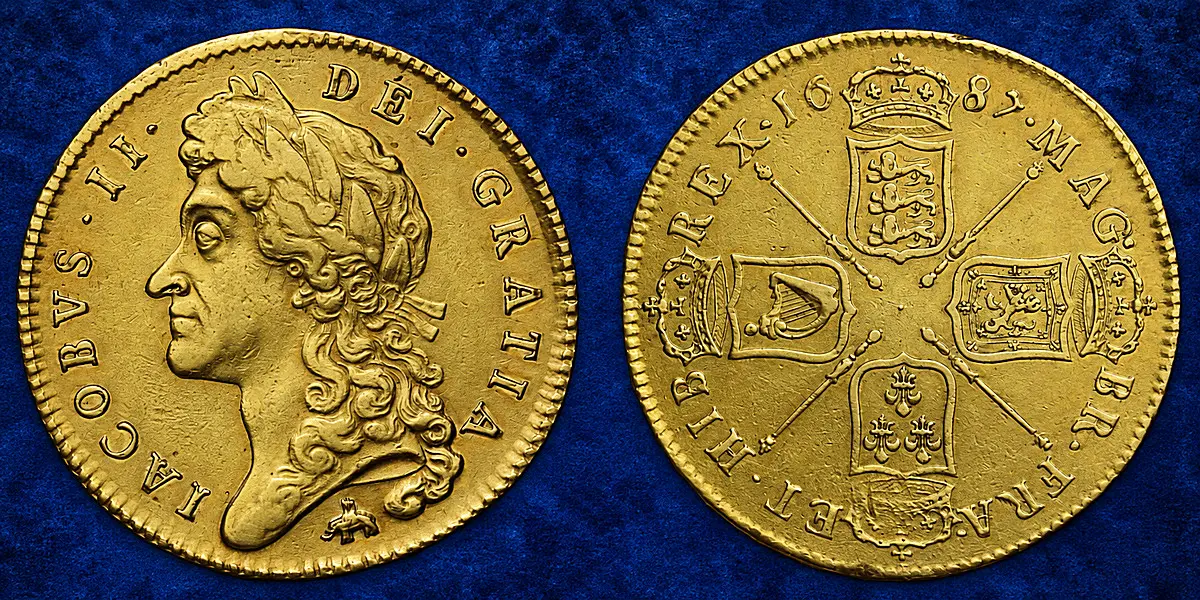
Lot 170 is a rare 1687 James II gold Five Guineas bearing an elephant-and-castle mark beneath the king’s portrait. Sovereign Rarities opens bidding at £9,000. At 41.76 grams, the coin is a substantial piece of 17th-century gold. More importantly, that small symbol beneath James II links the coin to the Royal African Company and to the complicated history behind the birth of the guinea.
A Five-Guinea Coin From the Last Full Year of James II’s Rule
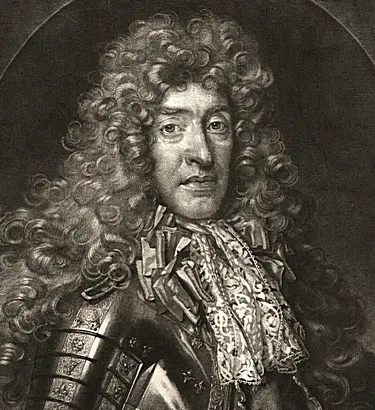
James II succeeded his brother Charles II in 1685. His reign lasted only three years.
By 1687, political and religious tensions had already intensified. James issued his Declaration of Indulgence that year as he attempted to loosen restrictions on Catholics and Protestant dissenters. His policies increasingly alienated political and religious leaders. Then, in November 1688, William of Orange invaded England. James eventually fled to France, bringing his English reign to an end.
That timeline gives the 1687 Five Guineas remarkable immediacy. The Tower of London Mint produced this imposing gold coin near the end of a monarchy that was about to collapse.
The Royal Mint had occupied the Tower of London since the late 13th century. By James II’s reign, mechanized screw presses had replaced England’s old hammered-coin process.
In fact, the Royal Mint Museum describes James II’s reign as the first to produce exclusively milled English coinage.
The Tiny Mark That Changes the Story
The most important detail on Lot 170 sits beneath James II’s laureate portrait.
An elephant carrying a castle identifies gold supplied through the Royal African Company. Auction catalogs sometimes call the device a mintmark. However, it works more precisely as a provenance or source mark because the coin itself came from the Royal Mint at the Tower of London.
The Royal Mint Museum confirms that the Royal African Company supplied West African gold for British coinage and used the elephant or elephant-and-castle symbol on some coins produced from that supply.
That history carries a darker dimension.
James had served as governor of the Royal African Company while still Duke of York. The company traded gold and silver from West Africa, but it also became deeply involved in the transatlantic trafficking of enslaved Africans. The Royal Mint Museum notes that the company transported thousands of enslaved people annually by the 1680s. Therefore, the mark beneath James II’s portrait connects this coin not only to the origins of Britain’s guinea coinage but also to the broader economic system in which the company operated.
Few details on a coin carry that much history in so little space.
Why the 1687 Elephant-and-Castle Five Guineas Is Rare
Sovereign Rarities cites total British gold output for calendar year 1687 at £401,301. That figure covered the gold denominations produced that year: Five Guineas, Two Guineas, Guineas, and Half Guineas.
However, only a small portion of that gold carried the elephant-and-castle source mark. In 1687, the mark occurs on Five Guineas, Guineas, and Half Guineas. The Two Guineas did not carry this particular mark.
The best evidence for the Five Guineas’ relative rarity comes from a long-term market study.
In 2005, researchers examined auction catalogs and dealer lists dating from 1960 through 2005 for The Rarity of Five Guinea Pieces – An Analysis, which appeared with the Samuel King Collection sale.
That study recorded 38 individual market appearances for the 1687 elephant-and-castle Five Guineas. By comparison, researchers recorded 127 examples of the regular 1687 Five Guineas without the mark.
Those figures should not be interpreted as a current population census. However, they show how much less frequently the elephant-and-castle variety appeared in the numismatic marketplace during that 45-year study period.
The market has repeatedly treated the type accordingly. For example, Heritage sold an NGC MS60 1687 elephant-and-castle Five Guineas for $156,000 in November 2020. Spink sold another example, graded NGC AU55, for £50,000. These higher-grade pieces also demonstrate how sharply quality can influence prices for the type.
A Royal Portrait in Nearly 42 Grams of Gold
Chief Royal Mint engraver John Roettier created James II’s coinage punches and dies. The Five Guineas shows the king facing left beneath a laurel wreath.
Around the portrait appears: IACOBVS II DEI GRATIA
The inscription translates as “James the Second, by the Grace of God.”
The reverse carries four crowned cruciform shields with sceptres in the angles. Around them appears: MAG. BR. FRA. ET. HIB REX.
That legend continues the royal title: “King of Great Britain, France, and Ireland.”
Then comes another important feature. Raised lettering around the edge reads: DECVS ET TVTAMEN ANNO REGNI TERTIO
The inscription means “An ornament and a safeguard, in the third year of the reign.” The phrase DECVS ET TVTAMEN later returned to British coinage on the £1 coin introduced in 1983.
1687 James II Five Guineas Specifications
- Monarch: James II
- Date: 1687
- Denomination: Five Guineas
- Mint: Royal Mint, Tower of London
- Production Method: Milled coinage
- Metal: Gold, approximately .917 fine / 22 carat
- Standard Weight: About 41.94 grams
- Diameter: Approximately 37 mm
- Obverse: First laureate bust of James II facing left; elephant and castle below
- Reverse: Four crowned cruciform shields with sceptres in angles
- Edge: Raised-letter inscription
- Engraver: John Roettier
- King Survey: 38 market appearances, 1960–2005
The traditional standard for the type calls for approximately 41.94 grams of 22-carat gold and a diameter near 37 mm.
The provenance for Lot 170 records a private purchase from A. H. Baldwin on February 15, 2013.
From James II to Charles III: More Than Three Centuries of British Gold
The auction’s gold offerings also illustrate how Britain’s largest royal gold coins evolved after the Five Guineas era.
Lot 183 jumps forward exactly 200 years to Queen Victoria’s 1887 Jubilee gold Five Pounds. Joseph Edgar Boehm’s crowned Jubilee portrait appears on the obverse, while Benedetto Pistrucci’s St. George and the Dragon dominates the reverse. NGC graded that example MS60, and bidding starts at £3,800.
Later Five Pounds issues continue the royal portrait sequence. Lot 231 offers a 1980 Elizabeth II gold Proof Five Pounds with Arnold Machin’s portrait and Pistrucci’s famous reverse. NGC graded the coin PF70 Ultra Cameo.
The timeline reaches the present reign with Lot 250, a 2023 Charles III Coronation gold Proof Five Pounds. It carries Martin Jennings’ special crowned portrait of the king and Pistrucci’s St. George reverse. NGC graded that coin PF70 Ultra Cameo.
Auction XXIII even includes a 2026 Charles III gold Proof Five Pounds marking the 100th anniversary of Queen Elizabeth II’s birth. Its reverse revives Mary Gillick’s first portrait of the late queen.
Together, these coins create a remarkable visual timeline of British monarchy in gold.
Why Lot 170 Stands Apart
Large gold coins naturally command attention. However, size alone does not make the 1687 James II Five Guineas important.
Its appeal comes from the collision of rarity, politics, economics, and history.
It dates to the final full year of a king whose removal reshaped the relationship between monarchy and Parliament. It comes from the first English reign to rely entirely on milled coinage. In addition, its elephant-and-castle mark traces part of its metal supply to the Royal African Company and the complex, often disturbing history surrounding that organization.
Finally, the surviving market evidence suggests collectors encounter the marked 1687 Five Guineas far less often than the ordinary issue.
That combination makes Lot 170 more than another large British gold coin.
It is nearly 42 grams of evidence from a moment when Britain’s monarchy, money, overseas commerce, and political order were all changing at once.
Sovereign Rarities Auction XXIII, presented in partnership with The Royal Mint, begins at 10 a.m. BST on Tuesday, September 22, 2026.






Great coin, great article and very cool elephant and castle mark
Beautiful coin! I’m trying to put together a collection of the British monarchs, but I have so far been unsuccessful in obtaining a James II coin of any denomination.
Interesting