Lost Sidney Poitier Medal Hubs Resurface 25 Years Later
Article Based on content sent to CoinWeek by Ken Potter on Sept.11, 2026
Some numismatic artifacts tell their story through the coins or medals they produced. Others survive long after the finished pieces have disappeared from view.
A remarkable pair of massive steel hubs from the former Roger Williams Mint belongs in the second category.

Numismatist and error-coin specialist Ken Potter owns the matching obverse and reverse hubs for a three-inch presentation medal honoring legendary actor and diplomat Sidney Poitier. Roger Williams Mint produced the tooling for Costco’s second annual Scholarship Fund Breakfast in 2001.
Each hub weighs about 11 pounds. Potter measured the face of the obverse hub at 76.27 mm with a digital caliper.
More importantly, the tooling preserves a date that gives the medal an unexpected historical context: September 20, 2001.
That was only nine days after the September 11 terrorist attacks.
Yet the significance of these pieces goes well beyond their proximity to one of the defining events in modern American history. They connect an important private American mint, a pioneering Hollywood figure, a major educational initiative, and the industrial process behind medal production.
Sidney Poitier and the Costco Scholarship Fund
Costco launched its Scholarship Fund in 2000 to help outstanding students attend the University of Washington and Seattle University. The program grew rapidly.
Basketball legend Earvin “Magic” Johnson spoke at the inaugural breakfast. Then, in 2001, organizers selected Sidney Poitier as the keynote speaker.
That choice carried considerable weight.
Poitier had broken one of Hollywood’s most important racial barriers decades earlier. In 1964, he became the first Black actor to win the Academy Award for Best Actor, earning the Oscar for his performance in Lilies of the Field. His honors also included Golden Globe awards, NAACP Image Awards, a Grammy, and the Screen Actors Guild Life Achievement Award. Moreover, Poitier served as the Bahamas’ ambassador to Japan from 1997 through 2007.
The scholarship program itself had already demonstrated tangible results. The first Costco breakfast raised enough money to make 91 scholarship offers to prospective University of Washington students. The second breakfast generated funding for another 70 prospective students.
Potter’s documentation identifies the September 20 event with the Costco Scholarship Fund Breakfast in Bellevue, Washington. The College Success Foundation independently confirms Poitier as the program’s 2001 keynote speaker.
What cannot be documented is the emotional atmosphere described in the AI-generated version of this story. There is no reason to invent one. The date engraved into the tooling supplies enough historical context on its own.
An 11-Pound Portrait of a Hollywood Pioneer
The obverse hub carries a high-relief portrait of Poitier along with a facsimile of his signature.
The reverse takes a different approach. Its design centers on a torch of knowledge above a map of North America, surrounded by a laurel wreath. Potter describes the reverse as a “Great American” motif.
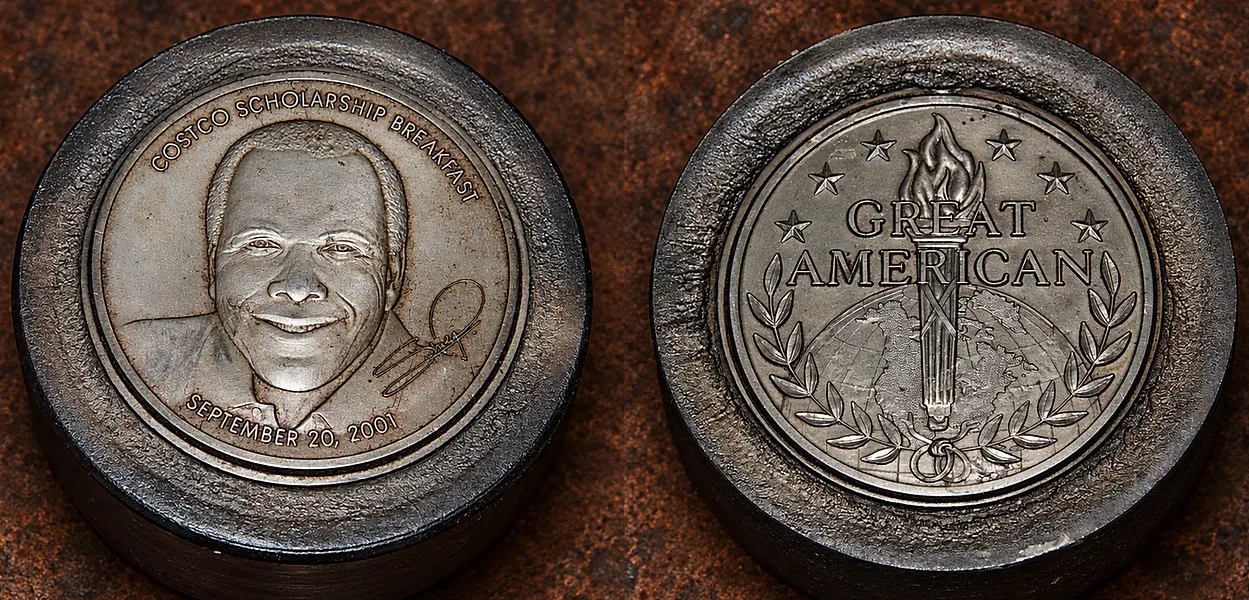
These are not ordinary dies or medals. They are production tools.
A hub carries a design in positive relief. The minting process uses that positive image to create a die with the design recessed and reversed. That die can then transfer the positive design to a planchet. The United States Mint still describes the basic relationship in essentially those terms: the hub carries the positive image while the die acts like a photographic negative.
Consequently, surviving hubs can reveal far more about medal production than a finished medal alone. They preserve part of the manufacturing chain that made the medal possible.
Roger Williams Mint Was Once a Major Name in Tokens and Medals
Roger Williams Mint operated in Attleboro, Massachusetts, a city long associated with American jewelry and metalworking.
The firm handled a surprisingly broad range of private-mint work. It produced medals, commemoratives, amusement pieces, casino pieces, and transportation tokens. Roger Williams Mint also struck huge quantities of New York City transit tokens. Contemporary transportation records, for example, document orders totaling tens of millions of pieces.
By 2006, however, the company had reached the end of its independent existence.
Contemporary numismatic reporting states that Roger Williams Mint went out of business during the summer of 2006. Osborne Coinage of Cincinnati then acquired the company. Osborne’s own history confirms that it acquired Roger Williams Mint, along with distributor Van Brook, and incorporated the businesses into its TokensDirect operation.
That transition created an opportunity for old production tooling to escape destruction.
Ken Potter Rescues a Piece of Private-Mint History
Potter acquired numerous Roger Williams Mint hubs and punches after the company closed. Some came from the large group of tooling dispersed from the former mint.
This provenance isn’t a recent recollection. Potter discussed the material publicly more than a decade ago. In a 2013 contribution to The E-Sylum, he wrote that he owned “many hubs” from the Roger Williams Mint hoard that sold after the facility ceased operation. He also noted that the material revealed how extensively Roger Williams Mint produced medals and related pieces for outside organizations.
The Sidney Poitier hubs remained in Potter’s collection for roughly two decades.
Their survival matters. Industrial tooling carries little sentimental value once a contract ends. Steel hubs and dies can disappear into scrap, undergo destruction, or simply become separated from the finished objects they once produced.
These two did not.
Where Are the Sidney Poitier Medals?
That question may prove more interesting to collectors than the hubs themselves.
Potter reports that a medal went to Poitier in connection with the 2001 event. However, he has never encountered another example.
Nor has he seen a salesman sample, trial strike, planchet proof, or other test piece from the Roger Williams Mint production.
Therefore, CoinWeek cannot responsibly describe the medal as having a confirmed “low mintage.” The production quantity remains unknown. It is also possible that additional pieces survive in corporate, institutional, or private hands without having entered the numismatic marketplace.
That makes the search worthwhile.
A previously unknown example could establish the medal’s metal, weight, finish, edge treatment, and other production details. It could also help determine whether Roger Williams Mint struck only a presentation piece or produced a larger group for the event.
For now, the hubs provide the strongest surviving numismatic evidence.
Potter says he now plans to offer the pair at auction. Their ultimate value will depend on a market that must weigh several different collecting fields at once: medallic art, private-mint history, Hollywood memorabilia, African American history, and the legacy of Sidney Poitier.
The most compelling aspect, however, may be simpler.
Twenty-five years after the event they commemorate, two enormous pieces of hardened steel still preserve the portrait, signature, date, and manufacturing history of a medal that virtually disappeared from the numismatic record.
And somewhere, perhaps, the medal they made may still be waiting to be found.
Sidney Poitier Medal Hub Specifications
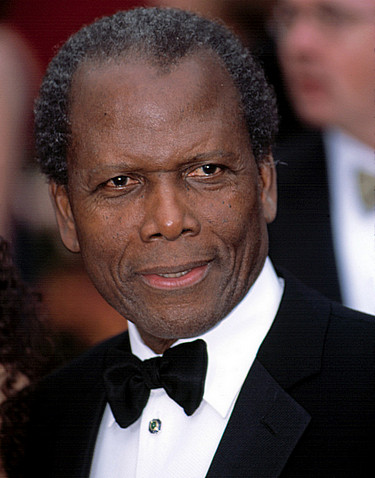
- Subject: Sidney Poitier
- Commission: Costco Scholarship Fund Breakfast
- Event Year: 2001
- Date on Tooling: September 20, 2001
- Manufacturer: Roger Williams Mint
- Mint Location: Attleboro, Massachusetts
- Tool Type: Matching obverse and reverse hubs
- Material: Hardened die steel
- Approx. Weight: 11 pounds each
- Obverse Hub Face: 76.27 mm, measured by Ken Potter
- Intended Medal Size: Three inches
- Obverse Design: Sidney Poitier portrait and facsimile signature
- Reverse Design: Torch of knowledge over North America with laurel wreath
- Medal Mintage: Unknown
- Known Trial/Sample Pieces: None reported by Potter
- Current Provenance: Ken Potter Collection