


1861-D Gold Dollar: The Only U.S. Coin Struck Entirely by the Confederacy
It looks like a United States coin.
It carries UNITED STATES OF AMERICA around Liberty’s portrait. It uses a design created by U.S. Mint Chief Engraver James B. Longacre. Even its dies came from the United States Mint.
Yet the United States government never struck an 1861-D Gold Dollar.
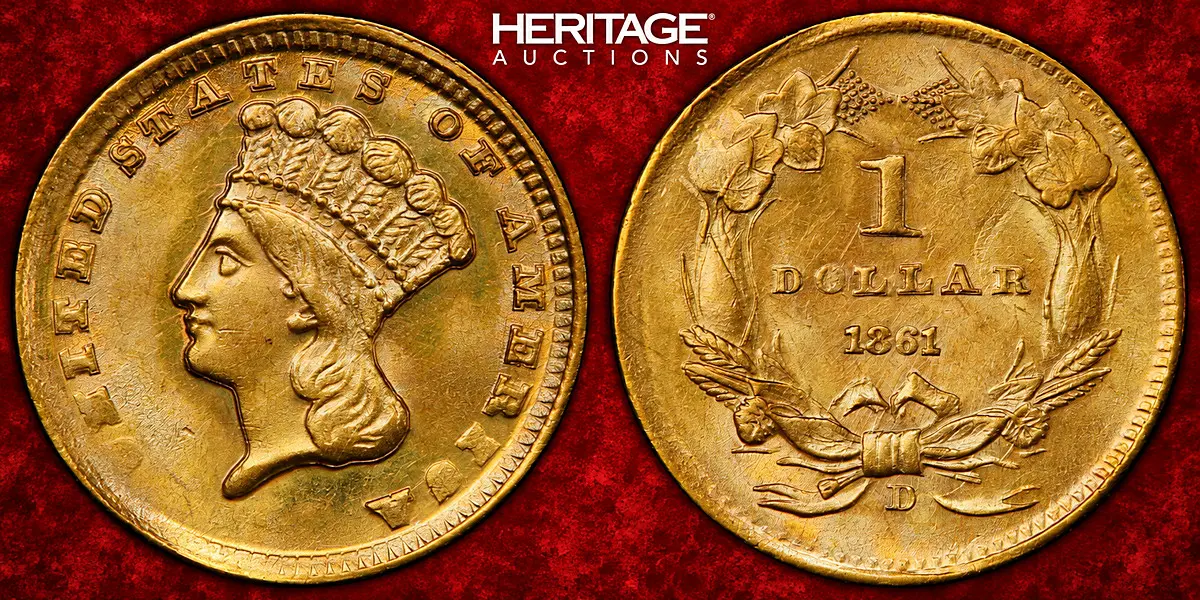
By the time workers at the Dahlonega Mint produced these tiny gold coins, the Georgia facility had passed into Confederate hands. That gives the 1861-D Gold Dollar a place in American numismatics that no other regular-issue U.S. coin can claim.
Its entire production took place under Confederate authority.
Other Southern branch mints struck U.S. coins during the chaotic opening months of the Civil War. However, those issues included coins produced before and after Federal control ended. The 1861-D Gold Dollar stands alone. No Federal production preceded the Confederate coinage.
That makes this small gold dollar one of the most tangible numismatic artifacts of the Civil War.
Dahlonega Before the Confederacy
Congress authorized the Dahlonega Branch Mint after the Georgia gold rush created a need for a Federal facility near the Southern gold fields. The mint began coinage in 1838 and produced only gold coins. Its familiar D mintmark identifies Dahlonega rather than Denver, which did not begin coinage until decades later.
By 1860, however, the country had begun to fracture.
Philadelphia sent two 1861-dated gold dollar reverse dies to Dahlonega on December 10, 1860. The branch received them on January 7, 1861.
Georgia seceded from the Union on January 19.
Suddenly, a Federal mint filled with Federal equipment and Federal coin dies stood inside a state that no longer considered itself part of the United States.
The situation became even stranger during the next several weeks.
A United States Mint Changes Allegiance
On March 9, 1861, the Confederate Congress approved a resolution to continue operations at the New Orleans and Dahlonega mints. It also instructed officials to arrange for dies for future Confederate coinage. The surviving Confederate legislation confirms that order directly.
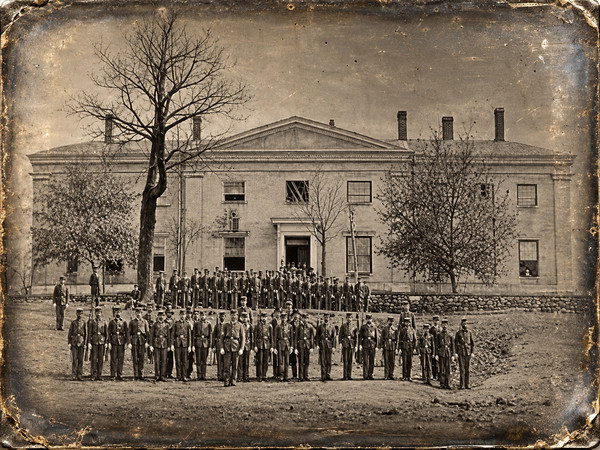
Georgia authorities had already moved to secure Federal property within the state. Then, on April 8, the Dahlonega Mint formally passed from Federal control.
Superintendent George Kellogg later told President Abraham Lincoln that Georgia had transferred U.S. public property to the Confederate government.
However, an important distinction often disappears from popular accounts of the 1861-D.
Confederate soldiers did not simply march into the coining room and start operating the presses.
The existing Dahlonega employees remained. Those experienced mint workers continued production, but they now worked under a different government. Therefore, describing the 1861-D as “struck by rebels” captures the political reality, but the actual men operating the machinery largely came from the former Federal mint staff.
That distinction makes the story even more compelling.
The machinery remained American. The dies remained American. The design remained American.
Only the authority behind the coinage had changed.
The Only Regular U.S. Coin Entirely Struck Under Confederate Authority
Dahlonega had already produced 1,597 1861-D Half Eagles before Confederate control. Afterward, workers struck additional half eagles.
Therefore, collectors cannot automatically look at an 1861-D Half Eagle and know whether Federal or Confederate authorities produced it.
The gold dollar presents no such problem.
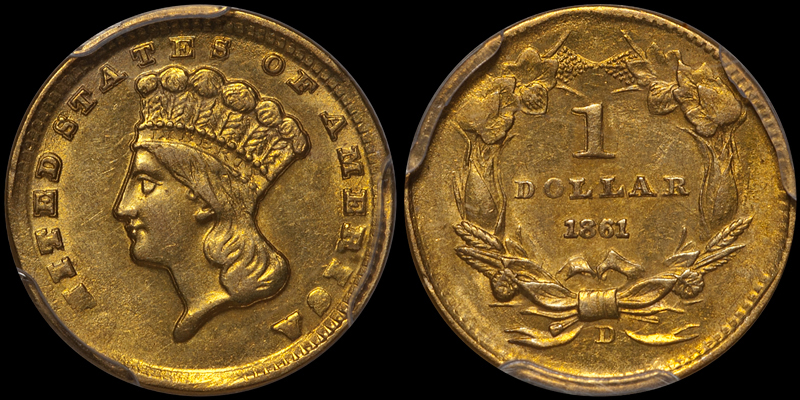 Dahlonega produced no 1861-D Gold Dollars before the takeover. Consequently, every genuine 1861-D Gold Dollar traces its manufacture to the period of Confederate control.
That is the heart of the coin’s appeal.
The 1861-D does not merely date from the Civil War. Its very existence resulted from the transfer of an American mint to a government in rebellion against the United States.
How Many 1861-D Gold Dollars Did the Confederacy Make?
No surviving Federal mintage report gives us a definitive answer.
That absence has produced competing estimates for more than a century.
Modern references generally place production around 1,000 to 1,500 coins. PCGS uses an estimate of 1,000, while NGC and the Guide Book of United States Coins have traditionally used 1,250. Other researchers have proposed both lower and substantially higher totals. Heritage noted estimates ranging from roughly 1,000-1,500 by Q. David Bowers to 2,750-3,250 in earlier research by Clair Birdsall.
Therefore, CoinWeek should describe the mintage as unknown, rather than present 1,250 as an official figure.
Doug Winter estimates that roughly 65 to 75 examples survive in all grades. Other estimates fall somewhat lower. Perhaps 10 to 15 coins survive in Mint State.
Interestingly, many survivors grade unusually high for such a rare Southern gold issue.
That probably tells another part of the story.
People apparently recognized these coins as something unusual almost immediately. Some may have saved them as Civil War souvenirs rather than spending them.
Unfortunately, others turned them into jewelry.
That fact creates another challenge for today’s collector.
Crude Production Became the Coin’s Fingerprint
Dahlonega workers used only one known die marriage for the 1861-D Gold Dollar. Specialists identify it as Winter 12-Q.
The obverse die had already produced 1860-D Gold Dollars. Workers paired that worn obverse with one of the newly delivered 1861 reverse dies. No coins from the second 1861 reverse have surfaced.
The resulting coins hardly resemble the sharp products of the Philadelphia Mint.
However, their imperfections now help authenticate them.
The U in UNITED normally appears very weak. The N also lacks strength. Liberty’s hair and plumes usually show softness. The I and C in AMERICA can also appear weak.
Meanwhile, planchet quality often falls below normal Mint standards. Collectors encounter roughness, splits, cracks, and grainy areas, particularly around Liberty’s head.
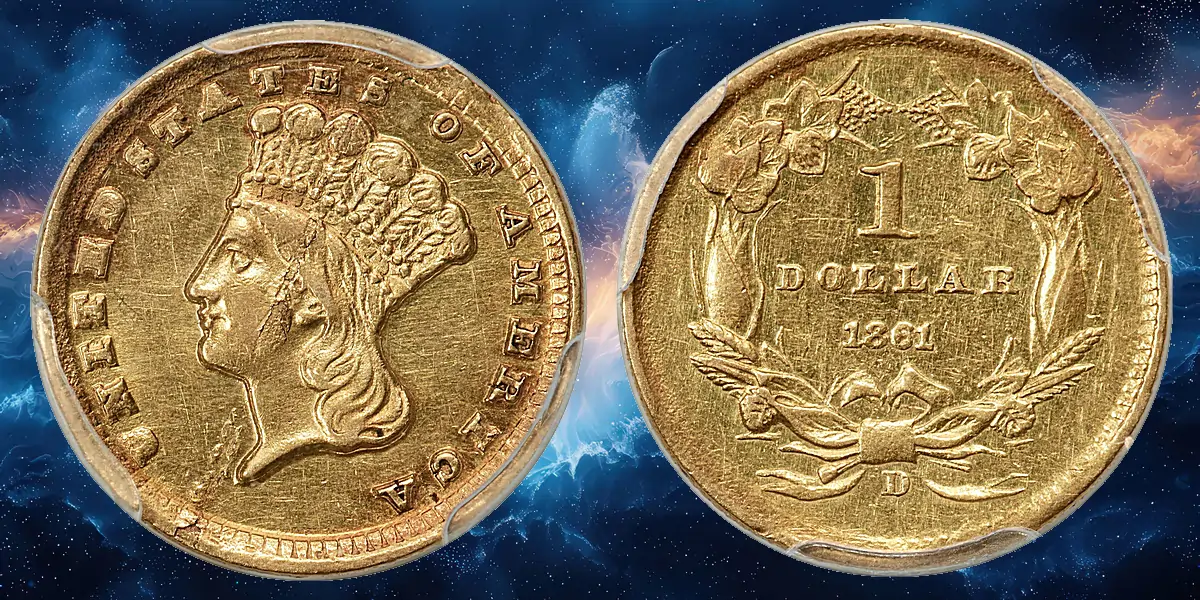
Yet collectors should not turn those characteristics into absolute rules.
A remarkable PCGS AU58 that Heritage sold for $96,000 in August 2025 displays a much better-than-usual strike. Heritage specifically noted that even its U in UNITED retained a full outline. Therefore, a visible U does not automatically condemn an 1861-D as counterfeit.
Authentication requires the complete die pattern.
Genuine 1861-D Gold Dollar Diagnostics
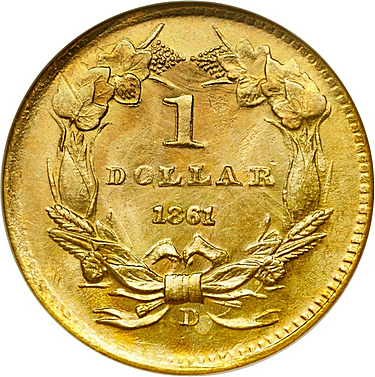
The single known 12-Q die marriage gives specialists several useful reference points.
- Area Genuine: 1861-D Diagnostic
- Obverse die: Same obverse die used for the 1860-D Gold Dollar
- U in UNITED: Characteristically weak; sometimes nearly or completely lost
- N in UNITED: Usually weak
- AMERICA I and C: may also show weakness
- Liberty Hair: and headdress plumes usually show incomplete definition
- Date Small: and positioned somewhat left
- First 1 in 1861: Sits beneath the left portion of the first L in DOLLAR
- D mintmark: Small, high in the field, noticeably tilted right
- Mintmark position: Very close to the right ribbon end
- Borders Obverse: left side typically weaker than the right
- Reverse Peripheral: definition often weak; die polishing affects portions of wreath and ribbon
- Die clashes: Some genuine pieces show clash marks at the centers
These characteristics come from the known 12-Q dies themselves. Consequently, their relationship to one another matters far more than any single weak letter or planchet flaw.
The Most Dangerous Fake: A Genuine 1861 Dollar With an Added D
The enormous price difference between an 1861 Philadelphia Gold Dollar and an 1861-D creates an obvious opportunity for fraud.
A counterfeiter does not necessarily need to manufacture an entire fake coin.
Instead, the fraudster can begin with a genuine 1861 Philadelphia Gold Dollar and add a D mintmark.
NGC has documented exactly such an example.
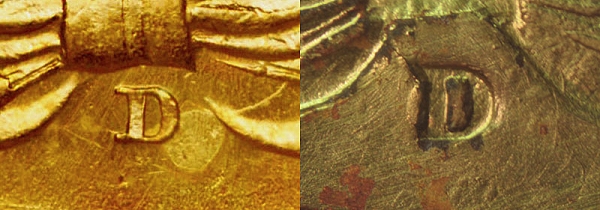
On the altered coin examined by NGC, the counterfeit D showed malformed and shortened serifs. Dark purple material surrounded the letter, apparently to conceal the point where the added mintmark met the coin. The surrounding field also displayed cleaning hairlines.
A genuine 1861-D should show the distinctive 12-Q mintmark placement: small, high, tilted to the right, and very close to the right ribbon.
Therefore, collectors should never authenticate this issue merely by confirming that a D exists.
The position and shape of that D must match the genuine die.
Jewelry Damage Creates Another Problem
Some owners apparently saved 1861-D Gold Dollars as Civil War keepsakes. Unfortunately, several surviving coins later became pins, pendants, or other jewelry.
NGC specifically warns collectors about expertly repaired examples for this reason. Auction archives also document 1861-D Gold Dollars with removed jewelry mounts, filed rims, smoothing, and reconstructed fields.
Collectors should examine the entire rim under magnification.
A former mount can leave flat areas, filing, solder traces, or disturbances in the reeding. A repairer may then smooth the adjacent metal to disguise the damage.
Likewise, an unnaturally smooth patch in the field deserves scrutiny. Genuine mint texture and flow lines should not suddenly disappear around one isolated area.
Repairs do not necessarily make the coin counterfeit. The underlying coin may remain genuine.
However, restoration can dramatically affect grade and value.
Cleaning, Whizzing, and Surface Doctoring
A valuable 1861-D also gives an owner a financial incentive to conceal scratches or previous damage.
Mechanical cleaning often leaves groups of parallel hairlines. Lines that cross fields, lettering, and devices can provide especially strong evidence of abrasive treatment.
Whizzing creates a different appearance.
A rapidly rotating brush moves surface metal in an effort to imitate mint luster. The resulting coin may look unusually bright. However, natural cartwheel luster disappears or behaves incorrectly under light. Raised ridges can also form beside letters or other design elements.
Coin doctors have also used foreign substances, including putty and wax, to disguise surface marks. PCGS specifically identifies added substances, rim filing, tooling, and reworking of metal as forms of coin doctoring.
Again, these problems concern surface originality, not necessarily authenticity.
That distinction matters with an 1861-D because so many surviving coins have experienced cleaning, jewelry use, or other manipulation.
The Finest Known 1861-D and a New $180,000 Benchmark
For years, references cited the famous Duke’s Creek Collection specimen, graded NGC MS65, as the finest certified 1861-D Gold Dollar.
Heritage sold that coin for $138,000 in April 2006. It returned in January 2008 and realized $149,500.
However, the story did not end there.
The same coin later crossed to PCGS as MS64+. Heritage offered it as part of the Bob R. Simpson Collection on September 17, 2020. It brought $180,000.
PCGS currently lists that price as the auction record for the issue and ranks the coin first in its condition census. A PCGS MS63 CAC example later matched the $180,000 level at Heritage in May 2023.
Even circulated coins now command prices that would have seemed extraordinary only a generation ago.
A PCGS AU58 brought $102,000 at Stack’s Bowers in November 2024. Another PCGS AU58 realized $96,000 at Heritage in August 2025. Then, in January 2026, a PCGS AU55 sold for $88,450.
Clearly, the old $15,000-$20,000 estimate for an AU example no longer reflects today’s market.
1861-D Gold Dollar Specifications
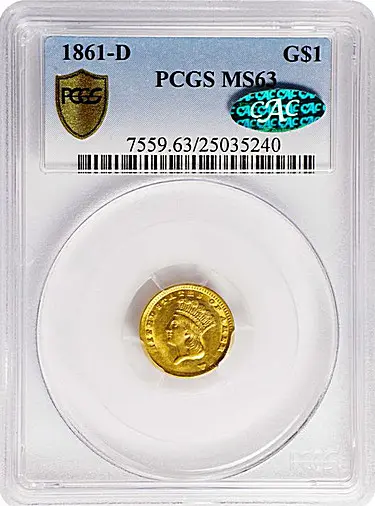
- Specification: 1861-D Gold Dollar
- Denomination: One Dollar
- Date / Mintmark: 1861-D
- Mint: Dahlonega, Georgia
- Design Type: Type 3 Gold Dollar, Large Head / Indian Princess
- Designer: James Barton Longacre
- Composition: 90% gold, 10% copper
- Weight: 1.672 grams
- Actual Gold Weight: Approximately 0.04838 troy oz.
- Diameter: Approximately 15 mm
- Edge: Reeded
- Known Die Marriage: Winter 12-Q
- Mintage Unknown: commonly estimated at 1,000-1,500
- Estimated Survivors: Approximately 65-75 by Doug Winter’s estimate
- Strike Period: Spring 1861; specialists generally place production in May
- Authority: Confederate States of America
Specifications and production estimates reflect NGC, PCGS, Heritage, and specialist research.
A U.S. Coin From a Mint the United States No Longer Controlled
Collectors can own many coins connected with the Civil War.
They can buy coins dated 1861. They can collect New Orleans pieces produced as Louisiana left the Union. They can pursue Charlotte and Dahlonega gold. They can even collect privately produced Confederate-related tokens and restrikes.
The 1861-D Gold Dollar occupies a different category.

It carries the name of the United States. Federal engravers created its design. Federal machinery struck it from Federal-style dies.
Yet Confederate authority controlled the mint when every known example came off the press.
Within weeks, Dahlonega stopped making coins. Confederate officials closed the mint as a coining facility in June. Later that summer, they converted it into an assay office. The Dahlonega Mint never struck another coin.
So the 1861-D represents more than a rare Southern gold dollar.
It captures a moment when the country had split so quickly that the coins had not yet caught up with the politics.
UNITED STATES OF AMERICA remained on the die.
The United States, however, no longer controlled the press.





Would be a great coin to have. Just came from Gettysburg.
One can never go wrong with gold – always true
gold and history
How very well educated you all are!!
Now that was an interesting article
very nice
Amazing peice of history
nothing beats gold!
Would love one for my collection
Cool story!! Cool coin !!
Interesting article.
Cool coin with a cool story.
Great coin to have.
What a very interesting coin.
I just learned a lot.
I didn’t know the CSA minted ANY coins.
Rebel gold: better than Yankee pot roast.
I would love to have some of those.
Fascinating piece. The detail that stands out to me is the timeline. The reverse dies arrived on January 7 and Georgia seceded on January 19, so the Dahlonega staff had Federal dies in hand for less than two weeks before the building effectively changed hands. That’s what makes the 1861-D unique: every coin was struck under Confederate authority, with no earlier Federal production to muddy the attribution.
It’s also a striking example of how far numismatic value can drift from metal value. A gold dollar weighs just 1.672 grams at 90% fineness, which is about 1.5 grams of pure gold. At today’s prices, the melt value per gram https://oroprecio.es puts that at a small fraction of one percent of the $180,000 the Simpson coin brought. Almost all of the value comes from history, rarity and condition.
Given the low mintage (usually cited at around 1,250 pieces) and Dahlonega’s reputation for soft, weak strikes, I’d be curious how many survivors are known in Mint State today. Has anyone tracked the census for this issue?