


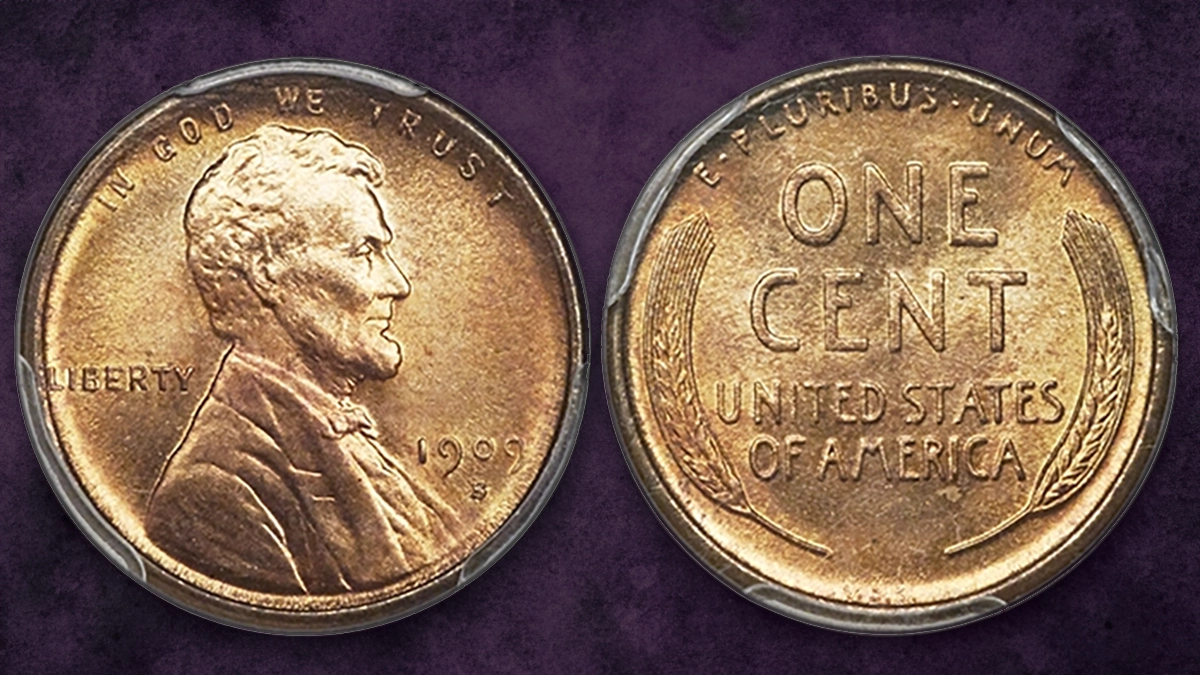
By Charles Morgan and Hubert Walker for CoinWeek Notes …..
The Philadelphia Mint had been solely responsible for producing minor coins since the first half cents and large cents rolled off the presses in 1793. This all changed starting in 1908 when the San Francisco Mint was tasked with producing Indian Head Cents. That year, San Francisco’s output of 1,115,000 one-cent coins was dwarfed by Philadelphia’s output of 32,326,367. The western states required cents, but most of America’s population centers were located east of the Mississippi.
In 1909, the San Francisco Mint began the year with its normal coin taskings. As was the case in 1908, the Philadelphia Mint dispatched dies for the Indian Head Cent. In January and February, the San Francisco Mint produced its entire mintage of 309,000 1909-S Indian Head Cents. As this was taking place, Litvak-American artist Victor David Brenner was hard at work preparing the Lincoln Wheat Cent design. The new design, the first United States circulation coin to feature the likeness of a political figure, was timed for release to honor the Centennial of Abraham Lincoln’s birth. On February 27, Mint Director Frank A. Leach reviewed the design and authorized the placement of Brenner’s initials, V.D.B., at the bottom of the coin’s reverse. For the Mint, this would prove to be an unfortunate decision.
Production of the new coin began on June 10 at the Philadelphia Mint, an entire month before Treasury Secretary Franklin MacVeigh notified the Mint that he had approved the design. The month concluded with Leach’s resignation.
On August 2, the Lincoln Wheat Cent entered circulation, and the Treasury Department immediately received queries concerning the V.D.B. initials. Three days later, MacVeigh ordered a stop in production and ordered the removal of the initials. In a slight to Brenner, his designer credit wouldn’t return to the coin until 1918, when his initials were placed on the bust truncation.
In the short time that the San Francisco Mint produced the Lincoln Cent before the removal of V.D.B. initials, only 484,000 examples of the 1909-S V.D.B. Lincoln Wheat Cent were struck, making this the lowest mintage of the business strike Lincoln Cents. In total, only four obverse dies were used to strike this type. They are identifiable by mintmark placement and serve numismatists in detecting counterfeits. The S mintmark is clearly defined on all genuine coins, and the serifs are parallel. Genuine V.D.B.s have angled bases of the B and the D and are clear and sharp.
* * *
Market Data and Noteworthy Specimens
The 1909-S V.D.B. and the 1909-S Without V.D.B. Lincoln Wheat Cent are largely responsible for the development of coin collecting by mintmark, as it was known at the time that the 1909-S was scarce and the 1909-S V.D.B. even more so.
Numismatist Augustus Goodyear Heaton wrote extensively about branch mint issues in his 1893 book. Still, the 1909-S Lincoln Wheat Cent issues presented the first real-time opportunity for dealers and collectors to capitalize on the new collecting strategy.
San Francisco coin dealer R.A. Webb advertised for sale brilliant uncirculated examples for 30¢ in the January 1936 issue of The Numismatist.
Mint State Red examples were sold in 1956 for prices between $20 and $30.
By 1960, after years of heavy promotion, the price of Mint State Red examples had increased to $300.
Despite being the Key Date in the Lincoln Wheat Cent series, the 1909-S V.D.B. is more frequently found in Mint State Red than the 1914-D Lincoln Wheat Cent.
The PCGS, NGC, and CAC MS67RD populations have remained constant since at least November 2024.
Top Population: PCGS MS67RD (17, 7/2025), NGC MS67RD (3, 7/2025), and CAC MS67RD (3:0 stickered:graded, 7/2025).
- PCGS MS67RD #48300135: “The Whispering Pines Collection,” Heritage Auctions, January 16, 2025, Lot 4531 – $99,000.
- PCGS MS67RD CAC #2594746: “Stewart Blay’s Red Copper Collection of Lincoln Cents,” GreatCollections, January 15, 2023, Lot 1272808 – $345,375.
- PCGS MS67RD #03422486: “The Bender Family Collection, Part I,” Heritage Auctions, August 24, 2022, Lot 3649 – $102,000. Bender Collection on insert.
- PCGS MS67RD #30397554: Stack’s Bowers, April 5, 2022, Lot 3015 – $168,000.
- PCGS MS67RD #03546555: “The Jerald L. Martin Collection,” Heritage Auctions, January 10, 2019, Lot 4337 – $55,200. Jerald L. Martin Collection on insert.
- PCGS MS67RD #25635311: Heritage Auctions, January 5, 2017, Lot 5534 – $61,687.50; Heritage Auctions, January 14, 2022, Lot 4576 – $108,000. The color is turning purple on the reverse.
- PCGS M67RD #81633616: Heritage Auctions, June 6, 2019, Lot 3016 – $50,400.
- PCGS MS67RD #25612691: Heritage Auctions, February 16, 2017, Lot 3633 – $61,687.50.
- PCGS MS67RD #25612402: Heritage Auctions, August 10, 2016, Lot 3967 – $70,500.
- PCGS MS67RD #25640069: Heritage Auctions, January 7, 2016, Lot 5260 – $94,000.
- PCGS MS67RD #25350756: Heritage Auctions, February 27, 2014, Lot 3726 – $117,500.
- PCGS MS67RD #05221719: “The Joshua and Ally Walsh Collection of United States Cents,” Heritage Auctions, January 5, 2006, Lot 3076 – $97,750. Joshua and Ally Walsh on insert. The certification number is no longer active.
- PCGS MS67RD #8426691: Heritage Auctions, September 22, 2005, Lot 1008 – $77,050. Old Green Holder. The certification number is no longer active.
- PCGS MS67RD #03546555: “The Tom Mershon #2 All-Time Registry Collection of Lincoln Wheat Cents”, Heritage Auctions, May 4, 2005, Lot 5299 – $92,000. Tom Mershon Collection on insert.
* * *
Coin Specifications
| Country: | United States of America |
| Year of Issue: | 1909 |
| Denomination: | One Cent (USD) |
| Mintmark: | S (San Francisco) |
| Mintage: | 484,000 |
| Alloy: | .950 Copper, .050 Tin and Zinc |
| Weight: | 3.11 g |
| Diameter: | 19.00 mm |
| Edge: | Plain |
| OBV Designer: | Victor David Brenner |
| REV Designer: | Victor David Brenner |
| Quality: | Business Strike |
* * *



I can remember in 1958 when you buy a very fine 1909-S VDB cents for $26. Sterling Harrison had a coin shop in Evansville, Indiana right across the street from Bosse High School. Two years later, we secured that coin for $110 from Marshall Fields in Chicago.
I have 2 1909 VDB coins
@Kari A Carberry Be sure to distinguish between 1909 VDB plain (= no mint mark) struck in Philadelphia and 1909 S VDB struck in San Francisco. Philadelphia struck almost 28 million cents before the reverse was changed, about thirty times as many as San Francisco. That population difference means circulated 1909 VDB cents retail in the $6 to $10 range versus 3- and 4-digit figures for their 1909 S VDB counterparts.
I m coins collector and I have 4 one cent old coins since 1930 to 1960
In September, 1963 I was clearing my grandfather’s attic in central Indiana of junk as he went to a home for old people. I found a children’s bank and in it was a nearly uncirculated Lincoln 1909-S VDB Lincoln cent.
During my childhood I collected pennies and could not afford to buy a quality 1909-S VDB. At that time (late 1960’s) there weren’t many reliable sources for a high grade 1909-S VDB penny. The average price for an AU version was around $150 at the time. A lot of money for an 10-13 year old! LOL! It wasn’t until around 1988 that I was able to buy an AU version for $780. The slabbed high grade MS versions are through the roof and will most likely increase in value. Any young penny collector would be wise to try to buy a highest grade slabbed PCGS or NGC 1909-s vdb penny they can afford. It will probably be the best investment the person will make.