


The Gold Sovereign That Almost Vanished During World War I
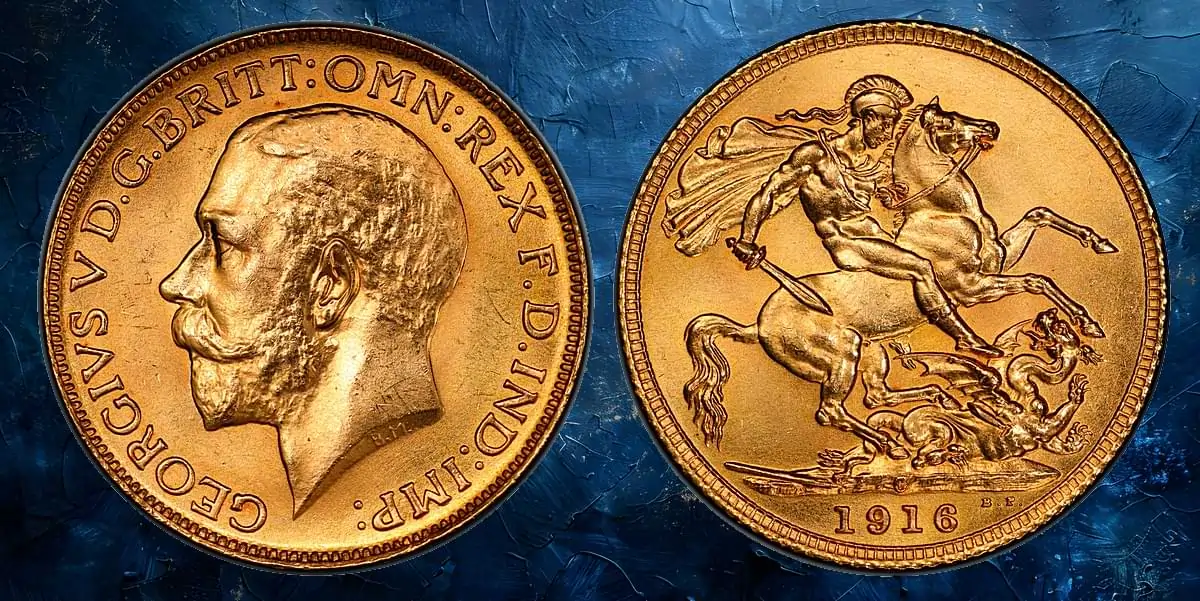
The 1916-C George V Gold Sovereign carries one of the strongest backstories in Canadian numismatics.
Ottawa struck the coin during World War I. Records list a mintage of just 6,111 pieces. That number makes the coin scarce. However, the real mystery starts after the coins left the mint.
Today, specialists can account for only a small fraction of that original mintage. No document explains the disappearance. As a result, the 1916-C sovereign has become the key coin of the Ottawa Mint sovereign series.
More importantly, it ranks as one of the great wartime gold mysteries in world coin collecting.
A British Sovereign With a Canadian Mintmark
The 1916-C sovereign is a British £1 gold coin. Yet the Ottawa Mint struck it while operating as a branch of the Royal Mint.
Its “C” mintmark appears on the reverse above the date. That small letter identifies the coin as a Canadian issue.
The coin follows the standard sovereign format. It has a diameter of about 22 mm, weighs 7.9881 grams, and contains .917 fine gold. Its actual gold weight comes to about 0.2355 troy ounce. Greysheet lists the Ottawa mint location, 6,111 mintage, “C” mintmark, .917 fineness, 7.9881-gram weight, and 22 mm diameter for the 1916-C sovereign.
Collectors also recognize the design instantly. Bertram Mackennal created the George V portrait. Benedetto Pistrucci’s St. George and the dragon appears on the reverse. The Royal Mint identifies Mackennal as the obverse designer and Pistrucci as the reverse designer for the 1916 George V sovereign.
The Ottawa Mint Sovereign Series
Ottawa Mint sovereigns occupy a fascinating place in Canadian collecting.
They are British coins by denomination. They also came from a Canadian mint. Because of that, they connect Canada to the wider gold coinage system of the British Empire.
The Ottawa Mint struck these coins only in select years. The George V Canadian sovereign run includes 1911-C, 1913-C, 1914-C, 1916-C, 1917-C, 1918-C, and 1919-C. Greysheet places the George V Ottawa sovereign coinage years from 1911 to 1919.
Within that short run, the 1916-C stands apart.
Recorded mintage: 6,111 pieces. Some later market descriptions list 6,119, but major catalog and auction sources support 6,111.
A Low Mintage Does Not Explain the Mystery
Many coins have low mintages. Few create a mystery like the 1916-C.
A mintage of 6,111 pieces should produce more survivors than collectors see today. Yet the 1916-C appears far rarer than its mintage suggests.
Heritage made that point in 2019. Its auction description notes that fewer than 50 pieces were known, even though the 1916-C had a higher mintage than the 1913-C sovereign. Heritage also stated that no theory fully explains what happened to the missing coins.
Earlier rarity estimates vary. James A. Haxby wrote that fewer than 10 examples were known. The Charlton catalog later suggested about 50. Sandy Campbell’s census work reportedly found no fewer than 29 and no more than 36 at the time of his calculations.
Modern population data confirms the coin’s elite status. PCGS currently lists 35 Mint State grading events for PCGS #32654, the 1916-C sovereign. The same report shows two examples at MS66.
That number needs context. Resubmissions and crossovers can inflate population reports. Even so, certified examples remain scarce.
NGC’s price guide takes an even tighter view. It lists the 1916C sovereign as “About 20 known.” NGC also notes the Stack’s A.G. Carter Jr. Gem BU sale in December 1989 at $82,500.
Where Did the Gold Go?
This is the part that makes the 1916-C unforgettable.
The coin did not simply become hard to find. Most of the mintage seems to have vanished.
One theory points to melting. Heritage wrote in 2019 that one hypothesis places nearly the entire mintage in the melting pot, with only a few pieces spared. That idea fits the fate of many wartime sovereigns. Gold coins moved through international settlements. Governments and banks treated them as bullion first and collectibles second.
Another theory adds drama. Some stories claim the coins went down at sea during World War I while traveling to England as payment. That story has circulated for decades.
However, the shipwreck tale lacks proof. Heritage called both the melting theory and the lost-at-sea theory unconfirmed. It also explained why the sea-loss story seems unlikely. Canada could have transferred gold through the New York Federal Reserve for Great Britain’s account. In that case, no dangerous wartime voyage would have been necessary.
The best answer may never surface. Still, the mystery gives the coin its power. A Canadian branch mint struck 6,111 sovereigns in wartime. Then most of them disappeared into the machinery of gold finance.
The paperwork survived. The coins mostly did not.
Auction Records for the 1916-C George V Gold Sovereign
The current public auction record stands at $156,000.
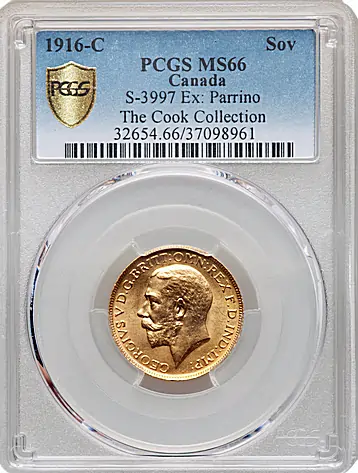
Heritage sold a PCGS MS66 example on August 15, 2019, as lot 31390 in its ANA World’s Fair of Money World Coins Platinum Night Auction. Heritage described the coin as “tied for finest certified.”
Coins and Canada reports the same Cook/Parrino example at C$207,636. Its listing identifies the coin as PCGS MS66 and S-3997.
Collectors should also note one grading inconsistency. Coins and Canada’s narrative line says another example sold in August 2019 as PCGS MS66+. However, its renowned-collections line lists the Cook/Parrino coin as PCGS MS66. Heritage, the primary auction source, also lists the record coin as PCGS MS66.
Date Grade / Holder Auction or Source Price
- Dec. 1989 Gem BU Stack’s A.G. Carter Jr. sale, noted by NGC $82,500
- Jan. 3, 2010 PCGS MS65 Heritage, Canadiana Collection $86,250
- Aug. 13, 2015 PCGS MS66 Heritage, Eric Beckman example referenced in 2019 $88,125
- Jan. 7, 2019 NGC MS61 Heritage NYINC World Coins Signature Auction $22,800
- Aug. 15, 2019 PCGS MS66 Heritage, George Hans Cook Collection $156,000
- May 17, 2020 PCGS MS64 Heritage, Caranett Collection $38,400
NGC records the 1989 Stack’s A.G. Carter Jr. result at $82,500. Heritage records the 2010 PCGS MS65 sale at $86,250. Its 2019 MS66 record listing also references the Eric Beckman MS66 example at $88,125. Heritage separately records the January 2019 NGC MS61 sale at $22,800 and the May 2020 PCGS MS64 sale at $38,400.
Is the 1916-C the “Undisputed Key”?
Yes – with a precise qualifier.
The 1916-C George V Gold Sovereign is the undisputed key to the Ottawa Mint sovereign series. Heritage used that exact market position in its January 2019 description, where it called the 1916 date the “undisputed key” to the short George V sovereign series.
Still, writers should avoid overextending the claim.
Across the broader worldwide George V sovereign series, the 1916-C faces other major rarities. Drake Sterling ranks the 1916-C seventh among George V sovereign rarities, behind issues such as the 1920-S, 1923-SA, 1917 London, 1921-M, 1922-S, and 1926-S.
The 1916-C is the undisputed key to the Ottawa Mint sovereign series and one of the great rarities of the broader George V sovereign series.
Why the Coin Matters
The 1916-C George V Gold Sovereign matters because it brings several collecting worlds together.
It belongs to Canadian numismatics. It also belongs to British imperial coinage. In addition, it sits inside the financial chaos of World War I. Finally, it carries a survival mystery that still resists a firm answer.
Gold coins often tell economic stories. This one tells a wartime story. Canada struck the coin. Empire moved the gold. Collectors later found only traces.
That gap between recorded mintage and known survivors gives the 1916-C its magic.
For Canadian gold specialists, the coin represents the summit of the Ottawa Mint sovereign series. It marks one of the great George V rarities. And for historians, it offers a compact artifact of war finance and imperial monetary movement.
Small coins rarely carry this much weight. The 1916-C does.
It is not just rare. It is unresolved.






So much history, so many interesting stories, not enough time to absorb them all. Thanks for this great article.