


The $3.12 Million Half Dime That Hid From Collectors for 108 Years
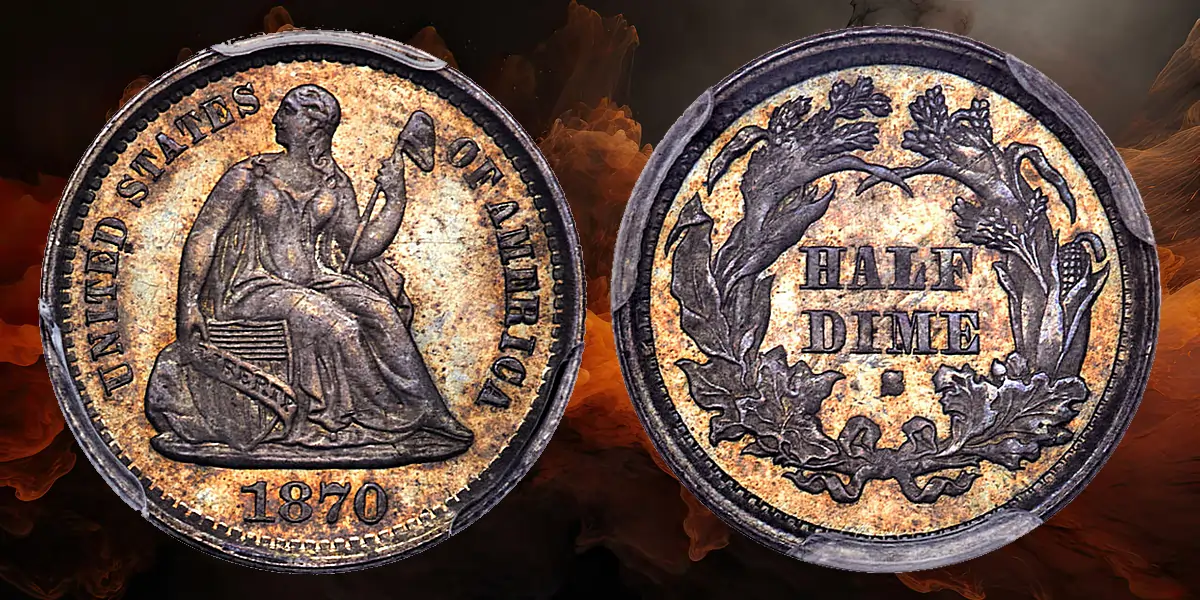
The 1870-S Liberty Seated Half Dime ranks among the most important trophy coins in American numismatics. Only one verified example exists outside the San Francisco Mint cornerstone story. Today, that single collectible specimen carries a PCGS grade of MS64 and CAC approval. Heritage Auctions sold it in January 2023 for $3,120,000, a record price for the issue.
That price reflects more than rarity. It also reflects mystery. Official Mint records did not list an 1870-S half dime. In fact, collectors did not learn that the coin existed until 1978. Since then, researchers have connected the issue to the laying of the cornerstone of the second San Francisco Mint. However, they have not fully explained how the known coin left the Mint.
Why the 1870-S Half Dime Matters
Numismatists often place the 1870-S half dime with two other United States coin issues that have only one verified survivor: the 1870-S Three-Dollar Gold Coin and the 1873-CC No Arrows dime. Some specialists also add the 1933 Saint-Gaudens Double Eagle to this discussion, although that coin survives in more than one example and only one specimen remains legal for private ownership.
Even by that standard, the 1870-S half dime stands apart. It remained unknown for 108 years. Then it appeared in a suburban Chicago-area coin shop. Because of that late discovery, the coin still invites questions that documents have not fully answered.
Half Dimes and the San Francisco Mint
Before the Civil War, Philadelphia and New Orleans handled most half dime production. Then the war changed the Mint system. In 1861, Confederate authorities gained control of the southern branch mints at Charlotte, Dahlonega, and New Orleans. As a result, Philadelphia and San Francisco became the key operating coinage facilities for federal coin production.
San Francisco had opened as a branch mint in 1854. It served Gold Rush commerce and converted western bullion into coin. By 1870, the facility had outgrown its first building. The government had already started work on a larger mint at Fifth and Mission Streets.
That second San Francisco Mint later became known as the Old Mint. The U.S. Mint states that construction began on April 1, 1869. Workers laid the cornerstone on May 25, 1870. The building reached completion in November 1874.
San Francisco Half Dime Mintages, 1863-1873
From 1863 through 1873, San Francisco struck half dimes in most years. Most mintages reached six figures. Therefore, collectors can pursue the San Francisco subset with some hope, at least until they reach the 1870-S.
The following table follows PCGS CoinFacts mintage listings for the Type 5, Legend Obverse half dimes.
Year Reported Mintage
- 1863-S 100,000
- 1864-S 90,000
- 1865-S 120,000
- 1866-S 120,000
- 1867-S 120,000
- 1868-S 280,000
- 1869-S 230,000
- 1870-S No regular mintage recorded; one verified collectible example
- 1871-S 161,000
- 1872-S 837,000
- 1873-S 324,000
The denomination ended in 1873. PCGS notes that the federal government had worked since 1866 to replace the silver half dime with the nickel five-cent piece. By 1873, that transition had succeeded.
The Cornerstone Order
For decades, researchers found no Mint annual report entry for an 1870-S half dime. That silence made the coin harder to explain. Then Nancy Oliver and Richard Kelly located key records in the National Archives.
Their research identified a San Francisco Mint warrant tied to coins for the new branch mint cornerstone. The warrant named Coiner J.B. Harmstead and covered one example of each denomination. Seven denominations already had San Francisco production. Four others did not: the half dime, quarter, silver dollar, and three-dollar gold coin.
This record matters. It confirms that San Francisco Mint officials had authority to strike an 1870-S half dime for the cornerstone. However, the known coin creates a second question. If the cornerstone coin remains sealed in the building, then the collectible 1870-S half dime must represent an additional strike.
Why a Second Coin May Exist
No document proves why another 1870-S half dime left the Mint. Therefore, any explanation must remain a hypothesis.
One theory points to J.B. Harmstead. Oliver and Kelly later suggested that Harmstead may have retained or presented an extra piece. They also explored possible family routes that could have moved the coin toward the Midwest. However, that path remains unproven.
Another theory involves the annual Assay Commission. Mint practice could have led officials to strike extra examples for assay purposes. Yet records show that San Francisco did not submit 1870 half dimes, quarters, silver dollars, or three-dollar pieces for assay testing. As a result, this theory also explains part of the mystery but not all of it.
The 1978 Discovery
The $3.12 Million Half Dime That Hid From Collectors for 108 Years
The known 1870-S half dime surfaced in early 1978. The traditional discovery account identifies Rich Storm’s Orland Coins & Stamps in Orland Park, Illinois, as the point of entry. According to William A. Burd’s June 1998 article in The Numismatist, a man entered the shop with a small box of coins. Phyllis Storm, wife of proprietor Richard Storm, bought the group for what Burd described as a fair price for the lot.
At first, the coin appeared to be an ordinary 1870 Philadelphia half dime. Then the Storms could not find an 1870-S listing in the standard references. They contacted Chicago-area dealer Ed Milas of RARCOA.
Later Heritage research adds caution to the story. The auction firm noted that the discovery account has produced conflicting claims. Heritage also argued that the coin was likely not a random “junk box” find. Someone had preserved it for a reason, even if that reason has vanished from the record.
RARCOA Authenticates the Coin
Ed Milas did not buy the coin without proof. RARCOA’s Jim Simek and Dennis Forgue first weighed, measured, and studied the piece. Then Simek contacted Charles R. Hoskins, director of the International Numismatic Society Authentication Bureau in Washington, D.C. Hoskins arranged further examination at George Washington University Medical Center.
The team used a stereo microscope. They also used scanning electron microscopy. That approach gave the authentication team a much stronger basis for judgment than a normal visual inspection.
Hoskins issued a certificate of authenticity on April 19, 1978. His letter recorded several key facts. The coin had a dry weight of 1.26797 grams on a Mettler analytical balance. It had a specific gravity slightly below 10.4. It also showed prooflike fields, a partial wire rim, and 107 reeds on the edge.
More important, the examiners found no evidence of date or mintmark alteration at 70x magnification. They also examined the date, mintmark, and other areas under scanning electron microscopy from 80x to 2,000x. In addition, they tested the base of the mintmark for tin, lead, cadmium, and zinc. They found none of those solder-related metals. Hoskins concluded that the 1870-S half dime was genuine and unaltered.
The Coin Reaches the Numismatic Public
The collecting community first saw the coin at the American Numismatic Association’s 87th Anniversary Convention in Houston in August 1978. Ed Milas displayed it at the RARCOA table. The coin immediately drew attention.
Heritage notes that specialists Kam Ahwash and Walter Breen examined the coin at the show and affirmed its authenticity. Their public approval followed the more formal authentication work that RARCOA had already completed. Soon after the convention, major hobby publications reported the discovery.
Mintmark Placement and Design Details
The 1870-S half dime also helps clarify a design transition. On 1869-S half dimes, the mintmark appears below the wreath. On 1871-S half dimes, it appears below the denomination. The known 1870-S shows the mintmark below the denomination. Therefore, the Mint had made the placement change by the time it struck this coin.
Heritage’s 2023 description also confirmed physical features that Hoskins recorded in 1978. The coin still shows a partial wire rim and prooflike fields. At the same time, it shows localized strike weakness, especially near Liberty’s shield and on part of the reverse wreath.
Market History and Provenance
The 1870-S half dime has not always performed like a seven-figure rarity. Dealer John Abbott bought it from Milas on April 16, 1980, for $425,000. That price reportedly reflected a $25,000 premium over the Garrett 1804 Draped Bust dollar sale. However, Abbott later took a loss. Bowers and Merena sold the half dime in September 1985 for $176,000.
The coin improved in Auction ’86. Superior sold it in July 1986 for $253,000. Goldberg Auctions offered it in October 2000, but it did not sell. Then Bowers and Merena sold it in July 2004 as part of Jim Gray’s “North Carolina Collection” offering for $661,250.
The next major leap came through private treaty. Legend sold the Law Collection half dimes to Bob R. Simpson in July 2009, and the 1870-S half dime carried a reported value of $1.4 million. Tom Bender later acquired the Law-Simpson half dime set through Legend Numismatics on October 28, 2015. Heritage then sold the coin from The Bender Family Collection, Part II, on January 11, 2023, for $3,120,000.
Noteworthy Specimen
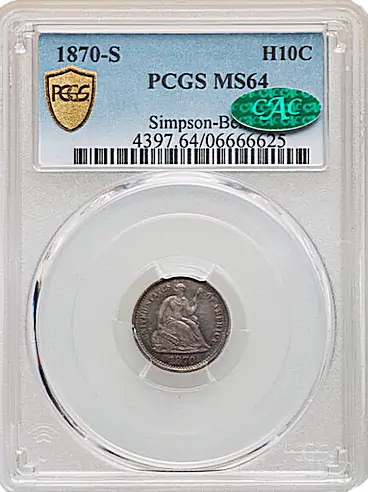
PCGS MS64 CAC, Cert. #06666625. Ex: Simpson-Bender.
Discovered in 1978; suburban Chicago-area coin shop; Ed Milas, RARCOA, April 1978; John Abbott, private sale, April 16, 1980, $425,000; Bowers and Merena, September 1985, lot 174, $176,000; Martin Paul; Superior Galleries, Auction ’86, July 1986, lot 1053, $253,000; Goldberg Auctions, October 2000, lot 1629, not sold; Jim Gray; Bowers and Merena, July 2004, lot 2065, $661,250; Law Collection; Bob R. Simpson, via Legend, July 2009, $1.4 million; Tom Bender; Heritage Auctions, The Bender Family Collection, Part II, January 11, 2023, lot 3341, $3,120,000.
PCGS lists the coin as MS64 and estimates one survivor in all grades and one survivor in Mint State 60 or better. It estimates no survivors at MS65 or better.
Coin Specifications
- Country: United States of America
- Year of Issue: 1870
- Denomination: Half Dime
- Mintmark: S
- Mint: San Francisco
- Known Population: One verified collectible example
- Alloy: .900 silver, .100 copper
- Standard Weight: 1.24 grams
- Diameter: 15.90 mm
- Edge: Reeded
- Design Attribution: Christian Gobrecht’s Liberty Seated motif; PCGS attributes the coin-specific Type 5 listing to James Barton Longacre
- Strike: Business strike
- Current Certified Grade: PCGS MS64 CAC
NOTE: The designer line requires care. PCGS describes the broader Liberty Seated half dime motif as Christian Gobrecht’s design. However, PCGS lists the 1870-S coin entry under James Barton Longacre, reflecting the later Legend Obverse type attribution.
The Lasting Importance of the 1870-S Half Dime
The 1870-S Liberty Seated Half Dime combines three forms of rarity. First, it has only one verified collectible example. Second, it connects directly to the San Francisco Mint cornerstone ceremony. Finally, it appeared only after more than a century of silence.
That combination makes the coin more than a key date. It is evidence, artifact, and unanswered question in one 15.9 mm silver coin. For collectors of Liberty Seated coinage, San Francisco Mint issues, and great American rarities, the 1870-S half dime remains one of the most compelling coins ever struck by the United States Mint.




First coin ever metal detected. Good article
Wonderful article. Guess my half dime set will always be short one coin!
I’ve always dreamt about finding an ultra-rare coin like this mixed in with a hoard of coins at a garage sale or auction.
Cool.
Imagine. 108 years. One low denom coin becoming life changing!
Never affordable by the average collector.
I’ll bet you that coin shop. The guy took it to you knew what they had.
The story is the coin shop thought it was a Philadelphia and only discovered later it had an S mintmark on it… That stinks to high heaven