The Tiny Mintmark That Turned a 1945 Mercury Dime Into a $25,875 Coin
An obsolete mintmark punch returned to service in 1945. Decades later, collectors would pay extraordinary prices for the finest coins it helped create.
On March 21, 2019, a remarkable 1945-S Micro S Mercury dime sold for $25,850 at Legend Rare Coin Auctions.
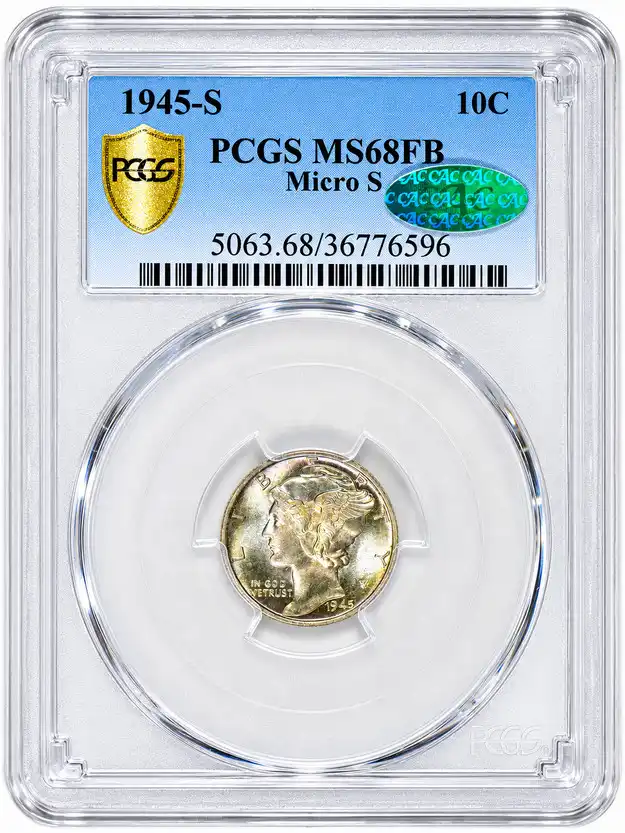
Three days later, another example brought $25,875 at GreatCollections.
Both coins carried the same unusual feature: a tiny S mintmark that looked noticeably different from the one normally found on a 1945-S Mercury dime.
Both also earned the coveted MS68 Full Bands grade from PCGS and received approval from CAC.
Yet the story behind these coins reaches much further into American history. In fact, it begins in 1907, when the San Francisco Mint prepared to strike coins for the Philippine Islands.
Nearly four decades later, the distinctive mintmark punch returned to American coin production. Its unexpected appearance created one of the most recognizable varieties in the Mercury dime series.
Today, circulated examples remain affordable. However, the finest fully struck survivors rank among the most desirable late-date Mercury dimes.
A Mercury Dime With a Philippine Connection
In 1907, the San Francisco Mint used a small S mintmark punch for coinage intended for the Philippine Islands.
At the time, the Philippines remained under American administration following the Spanish-American War. The United States had introduced a new Philippine coinage system in 1903, and American mint facilities produced coins for circulation in the islands.
San Francisco struck several Philippine denominations. Among them were silver 10- and 20-centavo pieces, which carried an S mintmark identifying their place of manufacture.
However, the mintmark on these coins differed from the larger S that collectors recognize on many later American issues.
The Philippine punch produced a smaller, more compact letter with distinctive serifs.
According to research by numismatist David W. Lange, the punch dates to 1907. It appeared on Philippine coinage through 1919.
Then, years passed.
The Mint eventually discontinued the use of that particular punch for its original purpose. Nevertheless, the tool or its distinctive design remained available within the American coin-making system.
In 1945, the small S appeared again.
This time, it identified the San Francisco Mint on an American Mercury dime.
The result was the 1945-S Micro S variety.
Why Did the U.S. Mint Reuse an Old Mintmark Punch?
The explanation begins with how the Mint manufactured coinage dies.
During the Mercury dime era, workers generally added mintmarks to individual working dies with steel punches.
The mintmark did not form part of the original master design. Instead, Mint personnel positioned the appropriate letter on each die before sending it into production.
This process allowed different facilities to use dies derived from the same basic design.
It also created opportunities for unusual mintmark varieties.
By 1945, the United States Mint faced substantial demands for circulating coinage. World War II had strained supplies of metals, industrial equipment, and labor.
Against that backdrop, an older mintmark punch returned to use.
The 1945-S Micro S apparently resulted from workers using the small punch originally associated with Philippine coinage rather than the standard contemporary S.
Importantly, the surviving evidence does not establish exactly why they selected it.
An old tool may have offered a convenient alternative. However, no verified production record identifies the responsible employee or proves that wartime pressure caused the substitution.
What numismatists can establish is the punch’s distinctive history and its appearance on multiple 1945-S dime dies.
The coins themselves preserve the result.
The Final Year of the Mercury Dime
The Micro S appeared at an important moment in American coinage history.

Adolph A. Weinman‘s Mercury dime had entered circulation in 1916. Its obverse featured Liberty wearing a winged cap, a design that many Americans mistakenly associated with Mercury, the Roman messenger god.
The nickname endured.
On the reverse, Weinman paired a fasces with an olive branch. Together, the symbols expressed military readiness and a desire for peace.
By 1945, the design had circulated for nearly three decades.
That April, President Franklin D. Roosevelt died. The Mint subsequently moved forward with plans to honor him on a circulating coin.
The Roosevelt dime debuted on January 30, 1946, which would have been the president’s 64th birthday.
Consequently, 1945 became the final year of regular Mercury dime production.
San Francisco struck 41,920,000 dimes that year.
However, the Mint did not separately record how many received the regular S mintmark and how many carried the Micro S.
That missing production figure remains one of the variety’s enduring uncertainties.
Bernard J. Maier Discovers the Micro S in 1947
Collectors did not have to wait decades to recognize the unusual mintmark.
According to David Lange‘s research, Bernard J. Maier discovered the 1945-S Micro S variety in 1947.
The discovery came only two years after the coins entered circulation.
Collectors soon recognized that some San Francisco Mercury dimes carried a noticeably smaller S. The letter differed not only in overall size but also in its shape and serifs.
As researchers examined the variety, they connected the small mintmark with earlier coinage produced for the Philippine Islands.
However, widespread collector recognition developed over time. The variety gained additional attention through specialized references and numismatic publications.
Today, the Cherrypickers’ Guide to Rare Die Varieties of United States Coins identifies the 1945-S Micro S as FS-512.
PCGS and NGC also recognize the variety in their certification programs.
Its popularity reflects an unusual combination of attributes: an identifiable design difference, an unexpected historical connection, and a range of prices that allows collectors with different budgets to participate.
How to Identify a Genuine 1945-S Micro S Mercury Dime
Fortunately, collectors do not need expensive equipment to begin searching for this variety.
Start with the reverse.
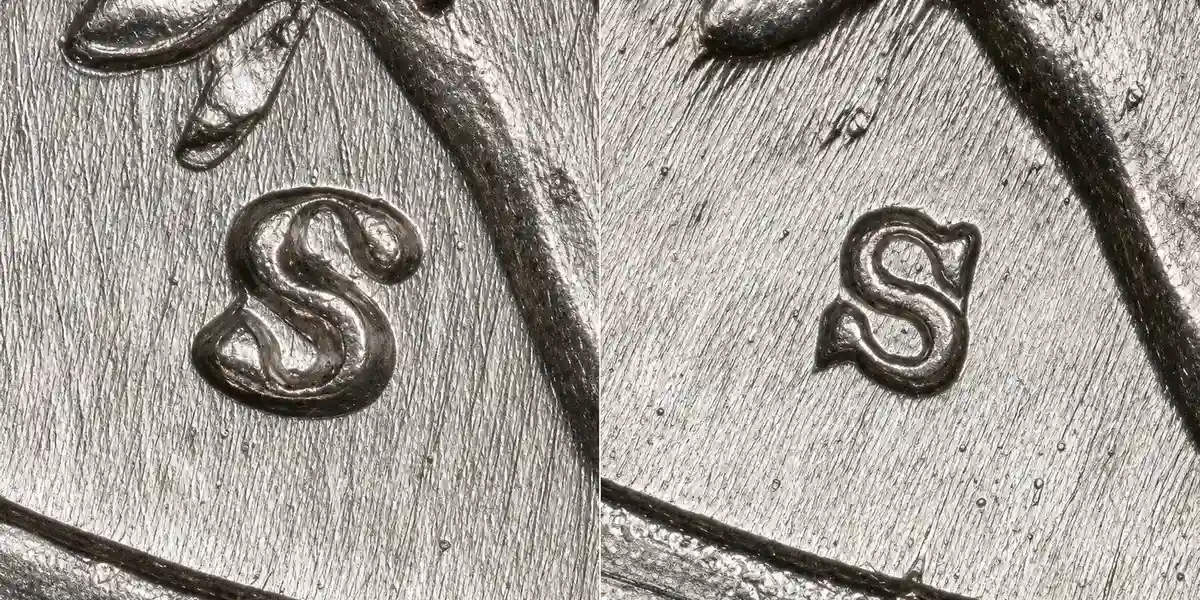
On the regular 1945-S Mercury dime, the letter appears larger and has a more rounded appearance.
The Micro S displays a smaller, more compact shape. Its serifs also appear sharper and more angular.
A magnifying glass or 5x to 10x loupe usually provides enough magnification to begin comparing the two styles.
However, size alone should not determine attribution.
Circulation wear, die wear, and photographic lighting can alter the apparent shape of a mintmark. Therefore, collectors should compare the complete letter against authenticated examples.
A particularly useful reference appears in PCGS’s January 2025 study, The Lowdown on the 1945-S Micro S Mercury Dime. The article includes a photographic comparison of the normal and Micro S mintmarks.
Also, collectors should understand what this variety is not.
The Micro S does not represent a repunched mintmark, a doubled die, or a mintmark that somehow shrank during striking.
Instead, the Mint used a different punch to add the S to certain working dies.
That distinction explains why the variety can appear on numerous coins without becoming a conventional striking error.
How Rare Is the 1945-S Micro S Mercury Dime?
The answer depends heavily on condition.
The Mint’s annual production figure of 41,920,000 includes all 1945-S Mercury dimes. It does not identify how many came from Micro S dies.
Therefore, claims assigning a precise mintage to the variety require caution.
PCGS estimates that approximately 30,000 examples survive across all grades. That figure represents an expert estimate rather than a documented population count.
Nevertheless, it indicates that the variety is not exceptionally rare in ordinary circulated condition.
In fact, collectors can sometimes acquire circulated pieces for less than $25.
Even attractive Mint State examples remain obtainable.
However, exceptional preservation and strong striking detail change the market considerably.
The greatest challenge involves coins with fully separated horizontal bands on the reverse.
The Full Bands Mystery: Why Strike Quality Changes Everything
Mercury dime specialists place considerable importance on the central bands that bind the fasces.
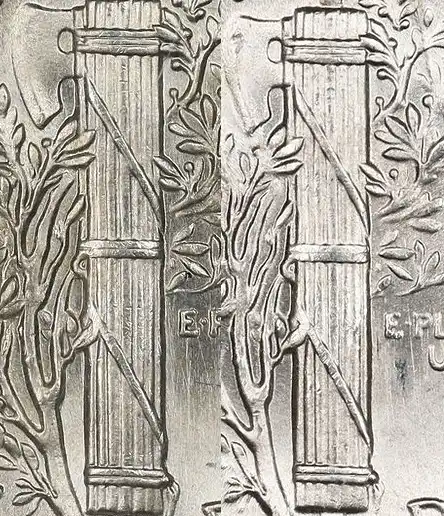
PCGS identifies the characteristic with FB. NGC uses a similar Full Bands designation.
The distinction can produce substantial price differences.
Many 1945-S Micro S dimes show incomplete separation in the central bands. Meanwhile, other examples have the necessary detail but lack the exceptional surfaces required for the highest numerical grades.
PCGS estimates that only about 10% to 12% of surviving Micro S examples exhibit Full Bands.
That estimate does not establish the percentage originally struck with those details. Nor does it provide an exact count of surviving coins.
Nevertheless, the market makes the importance of Full Bands unmistakable.
A certified Micro S without Full Bands may sell for a few hundred dollars in a desirable Mint State grade.
A comparable Full Bands example can bring considerably more.
At the very top of the condition scale, the combination of pristine surfaces, complete band separation, and strong eye appeal can push prices into five figures.
The 1945-S Micro S offers a textbook example of condition and strike rarity operating together.
Two 1945-S Micro S Dimes Break $25,000 in Three Days
March 2019 produced two of the most remarkable sales in the variety’s auction history.
March 21, 2019 — Legend Rare Coin Auctions
A PCGS MS68 Full Bands example with CAC approval realized $25,850.
PCGS lists this transaction as the auction record for its regular 1945-S Micro S Full Bands category.
The coin carried PCGS certification number 31080493.
Its market history also included earlier high-value appearances. That history helped establish the strength of collector demand for exceptional examples.
March 24, 2019 — GreatCollections
Only three days later, GreatCollections sold another PCGS MS68 Full Bands example with CAC approval for $25,875.
The beautifully toned dime appeared as GreatCollections Item 669971. It carried PCGS certification number 36776596.
The different certification numbers establish that these were separate coins.
Significantly, the GreatCollections result exceeded the Legend sale by just $25.
Therefore, although PCGS continues to display $25,850 as its category auction record, the GreatCollections archive documents a slightly higher public result.
The $25,875 transaction is the highest confirmed auction price located in CoinWeek’s review of the variety.
These two sales also illustrate how narrowly separated bids can determine records for exceptional condition rarities.
Both coins combined extraordinary preservation with fully separated central bands. Their CAC approvals added another recognized assessment of quality.
Such specimens represent the extreme upper end of the market, not the typical value of a 1945-S Micro S dime.
Another Exceptional Micro S Brings $18,000 in 2024
The variety returned to five-figure territory at Heritage Auctions on May 9, 2024.
A PCGS MS68 Full Bands example sold for $18,000 in Lot 4433 of Heritage’s Central States Numismatic Society Signature Auction.
The coin featured remarkable multicolored toning.
Its obverse displayed concentric shades of blue, orange, green, red, and gold around a brighter central area. Similar colors appeared around the reverse.
Heritage also emphasized its exceptional strike and surface preservation.
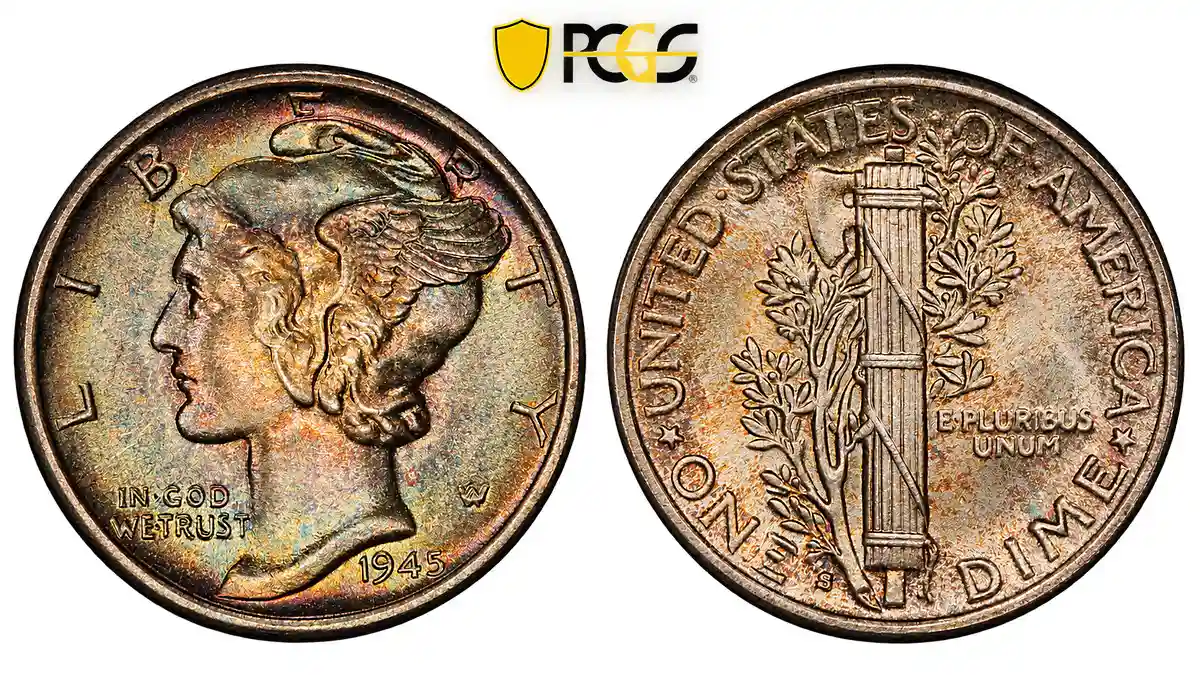
At the time, PCGS reported just four examples at the MS68 Full Bands level, with none finer. Those population figures reflected the certification data available in March 2024 and should not be treated as a current census.
The sale reinforces an important lesson.
For a major variety such as the Micro S, the finest coins rarely trade on numerical grade alone. Strike, eye appeal, surface quality, certification, and competition between advanced collectors can all influence the final price.
An NGC MS68★ Full Bands example also brought $10,200 at Heritage on June 13, 2024, according to published auction records.
Together, these results demonstrate the substantial premiums that exceptional specimens can command.
Recent 1945-S Micro S Auction Prices in 2026
Fortunately, collectors do not need five-figure budgets to participate in this market.
Recent auctions demonstrate the considerable difference between ordinary Mint State Micro S dimes and high-grade Full Bands examples.
Selected confirmed results include:
March 28, 2026 — Heritage Auctions: A PCGS MS67 Full Bands example realized $2,196.
June 9, 2026 — Heritage Auctions: A PCGS MS65 Full Bands example from the Fivaz Collection brought $537.
September 5, 2026 — Heritage Auctions: A PCGS MS67 Full Bands example sold for $2,013.
September 8, 2026 — Stack’s Bowers Galleries: A PCGS MS66 Full Bands specimen realized $1,586, according to Greysheet’s auction record.
September 8, 2026 — Heritage Auctions: A PCGS MS66 example without Full Bands brought $195.
September 9, 2026 — Stack’s Bowers Galleries: A PCGS MS65 example without Full Bands sold for $89, according to Greysheet.
These results provide a useful cross-section of the market.
For example, the September sales show how collectors could purchase attractive certified examples without spending thousands of dollars.
At the same time, Full Bands specimens in comparable or higher grades attracted significantly stronger bids.
However, each result represents an individual coin. Differences in eye appeal, surfaces, holder generation, and auction participation can affect prices.
Collectors should therefore compare several recent transactions before evaluating a particular specimen.
When Did the 1945-S Micro S Last Appear at Auction?
One of the most significant recent appearances occurred on October 11, 2026.
GreatCollections offered a PCGS MS68 Full Bands Micro S Mercury dime with attractive toning.
The coin carried certification number 25652458 and appeared as GreatCollections Item 2253248.
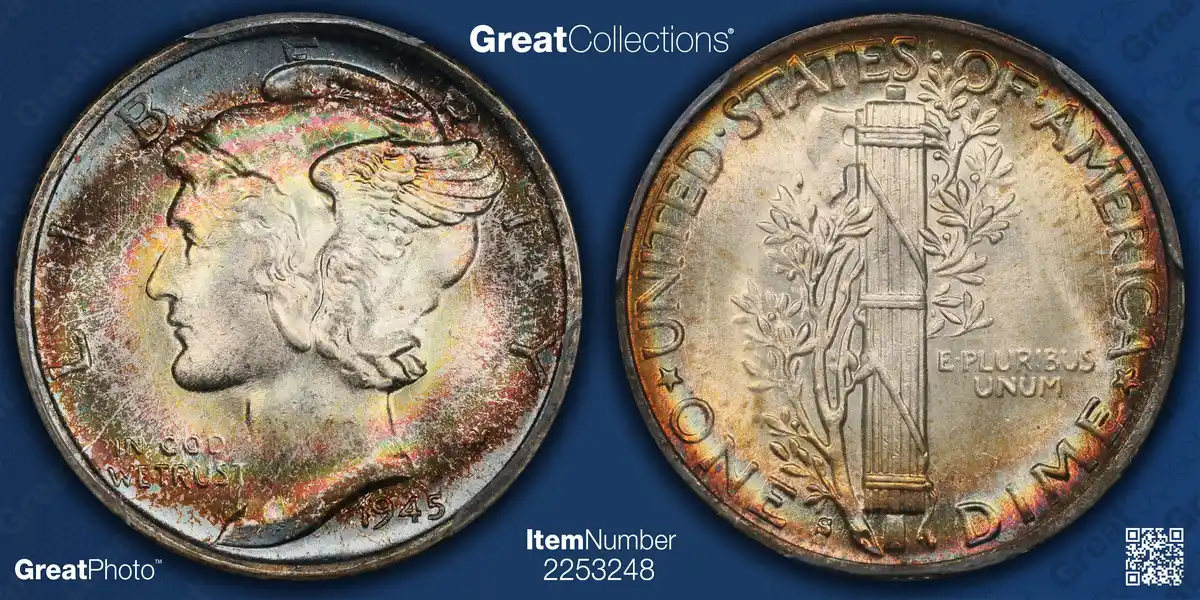
The auction closed that Sunday following 21 recorded bids. The final price was $15,255
This October appearance demonstrates that elite Micro S examples continue to reach the marketplace.
It also provides a particularly useful comparison with the exceptional coins that sold during March 2019 and May 2024.
The October transaction represents a confirmed recent auction appearance, although it should not be described as the latest sale across every auction venue without a complete transaction-level search.
What Collectors Should Look for Today
The 1945-S Micro S offers several collecting approaches.
For beginners, a circulated example provides an affordable introduction to mintmark varieties and historical die-making practices.
More advanced collectors may prefer an attractive Mint State specimen with strong luster and original surfaces.
Full Bands examples present a greater challenge.
Collectors seeking the finest certified specimens must also consider the unusually small population at the very top of the grading scale.
Regardless of budget, attribution should come first.
An ordinary 1945-S Mercury dime does not become a Micro S because the mintmark appears small in a poor photograph. The letter must match the recognized punch style.
Likewise, sellers should not describe a coin as Full Bands unless it meets the appropriate grading criteria.
For expensive specimens, certification and careful comparison with auction photographs provide additional safeguards.
A Small Mintmark With a Remarkable History
The 1945-S Micro S Mercury dime stands apart from the spectacular overdates and doubled dies that dominate many variety collections.
Its distinguishing feature measures only a fraction of an inch.
Yet that tiny letter connects American coin production in 1945 with an earlier chapter of U.S. monetary history in the Philippine Islands.
The variety also marks the closing year of one of America’s most admired circulating coin designs.
Bernard J. Maier’s 1947 discovery introduced collectors to a mintmark that the Mint had never intended to become a celebrated variety.
Decades later, that small difference helped push two exceptional Mercury dimes past $25,000 at auction.
Most examples will never approach those prices.
Nevertheless, the 1945-S Micro S remains a compelling reminder that the story behind a coin can begin with something as simple as an old tool returning to service.
For collectors searching through Mercury dimes, the lesson is clear: check the mintmark. A tiny S might lead to a much bigger story.