A 1932-S Quarter Sold for $76,250. In 1934, It Cost 25 Cents
In 1934, a collector could still order an uncirculated 1932-S Washington Quarter from the United States Treasury for 25 cents plus postage. More than nine decades later, a superb example brought $76,250 at Heritage Auctions.[See Below]
The two events tell a remarkable story about American coin collecting.
The 1932-S Washington Quarter entered the world during the Great Depression, when the nation had little need for new change. Yet it celebrated George Washington’s 200th birthday, introduced a design that would define generations of American coinage, and eventually became one of the hobby’s most recognizable key dates.
Today, its lowest-in-the-series mintage attracts collectors. However, the record auction price reveals something more interesting: the difference between owning a scarce coin and owning one of its finest survivors.
A Washington Quarter America Did Not Need
The story begins before the first 1932-S quarter reached a collector.
By 1931, the Great Depression had devastated the American economy. Businesses struggled, banks failed, and ordinary Americans held tightly to the money they possessed. Meanwhile, existing coins continued to serve commerce.
Under normal circumstances, the United States Mint had little reason to introduce another quarter.
However, 1932 marked the bicentennial of George Washington’s birth. Congress wanted a national tribute that Americans could encounter in everyday life.
On March 4, 1931, Congress authorized a change to the quarter dollar’s design. The law required Washington’s portrait on the obverse and appropriate national devices on the reverse.
Importantly, Congress specified general circulation. The new coin would not be another limited commemorative sold at a premium.
Instead, it would replace Hermon A. MacNeil’s Standing Liberty Quarter, which had appeared since 1916.
The economic timing could hardly have been worse.
According to numismatic research published by NGC, the nation already had enough quarters to meet commercial demand. The Mint had stopped quarter production during 1930. It struck no quarters in 1931, and production would pause again in 1933.
Nevertheless, Congress had created a reason to make coins that commerce did not urgently require.
San Francisco’s 408,000 Coins
The Philadelphia, Denver, and San Francisco Mints produced a combined 6,248,800 Washington Quarters in 1932.
Philadelphia accounted for most of them, striking 5,404,000 pieces without a mintmark.
Denver produced only 436,800.
San Francisco struck even fewer: 408,000.
That figure remains the lowest mintage for any regular-issue Washington Quarter. Moreover, the 1932-S and 1932-D are the only circulation strikes in the series with mintages below one million.
The comparison matters. Although San Francisco struck 28,800 fewer quarters than Denver, original mintage does not determine which date collectors will find scarcer in every grade.
Survival and condition also matter.
NGC’s historical account indicates that the branch-mint production served, at least in part, collectors seeking complete three-mint sets. That interpretation helps explain why the Mint produced quarters despite the lack of commercial demand.
It also introduces an unusual possibility: the weak economy that limited production helped preserve some of the coins collectors prize today.
The Forgotten 1934 Treasury Offer
One of the most revealing details appears in an old numismatic notice.
PCGS researcher Ron Guth cites the June 1934 issue of The Numismatist, page 416. According to that notice, collectors could still obtain uncirculated 1932-S Washington Quarters directly from the Treasury.
The price was simple: face value plus first-class mailing charges.
In other words, someone who recognized the coin’s future appeal could order an uncirculated example for 25 cents, excluding postage.
This was not a modern limited-edition release. It was a circulating coin that the Treasury still had available.
The notice does not establish how many collectors placed orders. Nor does it identify the original source of any specific high-grade survivor.
Nevertheless, it demonstrates that uncirculated 1932-S quarters remained accessible well after their production year.
That detail helps explain a puzzle in the surviving population.
PCGS estimates that approximately 40,000 examples survive today across all grades. The grading service also estimates that roughly 12,000 qualify as Mint State, or MS60 and higher.
Those are expert survival estimates, not a physical census. Still, they suggest that about 30% of surviving examples may retain Mint State condition.
For a low-mintage Depression-era coin, that is a meaningful distinction.
The Washington Portrait That Almost Appeared
The 1932-S Washington Quarter also carries a design story that collectors can still see on modern American coinage.
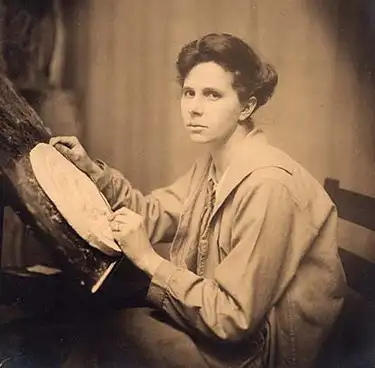
The competition drew work from prominent sculptors, including Laura Gardin Fraser and John Flanagan.
Both looked to the celebrated portrait of Washington created by French sculptor Jean-Antoine Houdon in the 1780s.
However, their interpretations differed.
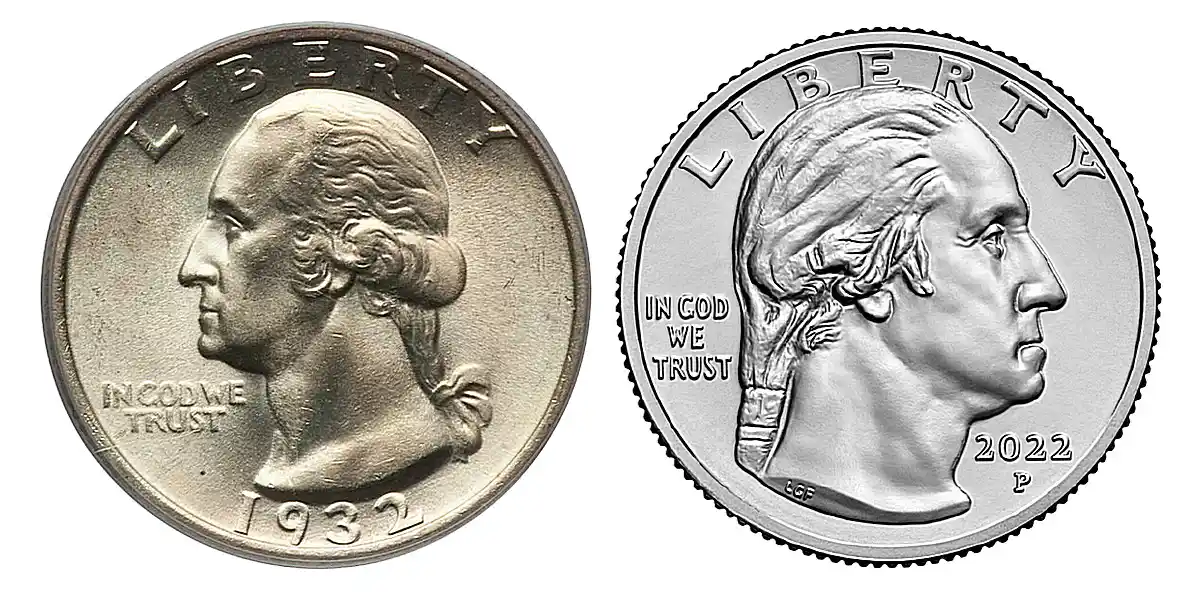
Fraser presented Washington facing right. Flanagan chose a left-facing portrait.
The Commission of Fine Arts favored Fraser’s submission and formally recommended her design to Treasury Secretary Andrew W. Mellon.
Mellon chose Flanagan’s design instead.
Consequently, Washington’s left-facing portrait became the familiar image on American quarters for decades. Flanagan also designed the reverse, featuring a spread-winged eagle standing on a bundle of arrows above olive branches.
Yet Fraser’s design never disappeared from numismatic history.
The Mint adapted her Washington portrait for the 1999 George Washington Commemorative Gold $5 Coin. Then, in 2022, her 1932 design finally appeared on circulating quarters.
It served as the obverse of the American Women Quarters from 2022 through 2025.
That development gives the original 1932 Washington Quarter a fascinating connection to the present.
Two artists competed to portray the same president. Treasury officials selected one image in 1932. Ninety years later, collectors could find the other in circulation.
John Flanagan’s Larger Artistic Legacy
John L. Flanagan brought considerable experience to the Washington Quarter project.
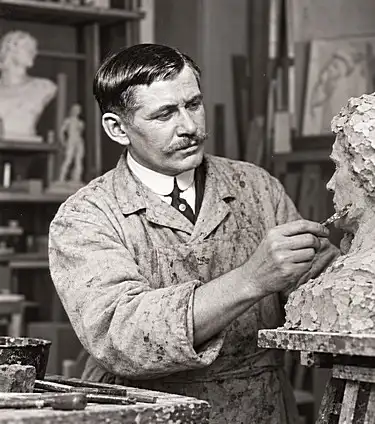
Born in Newark, New Jersey, in 1865, he worked in the studio of Augustus Saint-Gaudens from 1885 to 1890. He later pursued further artistic training and established a career as a sculptor and medalist.
His achievements extended far beyond coinage.
Flanagan designed the official medal for the 1915 Panama-Pacific International Exposition. He also created the Verdun Medal, which commemorated the World War I battle and honored France.
Additionally, he produced a notable bronze bust of Saint-Gaudens. The Metropolitan Museum of Art holds a cast completed in 1924.
Nevertheless, the Washington Quarter became his most familiar work.
Millions of Americans encountered his design without ever knowing the artist’s name.
Why the 1932-D Can Be Harder to Find in Gem
Here is another important distinction for collectors.
The 1932-S has the lower mintage. However, PCGS numismatic expert David Hall describes the 1932-D as substantially scarcer in Mint State.
In his assessment, the Denver issue is nearly twice as rare in uncirculated condition.
The difference becomes especially important in Gem grades.
PCGS estimates that approximately 500 examples of the 1932-S survive in MS65 or better. That figure represents a small fraction of the estimated total surviving population.
At MS66, the available supply becomes much smaller.
In June 2026, Heritage Auctions reported 11 PCGS grading events at MS66, including one example with the MS66+ designation. The auction catalog reported none finer.
Across PCGS and NGC, Heritage identified only 20 MS66-level grading events at that time. The firm also warned that the totals could include repeat submissions of the same coins.
Therefore, collectors should not treat certification populations as exact counts of unique surviving pieces.
The essential point remains clear: collectors can find a circulated 1932-S without enormous expense, but superb Mint State examples present an entirely different challenge.
The 2026 Auctions That Changed the Conversation
The past year provided an unusually revealing look at the 1932-S Washington Quarter market.
At the affordable end, certified circulated coins continued to trade within reach of many collectors. In April 2026, for example, a PCGS VF25 realized $84 at Heritage. A PCGS XF45 brought $149 the following month.
Mint State results covered a much wider range.
Recent confirmed auction appearances include:
- Heritage, April 28, 2026 – PCGS VF25 – $84
- Stack’s Bowers, May 2026 – PCGS MS63 – $537
- Stack’s Bowers, June 2026 – PCGS MS64 – $1,342
- Heritage, January 2026 – PCGS MS65 – $1,952
- Heritage, January 15, 2026 – PCGS MS65 CAC – $13,420
- Heritage, March 26, 2026 – PCGS MS66 – $31,720
- GreatCollections, March 8, 2026 – PCGS MS66, toned – $32,625
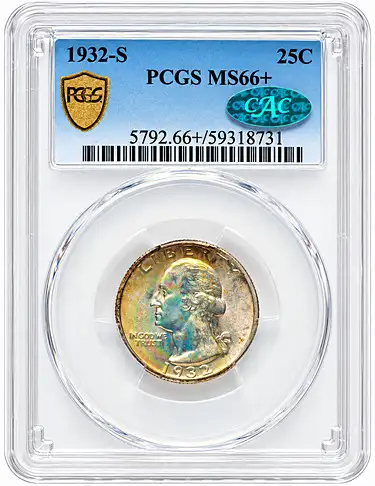
- Heritage, July 16, 2026 – PCGS MS66+ CAC – $76,250 (Auction Record)
Prices reflect reported auction realizations, including applicable buyer’s premiums. These sales represent individual coins, not guaranteed values for every example at the same grade.
The March GreatCollections result deserves particular attention.
Its toned PCGS MS66 example attracted 40 bids before realizing $32,625. Meanwhile, Heritage sold another PCGS MS66 for $31,720 during its March Signature auction.
Both results showed substantial demand for exceptional 1932-S quarters.
However, the year’s biggest surprise came in July.
The $76,250 Quarter
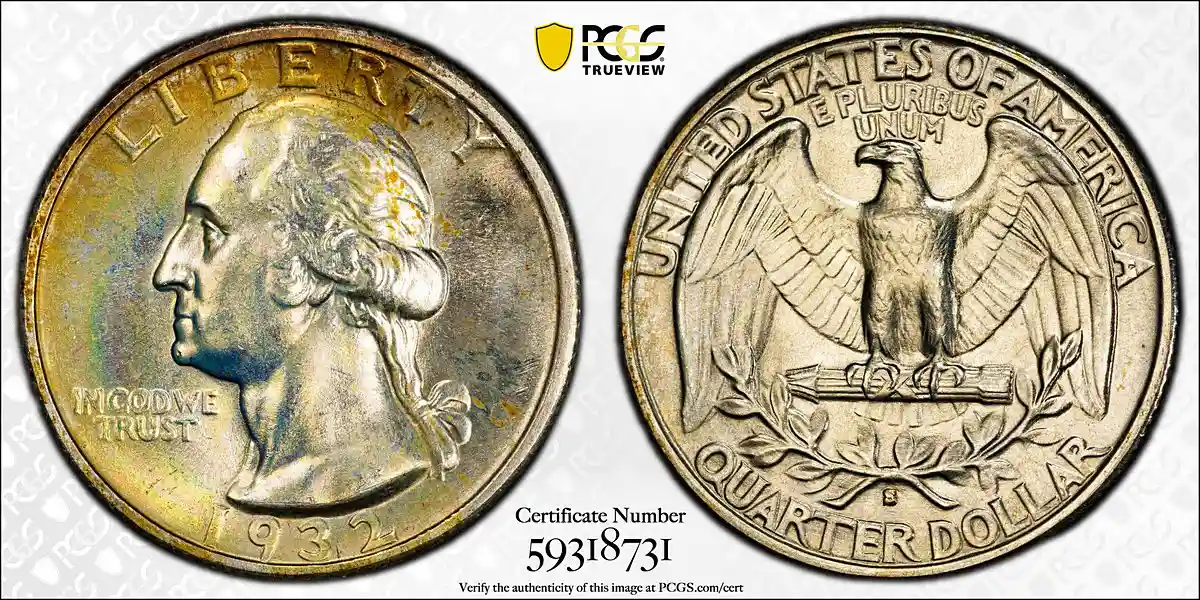
On July 16, 2026, Heritage sold a 1932-S Washington Quarter graded PCGS MS66+ with CAC approval.
Lot 3069 realized $76,250, establishing a new auction record for the issue.
Heritage described brilliant luster, strong portrait detail, and attractive iridescent color around the left side of Washington’s portrait. The auction firm also emphasized the coin’s clean surfaces and unusual standing within the certified population.
At the time of the sale, it was the only PCGS example with an MS66+ designation.
That distinction mattered to collectors building highly ranked Registry Sets, where securing the finest available certified example can require competition far beyond ordinary retail pricing.
The July sale also surpassed the previous auction record of $52,800, achieved by a PCGS MS66 with CAC approval at Heritage in February 2025.
The price history illustrates the evolution of the high-grade market.
In March 2020, a celebrated PCGS MS66 example from the D. Brent Pogue Collection realized $43,200 at Stack’s Bowers. Just two days later, another PCGS MS66 from the Red’s Silver Collection sold for $45,500 at David Lawrence Rare Coins.
Those two transactions attracted attention because they established successive records within the same weekend.
Other important appearances include a $38,400 Stack’s Bowers sale from the Washington Rainbows Collection in March 2021. Heritage also sold a PCGS MS66 for $34,800 in December 2021.
In addition, an NGC MS66 realized $15,600 at Heritage in October 2021.
These results show why the 1932-S market cannot be reduced to one published price for MS66.
The coins may share a numerical grade, but they do not necessarily share the same luster, toning, strike, or surface quality.
Why Two MS65 Coins Brought Very Different Prices
Collectors studying the 2026 results should also consider two coins that Heritage sold during its January FUN auction.
One PCGS MS65 brought $1,952.
Another PCGS MS65, approved by CAC, realized $13,420.
The second coin came in an older PCGS green-label holder. Heritage praised its frosty luster, strong design details, and attractive preservation.
Both coins carried the same numerical grade. Yet their prices differed by more than $11,000.
It would be a mistake to attribute that entire difference to one factor. CAC approval, originality, the holder, bidder preferences, and other coin-specific qualities may all influence auction outcomes.
Nevertheless, the comparison makes an important point.
The number on a grading label is a starting point, not a complete description of a coin’s quality or market appeal.
For advanced collectors, that distinction can carry considerable financial consequences.

What Collectors Should Examine
Not every attractive 1932-S needs an MS65 or MS66 designation to deserve consideration.
Collectors assembling a circulated Washington Quarter set can concentrate on originality, even wear, and surfaces free of distracting damage.
A pleasing Very Fine or Extremely Fine coin can offer the historical importance of the key date at a fraction of Gem Mint State prices.
For an About Uncirculated example, buyers should examine the highest design points carefully. Slight friction can separate AU58 from a true Mint State grade.
In Mint State, pay close attention to the quality of the luster, any distracting marks on Washington’s face, and the overall balance of the surfaces.
Strike quality also matters. Look closely at the hair and the eagle’s breast feathers. However, do not confuse a weakly struck detail with wear.
Toning requires equal judgment. Attractive original color may enhance a coin’s appearance. Conversely, dark or uneven toning can conceal problems or reduce its appeal.
Finally, authentication remains essential.
The 1932-S is a popular target for altered mintmarks and counterfeit pieces. Collectors should confirm that the S appears in its proper position on the reverse, below the olive branches and above QUARTER DOLLAR.
For expensive examples, independent authentication and grading offer an important additional safeguard.
1932-S Washington Quarter: Design and Specifications
Flanagan’s obverse shows Washington facing left, with LIBERTY above his head, IN GOD WE TRUST in the left field, and 1932 below the bust. His small JF initials appear at the base of Washington’s neck.
On the reverse, a heraldic eagle stands on arrows. Olive branches appear below, while UNITED STATES OF AMERICA, E PLURIBUS UNUM, and QUARTER DOLLAR complete the design.
The small S mintmark identifies production at the San Francisco Mint.
Specifications: United States quarter dollar; 1932; San Francisco Mint; regular business strike; mintage of 408,000; 90% silver and 10% copper; standard weight of 6.25 grams; diameter of 24.30 millimeters; reeded edge; approximately 0.18084 troy ounce of pure silver.
John Flanagan designed both sides.
A Depression-Era Coin With an Unusual Legacy
The 1932-S Washington Quarter occupies a special place in American numismatics.
Its low mintage makes it essential to a complete Washington Quarter collection. Its first-year status connects it to a landmark change in U.S. coin design. Meanwhile, the Great Depression explains why San Francisco produced so few pieces.
Yet the coin’s history offers a greater lesson.
In 1934, an uncirculated example remained available for face value plus postage. By July 2026, the finest PCGS-certified example had commanded $76,250 at auction.
That transformation did not occur because every 1932-S became extraordinarily rare.
It occurred because collectors learned to distinguish a historic key date from an exceptional surviving example of that key date.
For collectors who simply want to own a genuine 1932-S, affordable opportunities still exist. For those pursuing the finest certified examples, the competition can become intense.
And that is what makes this Depression-era quarter more than an entry on a mintage chart.
It is a coin whose history began with almost no demand for new quarters—and whose most remarkable survivors now inspire extraordinary demand.
For a traditional grade-by-grade reference, see CoinWeek’s original 1932-S Washington Quarter: A Collector’s Guide.