By Roger W. Burdette, special to CoinWeek …..
The nation’s first and arguably best-known military academy is at West Point, New York. But within the reservation was the largest storage facility for silver bullion in the country. The “Ft. Knox for silver” was rarely heard from –– until it became a mint.
* * *
While the United States was buying gold at $35 per ounce, it was also buying silver at above-open market prices. Through March 1938, the treasury had purchased approximately 204,470,400 troy ounces of domestically mined silver through the authority of the Thomas Amendment and December 1933 Executive Order; 113,031,400 ounces under the Silver Purchase Act of 1934; and 1,280,433,100 ounces of foreign silver, mostly from China and India to support their economies[1] (it would be ironic if some of the Indian silver were from U.S. silver dollars melted under the Pittman Act of 1918).
The Treasury Department’s plan to afford greater protection for the nation’s treasure included the construction of a gold bullion depository on part of the Fort Knox, Kentucky military base. This facility has become synonymous with high security for valuables and the phrase “as strong as Fort Knox” remains in current use. But Fort Knox was built for gold and transfers were tightly guarded media events complete with searchlights, military parameters, and bleary-eyed reporters looking for a unique angle for their story.
Silver was also part of the national treasure and Treasury’s plan included a second bullion depository, this one dedicated to silver. Storing silver in the form of 2,000-troy-ounce bars was considerably simpler than gold. Not only were standard silver bars two-and-a-half times heavier than gold bars, but their relatively low market value and difficulty in converting the metal into cash discouraged theft. Silver, even 0.999 fine, was much tougher than pure gold and could be handled with less fear of loss due to abrasion.
The Fort Knox location had been selected for its isolation, the presence of the nation’s mechanized artillery and tank command, and the fact that gold would not be needed for coinage – once in place, the gold was expected to stay there for generations. But silver was an active coinage metal and United States Mint Director Nellie Tayloe Ross wanted it within easy reach of the Philadelphia Mint should it be needed. However, any storage facility still had to be isolated.
In 1936, preliminary plans were prepared for a bullion storage site near Philadelphia by Walton Clark of the Treasury’s Procurement Division. Several sites in central Pennsylvania were examined, along with locations in the Hudson River Valley and as far away as New Hampshire. Ultimately, the only site that met requirements for security, access, public isolation, and geology was on the West Point Military Reservation just off Storm King Highway (Route 218) near the abandoned north entrance to the property.
On May 15, 1937, Secretary of War Harry H. Woodring approved the use of the preferred four-acre site by the Treasury for construction of the “West Point Bullion Depository”.[2] The building was planned as a double-walled, reinforced-concrete-and-steel structure with no windows. Large skylights let in natural light at the front part of the building and could be opened for ventilation (these were removed when a second floor was installed on the front half of the structure). At 166 by 252 feet, the one-story building had a footprint of around 41,832 square feet – about 15,000 square feet greater than Fort Knox.[3] The ceiling was 22-feet high. A three-foot-wide corridor between the outer and inner walls allowed guards to patrol the vault perimeter. Offices, assay facilities, and meeting rooms were planned for the front with 23 silver bar vaults behind a steel door.[4] Each vault could hold 50,000 silver bars. The planned storage capacity was two billion troy ounces or approximately 70 tons, most in 2,000-ounce bars.
Construction bids were released and the contract was awarded to Boudin Contracting Company of New York City for $559,790.00.[5] With work about to begin, the House Military Affairs Committee attached a provision requiring the construction of a bullion storage facility at Camp Dix, New Jersey to a funding bill. The Committee felt this location “midway between New York and Philadelphia” would be better and the presence of adult soldiers, rather than cadets, offered greater protection.[6] President Franklin D. Roosevelt signed the bill on August 24, which seemed to move everything to New Jersey. However, a quick analysis by Treasury legal staff determined that the original plans could proceed; Camp Dix would be used for additional silver storage.
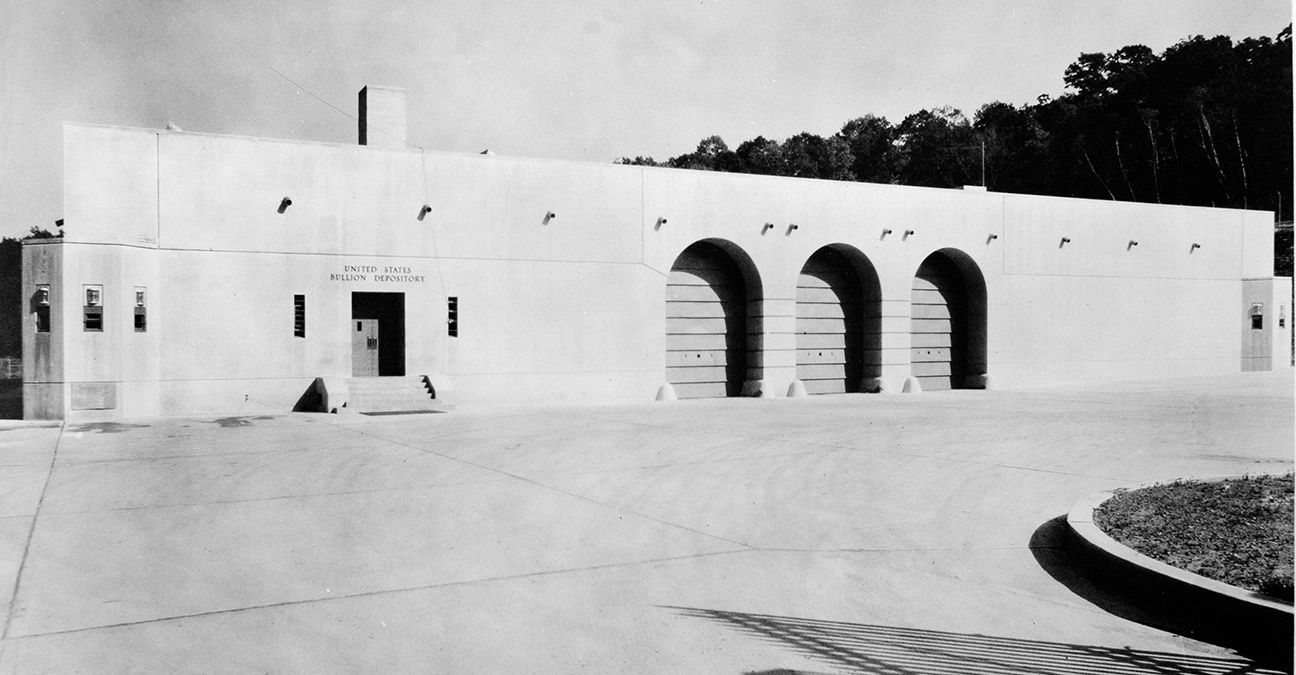
Less than a year later, on June 15, 1938, Mint Director Ross visited the nearly complete building for a final inspection tour. Shipments were to begin in early July, and the Treasury Department awarded a shipping contract for $157,000 to Peter J. Malley Company of New York. The company was to move 1,000,000 silver bars from the city to West Point, a distance of about 50 miles. Two Coast Guard personnel would ride “shotgun” in each truck, with the whole operation expected to use 25 bus-type trucks per day, five days a week, for 10 months.[7] Malley ran afoul of Local 320 of the Armored Car Chauffeurs and Drivers Union by pulling off union guards and using only the Coast Guardsmen. The union declared a strike and picketed the operation, but work continued normally.[8] Eventually, Malley and the Treasury allowed one private guard to accompany each truck.
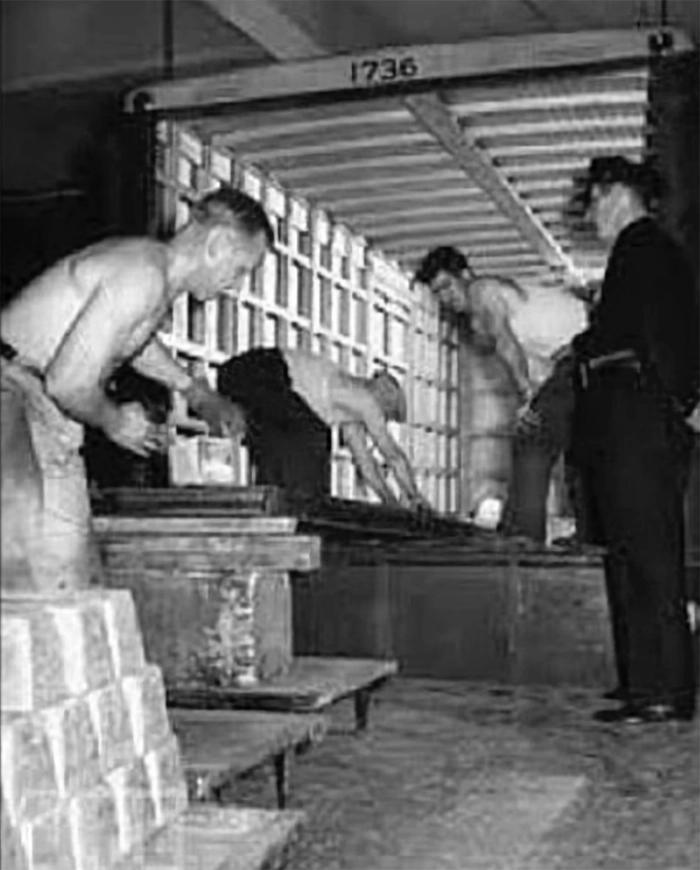
The first shipments left City Bank, Farmers Trust Co., the U.S. Federal Reserve Bank, New York Assay Office, and National City Bank on July 6. Each truck carried about 320 silver bars, with 10 trucks used on the first day. Different routes were used each day and occasionally the drivers got lost, only to reappear after an unexpected side-trip. The most consistent mechanical failures were truck brakes not built for the heavy load and steep roads.
Director Ross and New York Assay Office Superintendent E.R. Lynch supervised the first day’s deliveries. Trucks pulled into the depository building and were unloaded with all deliveries complete by 3:30 PM for the first day.[9]
Eventually, some of the silver bullion piled up at West Point was “loaned” to American allies and businesses for coinage and as a replacement for copper in electrical bus bars, wiring, and even tin in solder. Nearly all the loaned silver was returned, and the balance was paid for at rates above cost, so the Government made a profit on its silver.
Throughout construction, renovation, and the transportation of gold and silver, the threat of war seemed to creep ever closer. In a March 1939 letter, Tayloe Ross broke her usual cheerful stride:
Thank you for your good letter which arrived this morning. First, let me say how depressing I find the war news to be each day – or rather, threat of war. I tremble for the future of my son, and your son, and everybody else’s sons.
…I have much confidence in you all. I am getting anxious, though, to get back. It will not be long now.[10]
Ross had good reason to worry. German armies occupied parts of Czechoslovakia on March 15, 1939. They declared a “protectorate” over Bohemia and Slovakia, claiming they arrived to prevent violence against German-speaking residents.
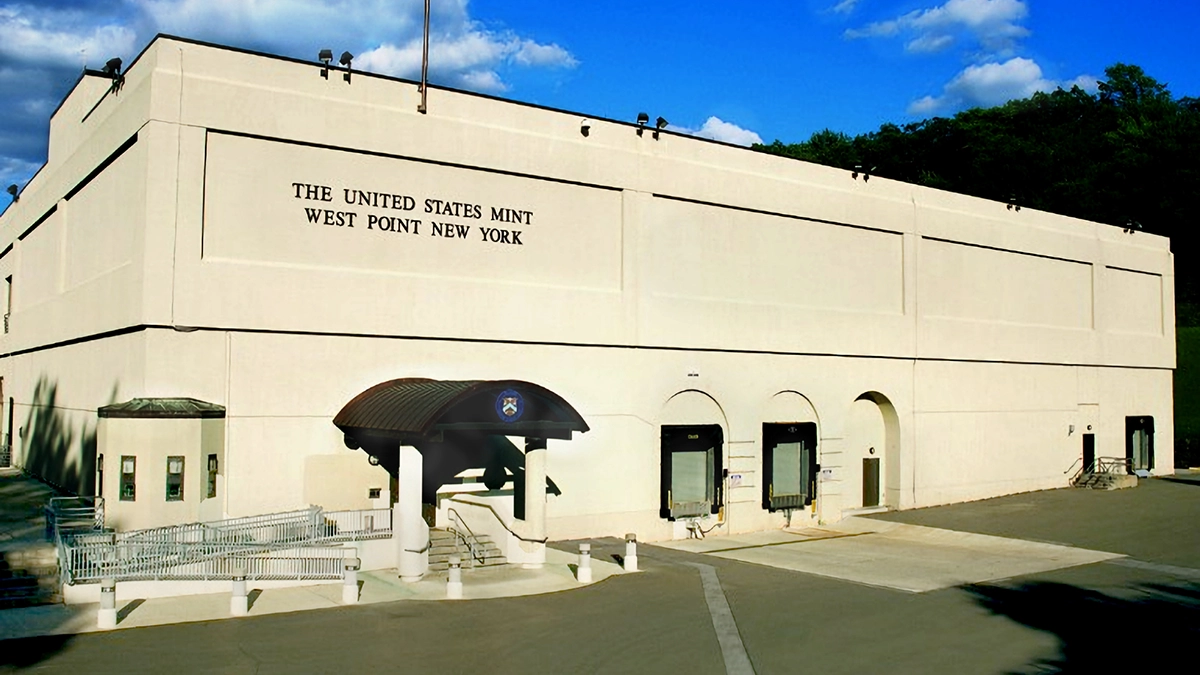
West Point Mint
The change from bullion depository to active coinage uses began in 1970. That year, approximately three million silver dollars made at the Carson City Mint in the early 1880s were found in the New York Assay Office and moved to West Point.[11]
By 1973, the West Point Bullion Depository, now largely vacant space, was put to use striking Lincoln Cents as an adjunct to the Philadelphia Mint. These were made to free space at Philadelphia and Denver mints to meet the anticipated high demand for Bicentennial coins, The coins had no distinguishing marks. Initially, this was believed to be a temporary arrangement intended to relieve production stress on the large mints in Denver and Philadelphia. Yet, over the next 12 years, about seven million cents were struck each workday at West Point.
West Point further expanded its production capacity and struck Bicentennial Quarters in 1976 and circulation quarters from 1977-1979. All of these quarters were struck on a new horizontal “Quad” press that produced four coins simultaneously. There were no mintmarks on any of these coins. This continued for a dozen years until 1986, by which time the West Point Mint was already producing commemorative coins and had begun production of American Silver Eagle bullion coinage. Manufacture of gold medals for the American Arts Gold Medallion Program began in 1980, and in the same year, 1,682 tons (142 truckloads) of U.S. gold were transferred from the old New York Assay Office to West Point bullion storage vaults.
The bullion depository was an administrative unit of the New York Assay Office until that facility was closed in 1982 and administrative responsibility shifted to the Philadelphia Mint. The silver depository eventually was renovated and outfitted and became the fourth United States branch mint on March 31, 1988.[12]
Highlights of this mint’s special operations include a 1984-W $10 gold commemorative (Proof and Uncirculated versions) for the 23rd Olympiad held in Los Angeles, California. This became the first legal tender gold coin struck by the United States Mint since 1933. The first American Eagle Platinum bullion coins were produced in 1997, and in 2000 a gold and platinum $10 bimetallic coin honoring the Library of Congress was struck. The Treasury Department expressed its commitment to bullion and commemorative coin programs in 2002 by updating electrical and security systems and adding a complete second floor. This addition more than doubled usable space from 44,000 square feet to 94,000 square feet.
Limited production of circulating design coins began in 1996 when a 1996-W Roosevelt Dime was offered with that year’s Uncirculated Coin Set. For 2019, West Point produced 10 million 2019 America the Beautiful Quarters – two million circulation coins of each of the year’s five designs: Lowell National Historical Park, American Memorial Park, War in the Pacific National Historical Park, San Antonio Missions National Historical Park, and Frank Church River of No Return Wilderness. These coins were randomly distributed to encourage citizens to examine their pocket change in search of these “rare” quarters.
Also in 2019, Lincoln Cents with the “W” mintmark were struck in three finishes for inclusion in separate packaging as premiums[13] for the three annual numismatic coin sets: clad Proof, silver Proof, and clad Uncirculated. The premium 2019-W Lincoln Cents were the first Lincoln Cents struck at West Point in more than 40 years and the first to bear the facility’s “W” mintmark. Three 2020 annual sets sold by the U.S. Mint — the Proof Set, Silver Proof Set, and Uncirculated Coin set — were accompanied by a 2020-W Jefferson Nickel with one of three different finishes.[14]
The first palladium bullion pieces were made in 2017 in response to a bill passed by Congress despite palladium’s lack of stature as either a coinage metal or a precious metal.
Some time ago, I was a member of the Citizens Coinage Advisory Committee (CCAC). One of the highlights of my tenure was our 2009 visit with Mint Director Edmund C. Moy to West Point to witness the first striking of the Mints’ reproduction of the MCMVII small-diameter double eagle pattern pieces.
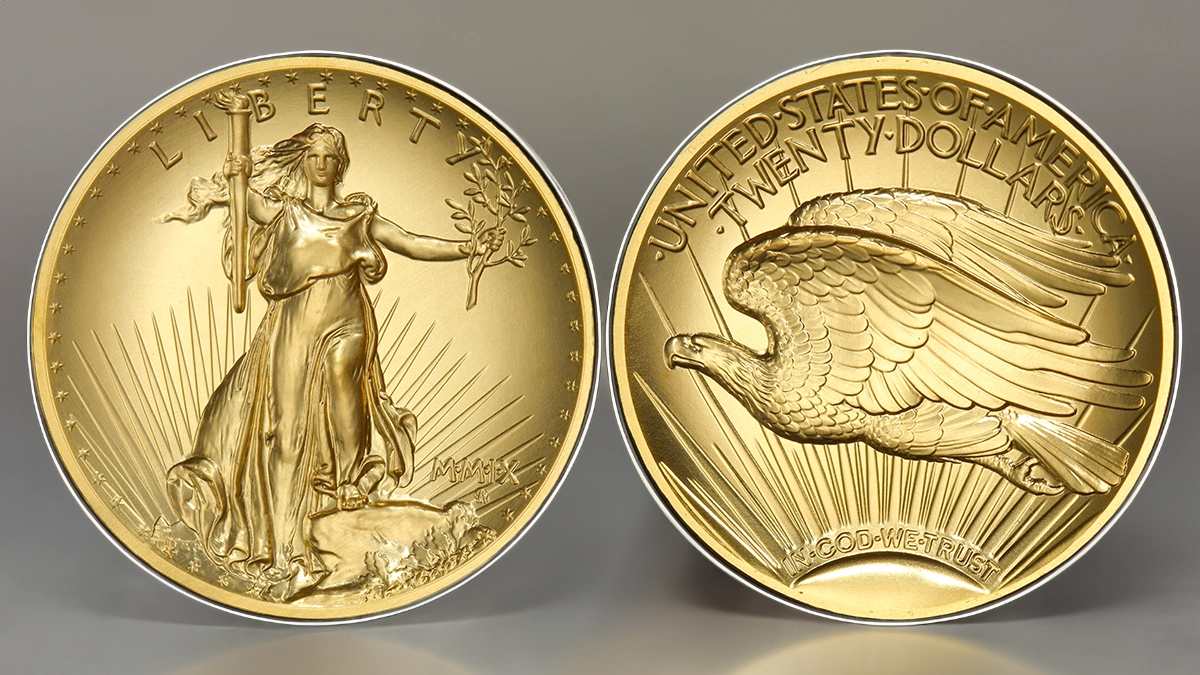
Today, the primary purpose of the mint at West Point is to produce bullion tokens in silver, gold, platinum, and palladium; non-circulating legal tender coins such as silver and gold commemoratives; and other items sold into the novelty and “collectible” markets. Precious metal planchets are manufactured by outside contractors.
* * *
Notes
[1] “U.S. to Send Silver Here”, New York Times. May 9, 1938: 29.
[2] “West Point Approved for a Silver Depot”, New York Times. May 16, 1937: 21.
[3] An acre of land contains 43,560 square feet, so the building was a little less than an acre in size, or roughly the size of a modern full-service American grocery store.
[4] “Treasury Plans Silver Cache Near Academy at West Point”, Washington Post. May 27, 1937: 3.
[5] “Bids for Silver Storage”, New York Times. July 23, 1937: 31.
[6] “National Affairs: Silver Fortress”, Time Magazine. September 6, 1937.
[7] “25 Trucks to Move a Billion in Silver”, New York Times. July 1, 1938: 21.
[8] “Union Votes to Picket Transfer of U.S. Silver”, New York Times. July 12, 1938: 8.
[9] “Huge Silver Vault Gets First Deposit”, New York Times. July 7, 1938: 21.
[10] Wyoming State Archives. Edness Kimball Wilkins papers H-81-1. Box 9, Ross correspondence 1936-1939. Letter dated March 23, 1939, to Kimball from Ross.
[11] The coins were organized and sold to the public by the General Services Administration (GSA), along with a quantity of non-CC dollars.
[12] There are two primary coinage mints: Philadelphia and Denver. There are also two specialty mints; the San Francisco Mint manufactures collector Proof coin sets, and the West Point Mint produces gold and silver collector and bullion coins.
[13] Think of prizes in a box of Cracker-Jax candy, or a free toaster for opening a bank account long ago, or a dinner-plate premium found in a box of laundry detergent.
* * *