

The Canadian Cent Mint Error That Put Queen Elizabeth II on Both Sides
A No-Date Canadian Cent With a Dramatic Minting Accident
“Two heads are better than one” rarely applies to coins. However, this no-date Canadian cent makes a strong case.
A Canadian one-cent mint error, cataloged as no date and circa 1978-1989, closed in a GreatCollections online auction on April 19, 2026. CACG certified the coin Mint State 62 Brown. GreatCollections described it as a “Canada Mint Error ND (c.1978-89) Cent Flip Over Double Struck Uniface Reverse Strikes CACG MS-62 BN.”
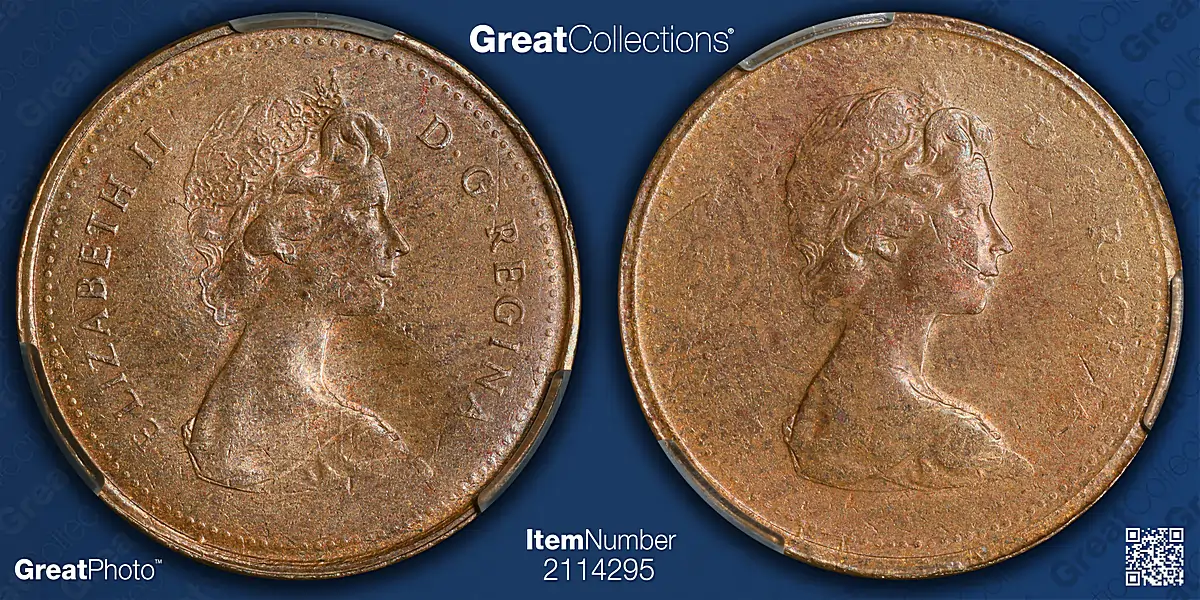
That title takes work to unpack. Yet every part matters.
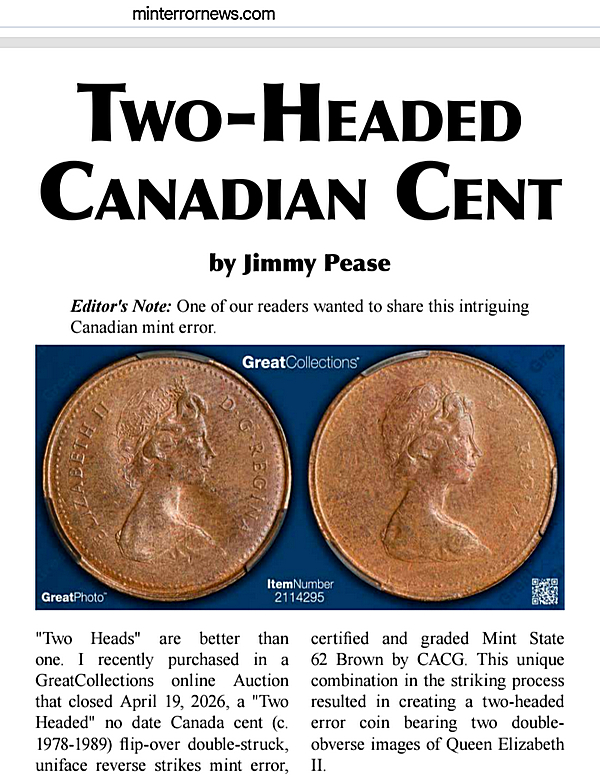
At first glance, the coin looks like a “two-headed” cent. Both physical sides show Queen Elizabeth II. However, this piece does not appear to come from a simple two-obverse-die setup. Instead, the error tells a more chaotic story.
A struck cent failed to leave the press. Then it flipped. Next, another blank planchet entered the striking chamber. Finally, the press struck again. That multi-stage accident created a coin with two Queen portraits and no readable date.
Why the Missing Date Matters
On normal Canadian cents of this period, the obverse carries Queen Elizabeth II. The reverse carries the denomination, date, “CANADA,” and the maple twig design.
That point explains the mystery. The date did not disappear because someone removed it after the coin left the Mint. Instead, the error process destroyed or blocked the reverse side that would have carried the date.
As a result, GreatCollections cataloged the coin as “ND,” or no date. The listing also assigned the piece to circa 1978-1989.
That range fits the late Elizabeth II Machin-effigy era for Canadian cents. The Arnold Machin portrait of the Queen appeared on Canadian coinage from 1965 through 1989. Therefore, the portrait helps place the coin in that broad design period. The auction attribution narrows it further.
The Backstory: Canada’s Maple Twig Vanishes
The “wow” factor comes from what the coin lost.
The Canadian 1-cent coin carried a deeply familiar national design. G.E. Kruger-Gray’s maple twig reverse first appeared in 1937. With the special exception of the 1967 Centennial cent, the design became one of Canada’s most recognizable pocket-change images.
Yet this error turns that design into a ghost.
The cent should show Canada’s maple leaves on one side and the Queen on the other. Instead, the striking sequence created a double obverse mint error with 2 portraits. The Queen took over both faces. Meanwhile, the date and maple twig vanished from view.
That makes this error more than a mechanical oddity. It rewrites the visual identity of the Canadian cent.
How the Coin Was Likely Made
The first strike began normally. A bronze cent planchet entered the collar. Then the dies struck the planchet and created a standard Canadian cent. One side received Queen Elizabeth II. The other side received the maple twig reverse, the denomination, and the date.
Then the normal process failed. The coin did not eject from the striking chamber. Instead, it remained seated in the collar and flipped over.
Next, a fresh blank planchet entered the chamber. That new planchet created the key complication. It sat between part of the already struck coin and one of the dies.
Then the press came down again.
Because the first coin had flipped, the die struck the wrong design relationship into the coin. A fresh Queen portrait appeared where collectors would expect the reverse. At the same time, the second blank planchet shielded one side of the struck coin from the die. That shielded side did not receive a normal die impression. Instead, it became a uniface strike area.
In plain English, one coin became trapped in a minting traffic jam. Then another blank joined the crash. The press struck both coins together. The result created a two-headed Canadian cent error.
What “Flip-Over Double-Struck” Means
A double-struck coin receives two strikes from the dies. In many cases, the second strike lands off-center or overlaps the first design.
A flip-over double strike adds another layer. The coin turns over between strikes. Therefore, the second strike lands across the opposite side of the first strike.
That is what gives this Canadian cent its dramatic look. The flip allowed the Queen’s portrait to appear again in a place where it should not appear.
What “Uniface Reverse Strikes” Means
“Uniface” means one side of a strike lacks a normal die design. That happens when another planchet or obstruction blocks the die.
In this case, the second blank planchet acted like a shield. It kept the reverse die from striking the original coin in the usual way. As a result, one side of the error did not show a full reverse design.
That detail matters because it explains the missing maple leaves and date. The coin did not merely suffer from a weak strike. It went through a stacked, interrupted strike sequence.
Why This Is Not Just Damage
Major mint errors often look strange. Therefore, new collectors sometimes mistake them for damaged coins. This example tells a different story.
CACG authenticated and graded the coin Mint State 62 Brown. The Mint State grade means the coin shows no wear from circulation. However, MS-62 also allows for visible marks, surface disturbances, and imperfections.
That matters with mint errors. A coin can look chaotic and still remain Mint State. The “damage” came from the minting process itself, not from circulation.
The BN, or Brown, designation also fits the coin’s copper-bronze composition. Copper and bronze coins often lose their original red color over time. Many develop a natural brown surface. On an error coin, that warm brown color can help the design details stand out.
Collector Appeal
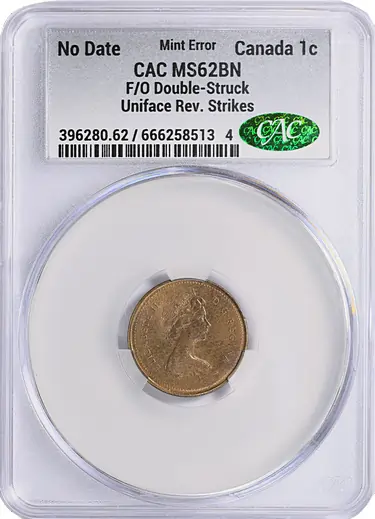
This Canadian cent checks several boxes at once.
It has no visible date. It has a flip-over double strike. It has uniface strike characteristics. Most importantly, it has two visible obverse images of Queen Elizabeth II.
That combination gives the coin instant visual appeal. It also gives specialists a clear technical puzzle. The error does not rely on a tiny doubled die or a subtle repunched detail. Instead, the whole coin tells the story.
GreatCollections’ auction activity also showed strong interest. The lot drew 65 bids before it closed on April 19, 2026.
Final Thoughts
This no-date Canadian cent captures the drama of mint error collecting. It shows how one failed ejection can turn a normal coin into a Numismatic rarity.
First, the cent entered the press as a routine piece of Canadian pocket change. Then the press failed to clear it. After that, the coin flipped. Finally, a second planchet entered the chamber and changed the outcome forever.
The result left Queen Elizabeth II on both sides and erased the maple twig reverse that should have carried the date.
That is why this coin works so well as a CoinWeek feature. It has rarity, technical depth, visual impact, and a clean backstory. It also reminds collectors that the most exciting mint errors do not just break the rules. They show exactly how the rules broke.
Great information!
What a great error coin.
Wow I thought it only happened on American coinage.