


The U.S. Mint’s $19,600 Liberty Bell Coin Revives a 1915 Rarity, and a Pricing Fight
The 2026 Liberty Bell gold coins mark one of the boldest U.S. Mint releases of the Semiquincentennial year.
They also revive a numismatic idea that almost never appears in American coinage.
For the first time in recent U.S. history, the United States Mint will issue a non-round legal-tender coin. The new Freedom Ringing – Liberty Bell gold coins come in two sizes. One contains one-half ounce of .9999 fine gold and carries a $125 face value. The other contains one troy ounce of .9999 fine gold and carries a $250 face value.
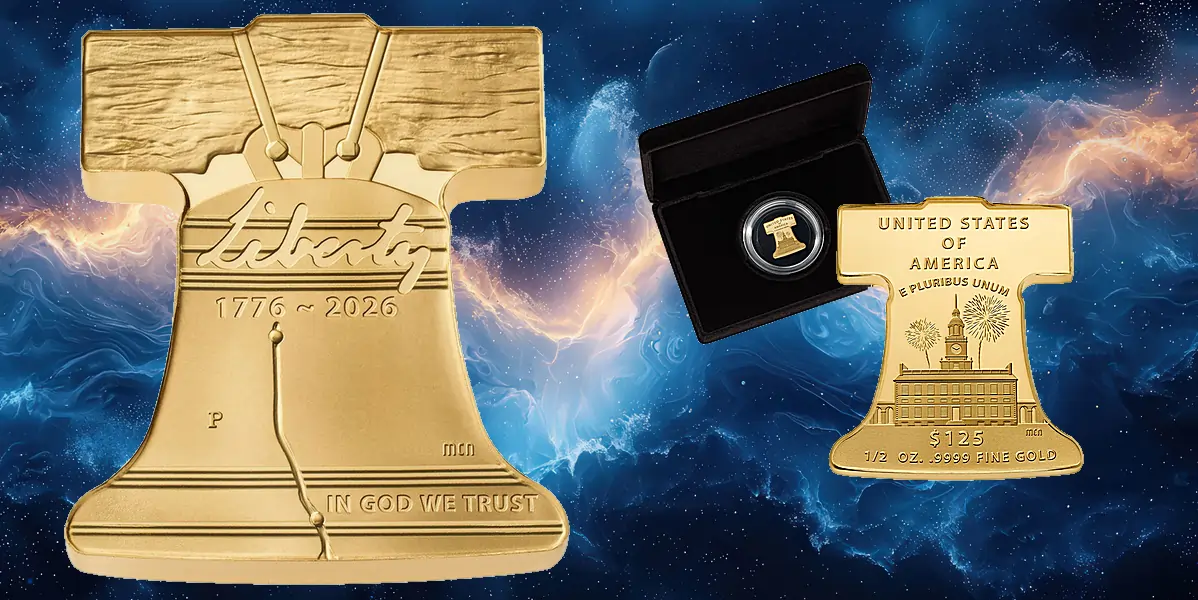
Both coins launch on July 16, 2026, at noon Eastern Time. Each has a mintage limit of just 2,026 pieces. Therefore, both coins will likely attract immediate attention from collectors, speculators, and critics.
Yet the story goes far beyond mintage. It reaches back to the Panama-Pacific International Exposition of 1915. It also raises a timely question for today’s hobby: How much can the Mint charge before collectors push back?
A Liberty Bell Shape for America’s 250th Anniversary
The Liberty Bell remains one of the nation’s most recognized symbols. Its inscription, “Proclaim Liberty Throughout All the Land Unto All the Inhabitants Thereof,” connects the bell to the American Revolution, abolitionism, civil rights, and the larger American promise of freedom.
Now the Mint has turned that symbol into the actual shape of a coin.
The obverse shows the Liberty Bell with its famous crack. The word LIBERTY appears across the shoulder of the bell. The design also carries the dual dates 1776 ~ 2026 and the motto IN GOD WE TRUST.
The reverse shows Independence Hall, the original home of the Liberty Bell. Fireworks rise behind the building. The bell’s yoke carries UNITED STATES OF AMERICA, with E PLURIBUS UNUM below. The sound bow carries the weight, fineness, and denomination.
The one-half-ounce gold coin shows “$125,” “1/2 OZ.,” and “.9999 FINE GOLD.” The one-ounce gold coin shows “$250,” “1 OZ.,” and “.9999 FINE GOLD.”
Mint workers handloaded and pressed the coins in the Research and Development Lab at the Philadelphia Mint. That detail matters. These pieces do not represent routine production. Instead, they reflect a specialized manufacturing project with tight tolerances and unusual geometry.
The Silver Liberty Bell Is a Medal, Not a Coin
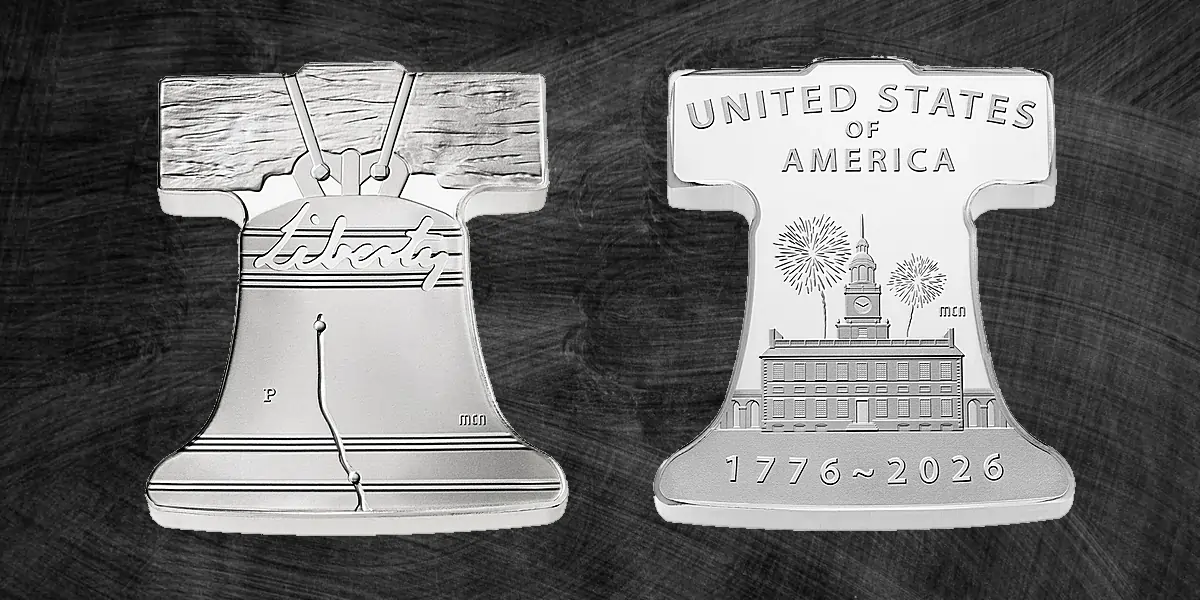
The Mint will also release a Freedom Ringing – Liberty Bell One-Half Ounce Silver Medal.
This silver issue shares the Liberty Bell shape. However, it does not carry a denomination. Therefore, it is not legal tender.
The medal contains one-half troy ounce of 99.9% silver. It has a Proof finish, a smooth edge, and a listed price of $750. Like the gold coins, it has a product limit and mintage limit of 2,026 pieces.
This distinction matters. Collectors often use “coin” loosely. However, numismatics demands precision. The gold Liberty Bell issues are coins. The silver Liberty Bell issue is a medal.
Product Snapshot
Product Status Metal Weight Face Value Price Mintage Limit
- Liberty Bell One-Half Ounce Gold Coin Legal-tender coin .9999 gold 0.500 troy oz. $125 $10,050 2,026
- Liberty Bell One Ounce Gold Coin Legal-tender coin .9999 gold 1.000 troy oz. $250 $19,600 2,026
- Liberty Bell One-Half Ounce Silver Medal Medal .999 silver 0.500 troy oz. None $750 2,026
All three pieces have Proof finishes, smooth edges, and Philadelphia Mint origins. Each measures just over one inch high. Yet each carries a far larger place in the 2026 Mint story.
The 1915 Panama-Pacific Shadow
The Liberty Bell gold coins invite an obvious comparison.
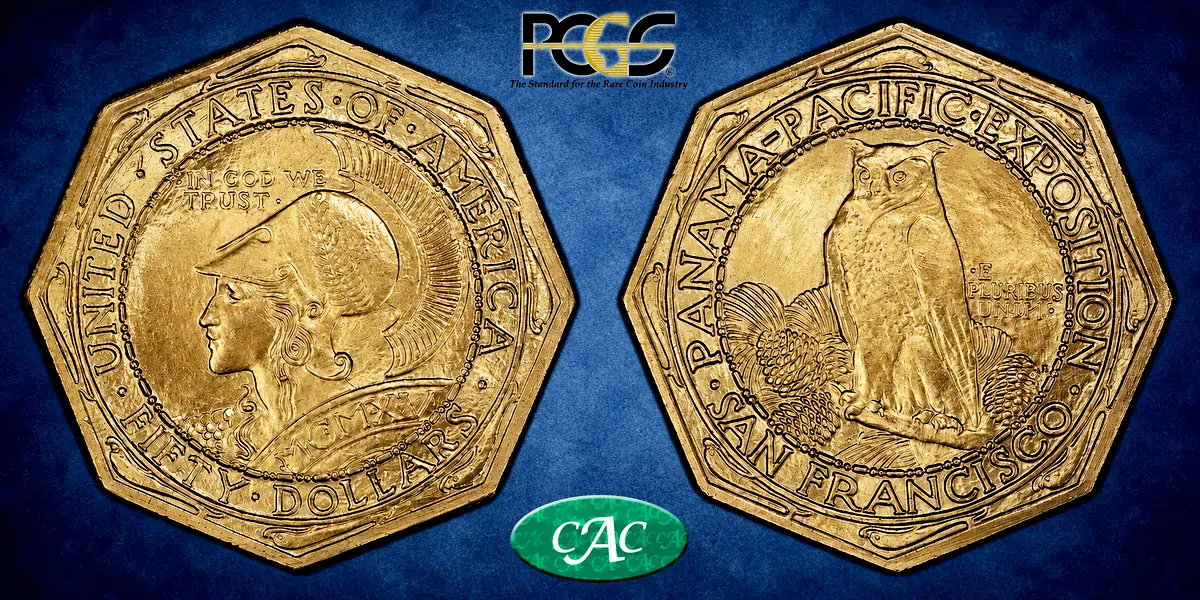
In 1915, the United States Mint struck the famous Panama-Pacific $50 gold coins for the Panama-Pacific International Exposition in San Francisco. The program celebrated the opening of the Panama Canal and the city’s recovery after the 1906 earthquake and fire.
The Mint produced two $50 versions. One was round. The other was octagonal.
Robert Ingersoll Aitken designed both. The obverse features Minerva, the Roman goddess of wisdom and strategic warfare. The reverse features an owl, another classical symbol of wisdom. On the octagonal coin, eight dolphins appear around the border.
That design choice gave the piece a visual drama no other U.S. coin could match.
The $50 face value also stunned buyers. At the fair, the coin sold for $100. That price doubled its already historic face value. As a result, sales disappointed. The Mint melted the unsold pieces, and the octagonal coin finished with a net distribution of only 645 examples.
Today, the 1915-S Panama-Pacific $50 Octagonal ranks among the great trophies of American numismatics.
That is the “wow” factor behind the 2026 Liberty Bell gold coins. The new coins do not copy the Pan-Pac design. Yet they return to the same big idea: a U.S. legal-tender gold coin that breaks the round format.
Collectors have waited 111 years to see that concept return.
Why the Norse-American Medal Does Not Count
One important exception often enters the discussion.
In 1925, the Philadelphia Mint struck the Norse-American Centennial medal. It also used an octagonal format. However, it was not a coin.
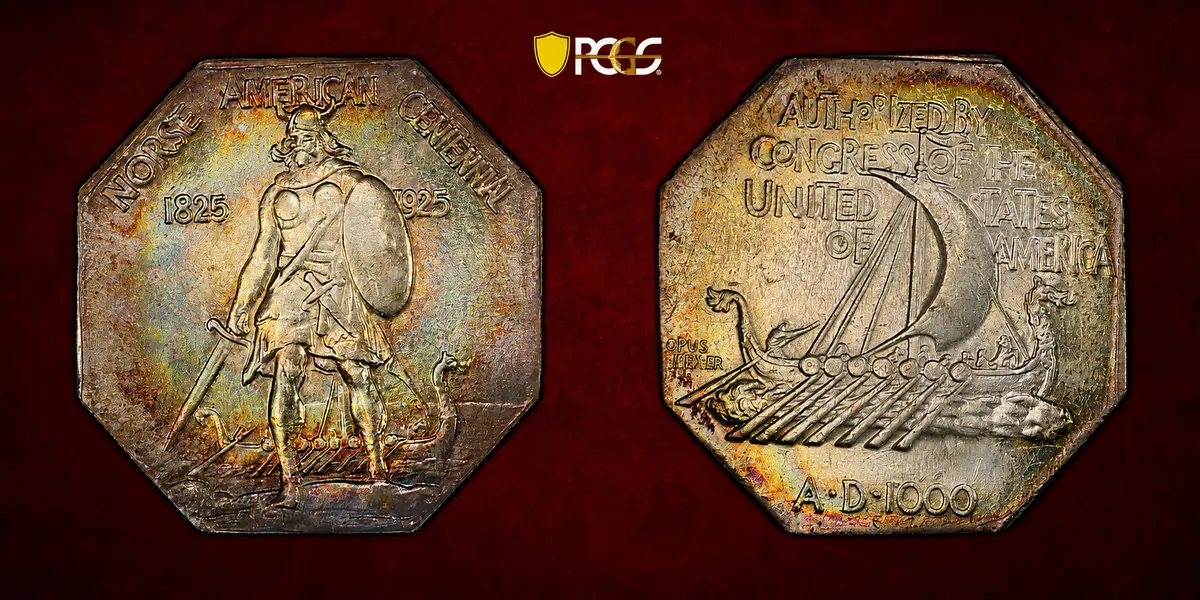
The backstory explains why.
Congressman Ole J. Kvale of Minnesota originally supported a commemorative half dollar to mark the 100th anniversary of the arrival of Norwegian immigrants aboard the Restauration. However, the Treasury Department had grown weary of commemorative coin proposals. Congress had already authorized several commemorative coins that year.
So sponsors changed course. They pursued an official national medal instead.
Because the Norse-American piece lacks a denomination, it carries no legal-tender status. Even so, collectors often place it alongside classic U.S. commemoratives. PCGS and NGC also grade it by coin standards. Auction catalogs regularly treat it like part of the classic commemorative orbit.
Still, it remains a medal. It does not interrupt the legal-tender line from the 1915 Pan-Pac octagonal $50 to the 2026 Liberty Bell gold coins.
A U.S. Rarity, But Not a World Rarity
Non-round legal-tender coins are not new in the global market.
Several sovereign mints and contract manufacturers have explored shaped coins for years. The Perth Mint has issued rectangular and other innovative legal-tender products. The Royal Canadian Mint has produced curved and shaped collector coins. Monnaie de Paris has pushed artistic formats in euro-denominated issues. Coin Invest Trust, Scottsdale Mint, PAMP Suisse, and Mennica Polska have also helped make shaped non-circulating legal tender a familiar category in the international market.
However, the United States Mint has moved far more slowly.
That restraint gives the 2026 Liberty Bell coins much of their importance. They do not merely add another Semiquincentennial product. They mark a rare technical and design departure from U.S. Mint tradition.
Pricing May Become the Bigger Story
The 2026 Liberty Bell coins have historic importance. However, their prices will dominate much of the collector conversation.
CoinWeek regularly hears from readers who cannot buy limited-mintage Mint products before they sell out. Many releases vanish within minutes. That pattern frustrates collectors who want one example for a personal collection, not a short-term flip.
At the same time, CoinWeek also receives growing criticism about U.S. Mint pricing. That criticism has intensified during the Semiquincentennial program.
The 2026 U.S. Mint Uncirculated Coin Set offers a clear example. It contains no precious metal. Yet the Mint priced it at $124.50. The 2025 set launched at $33.25. That represents a 274.4% year-over-year increase for a base-metal annual set.
The Liberty Bell Products Push the Debate Even Further
At $19,600, the one-ounce Liberty Bell gold coin costs far more than its melt value. The half-ounce gold coin costs $10,050. Their small mintages, unusual shape, Proof finish, and specialized production all add cost. That part makes sense.
Even so, nearly $20,000 for a new one-ounce U.S. Mint gold coin will strike many collectors as excessive.
The silver medal may draw even sharper criticism. It contains one-half ounce of silver and lists for $750. Based on late-June silver quotes, that places the issue price at roughly 25.14 times its silver value or a 2,414% premium cost over spot. Some collectors may accept that premium because of the shape, mintage, and anniversary theme. Others will see it as a symbol of a pricing model that has moved beyond ordinary hobby budgets.
Self Funding and Cost Recovery Basis
The U.S. Mint does operate on a self-funding, cost-recovery basis. It also faces rising labor, material, and manufacturing costs. Those facts matter. However, public perception matters too.
When longtime collectors cancel subscriptions or skip anniversary products, the Mint faces more than a pricing problem. It faces a trust problem.
The Mint handled one 2026 distribution far better. Its limited-edition Declaration of Independence quarters with the special July 4th privy mark offer a useful blueprint. The Mint placed 250,000 pieces randomly into circulation through banks and financial institutions. As a result, anyone can search rolls, pocket change, and bank finds.
That approach creates excitement. It also keeps the hobby accessible.
The Liberty Bell gold coins will not do that. Their audience will remain narrow by design. However, the Mint should still take the lesson seriously. Limited products can build the hobby, or they can alienate it.
Real-time online pricing should also play a larger role. In today’s market, metal prices move quickly. The Mint should adjust excessive price swings with more transparency, not less. Collectors understand cost recovery. They do not always accept sticker shock.
Final Takeaway
The 2026 Liberty Bell gold coins deserve attention.
They bring back the non-round U.S. legal-tender concept after more than a century and connect the Semiquincentennial to the Liberty Bell, Independence Hall, and the long American struggle to define liberty. The “coin” also recalls the 1915 Panama-Pacific $50 Octagonal, one of the most famous U.S. coins ever made.
Yet they also arrive at a difficult moment.
Collectors want history. They want beauty. They want access. Increasingly, they also want the Mint to explain why official products cost so much.
The Liberty Bell may proclaim liberty. However, at $19,600, the one-ounce gold coin also proclaims a new reality in modern U.S. Mint pricing.


Cool coins but honestly more and more proof that the U.S. government and related entities are out of touch with its population
Exactly and I’m not sure the mint is interested in keeping its registered account customers as they seem to be catering to those dealers who are selling their products thru e bay or other online retailers. The waiting room hasn’t solved the issues of overloading the sales it’s been quite the opposite with this software freezing, kicking customers out and making the process impossible.
Originally, I was excited and had planned to purchase several items from the mint but have been priced out of it. I am also disappointed that the coins meant for circulation are no where to be found; it appears that they got sent to the more populated areas. I am not willing to pay the speculators cost as I feel that after a while the price will come down when the speculators try to sell. I thought about the silver bell but there asking price is not realistic. I had better hopes for collecting the 250th set; now I just need to keep searching rolls from the credit union.
Ive been a coin collector since I was 12 yrs old in 1976. Ive never been able to afford pricey purchases, which have left a lot of coins (especially post 2020 proof sets and all gold coins) out of my reach. Its not fair to us who collect more for appreciation of a coin than its investment potential. So all I can collect is well circulated coins that are not stabbed. With exceptions of the proof sets of the 60s – 2009, I was able to afford those when they were released.
I agree that the US Mint prices are out of touch with the average collector.
Wow. Really nice, but at that price IDK.
I was ecstatic about these until I got to the price line. Understand fully a premium for such a small minting but at these pricings the Mint has priced out the majority of collectors. A coin, and medal, like this should also be minted in clad and sold at a significantly lower cost to afford collectors an opportunity to experience a special coin and medal like these.
Why is the Mint suddenly charging so much for their coins? Their prices are ridiculous!
I am glad the Mint has created such beautiful and imaginative coins for our 250th celebrations.
However, it is sad that most are out of the budget of the average citizen.
Limited mintage with most coins ending up in the hands of Big time dealers before you can even order them from the mint, who then mark up the already outrageous prices. I am out before I even had a chance to get in.
Brb refinancing
When is a coin no longer a coin?
If I was lucky enough to snag one, it would have to be buried with me as my wife would kill me. ;-}
A lot going on with the mint this year. I wonder if they have any insight into repricing gold and silver. I was hoping to at least get my hands on a proof set, but even that feels very overpriced.
The 250th Liberty Bell coins are really nice and it’s cool that they decided to make them in the shape of the bell but the prices they want, even for the silver medal is outrageous. I will never be able to afford to buy any of these but I will keep dreaming that someday….
The special 2026 coins are NOT circulating….yet? It is almost July 4th and only a few nickels have surfaced! Privy yeah we’ll c hem right after the V75 Privy, anyone get one of those???
Collectors should boycott the mint and large dealers purchase bulk. Skip 3 years of collecting. I canceled all my subscriptions since 2021.
Very nice coins, unique and interesting, but those prices are positively obscene.
Just not worth the price to me.
As much as I like the product, there is really no justification for the prices for things like this. It’s just not worth it.
TY
It’s more than obvious that Congress should’ve mandated prise restrictions on all the Mint’s products long ago. Just another prime example of our government failing to assume its appropriate fiduciary responsibility on behalf of its fine citizens.
I Love to collect coins !
This was outstanding, would love to have !
WOW! Incredible coin. Too bad the mint is trying to balance the Federal budget selling this coin.
for me this is, at best, an expensive curiosity
i’ll pass on this – not worth it
Priced out again!
When I received an email with info about this set, I was excited! When I got to the prices, I was disappointed, especially for the silver medal!
The prices are incredibly high. Very few collectors can afford to purchase the Freedom Ringing – Liberty Bell set. And that’s a shame. If wealthy people purchase the sets, it’s unlikely the collecting community will ever lay eyes on them – short of stories like Coin Week, or auctions at Stack Bowers, for example. I wish the decision makers at the U.S. Mint had considered minting proof sets for $200 or $300. We, the people, could actually afford them.
Not surprising seeing that many individuals associated with and members of the current government are having a vary profitable year at our expense.
I won’t spend what few dollars I have left over from increased food prices, increased gas prices, increased power bills and increased prices on what seems like everything.
Inflation has come down from the monthly gains of our last administration. Today I bought gas for $3.17 a gallon. The price of silver and gold do not justify the prices the mint is charging. To get one I will probably have to go through a dealer and pay a commission just to buy one.
There’s no way in hell i would pay that. Now its getting a little ridiculous here I mean come on
The uncirculated annual set pricing needs to be explained and substantiated with evidence. The Congressional Budget
Justification and Annual Performance Plan and Report FY2025 states under Numismatic Program, “Numismatic
products are priced to cover metal and production costs.” It specifically does not use the word “profit.” Let’s demand justification of the specific price increase from ~$33 to ~$124.
The reason that the pricing is set at this level relative to mintage levels is for the Mint to capture as much as the underlying premium that the secondary market would command in any case to support their operations as opposed to having brokers and dealers capture all the premium. At least the revenue raised here will support a more vibrant mint that is not affiliated with any political party so they can continue to offer several products at all price points and this is likely to support further future innovation and new ideas at the mint
No one is forced to buy, and having greater variety is usually a good thing
Similar trends are taking place re ticketed events and the like in the broader economy re the owners of the IP and consumers and trying to cut out what brokers earn on resales
Obviously a Grift.
Who is benefiting from this insane mark-up? The Staff?
I maybe want a silver half.. but Gold yes maybe 1oz (all my savings). Yes agree get it graded FR/ER PF70. 1st day issue whatever and sell when sold out. I do like shape of Liberty bell. But yes WAY over priced! I do have a Pan Pac or PACMAN coin cause I wanted it.
The WWII V75 privy 1 oz Gold Eagle with mintage of 1945 routinely sells over 20K at ha or GC or any other online retailers. With the US mint pricing these so high, the intent would be to cut down these enormous gains which the collectors are making. I can’t think of any other reason for these prices – besides of course funding the war & balancing the budget.
The distribution of the quarters was a total joke. One guy on YouTube shows himself finding 815 of them in one box!
Managed to get one of the 2026, half ounce gold Freedom Ringing Liberty Bell coins in the sale yesterday at the mint. Got it to have something beautiful and to leave to my kids in the fullness of time. Just wondering if this was a ‘wise’ investment that will be useful to them one day, or just a very expensive half ounce? No idea what this will be worth in the future, any thoughts from you guys?
I was fortunate enough to be able to buy the half oz gold Liberty Bell coin within 2 minutes of the original release on July 16. Took the US Mint 5 days to close out the credit card transaction , which normally would be done at the end of the business day for any other business. Finally received it today by UPS, the coin shipped 7/22, by UPS Next Day Air. I guess next day doesn’t mean what it used to. The coin is beautiful, but there is a very tiny fine scratch in the upper left corner on the reverse side. Im gonna keep it anyway because I might not be able to get a better replacement. I have also been able to purchase all of the semiq coins released so far. But I think I will no longer buy coins directly from the US Mint after this year due to the obvious corporate greed instituted by the current administration.
I was lucky to purchase a couple ASE’s, Morgan and Peace reissues before the mint repriced everything earlier this year, when Silver and Gold spiked. I was keen on hetting one of the Liberty Bell coins, it is just not worth the outrageous price. I did get one of the dual date ASE proofs, which was overpriced, but I wanted one.