


The $10 Bison Note That Turned a Battleship Into an American Icon
The 1901 $10 Legal Tender Note does something few American notes ever dared to do.
It pushes presidents, statesmen, and classical allegory away from center stage. Then it places a bison there.
That one decision made the note unforgettable. Today, collectors know it as the Bison Note. They also rank it among the great triumphs of American currency design. In 100 Greatest American Currency Notes, Q. David Bowers and David Sundman place the design at No. 6.
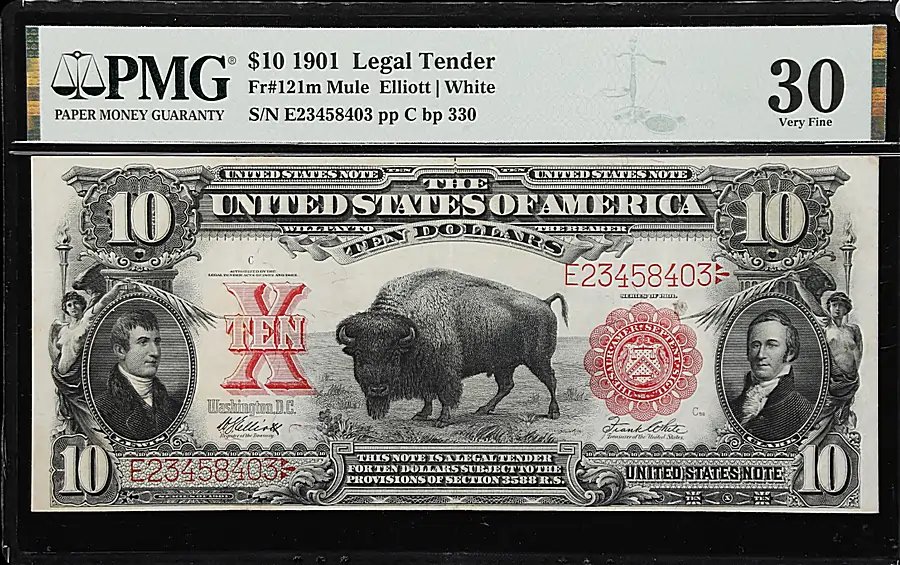
Now, a Fr. 121m 1901 $10 Legal Tender Note, graded PMG Very Fine 30, brings that story to the Stack’s Bowers Marketplace. The note offers strong collector appeal. However, it also carries a deeper backstory. It links the American frontier, the Lewis and Clark Expedition, the Bureau of Engraving and Printing, and an abandoned battleship design that never reached circulation.
A Bison at the Center of American Money
The face of the note delivers immediate impact.
A powerful bison stands at the center. Portraits of Meriwether Lewis and William Clark flank the animal at left and right. Together, the three images turn the note into a national statement. The design looks west. It celebrates exploration. It also captures the American imagination at a time when the frontier had already begun to pass into memory.
Collectors often identify the central animal as Pablo, a bison connected with the National Zoological Park in Washington, D.C. Stack’s Bowers notes that Pablo came from a Montana ranch and entered the zoo in 1897.
That detail gives the note its backstory. The animal that came to symbolize the untamed West actually stood in Washington when artists and engravers shaped one of America’s most famous banknotes.
Even so, collectors should not confuse Pablo with Black Diamond, the bison long associated with the Buffalo Nickel. The 1901 $10 Legal Tender Note belongs to a different design story.
Lewis, Clark, and the Centennial Moment
The portraits of Lewis and Clark add another layer.
The note appeared during the era of the Lewis and Clark Expedition centennial. That timing mattered. Americans in the early 1900s looked back on the Louisiana Purchase and the overland expedition with fresh pride. The nation had expanded from coast to coast. It had also become an industrial and naval power.
Therefore, the Bison Note does more than show a large animal. It tells a story about national identity. Lewis and Clark represent exploration. The bison represents the plains. Together, they turn a $10 note into a miniature mural of expansion.
The Legal Tender Issue With a Legal Citation
The note also carries unusual legal language.
The face reads that the note serves as legal tender for ten dollars, subject to the provisions of Section 3588 R.S. It also states that the United States will pay the bearer ten dollars and that the issue draws authority from the Legal Tender Acts of 1862 and 1863.
That language gives the design added importance. The Series of 1901 $10 notes formed the only release of the Fifth Issue of United States Legal Tender Notes. In addition, specialists often point to the explicit statutory reference as a distinctive feature of the type.
In short, the Bison Note looks bold. Yet it also speaks in the formal language of federal monetary authority.
The Reverse: “Progress” and Columbia
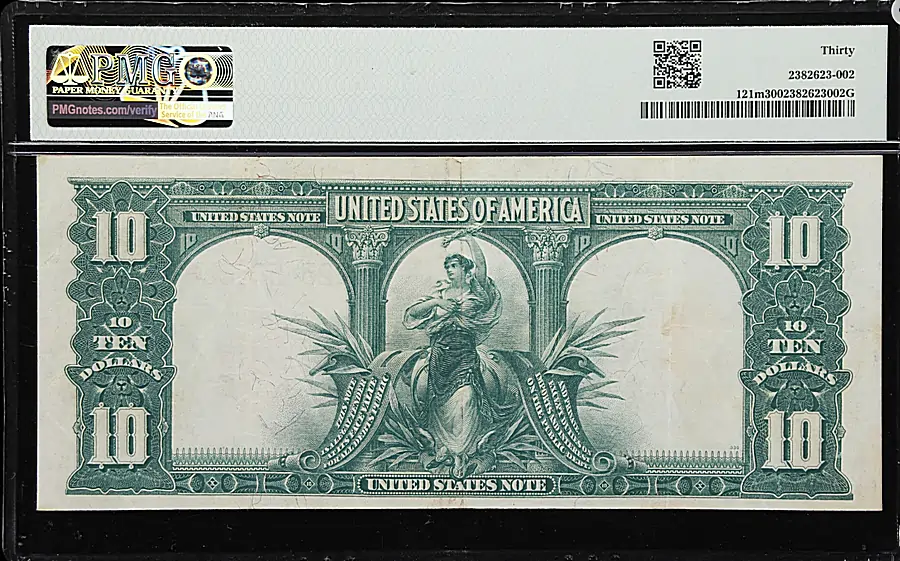
The back of the note shifts from frontier power to allegory.
At center, a female figure representing Columbia stands between two columns. The reverse vignette carries the title Progress. It presents the United States through classical symbolism rather than wilderness imagery.
That contrast gives the note balance. The face shows the frontier. The back shows national growth. As a result, the entire design moves from exploration to progress in one turn.
The reverse also connects the Bison Note to a larger world of American art. Walter Shirlaw designed the allegorical concept, and G.F.C. Smillie engraved the final vignette. The result fits the high artistic ambitions of the Bureau of Engraving and Printing at the turn of the 20th century.
The Battleship Note That Never Was
Here the story becomes even more compelling.
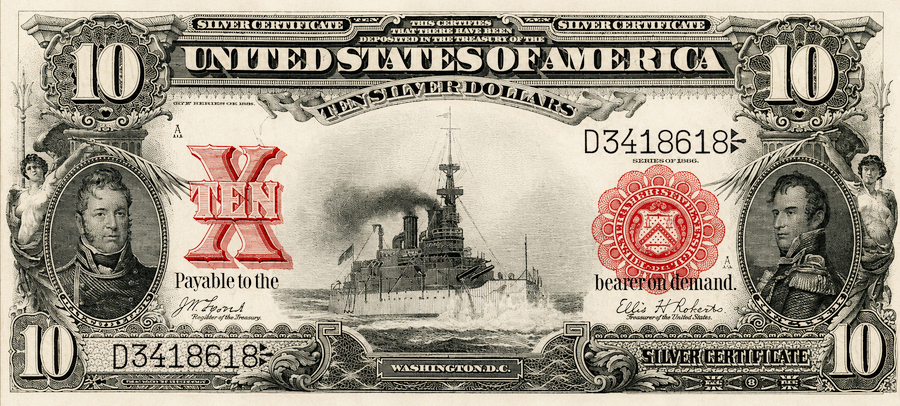
Before the Bison Note reached collectors, another design stood in its place. The Bureau had prepared elements for an unreleased $10 Silver Certificate, intended for the Series of 1899 and later tied to the Series of 1901 concept.
That earlier design did not feature Pablo. Instead, it placed the USS Massachusetts (BB-2) at center. Portraits of Commodore William Bainbridge and Commodore Stephen Decatur appeared at the sides. Both men held important places in early U.S. naval history, including the Barbary Wars.
In other words, one of America’s greatest currency designs began with a battleship.
Then the design changed.
The columns behind the side portraits remained. The broad design framework survived. The female allegorical figures at left and right also remained, although artists modified them. In the earlier concept, they held tridents. On the Bison Note, they hold torches.
Most importantly, the battleship left the center. The bison took its place.
That change transformed the entire message. A naval design became a frontier design. A symbol of steel and sea power gave way to a symbol of the American West.
Roosevelt, Muir, and the Conservation Age
The timing adds drama.
President William McKinley died after an assassin shot him in 1901. Theodore Roosevelt then entered the White House. Roosevelt brought a strong conservation vision to national politics. Soon after, he built a lasting relationship with naturalist John Muir, including their famous 1903 Yosemite trip.
Stack’s Bowers notes that the death of the battleship design has long drawn an alleged link to Muir’s influence and Roosevelt’s conservation circle. That claim deserves careful wording. The exact decision trail remains hard to prove. Still, the design change fits the national mood that Roosevelt helped shape.
The Bison Note arrived as Americans debated what progress should mean. Should the nation celebrate industry, naval power, and expansion? Or should it also preserve the wild spaces and animals that had defined the continent?
This note captures that tension. It places the bison in the center of commerce.
Why Fr. 121m Matters
The Stack’s Bowers Marketplace note carries the Fr. 121m attribution. That matters to specialists.
The Friedberg catalog number identifies a specific variety within the 1901 $10 Legal Tender Note series. The lowercase “m” marks the note as a mule. In paper money, a mule uses front and back plate elements that specialists would not expect as a standard pairing.
For Fr. 121m, the note carries the Elliott-White signature combination. However, it displays an Elliott-Burke back plate number. That mismatch gives the note its mule status.
This variety adds a technical collecting angle to an already famous design. Type collectors want the Bison Note for its beauty. Variety specialists want Fr. 121m for the production story.
What PMG Very Fine 30 Means
PMG grades this example Very Fine 30.
That grade places the note in a strong circulated category. A VF30 note has seen commerce. However, it should still retain solid visual appeal. PMG describes this grade as lightly circulated. Notes at this level may show light soiling and typically show seven to 10 folds.
For a large-size type note, VF30 often hits a practical sweet spot. It gives collectors a historic note with honest circulation. At the same time, it can retain enough detail, color, and design strength to display well.
That balance matters with the Bison Note. The design depends on impact. The central bison, red seal, serial numbers, portraits, and intricate reverse all need enough clarity to carry the full effect.
Available Through Stack’s Bowers Marketplace
This Fr. 121m 1901 $10 Legal Tender Note, graded PMG Very Fine 30, is currently offered through the Stack’s Bowers Marketplace.
The listing identifies the note as a Legal Tender $10 1901 Fr. 121m Mule with a small red scalloped seal. It also lists the note’s serial number as E23458403 and the PMG certification number as 2382623002.
For collectors, the marketplace offering adds a timely angle to the note’s long historical appeal. The Bison Note already ranks as one of the most celebrated designs in U.S. currency. However, this example also brings the scarcer Fr. 121m mule attribution into focus. That combination gives the note appeal for both type collectors and paper money specialists.
Collectors can view the note and purchase it through its Stack’s Bowers Marketplace listing.
A Classic With a Hidden Second Story
The 1901 $10 Bison Note ranks among America’s most recognizable banknotes for good reason.
It offers a bold animal vignette and also honors Lewis and Clark. It carries unusual legal language but belongs to the final Legal Tender issue. It also preserves the artistic ambition of the Bureau of Engraving and Printing at the dawn of the 20th century.
However, the deeper story makes it even better.
Behind the bison stands the ghost of the USS Massachusetts. Behind Lewis and Clark stand Bainbridge and Decatur. Behind the frontier scene stands a nation choosing which symbols would define its future.
That is why this Fr. 121m Bison Note deserves attention. It does not merely show the American West. It shows the moment when American money changed its mind.






Interesting article. I would like to see our paper currency return to featuring artwork that tells the story of our nation’s history rather than relying primarily on portraits of presidents.
-The bison was a wonderous symbol that we nearly eliminated. And now after years of care they are back only to be pushed off the land they roamed freely again. Truely, the bison needs to be continually protected. It is vital to the ecosystems and religioius beliefs.
Yes historical art work would be nice!
New information to me!
Absolutely a beautiful piece of American history and its heritage.