


The ONLY overdate in the entire 110+ year history of the Lincoln Cent series
A 1943/2-S Lincoln Cent certified MS-67 by PCGS crossed the block in Stack’s Bowers Galleries’ June 17th 2026 Showcase Auction. The coin appears as Lot 3071 in Session 3, and sold for $1,708.
At first glance, it looks like a spectacular Superb Gem 1943-S steel cent. However, this coin tells a much deeper story.
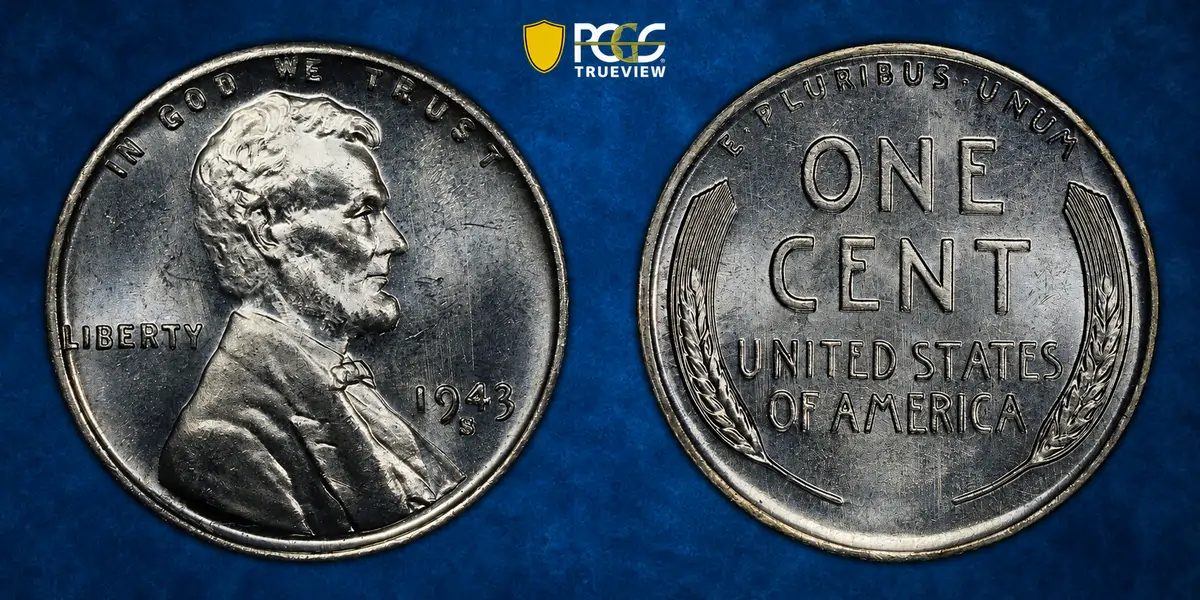
For decades, specialists knew the variety as the 1943-S Doubled Die Obverse, FS-101. Then, in 2022, numismatists changed the story. They confirmed that the famous doubled die also carried the remains of an earlier date.
That made it the 1943/2-S Lincoln Cent.
It also gave Lincoln cent collectors one of the most exciting wartime variety discoveries in modern numismatics.
A Superb Gem Steel Cent With Sharp Diagnostics
The Stack’s Bowers example carries a grade of MS-67 from PCGS. That grade matters.
Steel cents often look deceptively common. The United States Mint struck them in huge numbers in 1943. Collectors also saved many examples at the time. Even so, the zinc-coated steel surface created problems from the start.
Steel cents spot. They rust. They tone unevenly. They also show fingerprints and surface disturbances quickly.
As a result, a sharply struck, bright, frosty, steely-gray example in Superb Gem condition stands apart. Stack’s Bowers describes the coin as virtually pristine, with razor-sharp detail. That sharpness gives collectors a clear view of the variety’s diagnostics.
PCGS reports a population of 21 coins in MS-67, with eight finer. MS-68 ranks as the finest grade reported by PCGS.
Why the 1943 Steel Cent Exists
The 1943 Lincoln cent came from wartime necessity.
During World War II, copper and nickel served critical military uses. So, the Mint moved away from the traditional bronze cent alloy for one year. Instead, it struck circulating cents on zinc-coated steel planchets.
The San Francisco Mint struck 191,550,000 Lincoln cents in 1943. Those coins carried Victor David Brenner’s Lincoln obverse and Wheat reverse. However, they looked unlike any earlier Lincoln cent in circulation.
Their pale gray color made them stand out. Their steel cores also made them magnetic. Meanwhile, their vulnerable surfaces created long-term preservation problems.
That is why this MS-67 overdate matters. It combines wartime history, a major variety, and exceptional preservation.
The Coin Collectors Knew as a Doubled Die
For many years, specialists classified this coin as a 1943-S Doubled Die Obverse.
That made sense. The coin shows clear doubling. Collectors focused on the date, especially the digits 1 and 9. They also studied Lincoln’s profile, his lower lip, and LIBERTY.
The Cherrypickers’ Guide listed the variety as FS-101. Older references also used FS-019.5. As a result, older certified holders may still show the earlier doubled die description.
Yet the coin had one more secret.
The extra metal near the 3 in the date did not fit a simple 1943-over-1943 doubled die explanation. Something else seemed to hide under the final digit.
The 2022 Discovery Backstory
The turning point came in 2022.
Longtime collector James Elliott had studied the variety and questioned whether the doubled die was really an overdate. In July 2020, Elliott raised that possibility in a private online Lincoln cent error and variety forum. He focused on extra metal near the upper right side of the 3.
To Elliott, that feature matched part of a 2.
Later, fellow collector Pete Apple recommended that Elliott contact Tom DeLorey. Elliott did. Then DeLorey examined the evidence.
DeLorey did not work alone. He consulted several leading variety specialists, including Bill Fivaz, John Wexler, James Wiles, and David Lange. Together, they concluded that the coin was not merely a doubled die.
It was a true 1943/1942-S overdate. Here is the CoinWeek Article on the discovery
That finding rewrote the identity of a variety collectors had known for decades.
How a 1942 Hub Created a 1943-S Coin
The overdate formed during the die-making process.
A working die first received an impression from a 1942-dated hub. Then it received another impression from a 1943-dated hub. The two impressions did not align perfectly.
That misalignment created the doubled die features. It also left traces of the earlier 2 beneath and around the 3.
The pivot point sat near the left obverse rim. Therefore, some parts of the design show only minor doubling. LIBERTY sits close to that pivot area, so it shows less dramatic spread. By contrast, the date shows stronger evidence.
The 1 and 9 display clear doubling. The 4 can show evidence in early die states. Most importantly, the extra metal around the 3 matches the shape and position of a partially formed 2.
That detail changed the coin’s identity.
Why the Underlying 2 Looks Incomplete
Collectors should not expect to see a full 2 under the 3.
The die was not fully formed by the first hubbing. During this era, a die often needed more than one hubbing impression. The first impression formed the central design first. Outer design elements developed later as the hub sank deeper into the die.
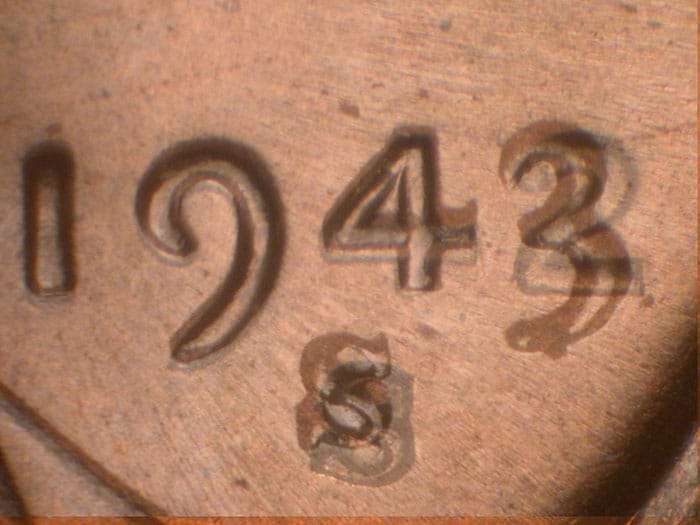
Because the earlier 1942 hubbing did not fully form every element, the underdate appears partial. The base of the 2 does not show clearly. However, the remaining metal fits the shape of the 2 better than it fits a second 3.
This detail explains why collectors missed the overdate for so long. It also explains why early die-state examples matter.
A Lincoln Cent Variety Hiding in Plain Sight
The 1943/2-S Lincoln Cent has a rare kind of appeal.
It did not emerge from a newly discovered hoard. It did not require a new date or mintmark combination. Instead, it hid inside a known variety for decades.
Collectors already had the coin. Dealers had sold it. Grading services had certified it. Reference books had listed it.
Yet the full story remained incomplete until specialists looked again.
That gives the coin its “wow” factor. It proves that even in the Lincoln cent series, one of the most heavily collected areas in American numismatics, new discoveries can still reshape the field.
Why It Is Still Listed as FS-101
The 1943/2-S remains FS-101.
The designation did not disappear because the coin still shows doubled die characteristics. Instead, the 2022 confirmation added another layer to the variety.
In simple terms, the coin is both a doubled die obverse and an overdate.
That is why auction catalogs and grading-service databases may describe it as 1943/2-S, DDO, FS-101. Collectors should also check certification records, especially when a coin remains in an older holder with the earlier 1943-S DDO wording.
Market Context
High-grade 1943-S steel cents already draw collector attention. The 1943/2-S FS-101 adds far more demand because it combines condition, variety status, and wartime history.
Recent sales have shown strong interest in certified Mint State examples. The highest-grade pieces command the greatest attention. In 2024, a PCGS MS-68 example sold for $5,760. Meanwhile, MS-67 coins continue to attract Lincoln cent variety specialists who want quality without chasing the top grade.
The Stack’s Bowers MS-67 example offers that balance. It delivers Superb Gem preservation and full visual access to the diagnostics. It also represents a variety whose story still feels fresh.
The Bottom Line
The 1943/2-S Lincoln Cent is more than a wartime steel cent.
It is a coin that changed its own identity after nearly eight decades. It began as a known doubled die. Then careful study revealed a hidden overdate. That discovery turned a familiar Cherrypickers’ Guide variety into one of the most fascinating Lincoln cent stories of the modern era.
For specialists, the lesson remains clear………. Keep looking!
Even a coin that “everybody knows” may still have something left to say.
Coin Specifications
- Country: United States
- Year: 1943/2-S
- Denomination: Lincoln Cent
- Mint: San Francisco
- Designer: Victor David Brenner
- Composition: Zinc-coated steel
- Weight: 2.70 grams
- Diameter: 19.00 mm
- Edge: Plain
- Mintage: 191,550,000 for the 1943-S issue
- Variety: FS-101, Doubled Die Obverse, 1943/1942-S overdate
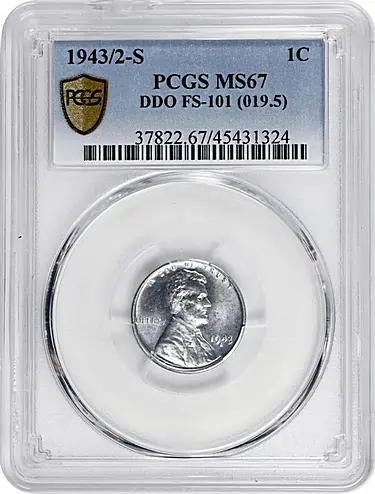
- Certification: PCGS MS-67
- PCGS Population: 21; 8 finer, MS-68 finest




Editors Note: Even after all these years I still am learning. The Double Die designation (DDO) is not in the RedBook for the 1943-S Lincoln cent. Not sure why but CoinWeek will follow up on it. Also, I had no idea that the 1943/2-S overdate Lincoln cent discovered by Tom Delorey in 2022 (and others) was in fact an Overdate. So taken all together, this coin is a Steel cent, a 1 year only type, with a Double Die Obverse and the only overdate in the entire Lincoln cent series. To me, it seems like this coin is way undervalued!
I have a few uncirculated war time steel pennies in a protected case. Plus a few pockets change wartime steel pennies. Plus a 1943 steel penny error, that is missing the number 4 on the date. Plus some war time nickels too, nothing but pocket change that I have had for a long time. Since I was a kid and I am 68 going on 69 next month. How can I get some one to appraise my whole collection, with out costing me to much? And do it here at the house, maybe. I have a Presidential Statue collection and it’s completed and in perfect shape to. Let me know if you’re interested.
I have a 1943 selver penny where can I sell it I have a lot of old money but I don’t know where to take it to can you help me Thank you and God Bless
PCGS then heritage auctions
The war years revealed a number of overdates. Glad to still have the discovery piece.
Good Job !!!
Oh but the copper 1 !! Like most collectives , I have a handful of the steel . Sounds like I should go through them, it’s been a while since i’ve done that.
This is so cool. We are recent collectors and I knew my husband had the “bug” when I caught him looking in change cups at the grocery store we go to! lol. We love the Lincoln pennies and he told me of the wartime coins. Good luck coming across one, especially with the likelihood of rust!
I have around 125 wheat pennies that I will sell fairly cheap if intersted I lost patience going thru them takes too long but seen some over 100 yrs old and some war years 42 43 44 45 46 47 etc
I have two silver Penny’s with no symbols just the date.. how can I sell them for more money. Than what people want to give me.. 5.00 just isn’t enough…
That’s a unique and interesting penny. Good luck on the coin giveaway everybody!
Ooooh! Another error I need to check for in my collection of wheat-backs!
Thank you – love to learn about this.
Wow!
Never heard of this before!
Wow- great article on the 1943/42 S Lincoln cent. Time for me to look at the few I have to see if there is a hiding gem.
Great article and interesting coin.