


The Silver Peace Dollars Series Hiding in Morgan’s Shadow
Although Peace Dollars are popular, Morgan Silver Dollars dominate the U.S. silver dollar market. Collectors love their size, history, and frontier-era appeal. Dealers also move them in huge numbers. The series ran from 1878 to 1921, and it includes both common dates and major rarities.
However, the Morgan Dollar can punish collectors who want completion. The 1895 Morgan Dollar sits far beyond the reach of most budgets. High-end Morgan Dollars have also crossed the $1 million mark at auction. As a result, many collectors build type sets, short sets, or mintmark groups instead of chasing every date.
Yet the Morgan Dollar’s immediate successor offers a different path.
The Peace Dollar ran from 1921 through 1935. It has beauty, silver content, history, and a realistic path to completion. Even better, it tells one of the most powerful stories in American coinage.
The backstory: America wanted a coin for peace
The Peace Dollar arrived after World War I. The United States had emerged from the conflict with new global influence. At the same time, Americans wanted symbols that looked forward, not backward.
Anthony de Francisci won the design competition for the new silver dollar. His design replaced the Morgan Dollar and gave the nation a modern Liberty. The result broke from the more classical portraits that appeared on earlier U.S. coins.
De Francisci’s wife, Teresa de Francisci, almost certainly inspired Liberty’s face. That detail gives the coin a human connection. It also gives the design a living quality that many older Liberty portraits lack.
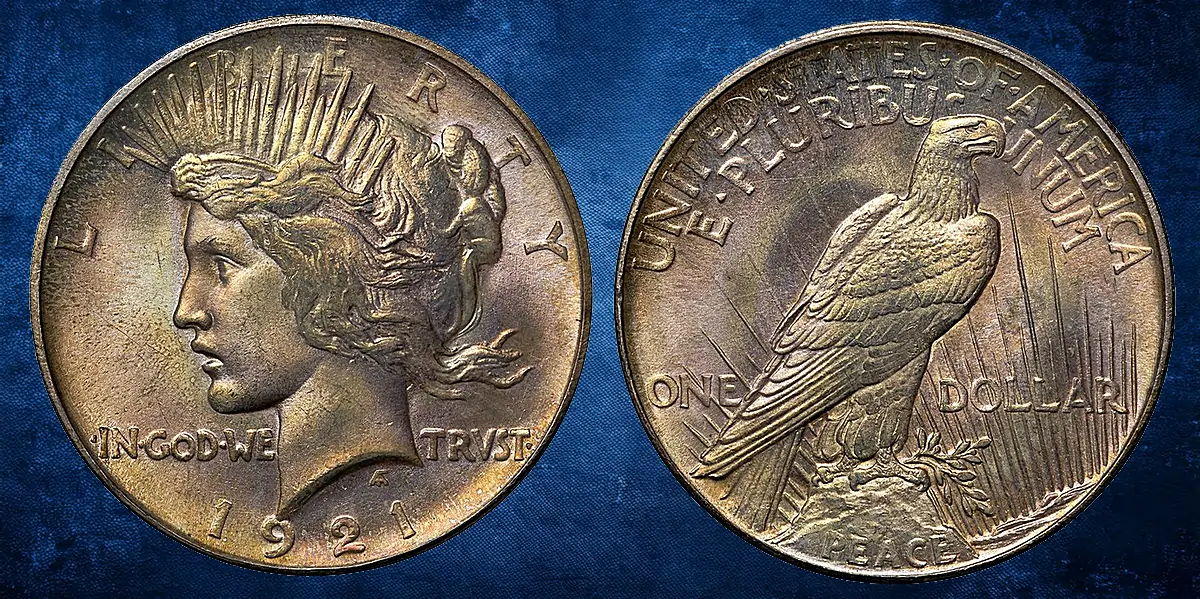
The 1921 Peace Dollar carried the design in bold high relief. The coin looks sculptural. Liberty’s hair, crown, and facial features rise with uncommon force. The eagle on the reverse also has a quiet strength.
That first-year issue remains one of the great 20th-century U.S. type coins.
A design with a clear message
The obverse shows Liberty facing left. She wears a radiant crown that recalls the Statue of Liberty. The word LIBERTY arcs above her head. The motto IN GOD WE TRUST appears below the portrait. The date sits at the bottom.
The reverse carries the message even more directly. A bald eagle rests on a rock. It does not attack. It does not clutch arrows. Instead, the bird sits in calm dignity above the word PEACE.
The reverse also includes UNITED STATES OF AMERICA, E PLURIBUS UNUM, and ONE DOLLAR.
Few U.S. coins state their purpose so clearly. The Peace Dollar did not just mark a denomination. It carried a national hope.
The 1921 Peace Dollar introduced Anthony de Francisci’s design in dramatic high relief.”]
Why Peace Dollars make sense for collectors
The Peace Dollar series offers a major advantage over the Morgan Dollar series. Collectors can complete it without needing an elite budget.
Morgan Dollars came from five mints: Philadelphia, Carson City, New Orleans, Denver, and San Francisco. Peace Dollars came from only three: Philadelphia, Denver, and San Francisco. The shorter run also helps. The classic Peace Dollar series includes issues from 1921 through 1928, then 1934 and 1935.
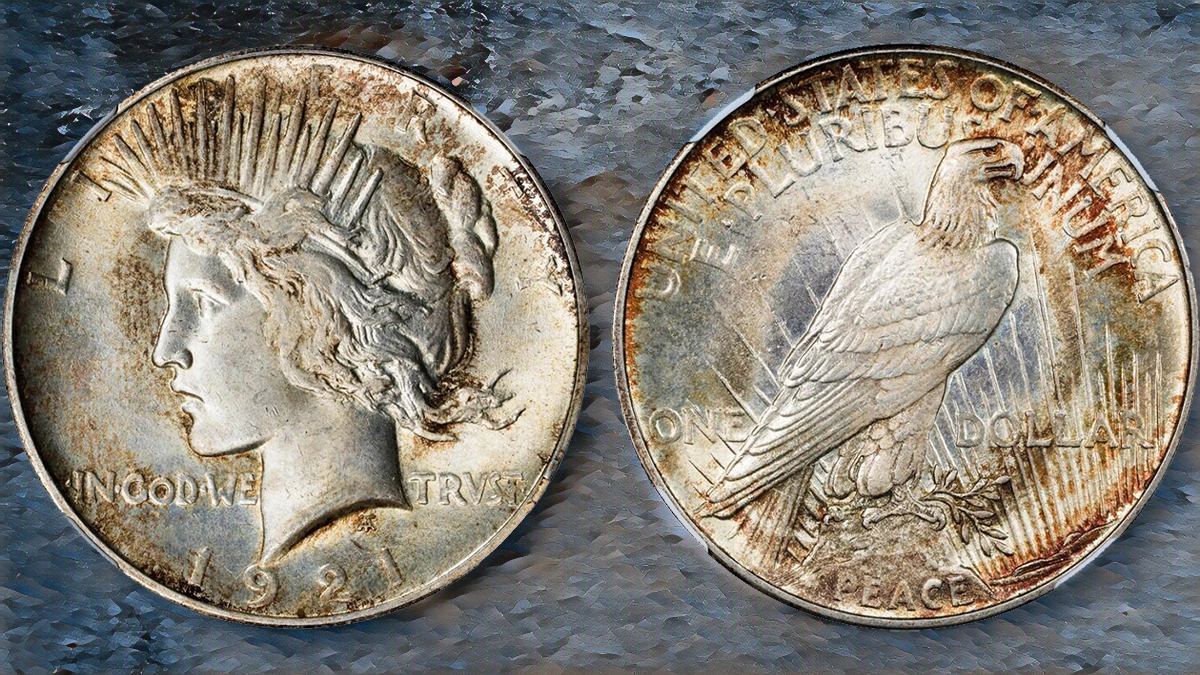
Most Mint State Peace Dollars remain approachable. Many Uncirculated examples trade in the $75 to $500 range, depending on date, mintmark, grade, and eye appeal.
The main stopper comes from San Francisco. The 1934-S Peace Dollar serves as the key date in Mint State. Even so, lower Mint State examples cost far less than the great Morgan Dollar stoppers.
That fact changes the collecting equation. A collector can build a meaningful Peace Dollar set with discipline, patience, and careful grading standards.
Silver value adds another reason to care
Classic Peace Dollars are large silver coins. Each one weighs 26.73 grams and contains 90% silver and 10% copper. That gives each coin about 0.77344 troy ounce of pure silver.
Because of that, common-date Peace Dollars often appeal to both collectors and silver buyers. They offer recognizable U.S. coinage, real silver content, and numismatic upside.
However, collectors should not treat every Peace Dollar as bullion. Strike, luster, surface quality, and originality matter. In higher grades, those factors can drive large premiums.
The population story favors Peace Dollars
NGC has certified more than 4,549,400 Morgan Dollars. By comparison, NGC has certified more than 1,026,200 Peace Dollars. The difference matters.
The Peace Dollar total also leans heavily toward common Philadelphia issues from 1922, 1923, 1924, and 1925. As a result, many dates become much tougher when collectors demand high grade, strong strike, and fresh eye appeal.
Superb Gem Peace Dollars remain rare. As of June 2026, only two Peace Dollars had reached NGC MS 68, with none graded higher. Morgan Dollars appear far more often at NGC MS 68 or better.
That contrast gives the Peace Dollar series a hidden strength. The set looks short and affordable at first. Yet it becomes challenging fast when collectors raise their standards.
What a complete Mint State Peace Dollars set can cost
A complete Peace Dollar set remains possible in several Mint State grade ranges.
A full set in MS 60 may cost about $7,500. In MS 63, the total rises to about $15,000, but MS 64, collectors should expect about $20,000. Moving upward, a MS 65, the number can jump to about $65,000.
That jump from MS 64 to MS 65 tells the real story. Many Peace Dollars become scarce in Gem. The San Francisco issues from 1924 through 1928 create some of the toughest challenges.
Therefore, collectors should set a grade target before they begin. A matched MS 63 or MS 64 set can offer strong value. A Gem set requires much deeper pockets and much more patience.
Eye appeal matters more than the holder
Peace Dollars often come with dull surfaces, uneven color, or unattractive toning. Truly attractive toning appears far less often than it does on Morgan Dollars.
Collectors should look for coins with strong luster and clean, frosty-white or nearly white surfaces. They should avoid dark, flat, or heavily spotted examples. Those coins often sell at discounts later.
Artificial toning also creates risk. Therefore, buyers should stick with certified coins when they pursue higher-grade pieces.
The best Peace Dollars look bright, clean, and alive. They do not need wild color. They need honest surfaces and strong visual appeal.
Strike separates average coins from great coins
Strike quality plays a major role in the Peace Dollar series.
The 1921 High Relief issue varies widely. Fully struck examples bring premiums because many pieces lack complete detail.
San Francisco issues create an even tougher test. Many “S” mint Peace Dollars show weak reverse strikes. For Gem examples, the reverse often decides the coin. Collectors should study the eagle, feathers, and central reverse details before they buy.
A sharp Peace Dollar can look dramatically better than a weak one in the same grade. That difference matters when it comes time to sell.
Varieties add another collecting lane
The Peace Dollar series also rewards variety specialists. The 1922 “mustache” variety remains one of the better-known examples. Other VAM and die varieties give advanced collectors a deeper field to study.
Collectors who want more than a date-and-mintmark set should consult NGC VarietyPlus and the “Mega Red” edition of A Guide Book of United States Coins from Whitman Publishing.
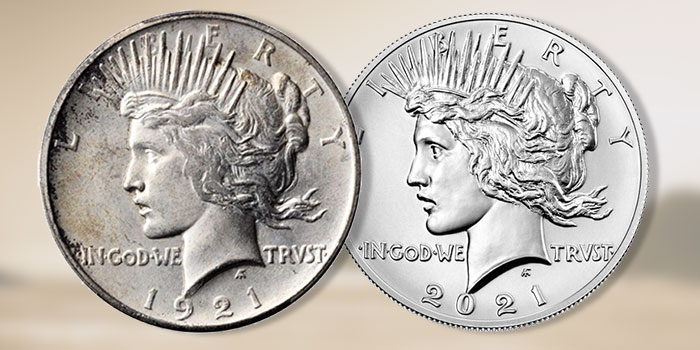
The Proof Peace Dollars of 1921 and 1922 add another layer. These coins include several important variations, and specialists continue to study them. For a short series, Peace Dollars offer more depth than many collectors expect.
Modern Peace Dollars keep the design alive
The U.S. Mint brought back the Peace Dollar in 2021 for the design’s 100th anniversary. The modern coins use .999 silver, not the classic .900 silver alloy. Also, the 2021 Peace Dollar did not use the same high relief as the 1921 original. The Mint adjusted the relief to match modern commemorative specifications.
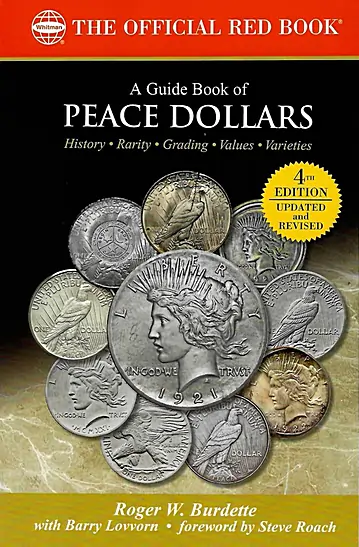
Even so, the revival matters. It introduced a new generation of collectors to de Francisci’s design. It also gave the classic series a fresh market hook.
The Mint has continued the Morgan and Peace Dollar programs with proof, reverse proof, and uncirculated products. In 2026, the Peace Dollar continues as part of the Mint’s modern silver dollar lineup.
Recommended book for serious collectors
Collectors who want to understand the series should read Roger W. Burdette’s A Guide Book of Peace Dollars. The book belongs to Whitman’s Red Book series and offers a deep study of the coin’s design, production, varieties, and market history.
A smart Peace Dollar collection starts with knowledge. Burdette’s book gives collectors the foundation they need.
Final thoughts
The Peace Dollar deserves more attention. It has a powerful origin story with an artistic design. It contains real silver but also gives collectors a realistic path to completion.
Morgan Dollars will always command the spotlight. However, that spotlight can blind collectors to better opportunities.
The Peace Dollar may be the smarter classic silver dollar set for many collectors today. It offers history without impossible barriers. It offers beauty without the Morgan premium. Most importantly, it offers a coin that still says exactly what America wanted to say in 1921:




I’ve always carried a 1935 S Peace Dollar as my pocket piece. I am building a rare VAM Peace Dollar Collection starting at R-7 or rarest depending on the year. At least one for every year of the series is the objective.
Easily put together a set in mostly circulated grades about 30 years ago. I personally liked the reverse more than the Morgan reverse.
One of my favorite series. I love the design and and ease of collecting.
The Morgan Dollars had the more complex design and far stronger strikes and proof like finishes.
I’ve always liked the design of the peace dollar. I hope to restart my stack someday.
I prefer the Peace Dollar to the Morgan. I have about twice as many Peace Dollars as Morgan’s. Not a full set but a collection and in various type sets.
I have a 1934 peace dollar. What is worth.
Such a beautiful design!
I have always liked this coin.
Peace dollars definitely don’t get the same love as Morgan dollars do
They’ve become pretty expensive these days. It is a beautiful coin!!
I have a few of these Peace Dollars. Great looking coin
Great article. I love collecting Peace Dollars. Its a classy design with a great story.
I love these, I have a few that my mom had saved and I cherish them!
I’ve always appreciated the beauty of the peace dollar design. Glad it made it back into production.
The Peace Dollar has been my most desired coin since I was a very young boy. My Pop had a small pouch filled with 20 of them, and he would let me check then out any time I’d like to. A burglar stole these coins – which I knew would be mibe some day, so these were the very first coins I purchased when I started collecting. Morgan’s may have the big price tags associated with them, but Peace Dollars capture the more art deco feel of America un the 1820s.
I have an easier time grading Morgan than Peace Dollars. Sure, you have your typical wear points, but sometimes it’s just a poor strike and not wear. I personally prefer the look of the Peace Dollar, though the Morgan does receive more attention. Perhaps it is a lingering feeling from the 1920’s when the Peace Dollar was not easily accepted as a Morgan replacement.
One of the most beautiful coin designs ever!
I prefer the Peace Dollar to the Morgan. Just a cleaner design to me.
I’m looking for a 1934 S Peace Dollar
My parents were born in 1934
I think it is great that we are looking out for our common man.
Thank you for the article. My favorite coin. Will enjoy acquiring more.
Great article. Even as such, just don’t get excited by the Peace dollar. Maybe one day I will.
I would love to be able to finish my collection
Peace Dollars are the only US coin series that I actively collect. I have a date set that I completed several years ago, and carry a 1922 as a pocket piece. It’s well on it’s way to becoming smooth.
Very informative!
One of my favorite coin designs. I think I will try to collect the whole set, but I’m not fancy enough to have to collect them all in uncirculated state.
I may have to start putting together a set.
To me when you say “silver dollar” it’s the Peace dollar that immediately comes to mind.
My father left me a few Morgan Silver dollars and I never wanna let them go.
They’re beautiful!!!
One of My favorite coins.
Definitely one of the most beautiful designs.
I always pick something up in your articles. this time it is the reverse of the ‘S’ mints that tend to show weak strikes