


Dioscuri Ancient Coins: Castor and Pollux Shine Across Greek and Roman Coinage
By Mike Markowitz for CoinWeek
Ancient coins carried stories. They also carried power.
Few ancient coin types show that better than the Dioscuri. Greek artists called them the Dioskouroi. Roman writers called them the Dioscuri. Collectors know them as Castor and Pollux, the celestial twins.
Their coins span centuries. They appear on Greek gold, Baktrian silver, Roman Republican denarii, Alexandrian bronzes, provincial issues, and late Roman folles. Therefore, the twins offer collectors one of the richest mythological themes in ancient numismatics.
Castor and Pollux: A Myth Written in the Stars
In Greek mythology, Castor and Pollux were twin brothers born to Leda, queen of Sparta. Zeus, captivated by her beauty, came to her in the form of a swan.
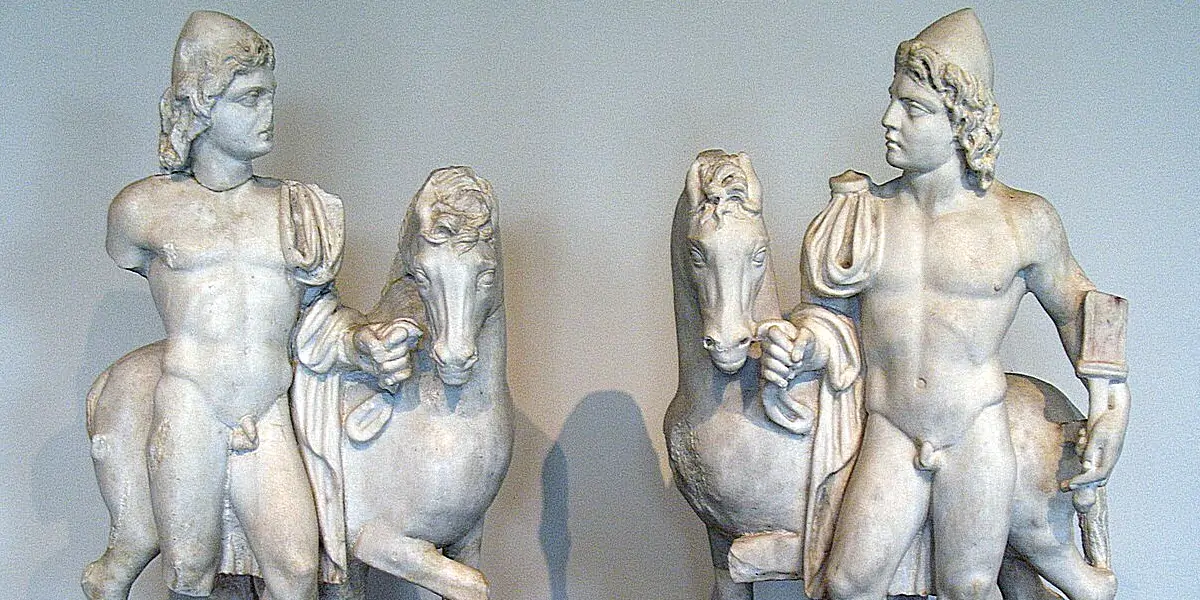
Leda then gave birth to four children hatched from eggs. Zeus fathered Pollux and Helen. Meanwhile, Leda’s mortal husband, King Tyndareus, fathered Castor and Clytemnestra.
That mixed parentage shaped the myth. Pollux possessed divine status. Castor remained mortal. Even so, the brothers stayed inseparable.
Later, Zeus raised both twins into the sky. There, Castor and Pollux became the two brightest stars in the constellation Gemini. The Greek name Dioskouroi means “god’s boys.” The Latin form, Dioscuri, entered Roman religion and art. As a result, the twins appear on many ancient coins.
Rome Adopts the Heavenly Horsemen
Like so many parts of their culture, Romans adopted Castor and Pollux from their Greek neighbors.
According to Roman legend, the twins appeared on horseback at the Battle of Lake Regillus, around 496 BCE. They helped Rome defeat Tarquinus Superbus, the city’s last king, who tried to regain his throne.
Rome honored the twins after the victory. A temple to Castor and Pollux rose in the Roman Forum. Builders rebuilt it several times over the centuries. Today, three tall Corinthian columns still stand in Rome [1].
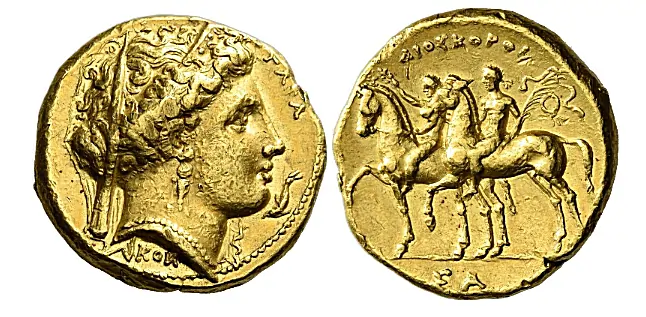
Tarentum: Spartan Roots and a Golden Statement
The Greek city of Tarentum, today Taranto, Italy, had a direct Spartan connection. Spartan settlers founded it as a colony in the eighth century BCE.
That origin made the Dioscuri a natural subject for Tarentine coinage. A magnificent gold stater dated to about 300 BCE shows the twins side by side on horseback [2].
The coin also names them in Greek: ΔΙΟΣΚΟΡΟΙ. That inscription makes the type especially compelling. Ancient coins often expect the viewer to recognize a deity or hero without help. This coin removes all doubt.
A recent Swiss auction described the piece as “a wonderful specimen of this intriguing issue of superb style.” The rare coin, pedigreed to several famous collections, realized more than $50,000 [2].
Eucratides I: The Dioscuri at the Edge of the Hellenistic World
The Greek kingdom of Baktria grew from the eastern world of Alexander the Great. Successors of Alexander established the kingdom around 250 BCE.
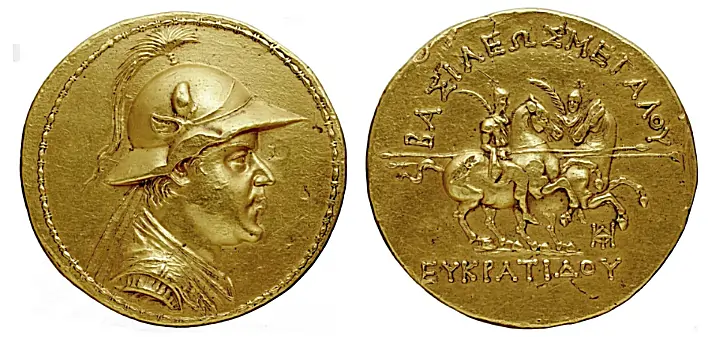
Eucratides seized the Baktrian throne in 172 BCE. He ruled for about 25 years. Then, according to ancient tradition, his own son murdered him. His coinage shows the scale of his ambition. Under Eucratides, Baktria reached a peak of prosperity and grandeur.
Eucratides issued the largest surviving gold coin struck in antiquity [3]. The piece likely served as a diplomatic presentation coin. Found in Bukhara, Uzbekistan, in the 19th century, it later entered the collection of Emperor Napoleon III. Today, the coin resides in the Cabinet des Médailles in Paris [4].
The unique 20-stater coin shows Eucratides in armor. He wears a plumed cavalry helmet. On the reverse, Castor and Pollux ride galloping war horses. They hold lances and palm branches.
The same reverse appears on rare gold staters and more common silver tetradrachms of Eucratides. Centuries later, that image gained a new life. When the Afghan central bank formed in 1939, it adopted this reverse as its seal. The design still appears on current Afghan banknotes, despite the Islamic aversion to pagan imagery [5].
Antiochus VI: A Child King Under Star-Crowned Riders
Antiochus VI was born in 148 BCE. His parents, Alexander Balas and Cleopatra Thea, jointly ruled the Seleucid Empire of Syria.
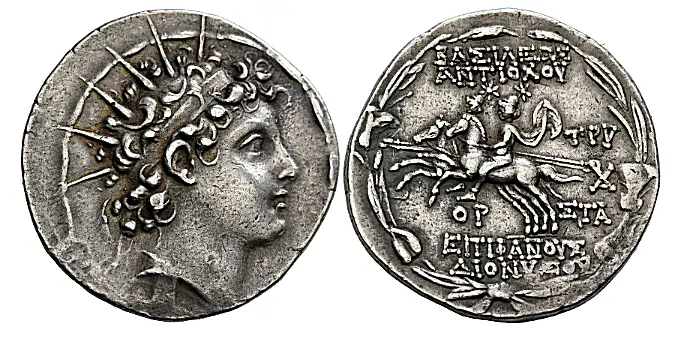
Supporters proclaimed Antiochus king as a child around 144 BCE. However, he never truly ruled. He died under uncertain circumstances at age 8 or 9.
His coin portrait shows a spiky radiate crown above youthful curls. Meanwhile, the reverse of his silver tetradrachm shows the Dioskouroi riding prancing ponies. They carry long lances. Tiny stars sparkle above their conical caps [6].
Leu Numismatik sold an example in Web Auction 34 on July 5, 2025. It realized $2,394 [6].
The Roman Republic: ROMA and the Galloping Twins
The Roman Republic placed the twins on one of its most familiar early silver types.
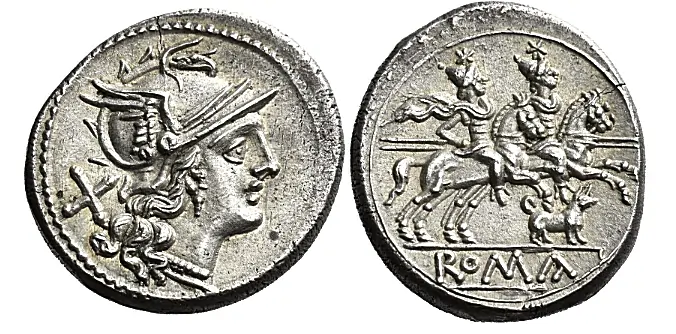
A long series of anonymous Roman denarii shows Castor and Pollux on horseback. The reverse places them above the simple word ROMA.
One outstanding early example dates to about 206–195 BCE. On that coin, the boys gallop with a small dog below them. The catalog described it as “possibly among the finest specimens known” and noted its sharp strike [7]. The coin realized $8,239 in NAC Auction 164 on May 26, 2026 [7].
The Fountain of Juturna: Rome’s Victory Report
Before the twins appeared at the Battle of Lake Regillus, Roman legend placed them at the Fountain of Juturna. There, they watered their horses. The fountain, or Lacus Juturnae, still survives in the Roman Forum [8].
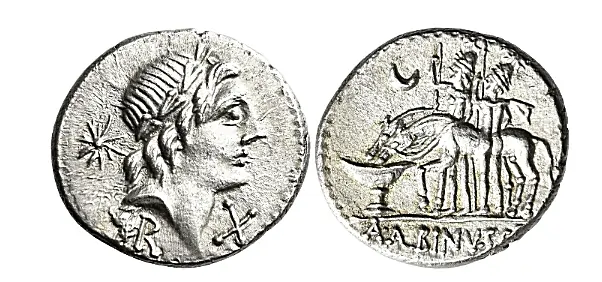
A Roman Republican denarius dated to about 96 BCE shows that scene. The reverse depicts the Dioscuri watering their horses at the fountain. A crescent appears above them.
A recent Swiss auction called the coin “rare and in exceptional condition for the issue.” The catalog also praised its broad flan and complete design. The coin realized more than $10,000 [9].
The moneyer, Aulus Postumius Albinus, remains a shadowy figure. We know that he was the son of Spurius Postumius Albinus, who served as consul in 110 BCE. That consul failed to defeat Jugurtha, king of Numidia.
However, the family connection reaches deeper into Roman legend. An ancestor, Aulus Postumius P. f. Albus Regillensis, won election as dictator in 498 BCE. Roman tradition credited him with leading Roman forces at the Battle of Lake Regillus.
Elite Roman families recycled personal names for generations. They sometimes used the same names for centuries [10]. Therefore, coins like this denarius turned family memory into public history.
Servius Rufus: The Dioscuri During Civil War
Julius Caesar’s assassination on March 15, 44 BCE, threw Rome into chaos. Civil unrest followed. In that world, familiar divine symbols carried extra weight.
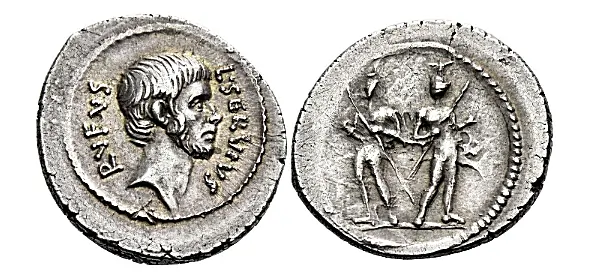
The celestial twins appear on a very rare denarius struck in 43 BCE by the moneyer L. Servius Rufus. The reverse shows the Dioscuri standing and facing one another. Each holds a spear.
A recent Swiss auction described one example as “possibly the finest specimen in private hands.” It realized more than $100,000 [11].
The cataloger added an intriguing political note: “This moneyer is only known from his coins… The portrait bears a remarkable resemblance to Brutus and it seems perhaps likely that the coin was struck as an expression of political sympathy toward Brutus’ cause” [11].
Alexandria: The Twins in Roman Egypt
Roman Egypt used a separate currency system under imperial rule [12]. Its large bronze coins carried Greek inscriptions because Greek served as Alexandria’s administrative language.
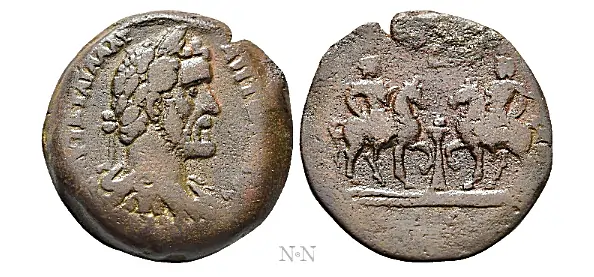
A bronze drachm of Antoninus Pius, who ruled from 138 to 161 CE, shows the twins facing each other on horseback. An incense burner, or thymiaterion, stands between them [13][14].
Numismatik Naumann sold an example in Auction 160 on January 4, 2026. It realized $141 [13].
Sagalassus: Hadrian and the Star-Topped Twins
Sagalassus stood in the mountainous region of Pisidia. Under Emperor Hadrian, who ruled from 117 to 138 CE, the town issued a rare bronze assarion [15].
![PISIDIA. Sagalassus. Hadrian, 117-138. Assarion (Bronze, 20 mm, 6.83 g,). ΑΔΡΙΑΝΟС ΚΑΙСΑΡLaureate and draped bust of Hadrian to right, seen from behind. Rev. ϹΑΓΑΛ[Α]ϹϹЄⲰ[Ν Μ] The Dioskouroi, each holding scepter and placing hand on hip, standing facing and looking at each other. RPC III 2795. RPC III online 2795.5 (this coin). Extremely rare](https://coinweek.com/wp-content/uploads/2026/06/8a.webp)
Leu Numismatik sold an example in Web Auction 26 on July 8, 2023. It realized $247 [15].
Geta: Castor as a Symbol of Youth and Succession
Castor sometimes appears without Pollux.
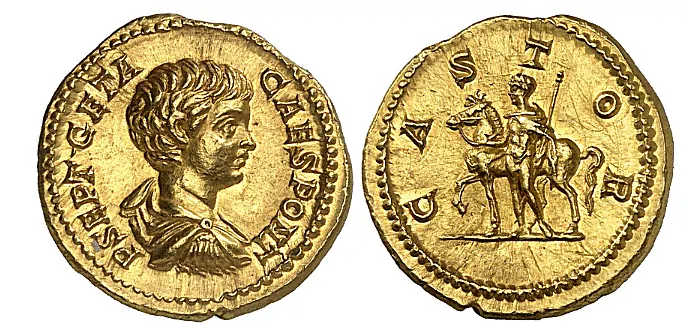
A gold aureus of Geta shows Castor alone. Geta met a violent end when his brother Caracalla murdered him in 211 CE.
The cataloger explained the symbolism:
“In imperial coinage, Castor was often associated with the Caesars. He appeared on coins issued under Marcus Aurelius and Commodus during their time as Caesars. In Roman symbolism, the Dioscuri embodied the ideal of youthful, dynamic, and valiant gods” [16].
Under the Roman Empire, the personal name “Caesar” gradually became a title. Junior emperors and designated imperial successors used it.
Numismatica Genevensis sold the Geta aureus in Auction 22 on November 24, 2025. It realized $23,524 [16].
Maxentius: The Last Ancient Appearance?
A bronze follis of Maxentius may show one of the last appearances of the Dioscuri on an ancient coin. The mint of Ostia, Rome’s port, struck it in 308/309 CE [17].
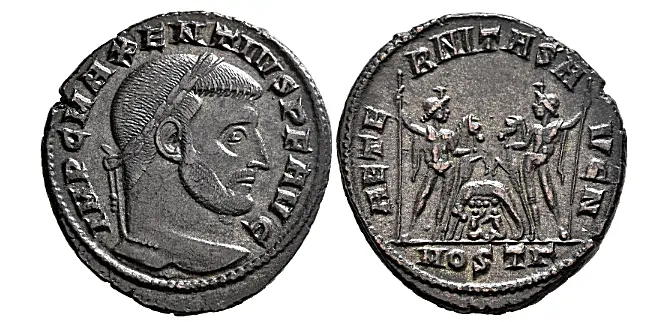
The reverse shows the boys facing each other. They hold the bridles of their horses. Between them appears a small image of the she-wolf nursing another pair of twins: Romulus and Remus, the mythical founders of Rome .
The design joins two famous sets of twins. Castor and Pollux symbolize divine rescue and martial courage. Romulus and Remus symbolize Rome’s origin. Together, they create a powerful statement of Roman identity.
Leu Numismatik sold an example in Web Auction 28 on December 9, 2023. It realized $273 [17].
Collecting the Dioscuri on Ancient Coins
Collectors can pursue the Dioscuri at many price levels.
CoinArchives Pro lists more than 2.7 million auction records dating back to 1999. A search for “Dioscuri” produced 14,165 hits. Many of these entries represent Roman Republican denarii. Some examples retail for under $100.
However, the field runs far beyond common denarii. Rare Greek gold, Baktrian silver, Roman Republican rarities, imperial aurei, and provincial bronzes all feature the twins. Condition, style, rarity, provenance, and historical context can push prices sharply higher.
The many Roman Provincial issues from Greek-speaking cities in the East also reveal something important. They show how popular the cult of the celestial twins remained in antiquity. Lightfoot’s 2024 study places this coinage within the broader context of Roman art.
That is the real power of the Dioscuri as a collecting theme. The twins connect Sparta, Tarentum, Baktria, Seleucid Syria, Republican Rome, Roman Egypt, Pisidia, and late imperial Ostia.
Castor and Pollux began as mythic brothers. Then they became stars. Finally, ancient mints turned them into symbols of rescue, courage, dynastic hope, and Roman memory.
References
- Adkins, Lesley and Roy Adkins. Dictionary of Roman Religion. New York, 1996.
- Lightfoot, Chris S. “The Dioscuri on Roman Coins and in Roman Art,” in Third International Congress on the History of Money and Numismatics in the Mediterranean World – Proceedings. Antalya, Türkiye, 2024.
- Romanescu, Sinziana. “Dioscuri – Castor and Pollux. Aspects of their Symbolism and Artistic Representations.” 6th International Multidisciplinary Scientific Conference on Social and Arts, Sofia, Bulgaria, 2019.
- Stevenson, Seth. A Dictionary of Roman Coins. London, 1964 reprint of 1889 edition.
Citations
[3] Original article citation listed as “NA.” Editorial note: verify against museum or auction documentation before final publication.
[4] https://commons.wikimedia.org/wiki/Category:Gold_stater_of_Eucratides_I
[5] https://en.wikipedia.org/wiki/Da_Afghanistan_Bank
[6] Leu Web Auction 34, July 5, 2025, Lot 908; realized $2,394.
[7] NAC Auction 164, May 26, 2026, Lot 3; realized $8,239.
[8] https://en.wikipedia.org/wiki/Lacus_Juturnae
[9] NAC Auction 164, May 26, 2026, Lot 15; realized $10,774.
[10] https://en.wikipedia.org/wiki/Postumia_gens
[11] NAC Auction 165, May 26, 2026, Lot 467; realized $101,407.
[12] https://coinweek.com/coins-of-roman-egypt/
[13] Numismatik Naumann Auction 160, January 4, 2026, Lot 517; realized $141.
[14] https://en.wikipedia.org/wiki/Thymiaterion
[15] Leu Web Auction 26, July 8, 2023, Lot 2297; realized $247.
[16] Numismatica Genevensis, Auction 22, November 24, 2025, Lot 168; realized $23,524.
[17] Leu Web Auction 28, December 9, 2023, Lot 4332; realized $273.
[18] Romanescu, Sinziana. “Dioscuri – Castor and Pollux. Aspects of their Symbolism and Artistic Representations.” 6th International Multidisciplinary Scientific Conference on Social and Arts, Sofia, Bulgaria, 2019.





This is very informative, had no idea so much I can learn from these coins and the history behind them.
As a twin myself I am glad I found this article! Very fascinating– thank you very much for researching and publishing this.
I enjoy their story. As a boy Iearned Gemini in the sky early. Then found them on coins.