



By CoinWeek Notes …..
The Mint Act of 1890 allows the design of a United States coin to be changed every 25 years. Thus, in 1916, there was interest in replacing United States Mint Chief Engraver Charles E. Barber’s dime, quarter, and half dollar designs. Mint Director Robert W. Woolley invited three renowned sculptors from outside the Mint to produce designs for the three denominations.
Although Woolley may have intended each coin to feature a different artist, Adolph A. Weinman, a former student of Augustus Saint-Gaudens, completed two designs, one for the dime and another for the half dollar. Hermon A. MacNeil created the design for the quarter.
US Mint releases New Designs
The new designs were representative of the artistic vigor of the early 20th century that was displayed on a group of U.S. coins – a group that, along with Weinman’s dime, included the Lincoln Cent; the Indian Head (Buffalo) Nickel; Weinman’s Walking Liberty Half Dollar; the incuse Indian Head $2.50 Quarter Eagle and $5 Half Eagle gold coins; Saint-Gaudens’ Indian Head $10 Eagle and eponymous Double Eagle; and several commemorative issues, such as the Panama-Pacific Exposition silver and gold pieces.
Weinman modeled Liberty on Elsie Stevens, the wife of poet Wallace Stevens and a tenant in a New York City apartment building that Weinman owned. Liberty wears a Phrygian cap, a soft, somewhat conical symbol of freedom. A small wing appears on the front of the cap. Together, these elements represent freedom from bondage, especially freedom of thought.
The Symbolism
The Symbolism
Despite this intent, most people know the coin as the Mercury Dime, which highlights the risks of overly subtle symbolism. The Roman god Mercury (the counterpart of Hermes) served as the swift messenger of the gods and the patron of trade and commerce, often depicted with wings on his hat and shoes. Unlike Liberty’s soft cap, Mercury wore a hard, brimmed hat. However, viewers focused on the wing and overlooked those differences.
The reverse features a fasces with bold symbolism, but that design also carries an unintended association.
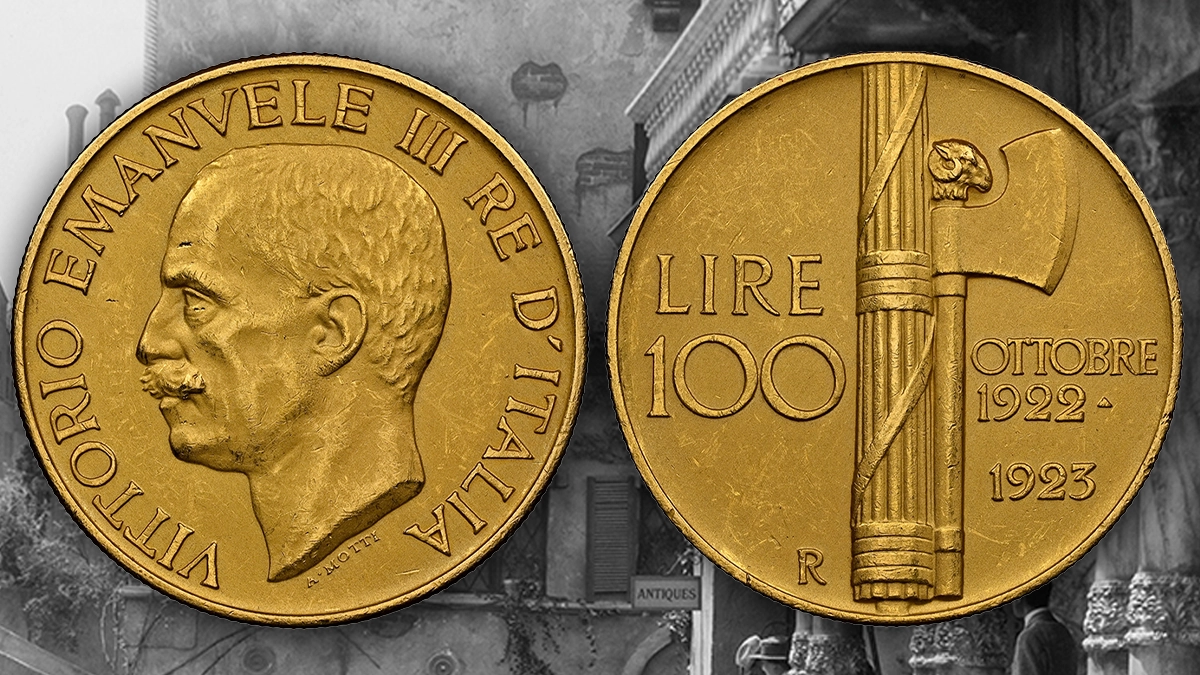
Representing power and authority, the fasces dates possibly to Etruscan times and was later adopted as a symbol by the Roman Republic. The bundle of rods represents strength through unity (many rods being much stronger than a single rod), with the axe denoting authority, particularly the power over life and death.
The Interpretation of the Reverse Design
Unfortunately, it was also a symbol used by the Italian Fascist Party in the 1930s and ’40s. The symbol was also popular in early 20th-century American art, and the fasces remain present on several government symbols and buildings, including the seal of the U.S. Senate and the frieze of the facade of the United States Supreme Court building.
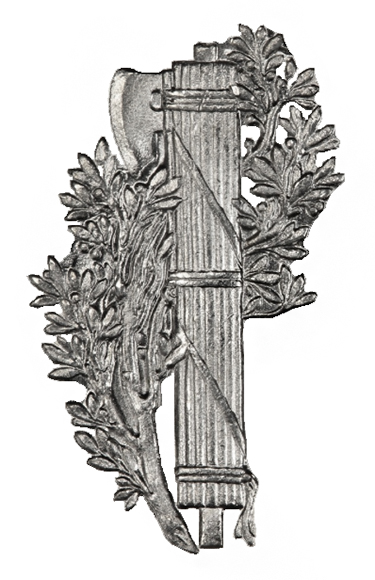 Weinman’s depiction was not fascist by intention. With the fasces wrapped in an olive branch, it presented a “desire for peace but [readiness] for war” message on the eve of America’s entry into World War I.
Regardless of possible mixed messages, the design produced by Adolph Weinman is considered one of the best modern U.S. coin designs, particularly on such a small palette, and the dime remains a collector favorite.
A Brief Overview of Certified Mercury Dimes
CAC, NGC, and PCGS have combined to certify nearly 400,000 business strike Mercury Dimes, including a few Prooflike pieces. The most commonly certified dates are from the mid-1930s onward and the heavily hoarded 1916 Philadelphia issue.
Mercury Dimes with Full Bands (FB)/Full Split Bands are not especially rare but are preferred by collectors. The key date 1916-D Mercury Dime, which has a lower Mint State survival rate than any other date in the series, is more frequently found with Full Split Bands than without, while the 1918-S, the 1919-S, the 1926-S, the 1927-D, and the 1927-S are tougher dates to find fully articulated strikes.
How Much Are Mercury Dimes Worth?
Every Mercury Dime is struck on a 90% silver planchet, and as such, even common dates in well-circulated condition have a basal value linked to the current spot price of silver. Based on April 10, 2024’s spot price of $28.28 USD an ounce, a Mercury Dime is worth a minimum of $2.04.
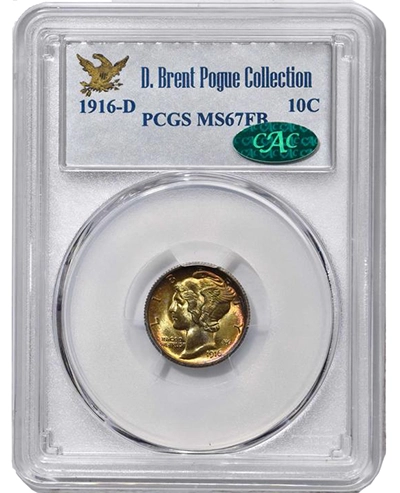
As a collectible coin, common date Mercury Dime values are modest for many dates through the grade MS66, particularly from the early 1930s forward. Issues released prior to the ’30s can sell for significant premiums with Full Split Bands in grades MS65 or finer.
Key to the Series
The key to the series is the 1916-D, which sells for over $1,000 even with most of its details worn off. Be advised that this is a heavily counterfeited coin; no example should be purchased unless it has been certified by CAC, NGC, or PCGS.
As the 1916-D approaches Mint State grades, prices increase dramatically. At MS63 with FB, examples sell at auction for $20,000 to $30,000. An example in MS67FB sold at a March 2020 Stack’s Bowers auction for $204,000!
Other Mercury Dimes in High Demand
The 1921 and 1921-D are expensive in grades finer than MS63. The 1926-S is expensive in grades finer than MS63. The 1942 2 Over 1, discovered years after its release, is expensive in grades finer than XF40. Coins designated with Full Split Bands by the major grading services sell for strong premiums over coins without, especially in Gem or better grades.
Brilliant Proof Mercury Liberty Dimes were minted from 1936 through 1942, with quantities ranging from 3,837 to 21,120. Despite these low mintages, prices for Mercury Dime Proofs are modest for most years through PR66 and PR67. Mercury Dime Proofs with Cameo contrast are rare; CoinWeek believes these are undervalued.
In-Depth Mercury Dime Date Analysis by CoinWeek Notes
-
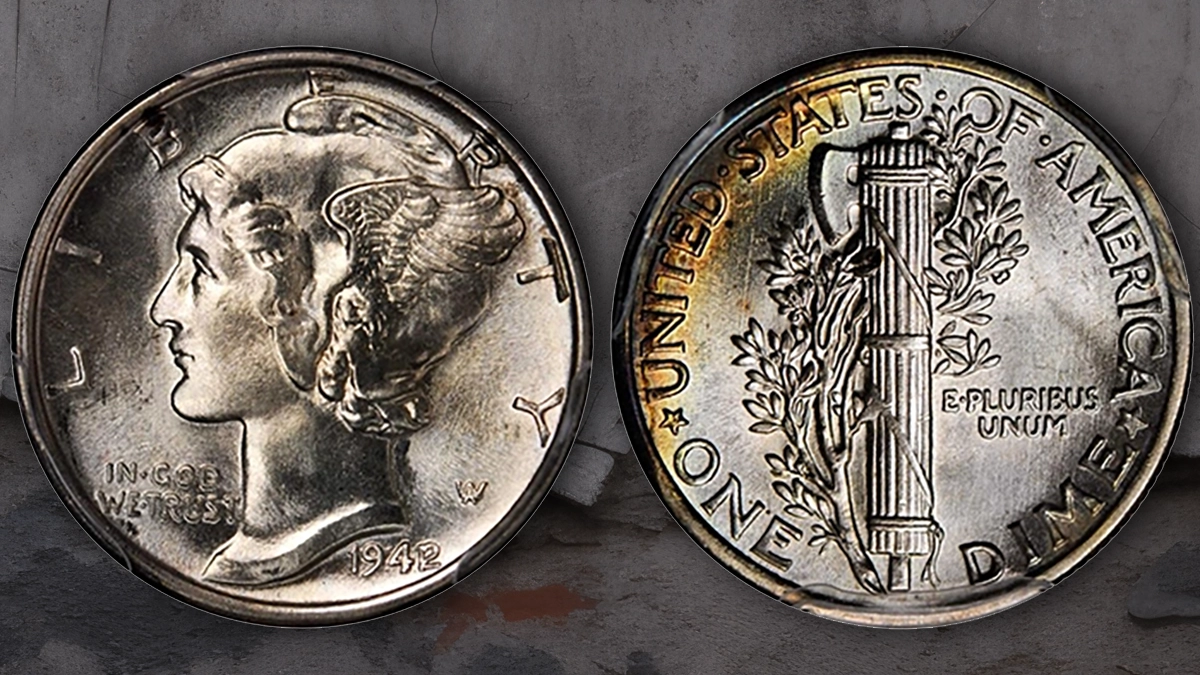
1942/1 Mercury Dime graded PCGS MS66FB. Image: Stack’s Bowers. - 1916-D – Series Key Date
- 1918-S
- 1920-D
- 1921-D – Semi-Key
- 1927-S
- 1931-S
- 1936 Proof
- 1941 Proof
- 1942
- 1942 Proof
- 1945
- 2016-W Centennial Gold Coin
Exclusive Mercury Dime Coverage on CoinWeek
With the majority of the surviving examples of the 1916-D Mercury Dime in the lowest Sheldon grades, CoinWeek provides valuable grading tips to ensure you get the best possible coin for the grade.
Articles by Greg Reynolds
Coin expert Greg Reynolds provides his take on the Mercury Dime series and presents a collecting strategy that will allow a collector to assemble a modestly-priced set without compromising quality.
In this article, Greg tackles the series from a slightly different perspective, providing a roadmap on how to collect Mercury Dimes on a $500 per coin budget.
Semi-keys are scarce coins from a series but not the most difficult ones to acquire. Coin writer Al Doyle, always looking out for the budget-minded collector, writes this piece about how to collect the Mercury Dime semi-keys.
CoinWeek Exclusive Mercury Dime Grading and Counterfeit Detection Videos
The Obverse:
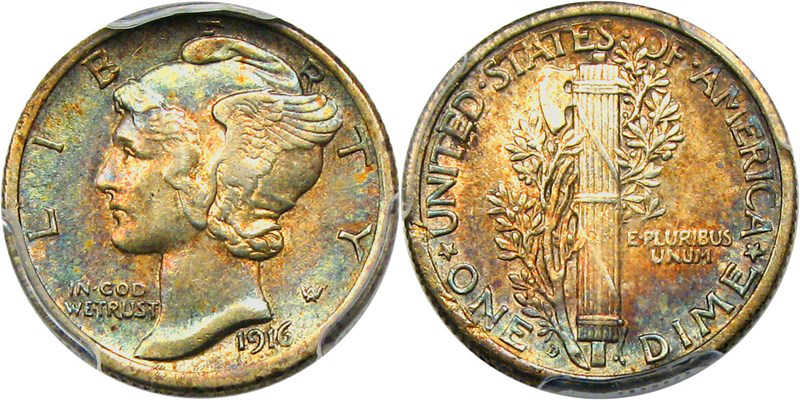
On the obverse, Liberty faces left, most of her hair covered by a soft cap with a soft peak folded toward the front. The cap has a small wing extending from the base upward to the back. The word LIBERTY, with E and R partially covered by the top of the cap, encircles around slightly more than the top half of the coin just inside the flat rim.
IN GOD WE TRUST, on two lines of two words each, with centered dots separating the words on each line, is to the lower left. The date is at the lower right, mostly below the truncation of the neck. The designer’s initials AW appear as a monogram to the lower right, about halfway between the Y of LIBERTY and the date.
The Reverse:
A fasces, its axe pointed to the left, occupies the center of the reverse. The bundle of rods is bound by horizontal banding at the top (three bands), in the middle (two bands), and at the bottom (two bands), with a single band diagonally across the bundle in the each open area between the horizontal bands.
An olive branch with berries curves from the left front behind the bundle of rods to appear again at the top right. UNITED STATES OF AMERICA, the words separated by centered dots, is concentric to the flat rim around slightly more than the top half of the coin; ONE DIME, the words separated by the bottom of the fasces and the olive branch, completes the circle at the bottom.
A five-point star separates ONE and UNITED on the left, and DIME and AMERICA on the right. Winged Liberty Dimes were minted in Philadelphia, Denver, and San Francisco; D and S mint marks are located to the left of the end of the olive branch and are oriented in alignment with the curve of ONE and DIME.
Edge:
The edge of the Mercury Dime is reeded.
Varieties
The Mercury Dime series offers cherrypickers with several doubled die varieties, repunched mintmarks, and overdates, including the 1942 and 1942-D 2 Over 1; the 1945-S Micro S; and other minor die variations.
Coin Specifications for the Mercury Dime
- Years of Issue: 1916-45
- Mintage (Circulation): High: 231,410,000 (1944); Low: 264,000 (1916-D)
- Mintage (Proof): High: 22,329 (1942); Low: 4,130 (1936)
- Alloy: 90% silver, 10% copper
- Weight: 2.5 g
- Diameter: 17.9 mm
- Edge: Reeded
- Designer: Adolph A. Weinman
Additional Resources
- Bowers, Q. David. The Experts Guide to Collecting and Investing in Rare Coins. Whitman Publishing.
- A Guide Book of Mercury Dimes, Standing Liberty Quarters, and Liberty Walking Half Dollars. Whitman Publishing.
- A Guide Book of United States Type Coins. Whitman Publishing.
- Breen, Walter. Walter Breen’s Encyclopedia of U.S. Coins. Doubleday.
- Guth, Ron, and Jeff Garrett. United States Coinage: A Study by Type. Whitman Publishing.
- Lange, David W. The Complete Guide to Mercury Dimes. DLRC Press.
- Taxay, Don. The U.S. Mint and Coinage. Arco Publishing.
- Yeoman, R.S., and Jeff Garrett (editor). The Official Red Book: A Guide Book of United States Coins. Whitman Publishing.
* * *



Hi my name is Harold Goodyear I have a couple mercury dimes and buffalo nickels of wheat pennies 43 still 44coppers And a bunch more coins I love my coins and I hate to sell them
Yes, their fun to collect and finding change, or anytime, wether
Trading, collecting, all older coin types are unique and beautiful!!!
Love me some mercury dimes! My favorite.
I love these coins
Interesting article with much good information.
I have nothing technical to add, but this is one of my favorite coins to collect.
interesting info about Full-Band
Great article. I’m just starting to learn about collectible coins and love the fascinating back stories.
My wife use to be a bank teller and would put all the old coins to the side for me. She found me quite a few Mercury dimes for my collection.
I have never found a merc in the wild.
Pro: less confusion regarding silver content over Rosies that could be clad or silver.
Con: Older coins with more wear can have less silver by weight.
But at the end of the day coin lovers love Mercs.
love mercury dimes design is flawless
Very interesting article.
I’m glad to lean more about the history of the fasces symbology.
Just commented on Facebook about this beitin the top threeost beautiful designs. Need more beautiful designs for today’s common coinage!
Mercury dimes are one of my most favorite us coins…Thank you Coin Week for this article it’s very imformative and well detailed.
Very interesting article about a dime everyone had in their pockets during that time!
The winged liberty dime series is one of my favorite!
great article
thank you for the information.
One of my favorite coins, great design both sides, good article.
Great article about a beautifully designed coin.
Just amazing information. Thanks.
Mercury Dimes were a beautiful coin. Thanks for the info.
I had a 1941-P show up in my pocket a couple of years ago. I pulled it out, and t looks to be in VG condition (lots of wear and a deep scratch across the face, but the rim in intact). Looks like nothing special, just silver value. It is always worth checking the change in your pocket, when you get some.
I understand the reason for the Mercury dime being replaced with the Roosevelt. However I believe the Mercury was a superior design, and certainly more beautiful. Sorry FDR!
Thank you for the information about the Winged Liberty dime. It is one of my favorite designs of all U.S. coinage.
“the artistic vigor of the early 20th century” – An aesthetic worth returning to.
Interesting stuff! Dimes are special.
Interesting article with much good information.
Great article with some very interesting information.
One of my favorite designs – love them!
I never thought I’d be a coin collector; but I have to admit, you are rapidly turning me into one. I love the in depth history of your articles. Thank you-Karianne
Very interesting articles. Thank you.
I had never heard of the Mint Act of 1890 previously. Interesting.
One of my favorite US coins
First coin I ever metal detected. Interesting article.
Very informative article on the Mercury Dime.
Very interesting article!
Back in 1978 I purchased a 1916-D Mercury dime at a flea market (paid $125 for it in AG grade). Being young and foolish, the thought never occurred to me that it might be an altered coin. About 15 years later I sent it to NGC for grading and certification. Thank goodness it came back as genuine and graded out as AG-3.
The classic design!!!!