


This $3,500 1804 Large Cent Looked Convincing, Until Jack Young Checked the Edge
By Jack D. Young and the Dark Side Group for CoinWeek
Sometimes a counterfeit announces itself immediately.
Other times, it looks just good enough to make you stop.
This story falls into the second category.
A familiar-looking 1804 Large Cent recently appeared on eBay. A large and reputable coin dealer offered the coin. Moreover, the asking price sat around $3,500.
For a genuine 1804 Large Cent in the apparent condition, the price did not look unreasonable.
However, something about this coin bothered me.
And once I started looking closely, the warning signs multiplied.
The investigation also inspired a podcast discussion from my friend at FrostByte Coins titled “Don’t Buy a Fake: The 1804 Large Cent ‘Trap.’”
A Familiar 1804 Large Cent Appears on eBay
Here is the subject coin as it appeared in the eBay listing.
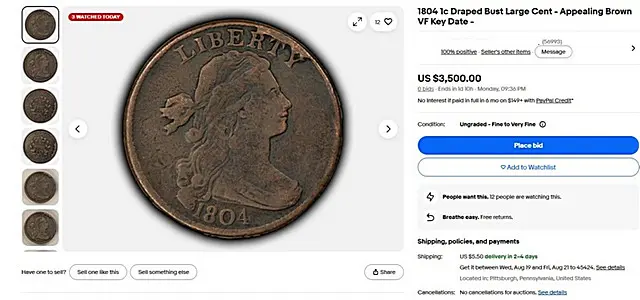
At first glance, collectors might see a well-circulated example of one of the key dates in the Draped Bust Large Cent series.
I saw something else.
Several marks looked extremely familiar.

I had seen every one of the marks circled in red before.
These marks looked like ordinary circulation damage. Yet they appeared in exactly the same places on another example.
That should not happen randomly.
Meanwhile, the feature circled in green created another concern. I had not seen that particular feature on any genuine 1804 Large Cent that I had studied.
Fortunately, I had a very useful reference piece.
I own a similar example.
So, I placed the two coins side by side.
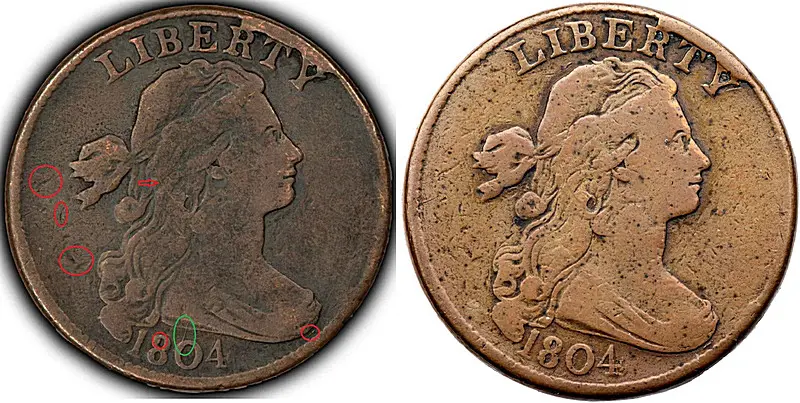
Now the problem became much easier to see.
How many matching marks can you find?
Nearly every feature highlighted in red repeats on both pieces.
Again, however, the green-circled feature differs.
Then I turned to the reverses.
The Reverse Makes the Case Even Stronger
The reverse comparison produced even more matches.
In fact, I could have covered the image with circles.
Instead, I will let readers play a numismatic version of Where’s Waldo?
Look carefully at the marks. Then compare their locations.
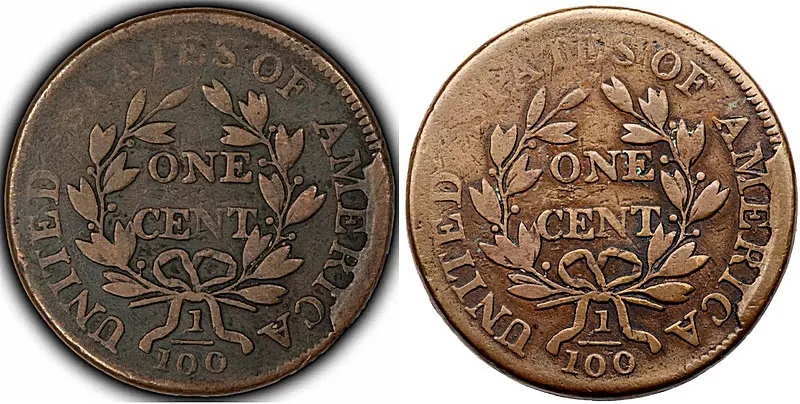
Random circulation does not create an identical pattern of hits, scratches, depressions, and surface characteristics on multiple coins.
A transfer process can.
That distinction matters.
However, before discussing electrotypes, we need to understand something about genuine 1804 Large Cents.
What a Genuine 1804 Large Cent Should Look Like
The Philadelphia Mint produced genuine 1804 Large Cents from only one known die marriage. Collectors identify it as Sheldon-266.
The Guide Book of United States Coins, commonly called the Red Book, lists a traditional mintage of 96,500 pieces.
However, collectors should understand what that number means.
The Mint did not maintain production records by the date on each individual cent. Instead, the frequently cited 96,500 figure comes from the Mint’s final cent delivery of 1804. Therefore, numismatists generally treat 96,500 as an estimate for the number of genuine 1804-dated cents.
Collectors recognize three principal die states for Sheldon-266.
Sheldon-266a represents the early state. The dies show no major rim cuds.
Next comes Sheldon-266b. At that point, the obverse die developed a large cud above RTY in LIBERTY.
Finally, Sheldon-266c shows the obverse cud plus a major reverse break above MERIC in AMERICA.
The subject coin and my reference electrotype copy both imitate that late state.
That point soon became important.
I Contacted the eBay Seller
I contacted the seller and told him what I saw.
Admittedly, I started rather bluntly.
I told him that I believed the coin represented an electrotype. I also wanted to know how closely he had examined it before offering a roughly $3,500 coin.

During that first exchange, I realized that I had taken the phrase “matching marks” for granted.
The large cuds on these coins do match.
However, they should match.
Genuine late-die-state 1804 cents struck from Sheldon-266 show those die breaks. Therefore, the cuds themselves do not prove anything suspicious.
The important evidence comes from the smaller marks that look like circulation damage.
Those should not repeat from coin to coin.
The seller responded.

Once we separated legitimate die-state characteristics from repeated post-strike-looking marks, the discussion moved forward.
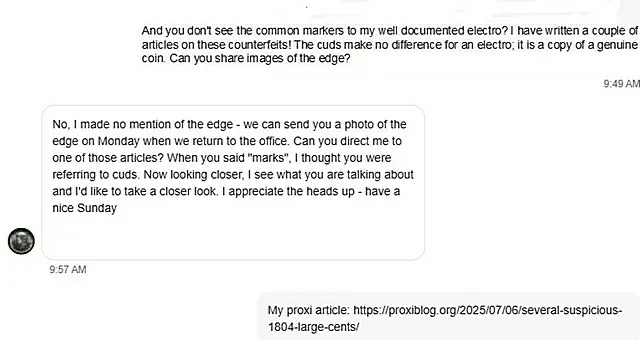
I Had Seen This Family Before
The situation reminded me of research I published on Proxiblog in July 2025.
That article, “Several Suspicious 1804 ‘Large Cents,’” examined several documented examples of suspicious 1804 cents. Some looked better than others.
Over the years, I missed several chances to purchase examples for study.
Eventually, however, I got lucky.
I acquired my example through an Early American Coppers (EAC) Convention auction.
Even better, the lot included provenance information that I loved.

My Proxiblog article documented the broader group and showed how several examples shared suspicious characteristics.
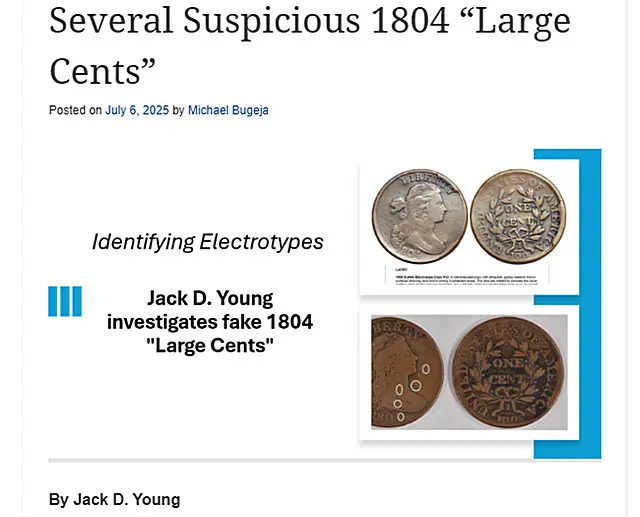
That earlier research gave the eBay seller something concrete to study.
And, to his credit, he began taking a deeper look at his coin.
What Is an Electrotype?
At this point, a short explanation helps.
An electrotype does not come from coin dies striking a planchet.
Instead, the maker takes an impression or mold from an existing object. An electrical process then deposits a thin layer of metal onto that mold.
For a coin, the process can create one thin metallic shell for the obverse and another for the reverse.
The maker then joins the two shells.
To create realistic weight and solidity, electrotypers often filled the interior with another material, including lead or solder.
The technique became practical during the 1840s. Museums and collectors soon embraced it because electrotyping could reproduce extremely rare coins, medals, and works of art with remarkable accuracy.
My friend Craig Sholley has researched this history extensively.
As Sholley explains, museums and collectors once viewed high-quality electrotypes very differently from how collectors view deceptive counterfeits today.
Museums could display an accurate copy while protecting an irreplaceable original. Meanwhile, collectors who could never afford a great rarity could still study a faithful reproduction.
Early instructions even recommended attaching the individual metallic shells to cardboard.
Collectors, however, wanted something that looked and felt more like a real coin.
Therefore, electrotypers adapted methods that printers already used when strengthening electrotype printing plates. Makers could fill the shells, join them, and create a solid object.
Honest manufacturers usually left the seam visible because they had no reason to deceive anyone.
However, manufacturers also knew how to conceal it.
Sholley points to an 1863 manufacturing reference that described a technique for masking the faces, returning the piece to the electrotyping bath, and depositing additional copper around the edge.
The period called the process “soldering by galvanic agency.”
Done skillfully, it could make the seam extremely difficult to see.
Sholley also notes that electrotypes of federal coinage remained popular until federal authorities began treating deceptive pieces as counterfeits in the late 19th century. He specifically cites government seizures beginning in 1885.
That history explains why some antique electrotypes can fool collectors today.
Their makers sometimes possessed extraordinary skill.

Then We Looked at the Edge
This brings us back to the eBay coin.
Once the seller studied the edge, the situation changed dramatically.
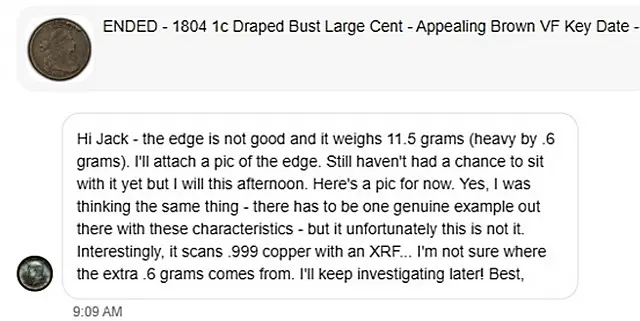
Wow.
That edge did not look right.

To my eye, someone appeared to have distorted or worked the edge in an attempt to conceal the telltale joining seam.
For an electrotype, the edge can provide one of the strongest diagnostic clues.
The obverse and reverse may look convincing because the maker copied them directly from a genuine host coin.
The edge presents a different problem.
Somebody still has to join those two shells.
The seller continued the discussion.


The exchange had now moved well beyond the original cuds.
We had matching surface marks and had previous documented examples.
We also had the construction method.
And now we had an edge that demanded explanation.
And, of Course, I Found Another One
Naturally, the story did not end there.
I found another example.

So I sent the seller another note.
The seller estimated that he had owned his example for about 10 years.
My reference example carries provenance back to 1987.
That gives mine a documented history stretching back 39 years as of 2026.
In other words, these things have been circulating through the hobby for a long time.
That makes them even more dangerous.
One More 1804 Large Cent Authentication Test
The 1804 Large Cent has another important attribution characteristic.
Look at the rotational alignment between the obverse and reverse.
Genuine Sheldon-266 cents show a distinctive counterclockwise reverse rotation.
A Stack’s Bowers description of a celebrated high-grade example described the reverse as “roughly 45 degrees counterclockwise of proper coin turn.”

Collectors should not treat 45 degrees as an absolute measurement for every genuine example. Auction descriptions of other genuine 1804 cents have reported somewhat different degrees of counterclockwise rotation.
The critical point remains the unusual rotational relationship between the two dies.
And what about my electrotype?
The maker got that right, too.

That should not surprise us.
A good electrotype can reproduce characteristics from its genuine source coin with remarkable accuracy.
And that leads to the larger lesson.
The Most Dangerous Fake May Copy the Right Diagnostics
Collectors often learn authentication through individual pickup points.
Find the correct cud.
- Check the lettering.
- Then Check the date position.
- and Finally, Check the die rotation.
Those techniques matter.
However, counterfeiters can copy genuine diagnostics when they reproduce a genuine coin.
That makes pattern recognition just as important.
If two supposedly circulated coins share the same random scratches, dents, hits, pits, or other surface marks, stop.
Circulation does not create identical fingerprints.
A copying process does.
Likewise, never ignore the edge.
A deceptive electrotype may reproduce the obverse and reverse beautifully. Yet the edge can reveal how someone assembled the piece.
Most importantly, do not assume that a long provenance or a respected seller automatically makes a coin genuine.
The seller in this case engaged with the evidence and examined the coin more closely. That matters.
The coin itself tells the final story.
You simply have to know where to look.
Best as always,
Jack




Wow, incredible eye!
Wow! Impressive
Yeah I am impressed, good job.
Well then….
When I get to a point where I can afford all these higher end coins, I’ll sure have some very good resources to fall back on.
WOWZER!!! What a story. Some great detective work IMO.
Fakes are common on eBay, 7 the counterfeiters are getting better … Fake Spanish cobs, in particular, are readily available, & priced in a range the eBay AI run programs won’t even consider removing them. Most purveyors are just ignorant of these coins, &, most will voluntarily remove them when notified with reasonable evidence. I’ts sickening to see fakes that are worthless selling to unsuspecting buyers for hundreds of dollars. Buyer beware … know that which you are buying.
Great information. Thanks
WOW!! Great article! I’m glad the dealer was amicable to the truth!!
Very Interesting article
Great article!!!
Interesting! I have 3 or 4 “possible counterfeit” coins in my collection from various countries around the world. One of them is of a Crusader State coin from about 750 years ago. The others are much more recent. They are all marked as possible counterfeits on the 2×2 flips in which they are housed.
Coin collectors rule. Counterfeiters drool.
Fascinating detective story.
Very interesting article analyzing this 1804 Large Cent to prove and convince that it is an electrolyte!!!
One has to wonder how many electrotypes are residing in collections and considered genuine. Frightening thought.