


Australia Put a Convicted Forger in Charge of Its First Coins. Now the Holey Dollar Is Back
Australia’s first locally minted currency began with a money shortage, 40,000 Spanish silver dollars, and one of the strangest personnel decisions in numismatic history.
Governor Lachlan Macquarie needed someone who understood metalworking, dies, and coins. He found his man in William Henshall.
There was just one problem.
British authorities had sent Henshall to New South Wales after his conviction for forgery and counterfeiting.
Yet that background did not end his story. Instead, Henshall became the craftsman behind Australia’s famous 1813 Holey Dollar and Dump.
More than two centuries later, the Royal Australian Mint has brought that extraordinary story back to life.
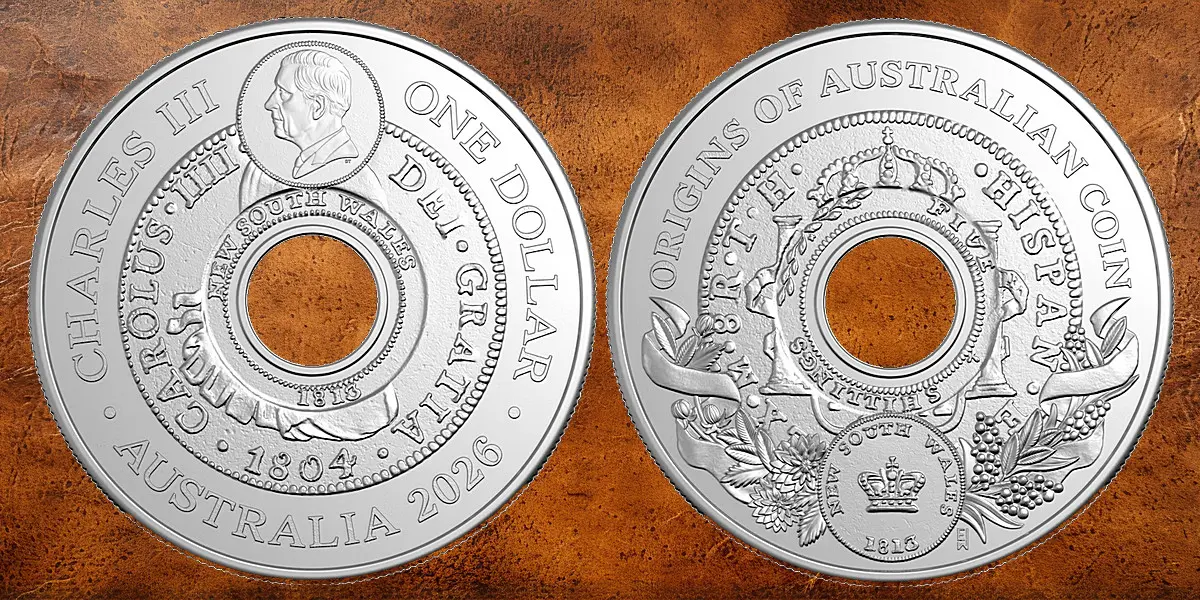
The Origins of Australian Coin: 2026 $1 Holey Dollar Uncirculated Coin honors Australia’s earliest locally minted currency. At the same time, it celebrates 60 years of diplomatic relations between Australia and Mexico.
The connection runs much deeper than modern diplomacy. In fact, Mexican silver helped make Australia’s Holey Dollar possible.
A Coin Shortage Creates an Australian Icon
New South Wales faced a serious monetary problem during the early 19th century.
The colony lacked enough reliable coinage for everyday commerce. Foreign coins circulated alongside promissory notes and other forms of payment. However, valuable silver coins often disappeared aboard merchant ships as traders used them to pay for imported goods.
Macquarie needed to keep money inside the colony.
A solution arrived from Madras in November 1812. The shipment contained 40,000 Spanish eight-reales silver coins, better known as Spanish dollars or “pieces of eight.”
Many Spanish dollars circulating through international trade came from colonial Mexican mints. The Mexico City Mint, one of the world’s great historic coin-producing institutions, struck vast quantities of eight-reales coins for global commerce.
Macquarie saw an opportunity.
Instead of allowing the newly arrived silver dollars to circulate unchanged, he decided to transform them.
William Henshall: From Convicted Forger to Australia’s First Mintmaster
Macquarie turned to William Henshall.
Henshall possessed valuable metalworking skills. More importantly, he understood the technical challenges involved in altering and striking coins.
The irony remains difficult to miss.
A man who had faced punishment for coin-related forgery now received responsibility for creating legal money for New South Wales.
Macquarie gave Henshall a workshop in the basement of a Sydney government building known as “The Factory.” That modest operation effectively became Australia’s first minting facility.
However, the job proved harder than expected.
Henshall needed to develop machinery, tools, punches, and striking techniques. Macquarie originally expected the work to take only a few months. Instead, Henshall spent more than a year perfecting the process.
The result became one of the most recognizable coins in Australian numismatics.
How One Spanish Dollar Became Two Australian Coins
Henshall punched the center from each Spanish silver dollar.
That single operation created two separate pieces.
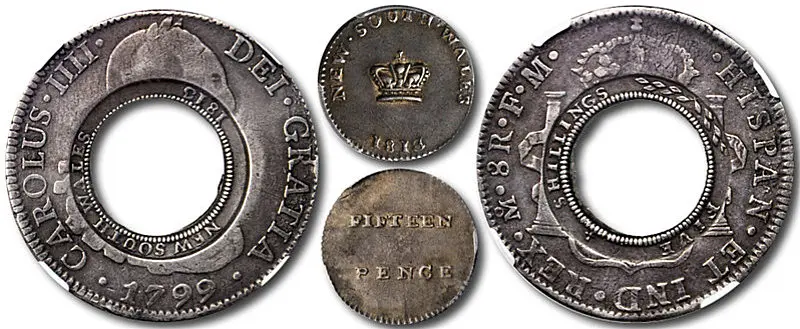
The outer silver ring became the Holey Dollar. Macquarie valued it at five shillings.
Meanwhile, Henshall transformed the center plug into the Dump, which carried a value of 15 pence, or one shilling and three pence.
Therefore, one imported Spanish dollar produced two pieces of local currency.
The Royal Australian Mint’s historical records indicate that the operation ultimately produced 39,910 Holey Dollars and the same number of Dumps.
The system did more than increase the available number of coins. It also raised their combined local value. More importantly, the distinctive form and New South Wales markings discouraged merchants from exporting the silver.
Henshall counterstamped the outer pieces with NEW SOUTH WALES 1813 and FIVE SHILLINGS. He also prepared the smaller Dumps with their own colonial designs and denominations.
By 1814, the coins had entered circulation.
Australia had created its first locally minted currency.
Mexico Was Part of the Holey Dollar Story From the Beginning
The Royal Australian Mint’s 2026 release highlights a connection that many collectors may overlook.
Mexico played a direct role in the Holey Dollar story.
Colonial Mexican mints produced many of the Spanish dollars that circulated throughout the international economy. These large silver coins moved across oceans and continents as one of the world’s most widely accepted forms of money.
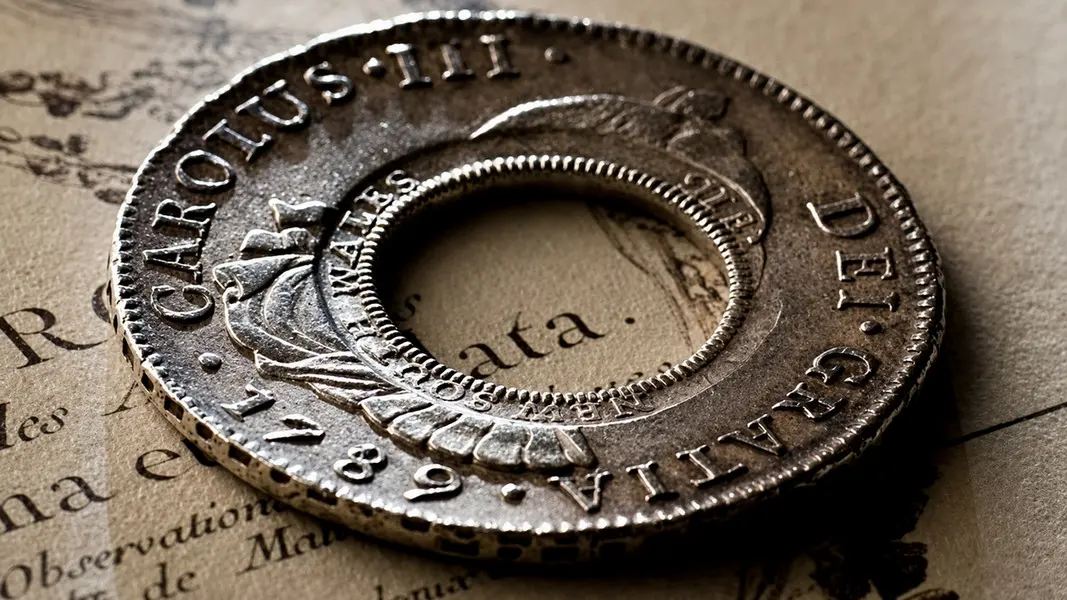
The connection becomes even stronger through the historic Holey Dollar that the Royal Australian Mint recently acquired for the National Coin Collection.
That surviving 1813 Holey Dollar began life as an 1804 Spanish silver dollar from the Mexico City Mint.
Therefore, the coin provides a physical link between Mexican minting history and the birth of locally produced Australian currency.
Only about 300 original Holey Dollars survive today.
That scarcity makes each surviving example an important artifact of both numismatic and Australian economic history.
From the Manila Galleon Trade to New South Wales
Mexican Ambassador to Australia Ernesto Céspedes Oropeza also placed the coins within a much larger global story.
In remarks accompanying the release, the ambassador traced Mexican eight-reales silver through the historic trading system that connected Acapulco with the Philippines. Silver then moved through Asian trading centers, including Madras in India, before some of it ultimately reached New South Wales.
The 40,000 Spanish dollars that Macquarie obtained for the colony arrived from Madras aboard the Samarang on November 26, 1812.
So, long before Australia and Mexico established formal diplomatic relations, trade had already created a numismatic connection between them.
Australia and Mexico formally established diplomatic relations in 1966. Therefore, 2026 marks the 60th anniversary of that relationship.
Ambassador Céspedes Oropeza described the new coin as a symbol of that longstanding connection. He also pointed to the continuing friendship and cooperation between the two countries.
Royal Australian Mint Chief Executive Officer Emily Martin emphasized the same theme. She noted that many Australians recognize the Holey Dollar but may not realize how strongly its history connects with Mexican silver.
That international backstory gives the 2026 coin far more significance than a simple historical reproduction.
The 2026 Holey Dollar Actually Has a Hole
The Royal Australian Mint did not simply place a picture of a Holey Dollar on a conventional $1 coin.
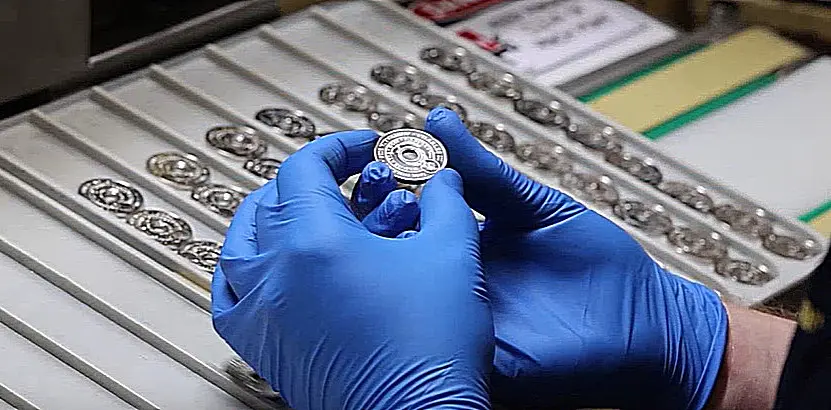
Instead, the Mint created an annular coin with a genuine central opening.
That decision gives the release immediate visual impact. It also creates a much stronger connection with the historic 1813 issue.
The design draws directly from the 1804/1813 Holey Dollar now held in the National Coin Collection.
On one side, imagery from the historic Holey Dollar appears alongside a representation of the Dump. Flowers and ribbons add another layer of symbolism.
A dahlia, Mexico’s national flower, represents Mexico.
Meanwhile, golden wattle, Australia’s national floral emblem, represents Australia.
Designer Elyssa Waterford incorporated both into the composition.
The other side continues the Holey Dollar imagery. A portrait of King Charles III appears in a circular element at the top.
Consequently, collectors can view references to both sides of the original historic coin across the modern issue.
2026 Australia $1 Holey Dollar Specifications
The Royal Australian Mint has limited the collector issue to 35,000 coins.
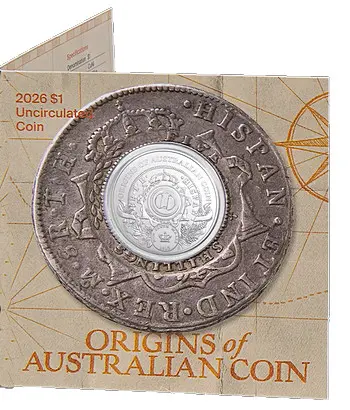
The specifications include:
- Country: Australia
- Year: 2026
- Denomination: $1
- Theme: Origins of Australian Coin – Holey Dollar
- Finish: Uncirculated
- Composition: Copper and nickel
- Standard Weight: 12.58 grams
- Maximum Diameter: 32.00 mm
- Maximum Thickness: 3.30 mm
- Shape: Annular
- Edge: Continuously milled
- Reverse Designer: Elyssa Waterford
- Mintage: 35,000
- Royal Australian Mint Issue Price: AU$35
The Mint limits purchases to one coin per person.
The EQL ballot opened September 4, 2026, at 8:30 a.m. AEST and closes September 7 at 8:30 a.m. AEST. The Mint plans broader availability through its Contact Centre, Mint Shop, and participating authorized distributors beginning September 8 at 8:30 a.m. AEST.
Why the New Holey Dollar Matters
The best commemorative coins do more than mark anniversaries.
They reopen stories.
The 2026 Holey Dollar does exactly that.
Its story begins with a struggling British colony and a shortage of money. Then it moves through Mexico, global silver markets, Asian trade routes, and colonial New South Wales.
Finally, it leads to William Henshall.
Few numismatic stories offer a greater reversal of fortune. Authorities punished Henshall for forgery. Yet Macquarie later relied on his skills to help create a stable colonial currency.
More than 200 years later, collectors still study the coins he produced.
That alone gives the Holey Dollar enormous historical importance.
However, the new Royal Australian Mint issue adds another dimension. It connects one of Australia’s foundational numismatic stories with Mexico, whose silver coinage helped power international trade for centuries.
The result is more than another commemorative dollar.
It is a modern coin built around one of the most unlikely origin stories in world numismatics.


Great article, great history, and cool commemorative.
Nice one from down under!
I would love to add an original holey dollar and a dump to my collection!
Interesting article