by Mike Diamond for CoinWeek…
Understanding Mechanical Damage
A blank, planchet, or coin can suffer mechanical damage at many points during minting. The specific culprit responsible for any particular case of mechanical damage is often unclear. However, the immensely variable nature of mechanical damage in terms of pattern, location, extent, and severity suggests that a diverse array of equipment and hardware is involved.
Regarding timing, mechanical damage is defined by whether it occurs before, during, or after the strike.
- Pre-strike damage occurs before the strike. It is sometimes possible to determine whether the damage occurred during blanking, before upset, during upset, after upset, or immediately before the strike.
- Post-strike mint damage occurs after the strike. Mint-cancelled (waffled) coins attract some collectors, although other forms of mint damage struggle to find a fan base. It is often impossible to determine whether a particular case of post-strike damage occurred inside or outside the Mint.
- Inter-strike damage takes place between a first strike and a second strike. Such damage can happen in an eye blink within the same striking chamber or occur after some delay in a more distant location, after which the coin winds up in a different striking chamber or press. The severity and nature of the damage can help establish the presence of a “delayed second strike.”
- Intra-strike damage occurs during the strike when an adjacent machine part damages a protruding portion of an off-center coin or when the downstroke of the hammer die pushes down the the off-center coin. Sometimes, damage occurs passively when the expanding portion of a coin pushes the unstruck portion into a fixed obstruction. Other times, damage is active, as when a moving machine part crushes or buckles the unstruck portion. Note: Coins split or torn apart by a foreign object in the striking chamber are classified as a subtype of “struck-through” errors, not as damage.
- Trans-strike damage is by far the rarest category when it comes to the timing of mechanical damage. Trans-strike damage occurs before or during the strike and continues immediately after the strike (Coin World, July 12, 2021). I know of only four examples.
Two 1998-P Washington Quarter Trans-Strike Errors

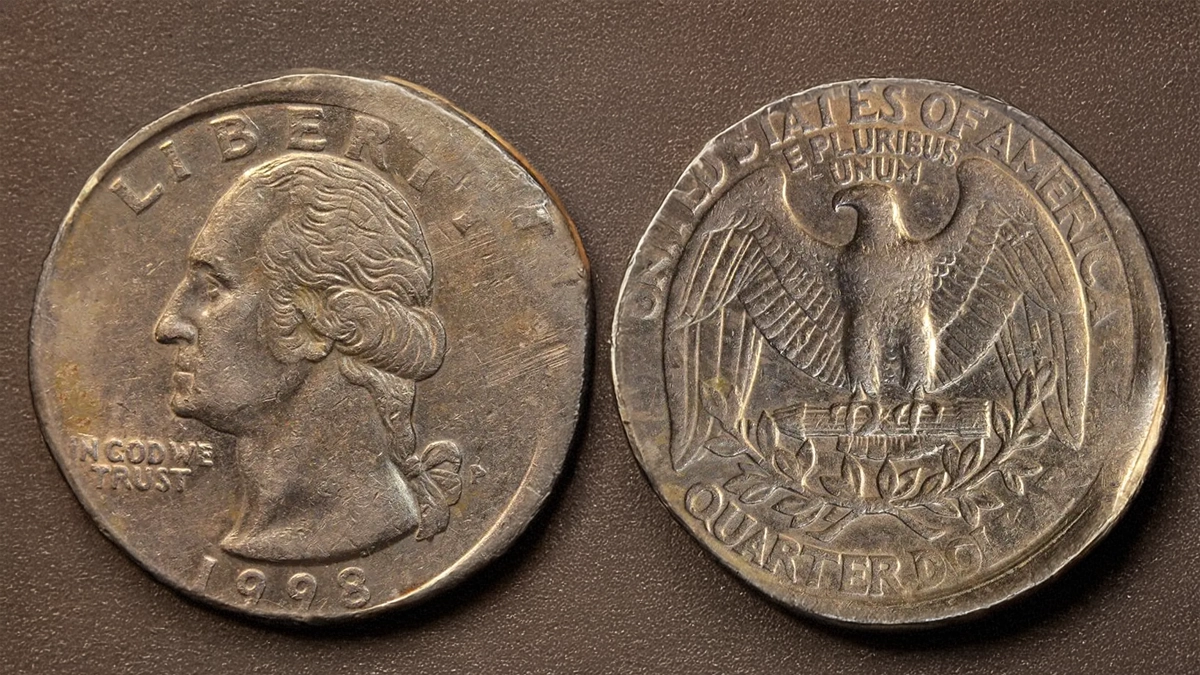
Here are two slightly off-center 1998-P Washington Quarters with trans-strike damage on the obverse face. The two examples are almost identical, so it should be no surprise that they originate from the same die pair.
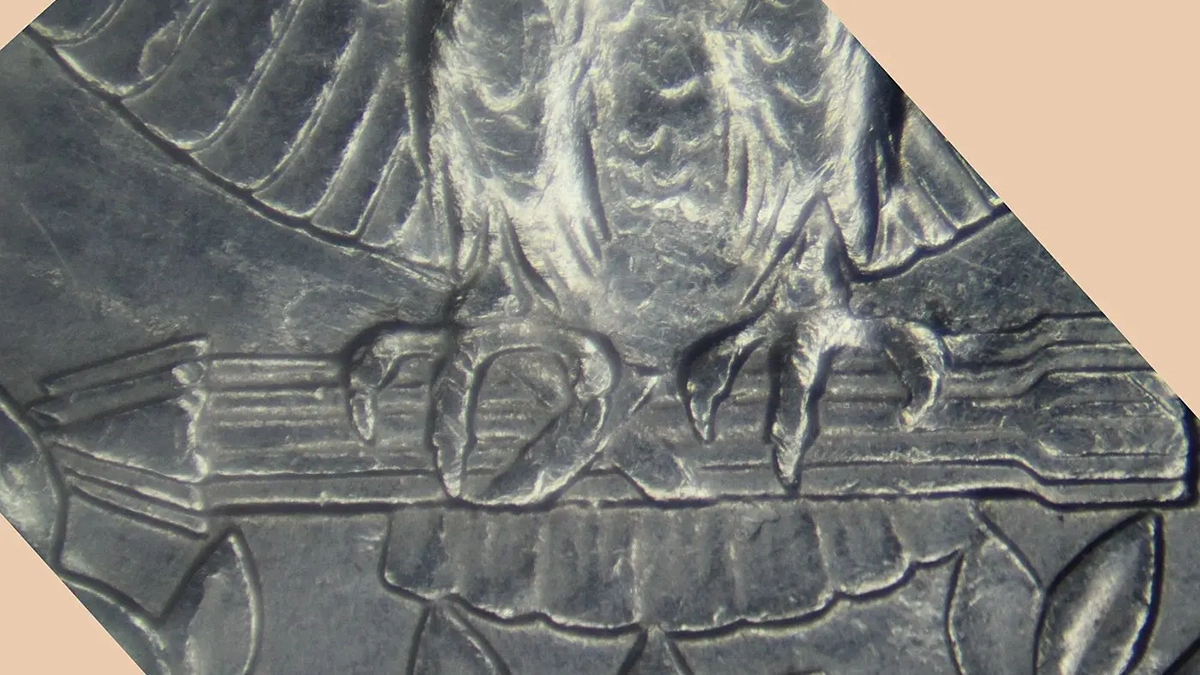
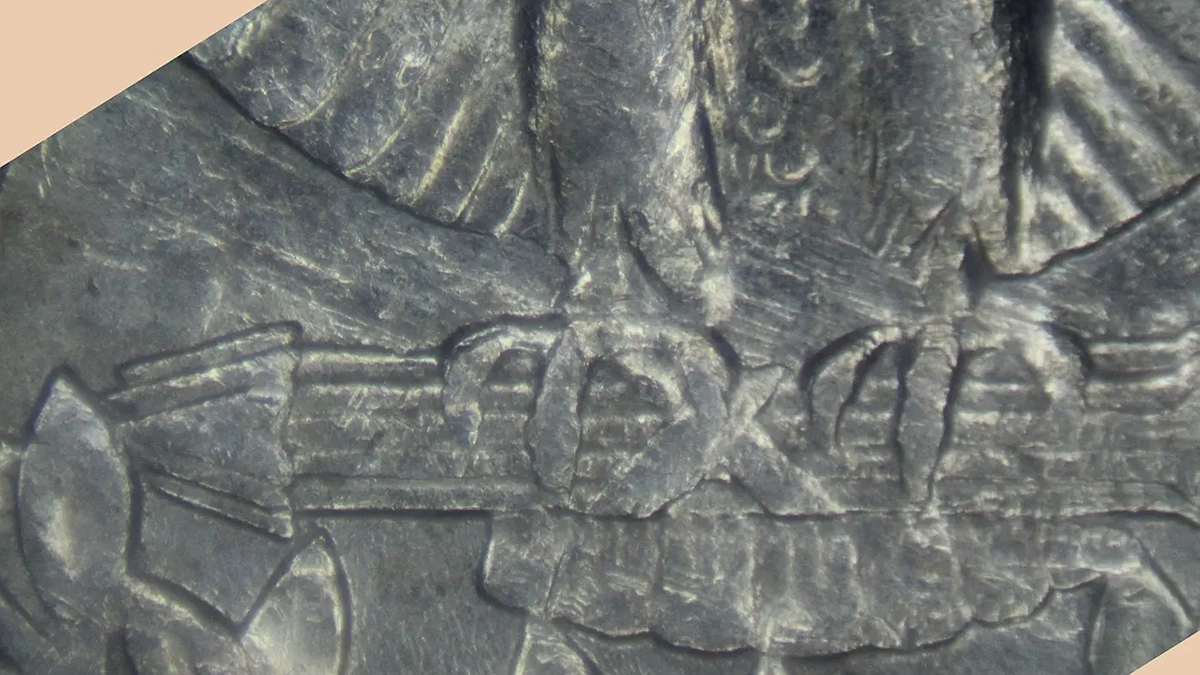
Evidence of this is visible around the eagle’s legs. In the earlier-stage specimen, discovered first, minor die scrapes from the feeder/ejector appear between the eagle’s legs. Minor “feeder-applied struck-through errors” are present in the field to the left of the eagle’s right leg (viewer’s left). These errors result from a gritty paste applied to the die face by the feeder/ejector, typically affecting only the field. We previously called these “field-restricted struck-through errors” (Coin World, November 18, 2013).
The later-stage specimen shows more severe die scrapes that have partly erased the lower portion of the eagle’s right-positioned leg. Lateral to the eagle’s right leg, the die scrapes and feeder-applied struck-through errors are longer and heavier.
Other Trans-Strike Damage Quarters
Only two other examples of trans-strike damage are known to me.
One appears on a slightly off-center 1997-P Washington Quarter. Although its damage field is somewhat larger, it is identical to the two 1998-P quarters. The fourth specimen is a 60% off-center 1999-P Pennsylvania State Quarter, in which the damage appears on the unstruck portion of the coin. This specimen is especially noteworthy because the off-center strike is a close double strike, with doubling only apparent on the obverse face. This “one-sided” double strike indicates that either the anvil die was unstable or the coin was firmly affixed to an unstable hammer die.
These four specimens share many features. All four coins were struck by a high-speed Schuler press using an inverted die setup (reverse die as hammer die). The damage always appears on the right side of the obverse face. Each specimen shows a small compressed lip at 2:30.
Heavy scrapes appear on the unstruck obverse crescent on the three minor off-center strikes. Some scraping occurred before the strike, thinning the planchet. The thinned area is responsible for weakness in the opposing reverse design (DOLLAR) and design rim, as well as an indistinct boundary between the field and the unstruck reverse crescent.
In the three minor off-center quarters, the last few letters of LIBERTY (RTY or just TY) are badly scraped, with lighter scratches continuing across Washington’s head and the field. These scrapes occurred after the strike.
Since the damage on the 60% off-center specimen does not overlap the design, it’s impossible to say how much (if any) of it occurred after the strike.
It’s unclear which moving machine part is responsible for scraping the planchet and the newly-struck design. However, the feeder/ejector is a prime candidate. The direction of the scrapes is identical to numerous 1996-D Washington Quarter obverse dies with heavy feeder scrapes as well as a series of 2003-P Arkansas State Quarter die pairs with heavy feeder scrapes on both faces (Coin World, September 8, 2014, and March 19, 2018). However, I can’t see how a malfunctioning, mistimed feeder could have produced the compressed lip at 2:30.
Equally puzzling is the means by which a feeder – or any machine part – can achieve such consistency in pattern, extent, and location as it scrapes across the surface of a planchet that is not held in place. This applies to a planchet in the process of being fed into the striking chamber or one that is already in the striking chamber awaiting the descent of the hammer die.
I see no sign that a feeder notch cradled any of these planchets. That being the case, it’s unclear what held the planchet in position as the feeder or other moving part scraped across its surface. If, despite all evidence, these planchets were cradled and stabilized by the feeder, it raises the question of what other piece of equipment was scouring the planchet’s surface.
A related point of confusion involves how the coin was held in place while the newly struck design was scraped in the same location and direction by the same machine part that caused the planchet scrapes. One possibility is that the coin was adhering to the hammer die, as suggested by the double-struck, 60% off-center specimen.