


If you turn three German notes to the left at a 90-degree angle, there is an image that looks like a vampire
During the early 1920s, post-World War I Germany saw its economy spiraling out of control. Hyperinflation took over the Weimar Republic from 1921 to 1923 (though it had begun slowly accelerating right after the war ended in 1918).
Germany decided to suspend the gold standard and borrow money from the German Central Bank, the Reichsbank, to help fund their war efforts. Meanwhile, the Allied forces paid for the war by raising taxes and other means.
The Treaty of Versailles brought an end to World War I and required Germany to accept financial responsibility for the war, which was a hefty sum of 132 billion German Marks. With no way of paying in currency-backed reserves or in gold, Germany printed money at a high volume. Therefore, between 1921 and 1923, the value of the Mark declined at a rapid pace. In January 1920, 50 Marks were worth one US Dollar. By November 1923, that number went from 50 to a staggering 4,200,000,000,000 Marks.
Once such note that was printed during this time was the 10,000 Mark. Issued in January 1922, it had three different styles on the back with the same design on the front (found under Pick #70, 71 and 72 for Germany Reichsbank). The first, Pick #70, had an eagle inside a rectangular box with ornamental designs. The second, Pick #71, had the same eagle but without the rectangular box. Finally, Pick #72 had the same design as Pick #71 but was a smaller sized note.
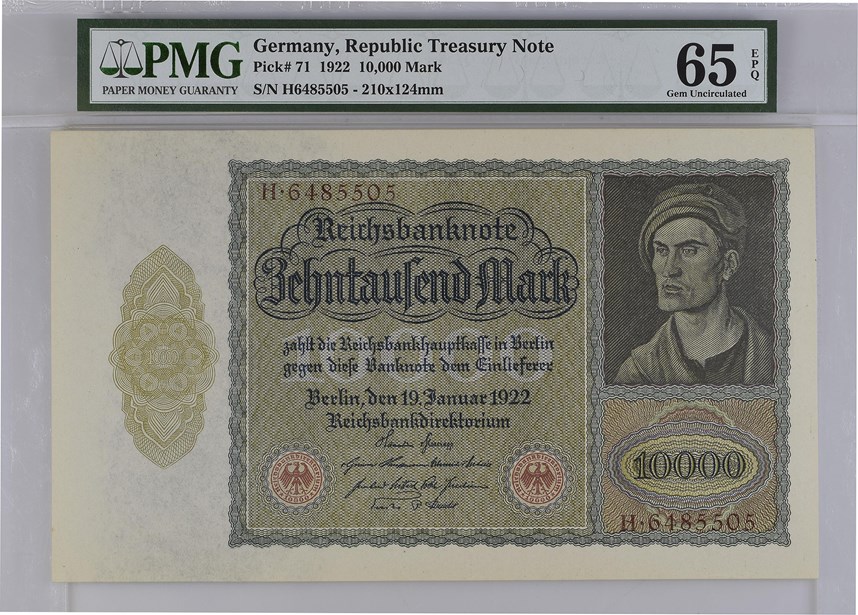
Germany, Republic Treasury Note, Pick #71, 1922, 10,000 Mark, front. PMG Graded 65 Gem Uncirculated

Germany, Republic Treasury Note, Pick #71, 1922, 10,000 Mark, back. PMG Graded 65 Gem Uncirculated
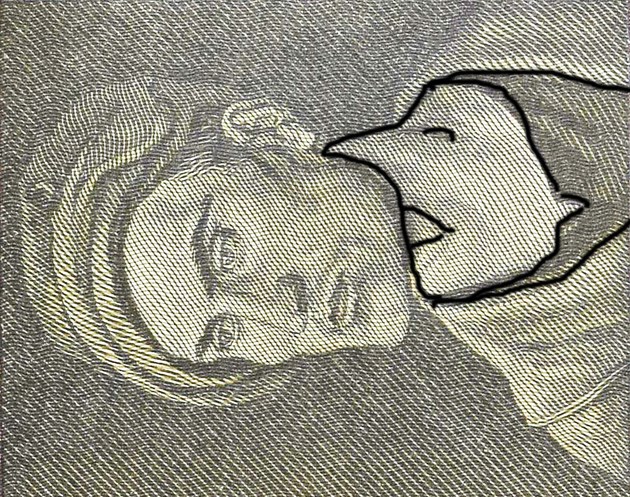
Close up of note showing “Vampire” image
The front design of the three notes featured work by the German painter Albrecht Durer called Portrait of a Young Man. Durer is one of Germany’s most famous Renaissance artists, and this piece was done during that time.
When this note printed, the engraver, whose identity is unknown, made an unusual alteration. If you turn the note to the left at a 90-degree angle, you can see what looks like a face and an open mouth on the man’s neck (as pictured in the image above). This would become known as the “Vampire Note”.
It does take a few long seconds and a bit of imagination to see the vampire. You could also say he has a black hood over his head, which is the man’s shirt.
This was supposed to represent anti-French sentiment in Germany after World War I by giving the impression that he is sucking the life out of Germany. The Treaty of Versailles, which held Germany responsible for the war, was signed in France. The Reichsbank did notice this alteration but did not stop the printing of the note for correction. They kept printing more notes, thus further emphasizing their disdain for France.






How much is this note worth? I have one and would like to know it’s worth.