


Dr. Steve Benner for CoinWeek …..
Introduction
Lycia has a history dating back to the Late Bronze Age (1550–1200 BCE) and the Hittites. Known as the Lukka Lands by the Hittites and Egyptians, Lycia was a decentralized political entity. Its people, known as raiders, rebels, and pirates, were among the so-called “Sea Peoples.” Located in southwestern Anatolia (Asia Minor) on the Mediterranean coast (see inset in Figure 1), Lycia was centered on the modern-day Teke Peninsula. The region extended approximately 80 miles west to east and 40 miles north to south, covering about 3,400 square miles. Situated at the western extremity of the Taurus Mountains, the area was mountainous, with major peaks including Masikytos, Antikragos, Patara, and Kragos. Several major rivers, including the Xanthos, Myra, and Limyra, divided the region, providing fertile land for cultivation. Lycia was bordered to the north, from west to east, by Caria, Pisidia, and Pamphylia. To the west lay the Lycian Sea. The principal cities were Xanthos, Patara, Myra, Tlos, Olympus, and Phaselis.
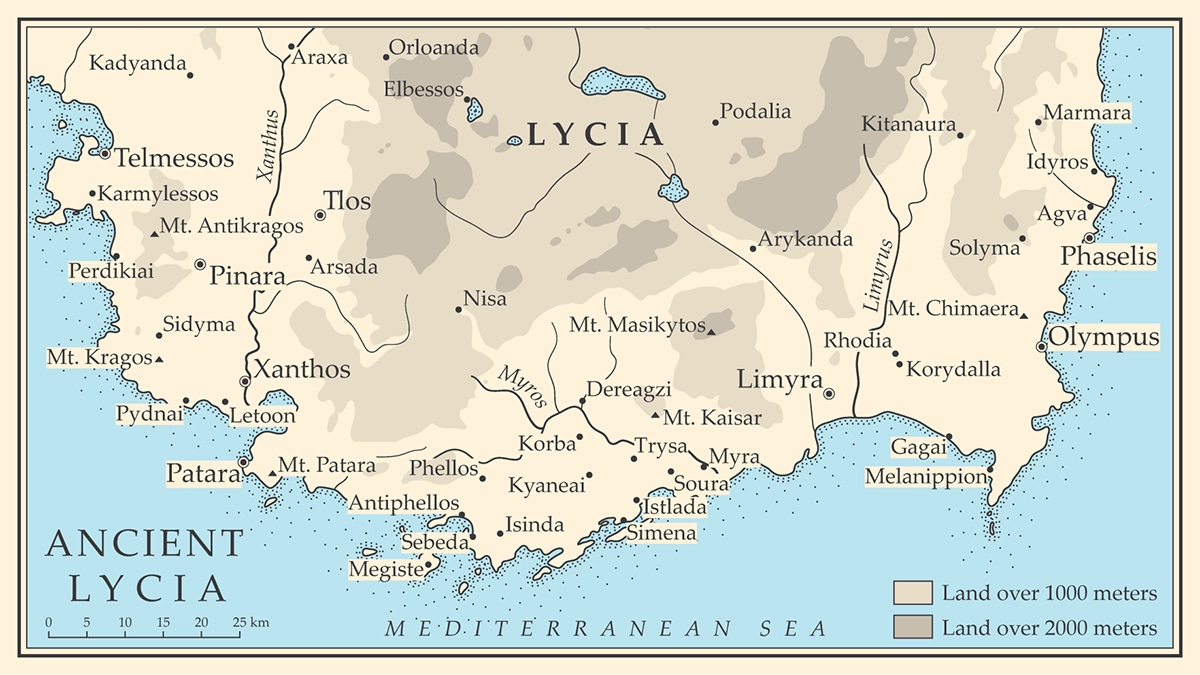
As noted, the Lycians were known to the Hittites and fought both for and against them. They had a reputation as a hostile and rebellious people with a strong military presence. At the end of the Bronze Age, the Sea Peoples invaded the area and merged with the local population. In 546 BCE, Cyrus’s general, Harpagus, arrived in Asia Minor and subdued the region, including Lycia. In a show of defiance, the citizens of Xanthos destroyed their property, killed their dependents, and fought the Persians to the last man. The Persians preferred a “hands-off” policy, establishing a client state with a monarchy that ruled Lycia from the capital at Xanthos. This marked the beginning of the Dynastic Period in Lycian history, lasting from 525 to 360 BCE. “Dynast” is a term used by modern scholars, but the Lycians referred to their monarchy as xntawati. The first king was Kheziga I (Lycian name: Kosikas), followed by approximately eleven more dynasties, each associated with one or more kings. Although controlled by the Persian Empire, the Lycians provided a fleet that was destroyed at Salamis. After the Persians were defeated by the Greeks in 479 BCE, Lycia may have briefly allied with Athens against the Persians but rejoined the Persian side by 470 BCE. The Athenian general Kimon convinced the Lycians to join the Delian League, but they withdrew as the Peloponnesian War (431–404 BCE) continued. Eventually, they fell back under Persian control, with satraps installed, though Lycian kings retained some autonomy under the dynasts. The last Lycian king, Perikles, ruling from Limyra, revolted against the Persians and was defeated. This led to tighter Persian rule in 366 or 362 BCE, with control of Lycia passing to Mausolus, the satrap of Caria. The Persians retained control until Alexander the Great conquered the region in 334–333 BCE.
After Alexander’s death, Lycia fell under the control of Antigonus, then Lysimachus, and later Ptolemy II, remaining under Ptolemaic control until 200 BCE. The Ptolemies helped the Limyrans defeat the Galatians during their invasion of Asia Minor in the first quarter of the 3rd century BCE. By 190 BCE, Lycia was under Seleucid control, and after the Seleucids’ defeat by the Romans in 188 BCE, Lycia was awarded to Rhodes. Around 167 BCE, the Lycian League was established. This democratic organization comprised more than twenty cities, led by a Lyciarch and a general assembly, in which large cities had three votes, medium cities had two, and small towns had one. The Lycians resented Rhodian rule and likely created the League to persuade Rome to grant independence. Rome agreed, making Lycia a Roman protectorate with home rule under the Lycian League. In 43 CE, Emperor Claudius dissolved the League and combined Lycia with Pamphylia to form a new Roman province.
The Lycians had their own language, a member of the Luwian branch of the Anatolian languages, a subfamily of the Indo-European family. Originating in the 2nd millennium BCE in Anatolia, it used a unique alphabet derived from the Greek alphabet of Rhodes. The language, which has not been fully deciphered, was used in inscriptions and on coins starting in the late 6th century BCE. As the population became more Hellenized, the Lycian language died out by about 300 BCE.
Pre-Dynastic Coinage (550-500)
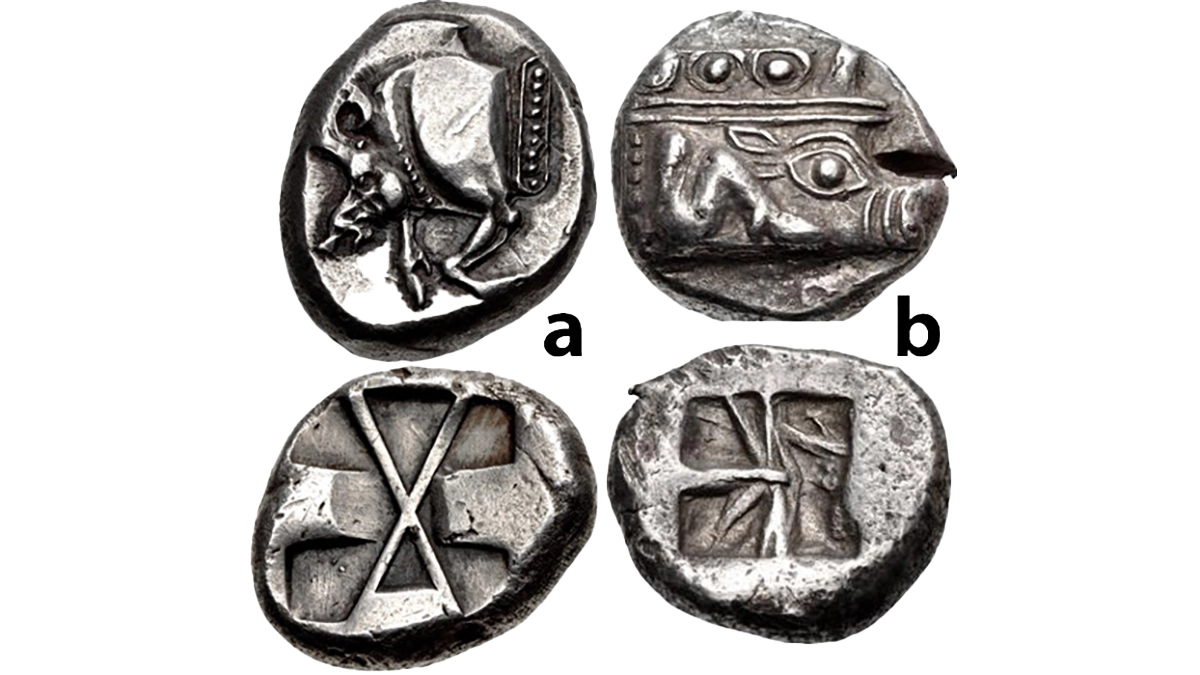
Pre-Dynastic coinage was minted before the Dynastic Period in the late 6th and early 5th centuries BCE. These were all silver coins, either staters or fractions such as one-third and one-sixth staters, with staters weighing 9.5 to 11.5 grams. Most were produced at unknown mints or at Phaselis. Founded in 690 BCE by the Rhodians, Phaselis was one of the oldest purely Greek cities in Lycia and the major city of eastern Lycia. Its coinage is among the earliest struck in Asia Minor. Phaselis’ coins feature the prow of a ship resembling the forepart of a boar on the obverse and an incuse on the reverse (see Figure 2b). Other coins from uncertain mints have the forepart of a boar on the obverse and an incuse on the reverse (Figure 2a). The incuse reverse is a common feature.
Dynastic Coinage (525-362)
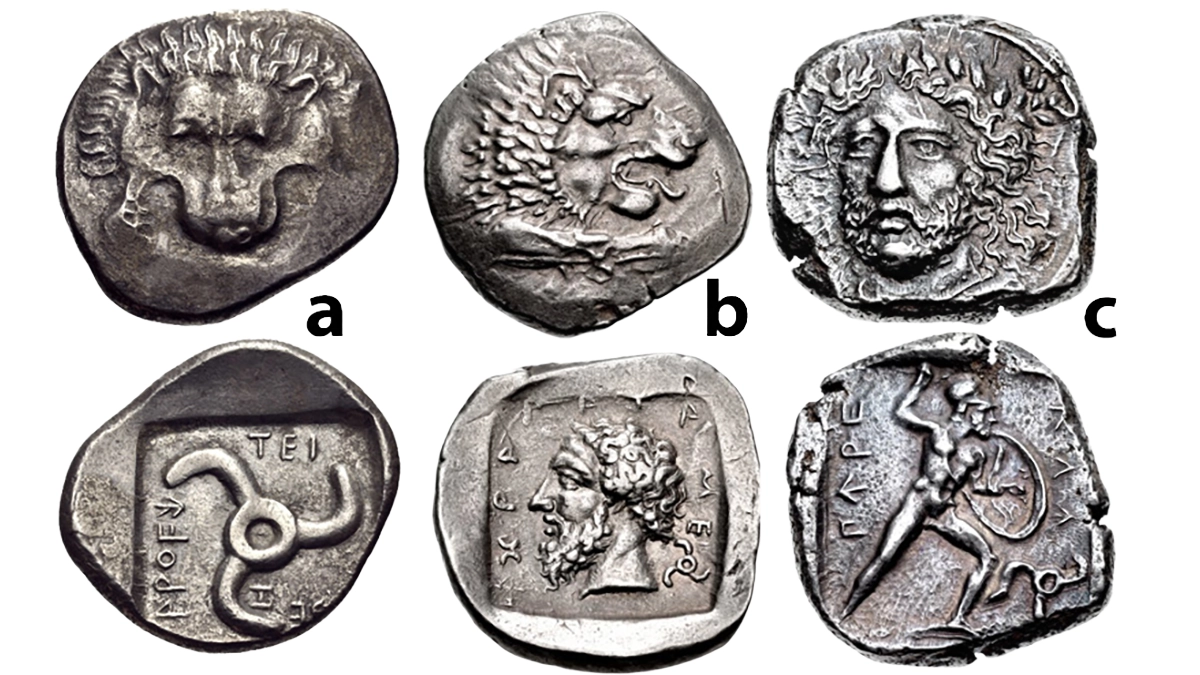
Under Persian control, Lycian monarchs were permitted to mint their own coinage, primarily silver staters weighing about 9.8 grams, along with various fractions. Each dynast had a unique coin design, resulting in a wide variety of obverses and reverses. A common feature on many coins was the Lycian triskeles, a symbol of three curved or jointed segments radiating from a central point (see Figures 3a, 3c, 4a, 5a, 5b, 5c). A facing lion’s scalp was also a frequent obverse design (see Figure 4a). The coins in Figures 3, 4, and 5 are presented in chronological order. The first group (Figure 3), minted around 525 BCE at the start of the Dynastic Period (sometimes called the Protodynastic Period), includes: Figure 3a, with a boar forepart obverse and a triskeles reverse instead of a geometric incuse; Figure 3b, with a full boar obverse and a turtle reverse; and Figure 3c, with a crab obverse and a triskeles reverse surrounded by Lycian writing. Few coins specify mint cities, but those that do typically name Xanthos, Pinara, Phellos, Telmessos, Antiphellos, or Limyra. (Note: Zagaba, mentioned in references as a mint, was likely a king, not a city.)
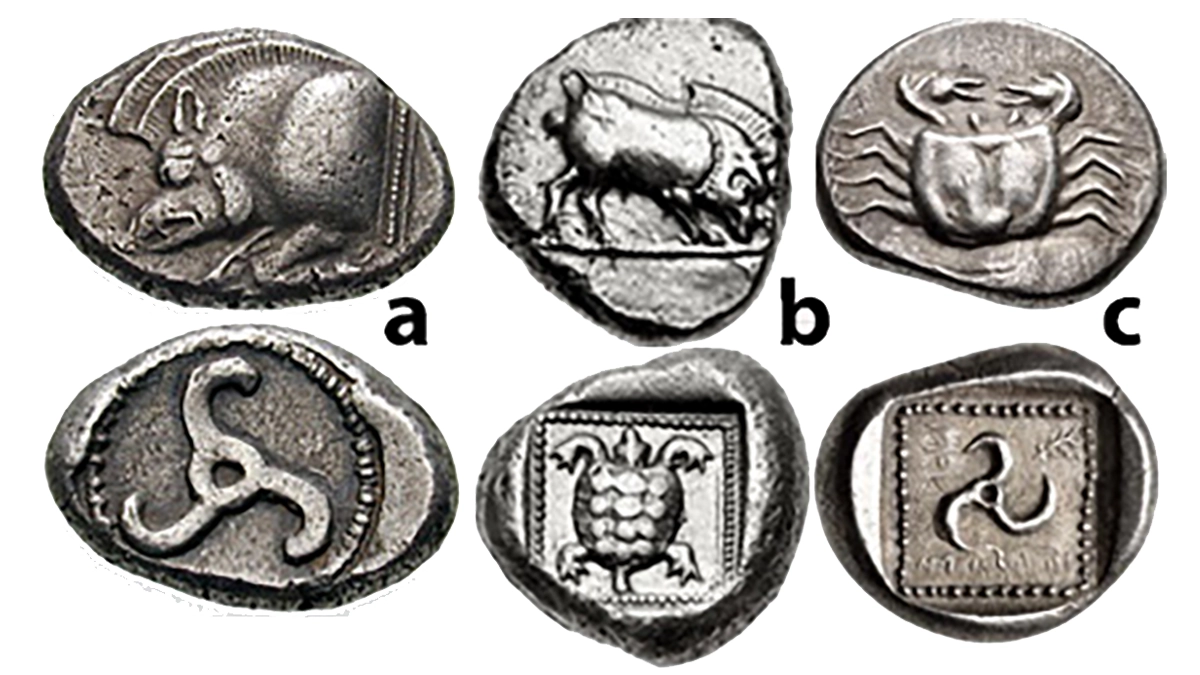
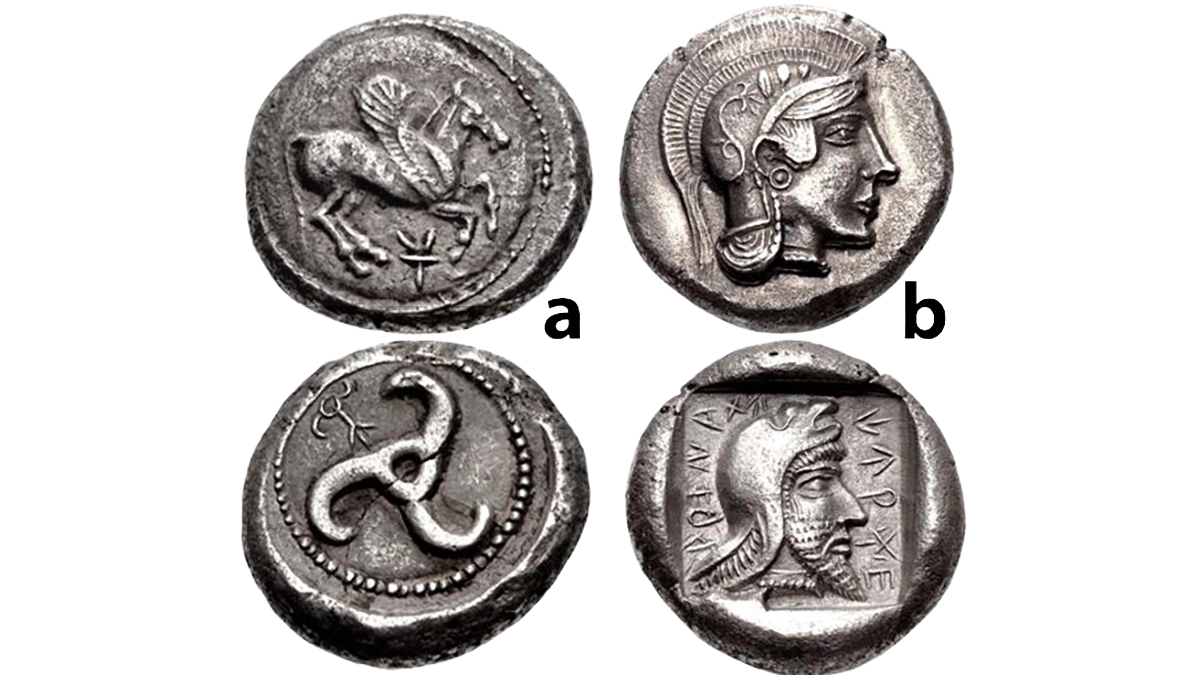
Figure 4 shows two staters from the mid-to-late 5th century BCE. Figure 4a features Pegasos flying right on a raised disk with a Lycian monogram below on the obverse and a triskeles with a conjoined monogram and diskeles on the reverse. The diskeles may be a mint mark (possibly Xanthos), though references are inconclusive. Figure 4b features Athena on the obverse and Kherei facing right, wearing a Persian tiara, with a Lycian legend surrounding on the reverse. Lycia was among the first regions to depict rulers on coins, a practice that became common by the late 4th century BCE. Over time, portraits became more realistic, with those of Mithrapata and Perikles being remarkable works of art (see Figures 5b and 5c).
The coins in Figure 5, from the 4th century BCE, include: Figure 5a, with a facing lion scalp obverse and a triskeles reverse with Lycian writing, considered the quintessential Lycian coin, minted in many denominations, especially sixth staters; Figure 5b, with a lion forepart right obverse and the head of Mithrapata facing left, his name in Lycian, and a diskeles on the reverse, notable for omitting Persian headgear, possibly indicating independence; and Figure 5c, with Perikles facing slightly left on the obverse and a nude warrior attacking right on the reverse, with Perikles’ name in Lycian and a diskeles. Dynastic coinage ended with Carian control under the Persians around 362 BCE.
Between the Dynasts and League (360 to 168)
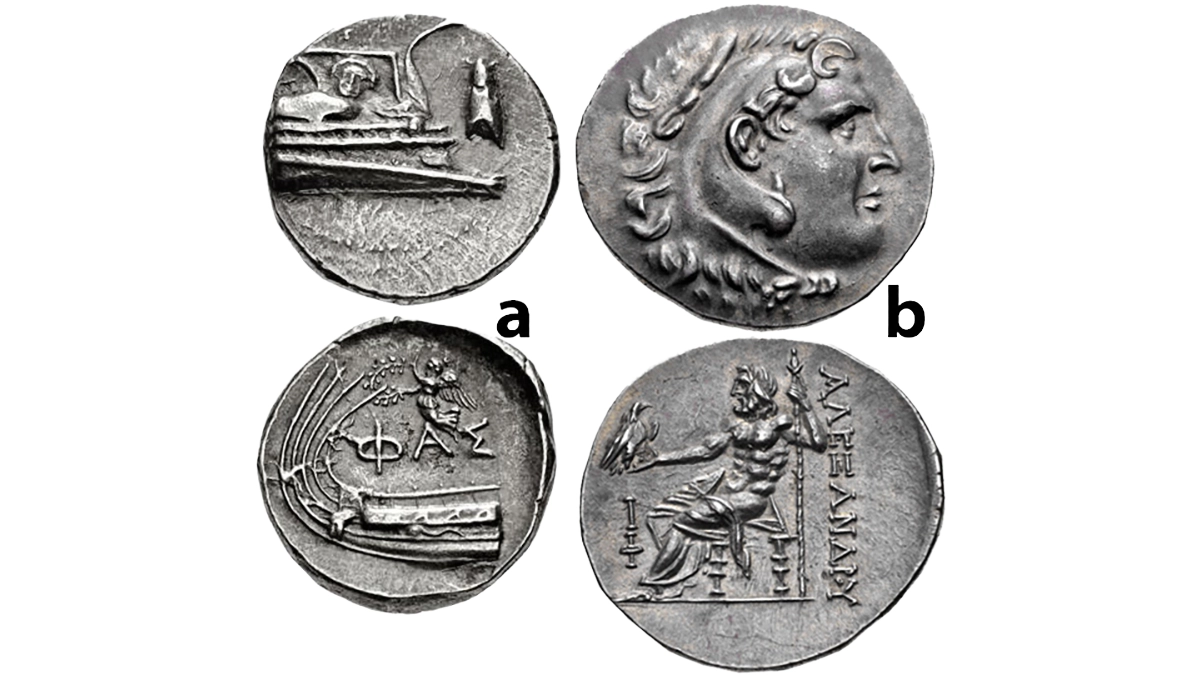
During the Dynastic Period, a few Lycian cities minted coins in their own names, but civic coinage was limited. Phaselis, a Lycian Greek city with abundant silver, was an exception. Distinguishing non-Dynastic from Dynastic coins is challenging due to overlapping minting dates. Cities that may have minted local coins include Antihellos, Aperlai, Phaselis, and Telmessos, but only Phaselis’ civic issues are well-documented. Figure 6 shows two Phaselis coins: Figure 6a, with a ship prow featuring a gorgon’s head and a cicada on the obverse and a ship stern with Nike crowning it and the Phaselis ethnic (FAS) on the reverse; and Figure 6b, a tetradrachm in the style of Alexander the Great, with a Herakles portrait obverse and a seated Zeus reverse with Alexander’s name and I and F on either side, minted for a successor state.
League Coinage (167 to 43 CE)
The Lycian League was established around 167 BCE, though some suggest it began at the end of the 3rd century BCE. Cities minted small bronze coins weighing 3.53, 2.15, and 1.10 grams with the reverse legend LUKIWN. This article focuses on the silver drachms minted from 167 BCE. Figure 7 shows four such coins (Troxell’s Period II). Figures 7a and 7b are typical League drachms: Figure 7a has Apollo on the obverse and a kithara with LUKIWN, P-A (Patara mint), and a star on the reverse; Figure 7b has the same obverse and reverse ethnic but with T-L and a branch for the Tlos mint. Figures 7c and 7d, minted by Olympus and Phaselis, respectively, bear OLUMPH and FASHLI instead of LUKIWN and are called “pseudo-League” coins. These cities, considering themselves more Greek than Lycian, were fringe members of the League but joined when it was advantageous. These coins are sometimes classified as hemidrachms due to their weight, but are generally considered drachms.

During the Mithridatic War with Rome (88–84 BCE), the weight of Lycian drachms dropped from about 2.75 to 2.55 grams (Series 2). After the war, around 77 BCE, the League further reduced the weight to approximately 1.75 grams (Series 3), now known as hemidrachms. Many Lycian mints ceased production during this period.
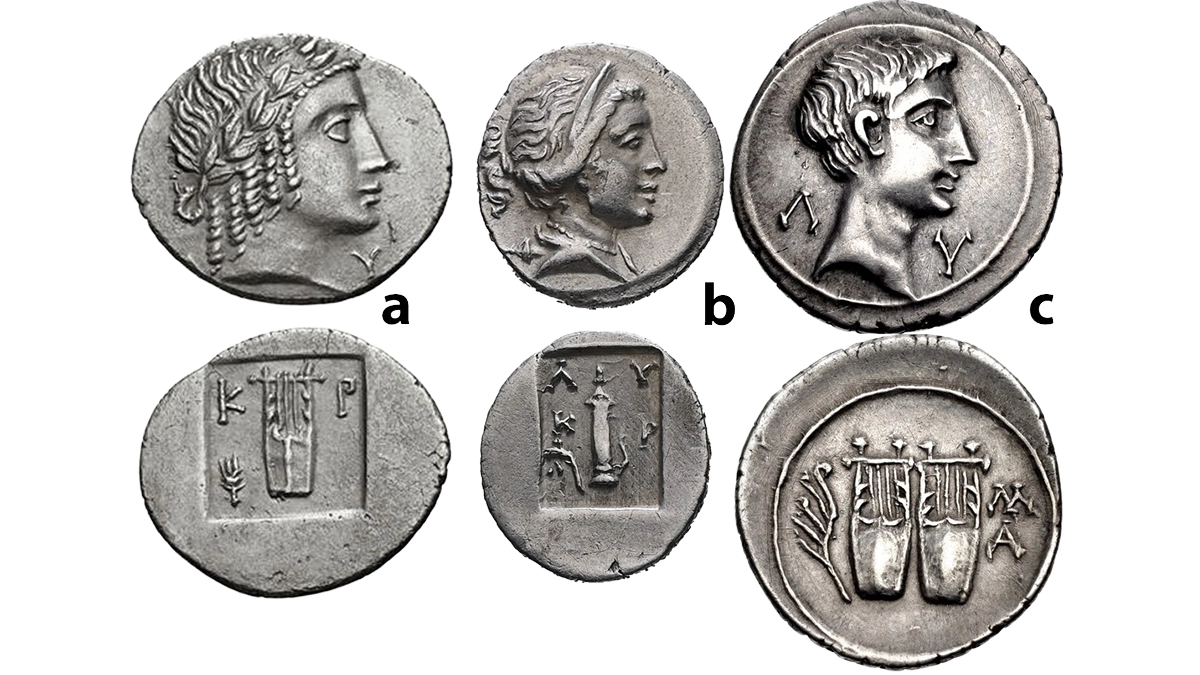
The final period of coinage (Period IV) began in the 40s BCE during the Roman Civil War. The League produced drachms, hemidrachms, and quarter drachms. Figure 8 shows all three denominations: Figure 8a, a hemidrachm with Apollo’s head on the obverse (L-U ethnic) and a kithara with K-R and a grain ear on the reverse, weighing 1.8 grams, nearly identical to the Roman quinarius; Figure 8b, a quarter drachm (0.9 g) with Artemis on the obverse and a quiver with L-U, K-R, and a filleted branch on the reverse; and Figure 8c, a drachm with Augustus on the obverse (L-U ethnic) and two kitharas with MA (Masicytus mint) and an aplustre on the reverse, indicating a double hemidrachm. Claudius dissolved the Lycian League in 43 CE, but League coinage featuring emperors’ portraits continued at least through Hadrian’s reign.
Closing Comments
Due to space constraints, this article covers only the silver coinage of the Lycian League, though bronze coins followed a similar style. Dynastic coins, particularly the portrait coins in Figures 4b, 5b, and 5c, can be expensive, but triskeles-reverse coins (Figure 5a) are often moderately priced and available in various silver fractions. League coins in Figures 7 and 8 are generally affordable, except for those featuring Augustus.
References
- Acsearch.info: an auction database
- Classical Numismatic Group (CNG)
- Grant, Michael. A Guide to the Ancient World: A Dictionary of Classical Place Names. Barnes and Noble (1986).
- Head, Barclay V. Historia Numorum: A Manual of Greek Numismatics. Oxford (1887).
Hornblower, Simon, and Antony Spawforth, ed. The Oxford Classical Dictionary, 3rd edition. Oxford (1996). - Sear, David. Greek Coins and Their Values, Vol 2: Asia. B.A. Seaby Ltd. (1979).
- Troxell, Hyla. The Coinage of the Lycian League. ANA, New York (1982).




Informative article. The pre-dynastic issues are some of my favorites. I have a few in my collection.
I need a “turtle” for my collection.
Interesting, complex series.
Some of the earliest coins minted. Really interesting. Also interesting that their written language has still not been deciphered by our ‘advanced’ society.
Very good article on ancient coins for sure!!