Spain Put Its Crown on a Silver Coin That Declared Liberty
On an 1834 Peruvian silver coin, Liberty stands proudly with a staff and a shield bearing the word LIBERTAD. Yet some surviving examples carry a second, startling symbol: the royal crown of Spain, hammered directly into the republican design.
The 1834 Peru 8 reales counterstamp tells a story of political contradiction, international commerce, and an empire struggling to accept the independence of its former colonies.
Spain rejected the revolutionary ideals that Peru celebrated on its coinage. However, thousands of miles away, Spanish officials in Manila faced an uncomfortable reality. Their colony needed the silver those same revolutionaries produced.
Ultimately, the Spanish crown found a remarkably practical solution. It put its own stamp on the money.
Peru’s Silver Coin Promised Liberty and Unity
In 1834, the Lima Mint struck silver 8 reales coins bearing the symbols of the young Peruvian Republic.
A standing female figure represented Liberty. She held a staff topped with a Phrygian cap, a familiar emblem of freedom, and supported a shield inscribed LIBERTAD.
Around the figure appeared Peru’s national motto: FIRME Y FELIZ POR LA UNIÓN — Firm and Happy Through Unity.
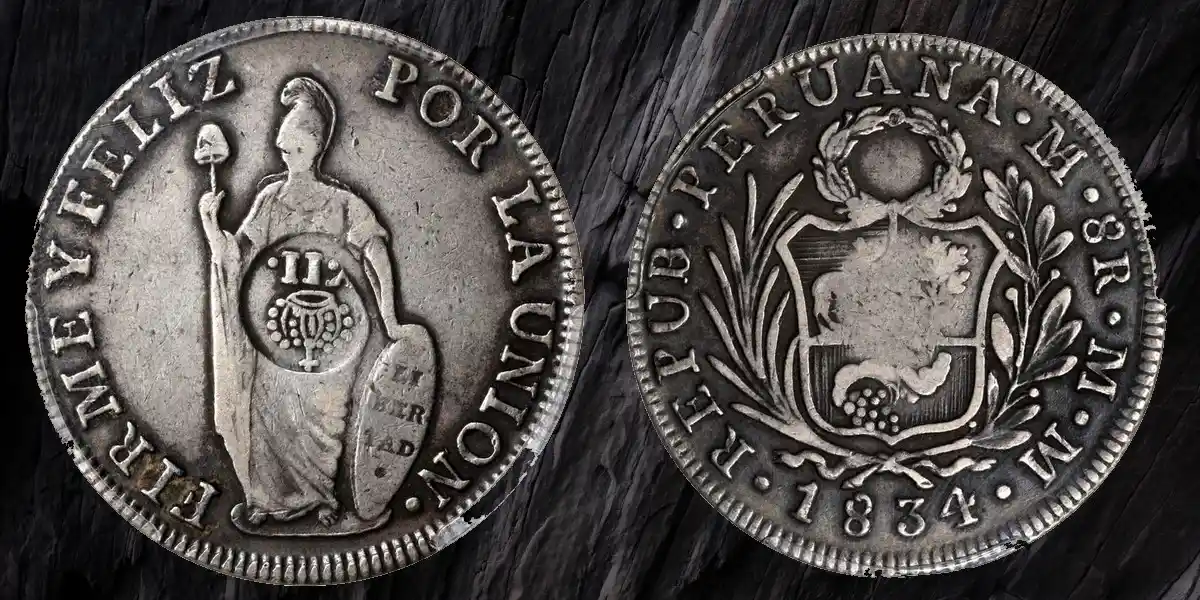
The opposite side displayed Peru’s national coat of arms, including a vicuña, a cinchona tree, and a cornucopia. Together, these symbols represented the country’s natural wealth.
The coin offered an optimistic portrait of a nation that had only recently broken free from Spanish rule.
However, 1834 brought turmoil rather than unity. Peru suffered a civil war as rival political and military factions struggled for control of the republic. The confrontation exposed the fragile institutions of the newly independent nation.
Consequently, the national motto carried a certain irony. Peru’s silver proclaimed political unity while competing factions fought over the country’s future.
Meanwhile, that same silver moved through international commerce toward another corner of Spain’s former empire.
Why Spanish Manila Needed the Silver of Its Enemies
For centuries, the Manila-Acapulco galleon trade helped connect the Philippines with the enormous silver wealth of Spanish America.
The last Manila galleon sailed in 1815. Nevertheless, Spanish American coins continued to reach the Philippines through other commercial channels.
Silver 8 reales coins served as an important medium of exchange throughout the region. Merchants accepted their substantial silver content, and the coins helped sustain trade between the Philippines and other Asian markets.
Then came the political complication.
As Mexico, Peru, and other Spanish American territories secured independence, their mints replaced royal portraits and imperial symbols with republican designs.
Those images carried a message that colonial officials in Manila considered dangerous.
Words such as Libertad, Independencia, and República celebrated precisely the political changes that Spain hoped to prevent in its remaining possessions.
Yet Manila could hardly reject the silver without disrupting commerce.
The administration needed a way to accept republican money while maintaining the appearance of Spanish royal authority.
Spain’s First Solution: Erase the Revolution
In 1828, Spanish colonial officials introduced a program to alter foreign coins carrying objectionable republican symbols.
Instead of melting the silver and producing entirely new coins, workers attempted to obliterate the original designs through an extensive overstriking process.
The resulting pieces carried Spanish royal imagery and inscriptions identifying Manila. Some also declared that Ferdinand VII had authorized their use.
The government wanted the coins’ silver, but not the political message stamped upon it.
Unfortunately, the operation proved troublesome.
The machinery struggled with the heavy silver pieces. Equipment failures complicated production, while full overstrikes demanded considerably more effort than a simple countermark.
Therefore, Manila’s authorities adopted a more efficient system in October 1832.
Rather than attempting to erase entire coin designs, workers used small, hand-held punches bearing a royal crown and the king’s cipher.
The new method required far less equipment. A worker could place a punch against an existing coin and strike it with a hammer.
The republican symbols remained visible.
However, the Spanish crown had now asserted its authority over the coin.
An 1834 Coin Could Carry the Mark of a Dead King
The chronology produces one of the most remarkable details in this series.
King Ferdinand VII died on September 29, 1833. His three-year-old daughter, Isabella II, succeeded him under a regency.
Yet Manila continued using Ferdinand’s royal countermark well into the following year.
The crowned F.7.º punch remained in official use until December 20, 1834.
As a result, an 1834-dated Peruvian 8 reales could receive the cipher of a Spanish monarch who had already died.
That is an extraordinary intersection of history and numismatics.
The Peruvian mint produced silver celebrating an independent republic. Meanwhile, Spanish authorities could legitimize that same silver using the initials of a deceased king.
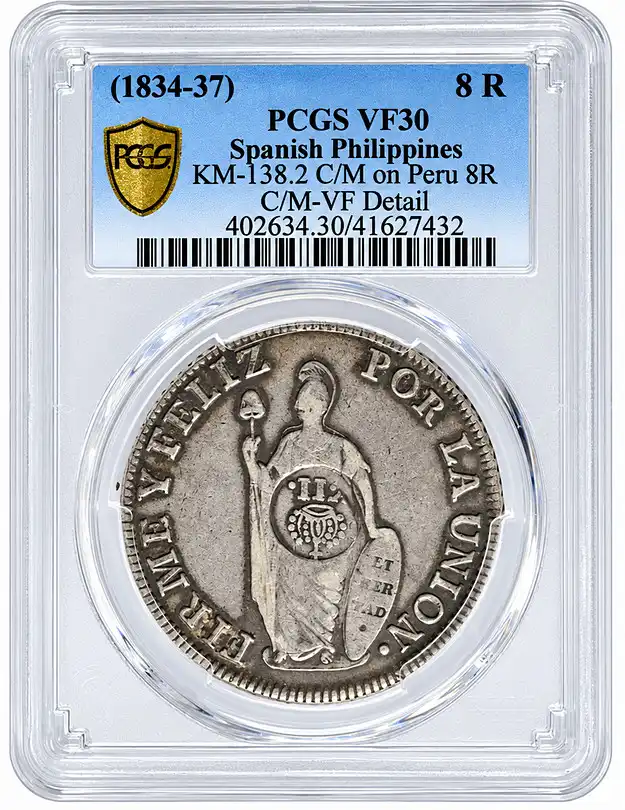
On December 20, 1834, Manila authorized a replacement countermark bearing the crowned initials Y.II., representing Queen Isabella II.
Officials continued using the new punch until March 31, 1837.
For collectors, this distinction matters. An 1834 Peruvian host coin may carry either of the two royal countermarks:
- F.7.º — Ferdinand VII: Type V countermark, generally cataloged as KM-83 on the relevant Peruvian 8 reales type. Manila used this punch from October 1832 through December 20, 1834.
- Y.II. — Isabella II: Type VI countermark, cataloged as KM-138.2 on the 1834 Lima host. Manila authorized this punch in December 1834 and continued its use through March 1837.
The 1834 date identifies when Peru struck the original coin, not necessarily when Manila applied the countermark.
That difference is essential when attributing these fascinating pieces.
Chinese Chopmarks, Pierced Coins, and the Pacific Trade
The royal countermark offers only one part of the story.
Some Philippine-counterstamped 8 reales coins also carry Chinese merchant chopmarks. These small punches helped money handlers identify silver coins they had examined and accepted.
Such marks provide evidence of the commercial networks that moved silver throughout East Asia.
Additionally, some coins display holes that their owners once used to string pieces together or wear them as ornaments.
These holes created another problem for Manila’s authorities.
In August 1834, the colonial administration prohibited pierced coins from circulating. Public opposition soon forced a reversal.
A September decree permitted owners to submit pierced coins for official revalidation. Workers applied countermarks around the perforations to restore their acceptance.
Consequently, some extraordinary survivors carry multiple royal stamps, merchant marks, and evidence of earlier alterations.
Each mark may represent a separate chapter in the coin’s working life.
The government finally ended the counterstamping program in 1837. Much later, in 1861, Manila began producing coins at its newly established government mint.
What Is an 1834 Peru 8 Reales Counterstamp Worth?
Collectors evaluate these coins differently from ordinary Peruvian 8 reales.
The original host coin matters, of course. However, the Philippine countermark introduces a second layer of condition, attribution, and historical interest.
A desirable specimen combines strong surviving host details with a clear, authentic royal punch.
The countermark’s placement also matters. Some punches overlap raised elements of the original design, leaving portions of the royal cipher weak or difficult to interpret.
Recent auction records demonstrate why collectors should avoid relying on broad price estimates.
In January 2022, Stack’s Bowers Galleries sold an 1834 Lima-mint Peru 8 reales bearing the crowned Y.II. countermark for $432. PCGS graded the host VF-30 and described the countermark as VF Details.
More recently, on February 8, 2026, Heritage Auctions sold another 1834 Lima-mint Peruvian 8 reales with the Isabella II countermark for $884.50. NGC graded the host VF-35 and assigned the countermark an XF Strong designation.
These results illustrate the range that comparable coins can achieve. However, they do not establish a fixed market value.
Scarcer host dates, unusual combinations of marks, strong preservation, and important provenances can produce considerably higher prices.
Authentication also deserves attention. Counterfeit Philippine royal countermarks exist, including deceptive modern punches on genuine period coins.
Therefore, collectors should examine both the host and the royal mark carefully. Established die characteristics, correct chronology, and third-party authentication can help distinguish genuine examples from deceptive alterations.
A Silver Coin That Two Governments Needed
The 1834 Peru 8 reales counterstamp represents far more than an unusual variety of world silver coinage.
It connects the independence struggles of South America, the economic demands of the Spanish Philippines, and the international silver trade that helped sustain commerce across the Pacific.
More importantly, it preserves an extraordinary political contradiction.
One government struck the coin to proclaim national liberty. Another placed its royal crown upon that same design to authorize its circulation.
Neither government could change the silver’s fundamental value.
And that may be the most revealing lesson of all.
Spain could stamp its crown onto Peru’s Liberty, but it still needed the silver that Liberty carried.
SEO and Google Discover Publishing Package
Focus Keyword: 1834 Peru 8 Reales Counterstamp
SEO Title: 1834 Peru 8 Reales Counterstamp: Spain’s Crown on Liberty
Google Discover Title: Spain Put Its Crown on a Silver Coin That Declared Liberty
Meta Description: Discover how the 1834 Peru 8 reales counterstamp turned republican silver into legal money under Spain’s crown in the Philippines.
Suggested URL Slug: 1834-peru-8-reales-philippines-counterstamp
Suggested Tags: Peru 8 Reales, Spanish Philippines, Philippine Counterstamps, Ferdinand VII, Isabella II, Lima Mint, World Coins, Countermarked Coins, Silver Coins, Spanish Colonial Coinage, Coin History
Suggested Hero Image Alt Text: 1834 Peru 8 reales silver coin featuring standing Liberty and a crowned Spanish Philippine counterstamp
Suggested WordPress Excerpt: Spain rejected the revolution that created Peru’s silver coins. Yet its Philippine colony needed that same money. The 1834 Peru 8 reales reveals how a royal counterstamp bridged an empire and a republic.