

Just 12 Mint Trial Pieces Accidentally Reached Collectors
Sometimes the difference between an ordinary modern Proof and a six-figure rarity comes down to a single word.
In this case, that word is FREEDOM.
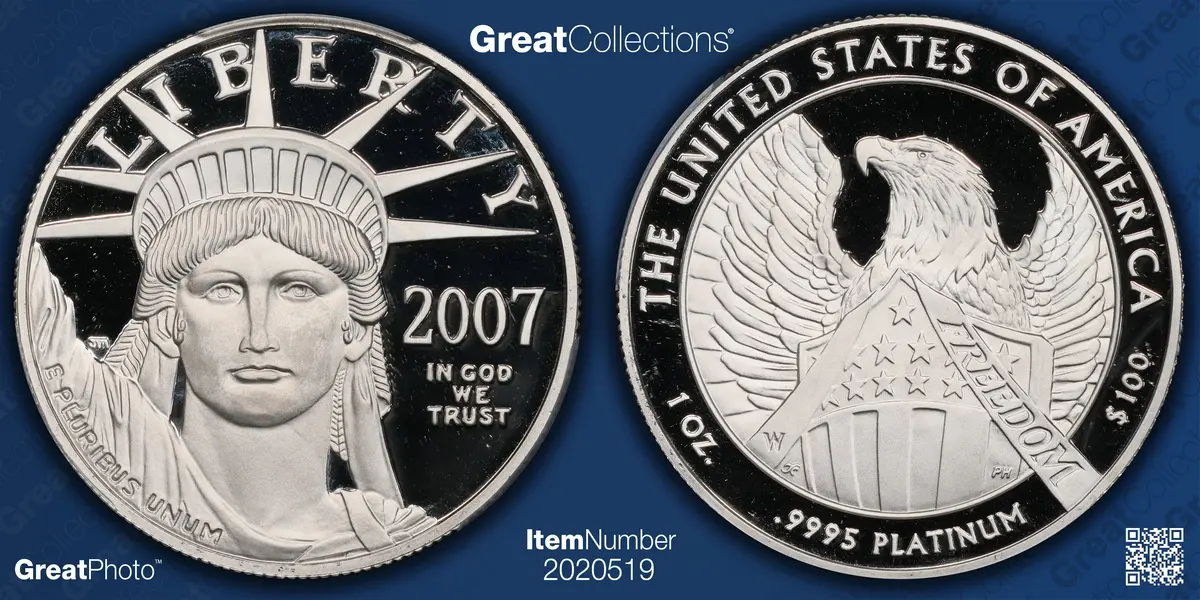
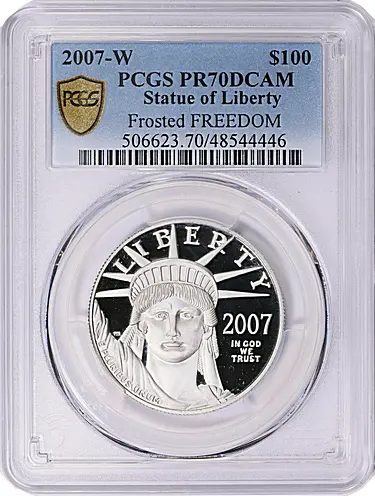
On January 11, 2026, GreatCollections sold a 2007-W $100 One-Ounce American Platinum Eagle “Frosted FREEDOM,” graded PCGS Proof-70 Deep Cameo, for an extraordinary $290,124. The auction attracted 109 bids. Moreover, the result established a new auction high for the famous one-ounce Frosted Freedom rarity.
Yet the coin’s real appeal goes far beyond its price.
The United States Mint never intended collectors to own it.
Instead, Mint employees struck a tiny group of pre-production pieces while testing the finish of the 2007 Proof Platinum Eagle. Mint officials then changed the design before regular production began. However, several trial pieces escaped into collector packaging anyway.
For nearly four years, nobody noticed.
That combination of intentional experimentation, accidental release, microscopic population, and a dramatic discovery story has made the 2007-W Frosted Freedom one of the defining rarities of modern American numismatics.
A Platinum Eagle Designed Around American Government
The American Platinum Eagle series began in 1997. Unlike bullion Platinum Eagles, the Proof series frequently changed its reverse designs. As a result, the program became something unusual within modern U.S. coinage: a precious-metal series that also served as a continuing canvas for American themes.
From 2006 through 2008, the Mint used its Foundations of American Democracy series to honor the three branches of the federal government.
The 2006 coin represented the Legislative Branch. The 2007 issue celebrated the Executive Branch. Finally, the 2008 design honored the Judicial Branch.
For 2007, United States Mint Artistic Infusion Program Master Designer Thomas S. Cleveland created the reverse. United States Mint Sculptor-Engraver Phebe Hemphill engraved it.
Cleveland placed a bald eagle at the center. Its wings stretch outward to symbolize freedom. Meanwhile, a shield represents the government’s readiness to enforce the laws that protect those freedoms.
A ribbon crosses the shield.
On that ribbon appears the word that would eventually transform a modern platinum coin into a legendary rarity: FREEDOM.
The obverse carries John M. Mercanti’s dramatic close-up portrait of the Statue of Liberty, a design the Platinum Eagle series had used since its 1997 debut.
The Mint Changes One Critical Detail
Before regular production, Mint officials examined pre-production examples of Cleveland’s reverse.
On those early strikes, the incuse letters in FREEDOM carried a frosted finish. However, the surrounding ribbon also carried frosting. Therefore, the letters visually blended into the ribbon instead of standing apart from it.
Mint officials wanted greater contrast.
So, they changed the production dies. On the coins intended for collectors, the Mint polished the recessed letters of FREEDOM to a brilliant, mirrorlike finish. As a result, the word stood sharply against the frosted ribbon.
The decision created two visually different versions of the same 2007 Proof design.
One became the regular issue.
The other should never have left the Mint.
The Trial Coins Escape
Collectors often describe Frosted Freedom pieces as errors. NGC initially discussed the first discovery as a die-polishing error because nobody yet knew the Mint’s full story.
However, the Mint later supplied a more revealing explanation.
Mint officials confirmed that the frosted pieces represented pre-production strikes produced for review purposes. In other words, the Mint intentionally created the finish during its development process.
The actual mistake came afterward.
According to information that the Mint supplied following the discoveries, employees inadvertently placed some pre-production pieces into the production stream while preparing for an internal audit. Those pieces then entered the normal distribution process and reached collectors.
That distinction matters.
The Frosted Freedom coin does not represent a random mechanical failure at the press. Instead, it preserves an abandoned stage in the Mint’s design-development process.
In that sense, collectors can view it as something closer to a modern trial piece or pattern that accidentally entered circulation through official Mint sales.
Indeed, numismatic references have treated the Frosted Freedom pieces as patterns or major varieties.
Only 12 One-Ounce Coins
Once the Mint investigated the situation, it supplied remarkably small production totals.
The Mint reported:
- Twelve $100 1 ounce
- Twenty One $50 1/2 ounce
- Twenty One $25 1/4 ounce
- No$10 1/10 ounce
The Mint therefore produced no Frosted Freedom tenth-ounce pieces.
The numbers alone explain much of the fascination.
The Mint reported total sales of 8,363 one-ounce 2007-W Proof Platinum Eagles. Yet no more than 12 carried the original Frosted Freedom treatment.
Even more important, a Mint production total does not necessarily equal today’s known population.
Collectors still have not publicly identified all 12 one-ounce pieces. Some could remain unnoticed in original collections or holdings assembled nearly two decades ago.
That possibility gives the story another layer. Somewhere, another ordinary-looking 2007 Platinum Eagle box may still contain a six-figure coin.
A Four-Year Secret Ends in 2011
The variety remained unknown to the collecting community from 2007 until January 2011.
Modern-coin dealer Jason Fishman discovered the first known one-ounce example. He submitted the coin to Numismatic Guaranty Company.
On January 14, 2011, NGC announced the discovery. The grading service certified the coin NGC PF-70 Ultra Cameo and identified the holder with both FROSTED FREEDOM and DISCOVERY SPECIMEN.
At first, the coin appeared unique.
Then the story grew.
In February 2011, another Frosted Freedom surfaced on the quarter-ounce $25 denomination. NGC confirmed that coin as well.
Later that year, the half-ounce $50 version finally appeared. Contemporary reporting traced that discovery to collector Lawrence B. Gratt’s holdings. NGC graded the $50 discovery specimen PF-69.
The discoveries forced the Mint to explain how the coins came into existence. Consequently, what began as a suspected die-finishing mistake became something far more interesting: evidence of an abandoned pre-production format that somehow escaped the Mint.
From $45,000 to Nearly $300,000
The market quickly recognized the significance of the one-ounce discovery coin.
In October 2011, the original NGC PF-70 Ultra Cameo Discovery Specimen changed hands through a private treaty transaction involving approximately $45,000 worth of coins in trade.
Then the market waited.
For more than a decade, collectors had almost no public auction evidence for the $100 Frosted Freedom.
That changed dramatically in 2022.
GreatCollections identified another one-ounce example and submitted it to PCGS. PCGS graded the coin Proof-70 Deep Cameo.
GreatCollections then opened bidding at just $1.
Eighty-three bids later, the coin realized $232,624.12 on November 13, 2022. At that point, GreatCollections described it as only the second known $100 example and the first one to reach public auction.
Then came 2026.
On January 11, GreatCollections offered another PCGS Proof-70 DCAM example. The firm described the coin as one of 12 trial pieces that the Mint produced before changing the finish of FREEDOM.
This time, bidders pushed the price even higher.
After 109 bids, the coin realized $290,124.
Major Recorded Transactions for the $100 Frosted Freedom
- October 2011 NGC PF-70 Ultra Cameo, Discovery Specimen Private treaty trade $45,000 in coins
- November 13, 2022 PCGS Proof-70 DCAM GreatCollections, 83 bids $232,624.12
- January 11, 2026 PCGS Proof-70 DCAM GreatCollections, 109 bids $290,12
2007-W $100 Frosted Freedom Platinum Eagle Specifications
- Country: United States
- Year: 2007
- Denomination: $100
- Mint: West Point
- Mintmark: W
- Composition: 99.95% platinum
- Weight: 31.12 grams
- Platinum Content: 1 troy ounce
- Diameter: 32.70 mm
- Edge: Reeded
- Strike: Proof
- Obverse Designer/Engraver: John M. Mercanti
- Reverse Designer: Thomas S. Cleveland
- Reverse Engraver: Phebe Hemphill
- Theme Foundations of American Democracy: Executive Branch
- Frosted Freedom Trial Production: Maximum of 12 reported by the U.S. Mint
Specifications conform to U.S. Mint, PCGS, and contemporary series references.
Why Frosted Freedom Matters
Modern coins rarely offer this combination of ingredients.
The Mint intentionally experimented with a design finish. Officials rejected that version. Employees should have kept the trial pieces from reaching buyers. Instead, a few escaped inside official Mint packaging.
Then collectors overlooked them for almost four years.
Most importantly, the difference hides in plain sight.
There is no missing mintmark. There is no dramatic double strike. The coin does not show a spectacular off-center impression.
Instead, the entire rarity rests inside seven small letters.
On the normal 2007-W Proof Platinum Eagle, FREEDOM shines.
On the great rarity, FREEDOM disappears into the frost.
That subtle change now separates a collectible modern Platinum Eagle from a coin that has sold for nearly $300,000.
For modern-coin specialists, that is precisely what makes the 2007-W $100 Frosted Freedom so compelling. It offers extreme rarity, a documented Mint origin, a genuine discovery story, and the tantalizing possibility that more examples still sit unidentified.
The United States Mint meant to erase this version before production began.
Instead, 12 tiny pieces of that abandoned decision may have survived.
And almost 20 years later, collectors are still searching for them.
I’ll be on the lookout now!
I don’t have any platinum coins in my collection yet. One of these days that will change
Very nice coins…..
Very nice
I’ve never heard this story before, I love learning something new!
“Frosted”
..and all I can hear is “Ladies.. frost yourselves!” [How to Lose a Guy in 10 Days]