


Before coinage, money had weight. Then Lydia gave it a face.
That face belonged to a roaring lion. It appeared on a small lump of electrum more than 2,600 years ago. Yet this tiny coin helped change trade, kingship, and daily exchange forever.
Today, collectors know it as the Lydian lion trite. Many numismatists also view it as the first official coin. It carried a royal symbol. It followed a weight standard. Most important, it signaled value through an official mark.
That simple idea still defines money.
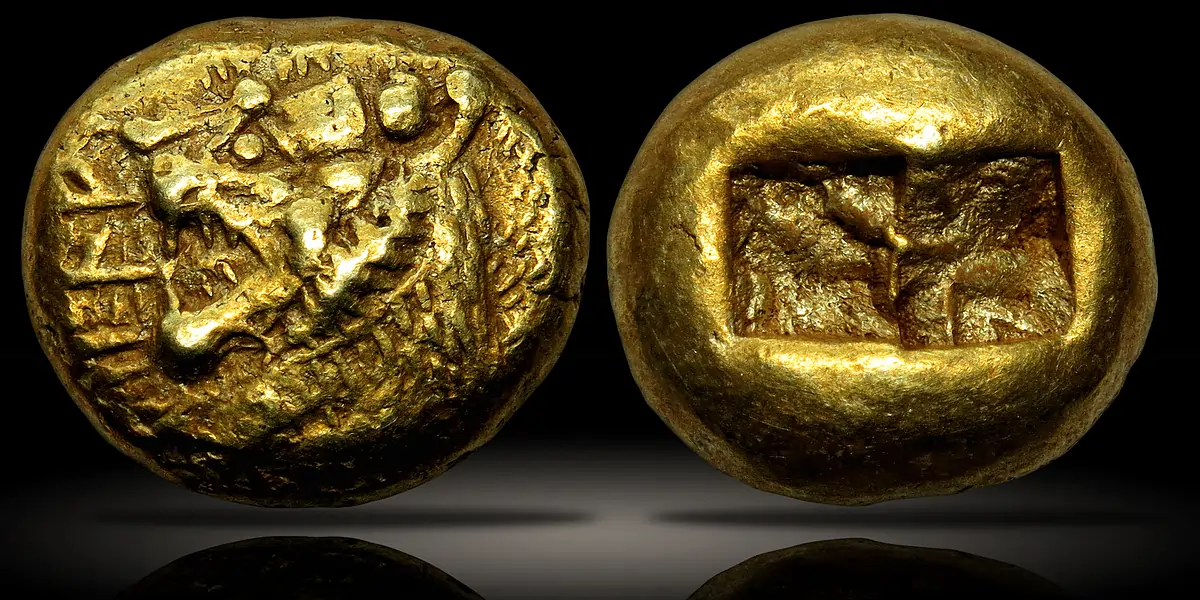
Lydia, Electrum, and the River of Gold
Natural resources can shape a nation’s history. In Lydia, they shaped money itself.
Ancient Lydia occupied part of western Anatolia, in modern Turkey. Its capital, Sardes, stood near the Pactolus River. Ancient writers linked that river to gold, electrum, and royal wealth. They also linked it to one of the most famous myths in the ancient world.
According to the legend, King Midas washed in the Pactolus to rid himself of his curse. The gods had granted him the golden touch. However, that gift soon became a nightmare. Even food turned to gold in his hands. So Midas entered the river, and the river gained its golden sands.
The myth gave Lydia a powerful origin story. Yet the region’s real wealth came from metal, trade, and geography. Lydia stood between the older commercial world of Mesopotamia and the Greek cities of the Aegean. Therefore, it had the right material and the right marketplace for a monetary revolution.
A Kingdom Built for Commerce
Ancient authors remembered Lydia as a commercial people. Herodotus credited the Lydians with striking and using precious-metal coinage. He also called them the first retail traders.
That matters. Coinage did not emerge in a vacuum. It solved practical problems in a busy economy.
Before coins, merchants could weigh metal. They could test it. They could also negotiate its value. However, every exchange took time. Electrum created an even bigger problem. Its natural mix of gold and silver could vary. As a result, two lumps of the same weight might not hold the same value.
A marked coin changed that equation. It gave a buyer and seller a trusted object. It also gave the king a public role in commerce.
Sadyattes, Alyattes, and the Earliest Lion Coinage
Lydian coinage began under the early Mermnad kings, most often associated with Sadyattes and Alyattes. Catalogers place this particular coin among the earliest Lydian lion issues. They commonly date it to circa 630–620 BCE, during the time of Sadyattes.
That early date gives the coin extraordinary importance. Later Lydian lion issues appear more often. This first major variety appears far less often. It came from a short emission, and few dies appear to have produced it.
Most surviving examples show heavy wear. Many grade Very Fine or lower. However, the featured specimen stands apart. It survives in Mint State with full luster. As a result, the catalog description calls it likely the finest known.
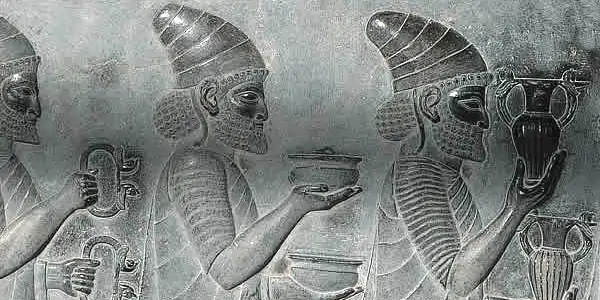
Why the Trite May Have Been the Largest Denomination
The coin weighs 4.70 grams. Its weight places it in the trite denomination, or one-third stater.
However, the term “one-third” creates a puzzle. Researchers have not confirmed full staters from this earliest Lydian lion period. Therefore, the trite likely served as the largest practical denomination in this first coinage.
That made it a serious piece of money.
Scholars still debate its ancient value. Some estimates place a Lydian trite at about one month’s pay or subsistence. Other estimates go higher. One famous comparison suggests it could buy as many as 11 sheep.
Either way, this coin did not function like pocket change. It represented stored wealth.
Why Collectors Call It the First Official Coin
The “first coin” question still invites debate. It depends on how one defines a coin.
That difference matters.
A coin needs more than metal. It needs a recognized value. It needs a mark that certifies that value. It also needs trust. The Lydian lion meets those requirements better than any earlier contender.
For that reason, many collectors and numismatists call the Lydian lion trite the first official coin.
Still, the claim deserves careful wording. Ancient coinage developed over time. Moreover, scholars continue to debate the earliest issues, their dating, and their exact issuers. Even so, the Lydian lion remains the strongest and most famous candidate for the first official coin.
The Lion, the Sun, and Royal Power
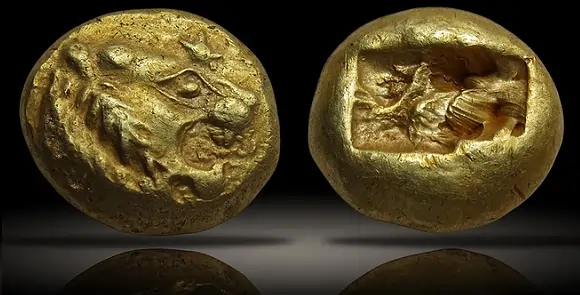
The obverse shows a roaring lion facing right. Its mouth opens wide. Its teeth show. A sharp triangular eye gives the animal a fierce archaic style.
In antiquity, the lion stood for royal power. It also symbolized strength, protection, and command. Therefore, it made perfect sense for a Lydian king. A ruler who controlled money could now place royal authority directly into trade.
Above the lion’s head appears a small sunburst with four rays. Early observers saw the lion as more than a beast. Many ancient cultures linked lions with the sun. People believed lions could look directly into the sun. Later tradition also assigned Leo to the hottest part of the year, from July 22 to August 22.
On this early type, the sunburst remains clear. Later varieties lost some of that sharpness. As the design changed, some catalogers and collectors interpreted the feature less as a sun and more as a wart on the lion’s nose.
Yet on the earliest coins, the message still feels powerful. The lion roars. The sun shines. The king guarantees value.
The Reverse: Two Punches and an Ancient Minting Method
The reverse shows two incuse square punches.
This feature reflects early minting technology. A mint worker placed a blank piece of electrum on an obverse die. Then he struck the reverse with punches. The blow forced the metal into the die and created the design.
The result looks primitive at first glance. However, it marks a major technological leap. The coin no longer needed repeated testing in every transaction. Its mark carried a promise.
Croesus and the Next Monetary Revolution
After Alyattes died, his son Croesus took the Lydian throne. His name still survives in the phrase “rich as Croesus.”
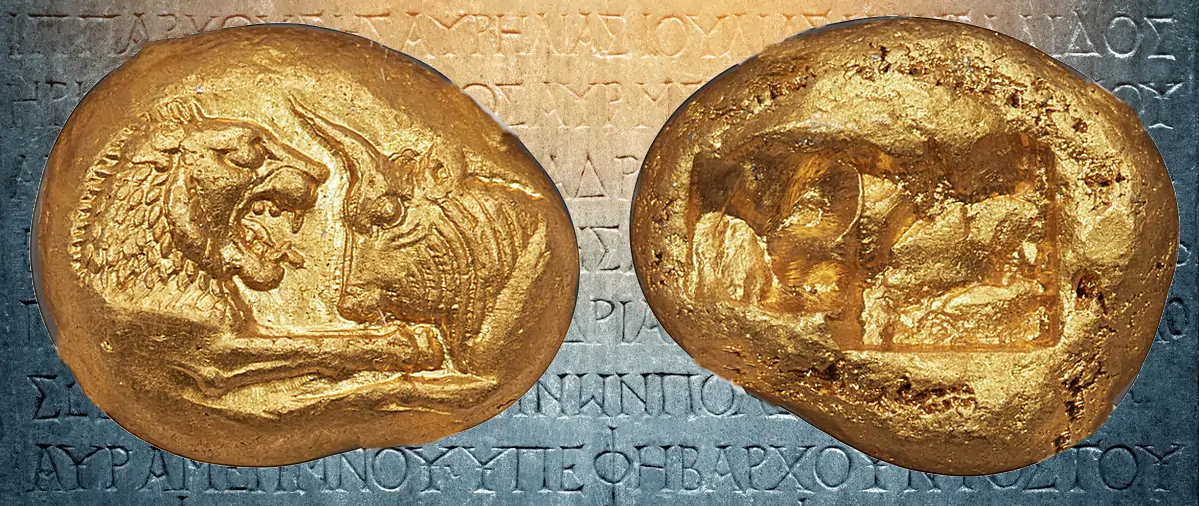
Croesus ended the Lydian lion trite series. Then he introduced a more advanced coinage system. Instead of electrum, Croesus issued separate gold and silver coins. This created the world’s first bimetallic coinage system.
That move mattered. Electrum had power, but it also had uncertainty. Gold and silver coinage offered clearer value. In time, that system influenced Persia, Greece, and the wider Mediterranean world.
However, Croesus did not erase the lion’s importance. He built on it.
The Lydian lion trite had already introduced the key idea. A government could certify metal. A design could stand for authority. A coin could make wealth portable, visible, and trusted.
The Moment Money Got a Face
This coin matters because it sits at the edge of history.
Before it, wealth often moved as raw metal. After it, wealth moved as official money. The difference seems small. Yet the effect changed civilization.
The Lydian lion trite gave the marketplace a symbol that people could trust. It joined myth, metal, monarchy, and trade in a single object. It also gave collectors one of the greatest origin stories in numismatics.
A roaring lion. A sunburst. Two square punches. One small electrum coin.
From that beginning came the world’s coinage.




Great history lesson from Lydia!!!!
Cool
Ancients are always fascinating.
These articles were more fun to read and more informative before they became mostly AI generated.
A new and interesting history lesson every week!
I suspect the ancients would have viewed this a bit differently. I suppose it works well for a modern definition of the first though.