


By CoinWeek
The Standing Liberty Quarter, Type I, stands among the most artistically ambitious coins ever struck by the United States Mint. Issued in 1916 and early 1917, this short-lived design reflects the sweeping transformation of American coinage during the early twentieth century, a period when sculpture, symbolism, and national identity reshaped everyday money.
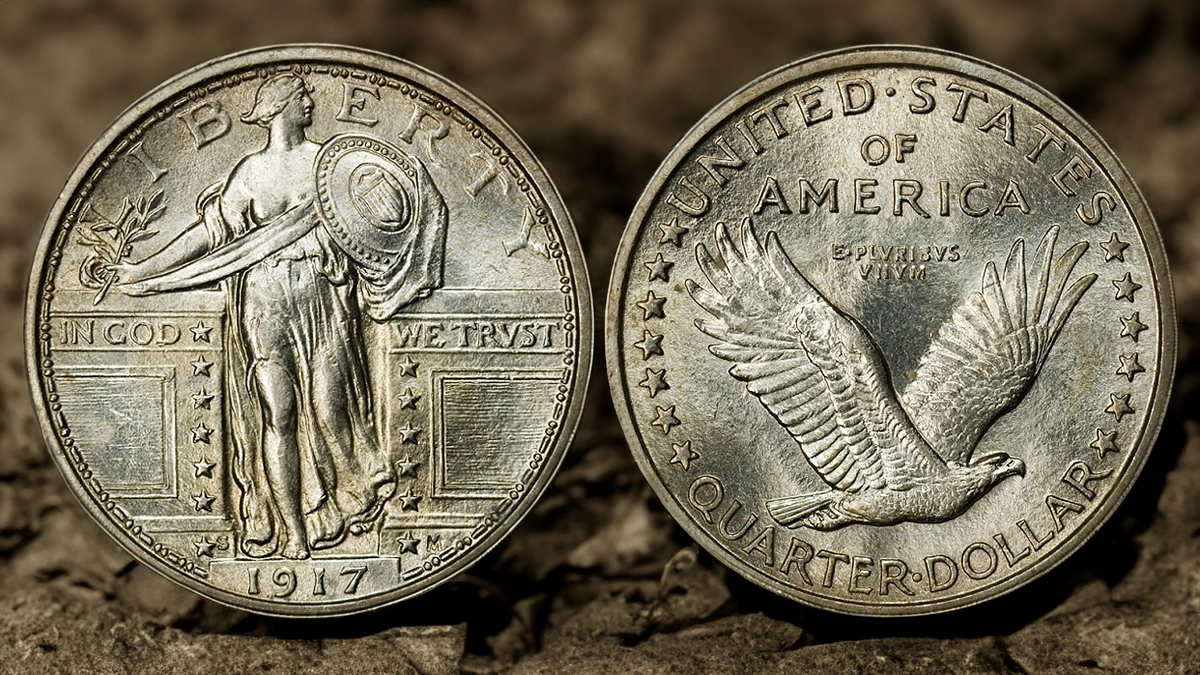
This CoinWeek guide presents the complete historical and technical context of the Type I Standing Liberty Quarter, written for collectors, researchers, and historians seeking an authoritative reference.
Origins of the Standing Liberty Quarter
Charles E. Barber’s long-running quarter dollar design entered circulation in 1892 under provisions of the Mint Act of 1890, which permitted, but did not require, coin redesigns every 25 years. By 1916, Mint Director Robert W. Woolley pursued a full artistic overhaul of the dime, quarter, and half dollar.
Rather than relying on in-house engravers, Woolley invited outside sculptors to compete for the new designs. The results defined a generation of American coinage. Adolph A. Weinman secured the dime and half dollar, while the quarter commission went to Hermon A. MacNeil, a sculptor widely recognized for his work in monumental and Native American–themed art.
An Artist of the American Renaissance
MacNeil brought a distinctly modern sensibility to the quarter dollar. His background included sculptural work for the World’s Columbian Exposition, public monuments, and architectural commissions. The Standing Liberty Quarter placed him among an elite group of artists whose designs transformed U.S. coinage, alongside the creators of the Lincoln cent, Buffalo nickel, Mercury dime, Walking Liberty half dollar, and Saint-Gaudens gold coinage.
MacNeil’s quarter reflects the artistic vigor of the era: Liberty is no longer static or heraldic but active, human, and symbolic.
Liberty Revealed: Symbolism and Controversy
The obverse figure of Liberty likely combines features of silent film actress Dora Doscher and Broadway performer Irene MacDowell. Liberty strides forward from a gateway, shield raised in defense, olive branch extended in peace. The imagery communicates readiness without aggression, America vigilant, yet restrained.
Public reaction, however, focused on Liberty’s exposed right breast. While artistic nudity had precedent in American currency, including the 1896 Silver Certificate, the design sparked debate almost immediately. In 1917, the Mint modified the design to cover Liberty’s torso with chain mail, creating the distinct Type II quarter and ending the brief run of the original Type I.
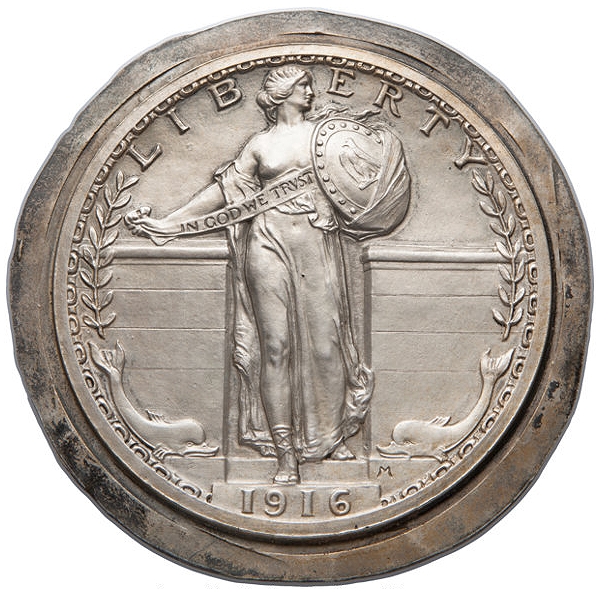
The “Full Head” Distinction
Standing Liberty quarters are closely studied for strike quality, especially in Liberty’s head. Coins displaying fully defined hair details, including distinct leaves, a sharp hairline, and a visible ear, qualify for the coveted Full Head designation.
Some numismatists also consider the completeness of shield rivets when assessing strike sharpness. However, head detail alone defines the Full Head subtype, even when shield details vary.
Design Analysis: Standing Liberty Quarter, Type I
Obverse Design
Liberty stands within a recessed gateway, advancing forward with her left foot raised. Her flowing gown drapes loosely, revealing the right breast and leg. In her left arm, she holds a circular shield bearing the Union emblem; in her right hand, an olive branch symbolizes peace.
Key design elements include:
- LIBERTY arcing across the top
- IN GOD WE TRUST split across the parapet walls
- Thirteen stars flanking the gateway
- The date placed prominently on the step below Liberty
- MacNeil’s initial “M” near the lower right star
- Mintmarks (when present) near the lower left star
- An ornamental inner border of alternating dots and bars frames the design.
Reverse Design
The reverse features an eagle in full flight, wings raised and extended, moving confidently to the right. Surrounding legends include:
- UNITED STATES OF AMERICA
- QUARTER DOLLAR
- E PLURIBUS UNUM
- Stars divide the inscriptions symmetrically, reinforcing balance and motion.
Edge
The coin features a traditional reeded edge, consistent with contemporary silver denominations.
Coin Specifications
- Denomination: Quarter Dollar
- Series: Standing Liberty Quarter, Type I
- Years of Issue: 1916–1917
- Composition: 90% silver, 10% copper
- Weight: 6.25 grams
- Diameter: 24.3 mm
- Edge: Reeded
- Obverse Designer: Hermon A. MacNeil
- Reverse Designer: Hermon A. MacNeil
- Proofs: No officially issued proofs; select 1917 Satin Proof or Specimen pieces are reported
Place in American Numismatics
The Standing Liberty Quarter, Type I, occupies a singular place in U.S. coinage. Its bold artistry, brief production span, and immediate redesign make it both a historical document and a sculptural achievement. More than a circulating coin, it represents a turning point, when American money embraced fine art as a public expression of national ideals.
For collectors and scholars alike, the Type I Standing Liberty Quarter remains one of the most studied and admired silver coins of the twentieth century.




The SLQ is arguably the most beautiful quarter design ever put out by the US Mint. It is unfortunate, however, that the date was one of the high points of the design (at least for Types I and II), meaning that a lot of them ended up dateless during their circulating lives. Still gotta love ’em, regardless.
One of my favorite coins. Love the design.
One of best designs of any coin made. Would like have more.
I have a Standing Liberty Quarter where can I sell it
Today’s coin designs are so bad when compared to what we used to have. I wish we’d stayed with Liberty, not dead presidents. George Washington would hate this.
Very interesting all the coin options available
The Standing Liberty is one of the best designs, by far, in my opinion.
Beautiful coin
One of my favorite coins!!
Beautiful coin.
love the design
The Standing Liberty Quarter is a beautiful design
One of my favorite coins. Also see the 2016 reissue in gold.
beauty and brawn in one coin
One if our best designs, scandal a bonus
One of my favorite coins. Love the design.
Great looking coin
A friend and mentor of mine who collected Standing Liberty Quarters uncirculated by the roll.
One of my favorite designs! I have 2 of them but not in good shape.
I would love to own one of these Standing Liberty Quarter’s. Coins had a lot more to them in the past. Thanks.
Herman A. MacNeil was one of the giant American artists of the twentieth century.
one of better looking coins
A very beautiful coin that anyone would be lucky to have in their collection!
I have a 1933 s like new is it worth anything I have from 1933 1945 some s and some got a D on them look real good
@Billy Robertson: Could you please recheck that date? No quarters were minted in 1933.
I have a 1926 and 1916 and one does not have a date on it but on coin app it said it a 1916 don’t no how cause I can’t c it but yall think they worth anything
Very informative
I remember finding a number of Type I Standing Liberty Quarters in change back in the early 1960’s!!! Unfortunately no 1916’s!!!
My favorite of all US coin designs!
The bronze 1916 quarter is my favorite because of the way it looks! I did not realize coins changed that often in the very early years.
@Katheleen Cannella: A bronze quarter would be either an off-metal error (unlikely) or a replica piece. All known Standing Liberty quarters were struck in 90% silver alloy.
The type 1 is one of the most beautiful coins ever minted in my opinion. The type 2 is close behind. A vast improvement from the Barber coinage, which became a little boring.
The article on the 1916 Standing Liberty is very informative and interesting. I learned more than I knew; the details given of the Full-head are interesting, as are all other important differences in the design markings.