


By Charles Morgan and Hubert Walker for CoinWeek Notes …..
It’s important to consider the strain under which the United States Mint was operating. A series of surprise Confederate victories, unclear outcomes, and the seeming unwillingness of Union General George B. McClellan to fully prosecute the war meant the country would suffer three more years of fighting.
Silver dollars, reintroduced in 1838 but never in high demand, entered circulation only to fall out quickly. Following the 1848 discovery of gold in California, the Mint introduced a more portable Gold Dollar. Over time, the intrinsic value of the silver dollar would exceed its face value as the war began. With specie too dear to circulate, the U.S. Treasury Department introduced Demand Notes (Greenbacks) in 1862. The fiat money failed to hold its value and soon traded for double-digit discounts compared to gold.
|
Production of 1862 Liberty Seated Dollars |
|||
| January 27, 1862 | 500 struck (Proofs) | February 4, 1862 | 700 struck |
| June 14, 1862 | 500 struck | July 30, 1862 | 5,000 struck |
| August 5, 1862 | 5,340 struck | Total Mintage: 11,540 coins | |
It was under these circumstances that the 1862 Liberty Seated Dollar was made.
On January 27, 1862, three days before the United States launched its first ironclad warship, the USS Monitor, the coiner at Philadelphia Mint struck 500 1862 Liberty Seated Dollar Proofs. The next week, the year’s first emission of business strikes, numbering just 700 coins were struck.
On June 14, two weeks after Robert E. Lee, a former Union Army Colonel, veteran of the Mexican-American War, and brutal enslaver, took command of the Army of Northern Virginia, Philadelphia struck another 500 business-strike 1862 Liberty Seated Dollars, bringing the annual mintage up to just 1,200 coins. The next 1862 Liberty Seated Dollars would not be struck until July 30 and August 5. It was these two summer deliveries of 5,000 and 5,340 coins that account for 90% of the total mintage. The entire mintage was struck at the behest of depositors.
Business-strike survivors are scarce and are outnumbered by Proofs by a factor of 1.3:1 in all grades, but in the grades of MS63 and Proof 63, Proofs outnumber business strikes by a factor of 3.11:1.
On many Mint State examples, obverse and reverse fields show die striations. This is probably due to the Mint rushing the dies into production before the dies could be finished.
* * *
Market Data and Noteworthy Specimens
Comparing PCGS TruView images of the Hansen and Simpson MS65 examples, we give the edge to the Hansen coin in the department of eye appeal thanks to its vivid toning. Both coins are approved by CAC.
Top Population: PCGS MS65 (3, 10/2024), NGC MS65 (3, 10/2024), and CAC MS65 (2:0 stickered:graded, 10/2024).
- PCGS MS65 CAC #21572854: Del Loy Hansen. Imaged on PCGS CoinFacts. Beautiful rainbow toning. Purple centers with Cerulean blue and light green outer areas.
- PCGS MS65 CAC #29582793: “The Bob R. Simpson Collection,” Heritage Auctions, January 7, 2016, Lot 5460 – $52,875. Simpson on insert. Pale cream color. Orange spot at 12 o’clock touching denticles. Diagonal dark mark at 1 o’clock touching denticles.
- PCGS MS64+ CAC #18481213: Stack’s Bowers, November 4, 2010, Lot 2278 – $21,850; Legend Numismatics to Eugene H. Gardner, via sale; “The Eugene H. Gardner Collection,” Heritage Auctions, January 7, 2016, Lot 5460 – $52,875. Crescent-shaped toning in green and red on the left side of the obverse. Champagne all over obverse and reverse.
- PCGS MS64+ CAC #16090456: As PCGS MS64 #16090456. “The Christmas Lake Collection,” Heritage Auctions, October 13, 2011, Lot – $12,650. As PCGS MS64+ #16090456. Legend Rare Coin Auctions, July 16, 2020, Lot 30 – $27,025. Imaged on PCGS CoinFacts. Upgraded by one-half point. Creamy. light russet toning from stars 3 to 5 to the rim. Rim hit on Liberty’s left elbow.
* * *
Design
Obverse:
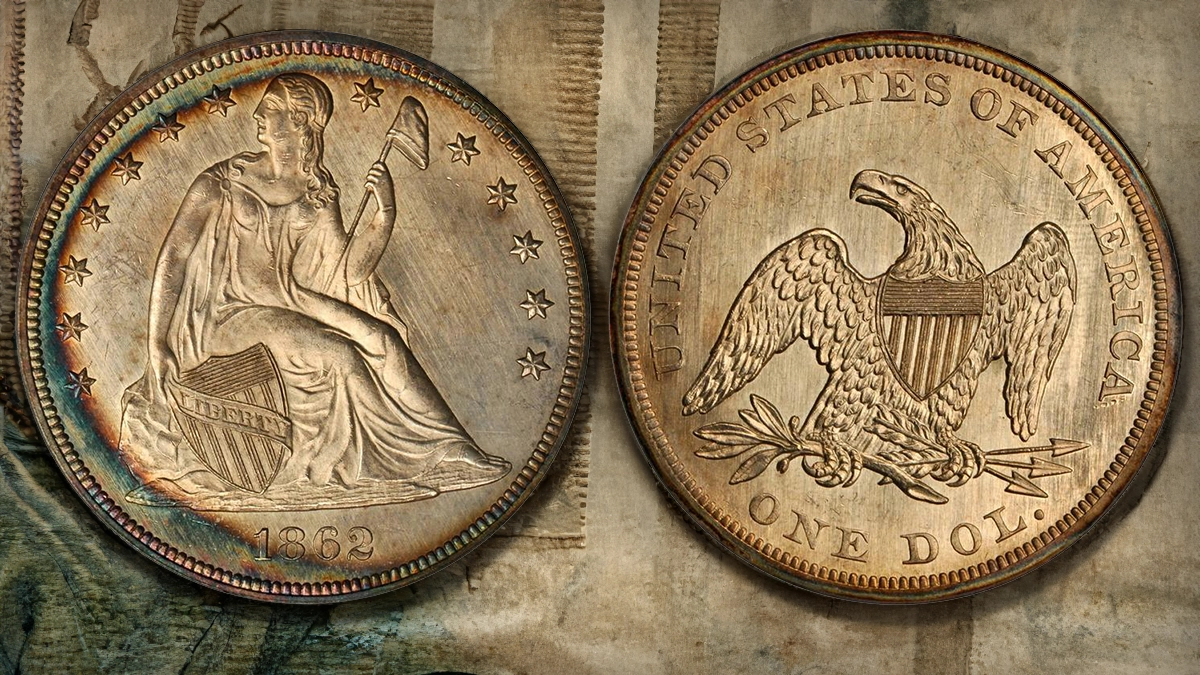
The obverse features Liberty seated on a rock in classical flowing robes, her head turned to the right (viewer’s left). Liberty’s left arm is bent, her raised hand holding a Liberty pole with a cap. The right arm is extended downward at her side, with the hand balancing a shield with the word LIBERTY displayed in a curving banner. Thirteen six-pointed stars surround the seated figure inside a denticulated rim with seven on the left side, one between Liberty’s head and the cap, and the remaining five along the right. The date 1862 is centered at the bottom between the base of the rock and the rim.
Reverse:
On the reverse, an eagle is prominently displayed inside a denticulated rim. The eagle’s wings are partly spread but folded downward at the joint as if the majestic bird had just landed or perhaps instead is preparing to fly away. An olive branch is in the dexter claw (viewer’s left); the sinister claw clutches three arrows. The legend UNITED STATES OF AMERICA encircles the top two-thirds of the coin inside the rim, with the ONE DOL. denomination centered at the bottom.
Edge:
The edge of the 1862 Liberty Seated Dollar is reeded.
Coin Specifications
| Country: | United States of America |
| Year of Issue: | 1862 |
| Denomination: | One Dollar (USD) |
| Mintmark: | None (Philadelphia) |
| Mintage: | 11,540 |
| Alloy: | .900 Silver, .100 Copper |
| Weight: | 26.73 g |
| Diameter: | 38.10 mm |
| Edge: | Reeded |
| OBV Designer: | Christian Gobrecht, from sketches by Titian Peale/Thomas Sully |
| REV Designer: | Christian Gobrecht |
| Quality: | Business Strike |
* * *
References
Julian, R.W. “The Silver Dollar, 1853-1873”, Numismatic Scrapbook Magazine. August 1964. 2124-2128. Data compiled and analyzed from the National Archives.
* * *




This grading companies has misattributed many 1862 dollars. My friend and I have seen over a dozen that were misattributed and have notified the seller or auction company. In many cases they have been returned to the grading company and are now correctly attributed.