


The Carson City Coin That Almost Disappeared: The 1876-CC Twenty-Cent Piece
By CoinWeek Notes
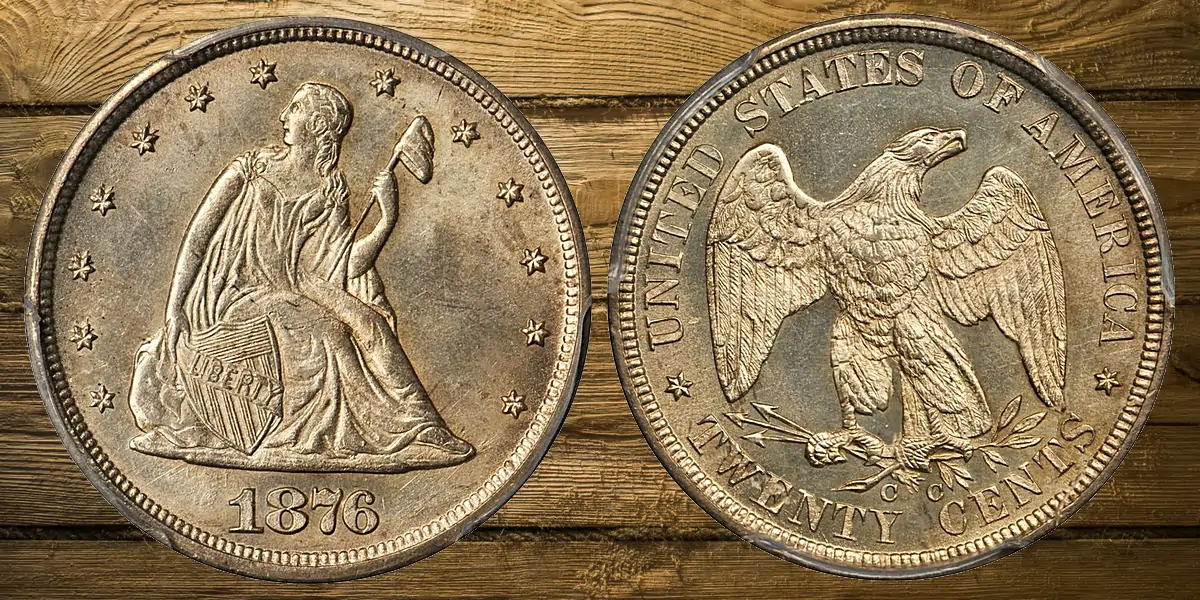
The 1876-CC Liberty Seated Twenty-Cent Piece ranks among the great rarities of United States coinage.
The Carson City Mint struck 10,000 pieces in 1876. Yet almost all of them disappeared before collectors had a fair chance to save one.
Today, fewer than 20 examples survive. That tiny census gives the 1876-CC Twenty-Cent Piece a special place in the U.S. rare coin market. It also gives the short-lived twenty-cent denomination its most famous coin.
A Coin Born From Western Silver Politics
Congress authorized the twenty-cent piece in 1875. Supporters promoted it as a useful coin for commerce in the West.
However, the public quickly rejected it.
The coin looked too much like the quarter. Its diameter measured 22 millimeters, while the quarter measured only slightly larger. Also, both coins shared a similar Liberty Seated obverse.
The Mint tried to help. It gave the twenty-cent piece a plain edge instead of the quarter’s reeded edge. Even so, merchants and customers confused the two coins.
As a result, the denomination failed almost at once.
Carson City Strikes 10,000 Coins
The Carson City Mint struck 10,000 Twenty-Cent Pieces in 1876. Specialists believe the entire run came from the press during the first week of May.
Only one die pair struck all known 1876-CC Twenty-Cent Pieces.
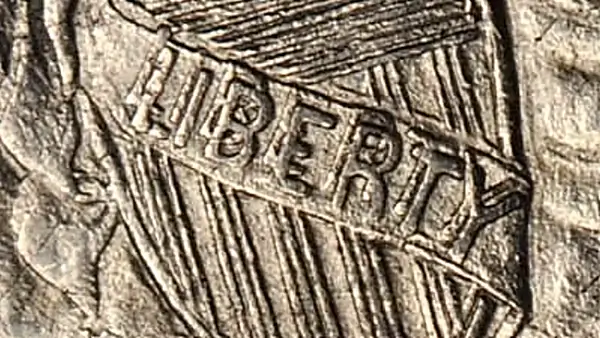
That die pair created one of the coin’s most important diagnostics. The Philadelphia Mint badly doubled the obverse die. The strongest doubling appears on the word LIBERTY. It also appears on several stars.
Therefore, bold doubling on LIBERTY appears on every genuine 1876-CC Twenty-Cent Piece.
The Diagnostic That Collectors Watch
The 1876-CC Twenty-Cent Piece carries several useful die markers.
First, the obverse shows strong doubling on LIBERTY. Next, the doubling extends to several stars. In addition, specialists note raised die lines near Liberty’s foot and around the date. Some examples also show traces of a misplaced 8 and 7 in the denticles below the date.
These markers matter. A collector cannot treat the 1876-CC like a normal date-and-mintmark issue. The coin survives in such small numbers that every genuine piece demands close study.
The Melt Order Creates a Legend
Congress moved against the denomination in 1876. The Mint also had little reason to keep striking or storing a coin that the public did not want.
Collector references place the destruction of the 1876-CC dies at Carson City on January 20, 1877. Later in 1877, Mint Director Henry R. Linderman directed Carson City Superintendent James Crawford to melt the twenty-cent pieces on hand.
That order sealed the fate of the issue.
Only a small number escaped. Some may have left the Mint through official channels before the melt. Others may have gone east for the Annual Assay Commission. A few may have entered private hands in Nevada.
Still, the result stayed the same. The vast majority of the 10,000-coin mintage went to the melting pot.
A Rarity Almost Unknown in the 19th Century
Very few 19th-century collectors knew the 1876-CC Twenty-Cent Piece.
That makes sense. In 1876, most collectors did not focus on mintmarks. Many pursued date sets instead. As a result, a Carson City mintmark on a failed denomination did not draw immediate national attention.
Slowly, examples reached the market.
Then came the major discovery. In the late 1950s, Baltimore dealer Tom Warfield unveiled a group of Uncirculated 1876-CC Twenty-Cent Pieces. Many references call it a hoard of 10 coins. Other sources suggest a smaller number, often five to eight pieces.
Either way, the Maryland discovery changed the market. It added several high-grade coins to the known population. It also helped turn the 1876-CC into the undisputed key to the twenty-cent series.
Why the 1876-CC Still Matters
The 1876-CC Twenty-Cent Piece combines several powerful collecting themes.
It comes from Carson City and represents a failed denomination. It carries a dramatic melt story but also offers a bold doubled-die diagnostic that specialists can see with the naked eye.
Moreover, the coin survives at a level that places it near the top tier of American silver rarities.
That explains the market. In 1950, one MS66 example brought $1,325. In 2022, an MS65 PCGS example from the Bender Family Collection brought $870,000. Two years later, another PCGS MS65 example brought $690,000.
The coin has moved from specialist prize to trophy rarity.
Roster Note
Grading overlap exists for this issue at NGC and PCGS. Resubmissions and crossovers can make population figures look larger than the actual survival count.
The following roster reflects coins that CoinWeek has photographically reviewed or traced through published auction records. CoinWeek should update this roster after a closer review of numismatist Rusty Goe’s table of known examples.
Noteworthy Specimens
PCGS MS66 #05226579:
This coin appeared in Heritage Auctions’ Joseph C. Thomas Collection, Part Two, on April 30, 2009. It sold as Lot 2299 for $460,000.
PCGS MS66 #2575134: This coin appeared in Numismatic Gallery’s June 1950 sale, where it brought $1,325. Harold M. Budd, Sr. purchased it at that sale. Later, it entered the Norweb Collection.
Bowers and Merena offered it in October 1987 as Lot 691, where it brought $69,300. Heritage Auctions sold it on October 4, 2001 as Lot 6222 for $138,000. Jay Parrino later marketed it through
The Mint in an undated early-2000s catalog for $300,000. The coin resides in an Old Green Holder and shows dark toning.
PCGS MS66: This example appeared in Edouard Frossard’s December 1900 J.G. Hubbard Collection sale as Lot 324. It brought $28. S. Benton Emery won the coin. It later passed to Walter P. Nichols. Bowers and Merena handled it in 1984.
PCGS MS65 #25508313:
This coin may trace to The Malcolm N. Jackson Collection, sold by U.S. Coin Company in May 1913 as Lot 997 for $250. F.C.C. Boyd later owned the coin. In 1935, Boyd placed an advertisement in The Numismatist and offered it for $350. The coin then appeared in The World’s Greatest Collection, Part II, sold by Numismatic Gallery in March 1945 as Lot 487. It brought $1,500.
B. Max Mehl next offered it in The Jerome David Kern Collection in May 1950 as Lot 1642. It brought $1,675. Abe Kosoff sold it in The Edwin M. Hydeman Collection in March 1961 as Lot 405. It brought $6,900.
Joe Flynn later offered the coin at $23,900 and sold it privately. It then passed through Julian Leidman, The Armand Champa Collection, Ron Winget, Bowers and Ruddy, and Stephen Tebo.
Tebo advertised the coin for sale in the November 1974 issue of The Numismatist for $100,000.

Superior offered it in August 1975 as Lot 349, where it brought $45,000. Quality Sales Corp. later handled it in November 1976 as Lot 349.
Bowers and Merena sold it in The Arnold and Romisa Collections in September 1984 as Lot 2211 for $44,000.
Stack’s sold it in The Reed Hawn Collection in July 1985 as Lot 1653 for $57,750.
Then sold it again in March 2002 as Lot 352 for $115,000.
Finally, Stack’s Bowers later offered it as PCGS MS65 #25508313 on January 22, 2013 as Lot 13170. It brought $564,000.
Heritage Auctions sold the same coin on August 14, 2024 as Lot 4132 for $690,000.
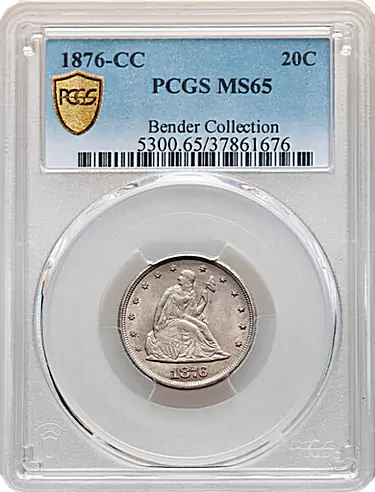
PCGS MS65 #37861676:
This coin (Shown Below) appeared in Bowers and Ruddy’s July 1979 Fixed Price List. Stack’s later offered it in January 1988 as Lot 1405.
Stack’s Bowers sold it in the E. Horatio Morgan Collection on August 15, 2019 as Lot 5182. It brought $456,000.
Heritage Auctions then sold it in The Bender Family Collection, Part I, on August 24, 2022 as Lot 3550. It brought $870,000.
The coin later regraded. The insert notes the Bender Collection. The piece shows a goldenrod hue, a spot to the right of Liberty’s upright hand, a scratch to the right of star 2, and a diagonal hit on Liberty’s stomach.
NGC MS64 #3222533-005:
Heritage Auctions offered this coin in the Belle Collection in March 2009 as Lot 983.
It later entered the Pacific Northwest Collector holdings. Heritage then sold it in Rian’s Bequest Collection on January 13, 2022 as Lot 3648. It brought $432,000.
The insert carries the Rian’s Bequest pedigree. Heritage Auctions assisted with pedigree information.
PCGS MS64 CAC #20714029:
This coin traces to the Maryland Hoard, discovered in the Baltimore area in 1956-1957.
It passed through unknown intermediaries. Then an unknown collector placed it in a set of 1876 coinage.
That collector sold the set to dealer Mark Mendelson. Mendelson sold the set intact to Dr. David Litrenta.
Heritage Auctions offered the coin in The Litrenta Collection in August 1999 as Lot 5518.
Heritage then sold it as NGC MS64 on January 5, 2000 as Lot 5177. It brought $69,000.
The coin later passed through Duncan Lee and Douglas Winter.
Stack’s Bowers sold it as PCGS MS64 in the Battle Born Collection on August 7, 2012 as Lot 11101. It brought $470,000.
Heritage Auctions later offered it as PCGS MS64 CAC #20714029 in The Poulos Family Collection, Part II, on September 6, 2019 as Lot 4716. It brought $456,000.
The insert notes the Battle Born Collection. The coin shows dark toning at the base of the date and around the obverse rim. It also shows multiple hits to the left of Liberty’s ankle, a vertical hit near the gap between stars 1 and 2, a cluster of dark stains to the right of the cap, and two spots to the right of the eagle’s neck and head.
Stack’s Bowers assisted with pedigree information.
PCGS MS64 #6566090:
This coin appeared in the Simon L. Lee Collection, sold by J.W. Scott & Co. on June 12, 1899. It brought $26.25.
John H. Clapp later owned it. The Clapp Estate sold it to Louis E. Eliasberg, Sr.
Bowers and Merena offered it in The Louis E. Eliasberg, Sr. Collection in April 1997 as Lot 1353. It brought $148,500.
Heritage Auctions later sold it in The Eugene H. Gardner Collection of U.S. Coins on June 23, 2014 as Lot 30342. It brought $470,000.
Coin Specifications
- Country: United States of America
- Year of Issue: 1876
- Denomination: Twenty Cents
- Mintmark: CC
- Mint: Carson City
- Mintage: 10,000
- Alloy: .900 silver, .100 copper
- Weight: 5.0 grams
- Diameter: 22.0 millimeters
- Edge: Plain
- Obverse Designer: William Barber
- Reverse Designer: William Barber
- Quality: Business Strike
- PCGS Number: 5300
Final Takeaway
The 1876-CC Twenty-Cent Piece should not exist in quantity. The public rejected the denomination. The Mint stored most of the Carson City mintage. Then officials destroyed nearly all of it.
Yet a few survived.
That accident of survival created one of America’s great silver rarities. It also gave Carson City collectors a trophy coin with a story as strong as its price record.
For advanced collectors, the 1876-CC Twenty-Cent Piece remains more than a key date. It stands as the last word in the “double dime” series.



I want one
Thank you. Informative article.
Very interesting article on the 1876 CC Liberty Seated Twenty Cent Piece.
I had 20 cent piece one time it was stolen.
Interesting article as always
Very interesting article
I have 5 of these coins . Someone tell me who to contact