


By Charles Morgan and Hubert Walker for CoinWeek Notes …..
In 1925, the United States was experiencing a dramatic economic boom, and the U.S. Mint increased coin production to meet the nation’s demand. That year, the three minting facilities struck a combined total of 188,909,000 Lincoln Cents, with roughly 74% of them produced in Philadelphia.
To keep up with demand, the Philadelphia Mint installed two new automatic weighing machines, which helped increase production speed. As a result, the mint produced its largest mintage of Lincoln Cents since 1920, with an official count of 139,949,000 coins. This impressive number still only makes the 1925 Philadelphia cent the 16th smallest mintage of the series. Interestingly, due to factors affecting a coin’s survival over time, the 1925 cent is currently the 10th rarest Philadelphia cent of the series in MS 67 or higher grades.
The U.S. Mint used profits from seigniorage—the difference between the face value of a coin and the cost to produce it—to fund distribution. According to the Annual Report of the Director of the Mint, about $47,000 was spent on distributing minor coinage, including the Lincoln cent.
Even with some die wear causing a loss of fine detail, it’s still common to find 1925 Lincoln Cents in high grades with full detail. There is only one recognized variety for this year, ODV 010, known as the “Flat Foot” G of GOD.
While coin collecting wasn’t a widespread hobby until decades later, some people still actively searched through their change. In 1925, E.S. Thresher wrote an article for The Numismatist titled “Coins That Can Be Found in Circulation,” where he mentioned finding a nice 1925-P cent in his pocket change. He noted that he hadn’t yet found a 1925-D.
Twelve years later, in 1937, the New York firm Stack’s released a price catalog for uncirculated Lincoln Cents. The 1925 cent was valued at $0.25, equivalent to approximately $4.25 when adjusted for inflation. In comparison, the 1924 cent was valued at 50 cents, and the 1926 cent was valued at 75 cents.
Today, despite the 1925 Lincoln Cent being relatively common in Gem Mint State, it is, according to PCGS, the 10th-most-challenging Philadelphia date to collect between 1909 and 1929. Additionally, according to Q. David Bowers, most of these coins are well-struck with sharp details. But there are a few known varieties. Firstly, as Philadelphia cents struck between 1923 and 1929, the type is ODV-010 or “Flat Foot to G of GOD”. The numeral “5” in the date has a short tail, a design oversight that was not corrected until 1950.
Another interesting observation is that the numerals 1, 2, and 5 are quite compact and seem out of place next to the long-tailed 9.
How Much Is the 1925 Lincoln Wheat Cent Worth?
As a result of this type’s common nature, the value of the 1925 Lincoln Cent is heavily dependent on the piece’s color designation as well as base grade. Fresh-struck coins that retain at least 90% of their original coloration will be designated as RD (Red). However, as the copper metal in a coin oxidizes, the color begins to darken, and the designation is changed to RB (Red Brown). Lastly, as it reaches a dark chocolatey brown, the official designation becomes BN (Brown).
The 1925 is common in all grades, and original rolls of this issue likely survive (albeit in diminishing numbers). Coins typically exhibit above-average strikes, but the reverse dies lack the fine detail of cents struck before 1918.

There is plenty of supply, and most low-grade examples are worth at most $1, while pieces with the BN color designation in VF range from $5 to $10. The vast majority of non-Mint State examples are not worth grading. That said, from MS60 until MS64BN, this type is worth between $40 and $50.
When designated as RB, collectors should expect to pay between $50 and $60 for examples in the same grade range. On the other hand, top population Red Brown coins can sell for prices ranging from $200 to $500. An MS67RB auctioned off in 2003 by Heritage Auctions realized $503.
Even though 24.28% of PCGS and NGC’s total certified population for the 1925 Lincoln Wheat Cent have been graded MS65RD, these cents still retain a price of between $230 and $250.
Regardless, examples preserved in high grades with a Red color designation are where the true value of this type sits. While straight MS67RDs have been known to regularly sell for between $800 and $900, one example sold for $2,400 in August 2022. With only a handful of coins graded higher, that piece is one of the nicest examples available on the open market. At one-half grade higher in MS67+RD, this type now typically brings in between $5,000 and $6,500. The auction record for this type was set at $15,172.88 when the Stewart Blay coin sold in January 2023.
* * *
Market Data and Noteworthy Specimens
PCGS has reported one coin at MS68RD since at least April 2023; we have not seen this coin appear at auction. NGC reports three examples in MS67+RD; likewise, we could not confirm auction appearances of these three coins.
The first PCGS MS67+RD coin to be certified would later become known as the Jerald Martin specimen. This coin was likely certified in 2015. A year later, PCGS would certify their first MS68RD. Since the Martin specimen earned its 67+ grade, PCGS has continued to add MS67+RD at a brisk pace of about three per year.
The Stewart Blay example brought an eyebrow-raising $15,172.88 in January 2023. The buyer likely viewed this coin as a strong upgrade candidate.
- Top Population: PCGS MS68RD (1, 7/2025), NGC MS67+RD (4, 7/2025), and CAC MS67RD (18:0 stickered:graded, 7/2025).
- PCGS MS67+RD CAC #49209554: “The Whispering Pines Collection,” Heritage Auctions, January 16, 2024, Lot 4577 – $6,300.
- PCGS MS67+RD CAC #491344397: GreatCollections, June 30, 2024, Lot 723451 – $14,162.62.
- PCGS MS67+RD #39752937: GreatCollections, August 9, 2020, Lot 832904 – View; Heritage Auctions, November 6, 2023, Lot 92063 – $6,300.
- PCGS MS67+RD CAC #21463373: “Stewart Blay’s Red Copper Collection of Lincoln Cents,” GreatCollections, January 15, 2023, Lot 1272853 – $15,172.88.
- PCGS MS67+RD CAC #46479217: GreatCollections, January 15, 2023, Lot 1270169 – View.
- PCGS MS67+RD CAC #38287083: “The GL & SL Stonebarger Collection,” Heritage Auctions, June 18, 2021, Lot 3341 – $5,520.
- PCGS MS67+RD #39891094: Stack’s Bowers, November 12, 2020, Lot 5051 – $2,640.
- PCGS MS67+RD #39062957: Stack’s Bowers, August 7, 2020, Lot 2426 – $2,640.
- PCGS MS67+RD CAC #35372003: Heritage Auctions, June 14, 2008, Lot 3195 – $5,280; “The Dr. and Mrs. Steven Duckor Collection of Lincoln Cents”, Heritage Auctions, April 23, 2020, Lot 3110 – $3,960.
- PCGS MS67+RD #36183928: Stack’s Bowers, August 13, 2019, Lot 1064 – $1,800 Reserve Not Met. Pale in color with dark patches on the reverse.
- PCGS MS67+RD #81352305: GreatCollections, July 24, 2016, Lot 377574 – $2,004.20; “Charlie O’s Collection,” Heritage Auctions, June 7, 2019, Lot 3445 – $1,140.
- PCGS MS67+RD #25670223: Heritage Auctions, October 30, 2015, Lot 3844 – $2,585. Top pop, pop one when sold. First PCGS MS67+RD certified. “Jerald L. Martin Collection”, Heritage Auctions, January 10, 2019, Lot 4067 – $2,280. Jerald L. Martin on insert. Dark around the periphery. Splotches on the obverse.
- PCGS MS67+RD #25792614: Heritage Auctions, August 10, 2016, Lot 3204 – $1,997.50.
- PCGS MS67+RD CAC #37476954: Heritage Auctions, July 24, 2016, Lot 3446 – $2,880. Brought significantly more than the “Charlie O” specimen, offered the lot before at the same sale!
* * *
Design
Obverse:
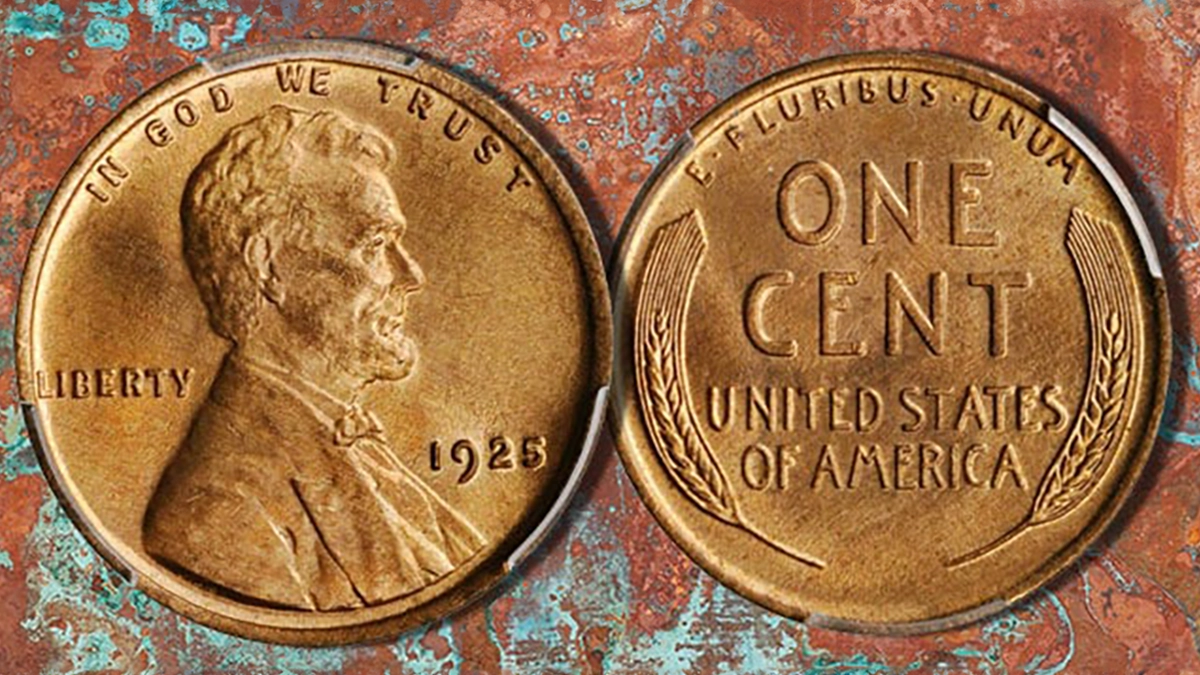
Designer Victor David Brenner’s portrait of the beloved former president Abraham Lincoln depicts the president from the shoulder up. Lincoln is dressed in a period suit and is wearing a bow tie. Brenner’s initials V.D.B. appear in Lincoln’s shoulder truncation. At the top of the design, wrapping around the rim is the motto IN GOD WE TRUST. The word LIBERTY appears behind Lincoln’s neck, on the left side of the coin. The date 1925 appears slightly lower on the coin’s right side in front of Lincoln’s portrait. While Lincoln Cent mintmarks appear below the date, there is no mark here since this coin was struck in Philadelphia.
Reverse:
Brenner’s “Wheat Cent” reverse. Two sheaves of wheat wrap around the right and the left side of the coin. At the top of the design, the motto E · PLURIBUS · UNUM wraps around the rim. ONE CENT is inscribed in large sans serif letters, and the bottom arm of the “E” extends beyond the arm at the top. The middle arm is recessed. Beneath, in the same font but in smaller type, is the legend UNITED STATES OF AMERICA.
Edge:
The edge of the 1925 Lincoln Cent is smooth or plain, without reeding or edge lettering.
Designer
Victor David Brenner, born in Lithuania in 1871, immigrated to New York at the age of 19. Among the classically trained sculptor’s clientele was the future President Theodore Roosevelt. Having previously created a medallion of Lincoln, Brenner was contracted by Roosevelt in 1908 to use one of the designer’s previous images of the 16th president for the obverse of a new cent. At the time of his death, Brenner had carved over 125 different medals, sculptures, and coins (View Designer’s Profile).
Coin Specifications
| Country: | United States of America |
| Year of Issue: | 1925 |
| Denomination: | One Cent (USD) |
| Mintmark: | None (Philadelphia) |
| Mintage: | 139,949,000 |
| Alloy: | .950 Copper, .050 Tin and Zinc |
| Weight: | 3.11 g |
| Diameter: | 19.00 mm |
| Edge: | Plain |
| OBV Designer: | Victor David Brenner |
| REV Designer: | Victor David Brenner |
| Quality: | Business Strike |
* * *
Sources
Bowers, Q. David. A Guide Book of Lincoln Cents. Whitman Publishing. (2021)
Lange, David W. The Complete Guide to Lincoln Cents. Zyrus Press. (2005)
https://nnp.wustl.edu/library/book/327
* * *





I am seeking a book for estimates of value for all types of coins. Please let me know if there are recommendations for such a guide..
I’m confused… why is the end of the article talk about a 1929 penny when the article is about a 1925 penny?
There were some typos, thanks for letting us know!
And yet another “oops”: sheaf of wheat rather than sheath.
How do I find out if my change is worth some money?
I have a 1925 penny.
@Rogelio Hernandez: The 2 most important things to know are the coin’s condition and whether it has a D or S mint mark below the date or is “plain”. You can look up approximate retail values at many numismatic-price sites or in the Guide Book to United States Coins, better known as the Red Book. That said, as the article explains most average-condition 1925 cents without mint marks are worth less than a dollar. However 1925-D and S cents do bring a modest premium.
Please get that coin graded by ngc or PCGS or Evan anacs. Just please get it graded fast ☺️
Can you call me ASAP I have a penny in good condition form the year 1925 D one cent wheat penny
I love coins and currency especially American.
I have a huge jug of pennies I am going to start going through since they are stopping production of the penny. I’ve got to get a list of the pennies I should be looking for when I go through them. Great article!
I don’t know why but I’ve always been interested in the lowly penny. Flow of circulated wheat pennies has slowed quite a bit over the years but I still enjoy getting one now and again.
I love to learn about coins I’ll never be able to afford. It helps to what’s out there
I’ll have to keep an eye out for these, I love finding old Pennie’s when I get change! Looks like some will actually be valuable if they are in ok shape despite being in circulation.