


By Lev Moiseev – Auction House Alexander
In 1704, Peter I was 32 years old. By then, he had already traveled through Western Europe during the Grand Embassy under the name Pyotr Mikhaylov. He had returned to Moscow in 1698 and crushed the Streltsy revolt. Earlier, he had forced Sophia from power and ended one of the most dangerous dynastic struggles of his youth. He was already the tall, forceful ruler who would reshape Russia by will, reform, and violence.
That history makes the 1704 ruble so striking.
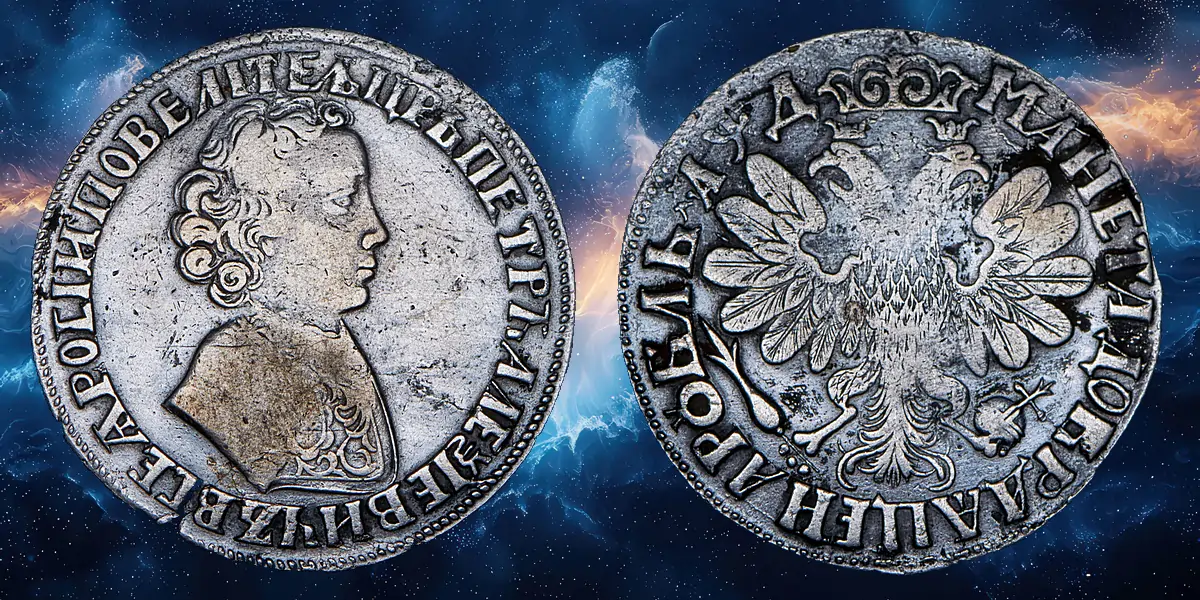
This coin does not show the iron ruler most people imagine when they think of Peter the Great. Instead, it presents a softer and younger image. The contrast feels almost jarring. Yet that contrast explains why the coin matters. The 1704 ruble belongs to a moment when Russia’s political reality had changed faster than its visual language.
A Modern Ruler in an Older Artistic Tradition
The portrait on the 1704 ruble does not read like a fully modern likeness. Peter appears youthful. His features look generalized rather than sharply individualized. That was not simply a failure of skill. It reflected the artistic world from which the image emerged.
To understand that portrait, one must understand the parsuna. In late 17th-century Russian culture, the parsuna stood between the icon and the secular portrait. It marked a transitional stage in Russian art. Artists working in that tradition did not aim first for exact physical likeness. Instead, they stressed rank, dignity, and symbolic presence.
That helps explain the obverse of the 1704 ruble. Peter had already begun dragging Russia toward Europe. However, the coin still spoke in the older visual language of Muscovy. As a result, the piece captures a real historical tension. The ruler was changing. The state was changing. Yet the image of power still looked back to an earlier age.
The Eagle Still Spoke the Language of Dynasty
The reverse continues that story.
The double-headed eagle on the 1704 issue looks stylized rather than naturalistic. It does not yet have the crisp, controlled presence that later imperial coinage would achieve. Even so, the symbol carried immense political meaning.
The double-headed eagle had long served as a statement of dynastic continuity and imperial inheritance. After Ivan III married Sophia Palaiologina in 1472, Muscovy strengthened its claim to Byzantine succession. Over time, that idea grew into a broader vision of Moscow as the heir to fallen Byzantium and the guardian of Orthodoxy. Later political writing pushed the claim even further and tied the ruling line to the legacy of Rome itself.
So the eagle on the 1704 ruble was never just decoration. It stood for legitimacy, succession, and power. That matters because Peter’s reign often gets reduced to Westernization alone. This coin shows something more complex. Peter built a new state, but he still relied on symbols rooted in older Russian and imperial claims.
The First Regularly Minted Russian Ruble
The 1704 ruble also occupies a central place in Russian monetary history. It belongs to the first year in which Russia regularly minted silver rubles as part of Peter’s major reform of the coinage.
That reform changed the system in lasting ways. It aligned the new ruble with the weight standard of the Western European thaler. It also fixed the decimal relationship of one ruble to 100 kopeks. That point was critical. Peter did not simply issue a new coin. He imposed a more coherent monetary structure on the state.
This move gave the Russian ruble a stronger and more legible place in commerce. It also tied the coin more directly to a standard familiar across Europe. In that sense, the 1704 ruble was both a domestic reform coin and an international statement.
Russia Still Needed Foreign Silver
Yet the reform did not emerge from ideal conditions. Russia had long depended on imported silver. For much of the 17th century, the state relied heavily on foreign bullion, especially European thalers known in Russia as efimki. Those coins often served as raw material for new issues.
That dependence helps explain why early rubles remain so elusive today. The mint worked within a strained bullion environment. It used what silver it could gather. Older coins and silver objects also went back into the melting pot. As the reform advanced, many earlier pieces disappeared into later production.
In 1704, an important change took place with the official opening of the Nerchinsk silver-smelting plant in Transbaikalia. That development marked a significant step toward a more secure domestic silver supply. However, the transition took time. Imported silver still mattered greatly in the early years of the reform.
A Coin Born in Experiment
The 1704 ruble also reflects the experimental character of Peter’s new system.
Early on, Russian authorities explored striking rubles over existing thalers. Some surviving pieces show evidence of overstriking. However, that method had obvious limitations. Old designs could remain visible. The new images did not always strike cleanly. Over time, the mint moved toward producing more uniform planchets and more controlled results.
That technical evolution matters because the 1704 issue stands at the beginning of the process. It was not the polished endpoint of reform. It was the opening stage. In that sense, the coin carries the marks of transition in both design and manufacture.
Peter Revalued the Silver Unit
The reform also had financial consequences beyond the mint.
Before Peter’s reform, the market value of a thaler in Russia often stood well below 100 kopeks. Yet the new system effectively treated the thaler-weight silver ruble as a 100-kopeck unit. That gave the state a clearer accounting structure, but it also created tension between official value and market reality.
Foreign observers noticed the problem. The reform unsettled exchange and complicated foreign trade. In effect, Peter made the new ruble stronger at home than it appeared in international exchange. That gap did not erase the importance of the reform, but it did reveal its costs.
Peter’s monetary program was ambitious, rational, and modernizing. At the same time, it was still an imposed state project. The 1704 ruble sits at the center of that contradiction.
The Design Revolution Was Still Coming
The artistic side of the reform would continue to evolve after 1704. In the years that followed, foreign medallists and engravers brought a more naturalistic style to Russian coinage. Gottfried Haupt played an important role in that transition. Under that new influence, eagles began to look more like real birds, and portraits of Peter grew more severe, more controlled, and more recognizably imperial.
That makes the 1704 ruble especially important. It belongs to the moment just before that visual transformation fully took hold. The coin still carries the last strong echoes of old Muscovy, even as the state itself was moving in a new direction.
Why the 1704 Ruble Still Matters
Collectors pursue the 1704 ruble for obvious reasons. It is rare. It is historically important. It marks the first year of the regular silver ruble under Peter the Great. Standard references list the issue as Bitkin 796 (R) and Diakov 82 (R2), and strong examples have realized substantial prices.
However, rarity alone does not explain the appeal.
This coin captures a state in transition. Its portrait still belongs to the world of the parsuna. Its eagle still speaks in the language of dynastic continuity. Yet its monetary role belongs to Peter’s new order: decimal, thaler-weight, and outward-facing.
That is why the 1704 ruble remains more than a key rarity. It is one of the clearest numismatic witnesses to Russia in the act of changing itself.






Great article. It seems that most coin portraits or effigies are parsuna-like, to the extent that they idealize their subjects.
Great article! I learn something new every time I read one of your articles.